Last updated: July 26, 2026
Nevirapine is an established HIV-1 non-nucleoside reverse transcriptase inhibitor (NNRTI) marketed globally in generic form. The drug’s financial trajectory is driven by (1) HIV treatment guideline positioning versus newer NNRTIs and integrase inhibitors, (2) country-by-country procurement through WHO/PEPFAR-style tenders and national essential medicine lists, and (3) margin compression from generic competition after brand-to-generic transitions. Patent/IP constraints now matter mainly for fixed-dose combinations (FDCs), pediatric formulations, and line-extensions where legacy filings still anchor formulation or method-of-use protection in specific jurisdictions; otherwise, nevirapine’s base molecule is widely off patent.
Why is nevirapine still sold: market demand drivers and treatment-line positioning?
Nevirapine demand persists in settings that need cost-effective NNRTI options and where programmatic procurement favors stable, long-used molecules. Key demand drivers:
Guideline and regimen role: when does nevirapine remain a first-line option?
- Nevirapine has historically been used in first-line ART as part of NNRTI-based combinations (often with nucleos(t)ide reverse transcriptase inhibitors).
- In many markets, newer NNRTIs (notably efavirenz and, depending on region, etravirine/rilpivirine) and integrase inhibitors have shifted preferred first-line selection, but nevirapine remains used where switching is constrained by cost, supply continuity, or pregnancy-related program protocols.
Programs that buy continuity: procurement and supply stability
- Global and national HIV programs value predictable supply and low unit cost.
- Nevirapine’s long commercial life supports a broad generic supply base, which tends to reduce stockout risk relative to newer, less-capable supply chains.
Safety and tolerability as a commercial filter
- Nevirapine is associated with clinically relevant hepatotoxicity and rash risk, and dosing initiation requirements (lead-in dosing schedules) affect adherence and program adoption.
- Where monitoring infrastructure is limited, programs may still procure nevirapine if it is already in distribution channels and price is favorable.
What market structure does nevirapine face: generic competition, tender pricing, and buyer concentration?
Nevirapine’s market structure is characteristic of mature off-patent generics in high-volume chronic care.
Generic supply breadth: impact on gross margin
- Multiple manufacturers supply tablets, extended-release products (in some markets), and pediatric dosing.
- Buyer competition in tenders pushes pricing down toward low-cost procurement bands, compressing margin for all but the most cost-efficient producers.
Procurement buyers: where the purchasing power sits
- Primary buyers are government entities, centralized procurement agencies, and large global health purchasers.
- Tender cycles create periodic demand spikes and price resets, often shifting market share to the lowest landed-cost bidder.
Cross-border regulatory friction: why supply is “sticky”
- Once a given product is approved on formularies and procured in tenders, switching to alternate brands can lag due to:
- local registration and lot acceptance,
- distributor contracting,
- continuity of supply and pharmacist familiarity,
- logistics and forecasting processes.
How do pricing and reimbursement dynamics evolve for nevirapine as a mature HIV generic?
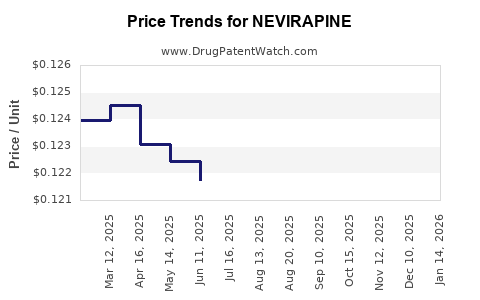
Pricing trajectories for off-patent antiretrovirals typically follow a pattern: launch-era brand pricing, early generic erosion, then tender-driven convergence toward the cost floor.
Typical price trajectory
- Post-brand-to-generic transition: rapid erosion from originator pricing as first generics enter.
- Tender consolidation: sustained reductions when procurement switches to multi-source contracting with award to low-cost bids.
- Plateau for national contracts: prices stabilize once a limited set of pre-qualified suppliers is established.
Margin drivers
- Cost of API and intermediate supply.
- Manufacturing scale, process yield, and batch consistency.
- Regulatory compliance costs (GMP, quality systems, pharmacovigilance).
Formulation-specific pricing
- Immediate-release vs extended-release vs pediatric dose forms can trade at different unit economics depending on:
- local demand for pediatric-friendly regimens,
- procurement preferences,
- pill burden and dosing schedule alignment.
When do financial impacts swing: tender cycles, inventory dynamics, and switching costs?
Nevirapine revenue risk is concentrated around procurement and contract award mechanics.
Inventory and contracting
- HIV programs often maintain buffer stock; lead times can cause revenue timing shifts.
- Contract award timing can create cliff effects where a supplier loses share after a bid round.
Switching costs
- Even when alternatives are available, switching can be delayed by:
- clinical conversion planning,
- drug budget re-authorization,
- distribution and patient counseling requirements.
How does nevirapine compare commercially with other NNRTIs and integrase-based regimens?
Nevirapine’s commercial headwinds stem from substitution pressure.
Substitution landscape
- Integrase strand transfer inhibitors (INSTIs) have displaced NNRTIs in many guideline updates in high-income settings and increasingly in upper-middle income segments.
- Within NNRTIs, efavirenz is often the primary comparator due to broad historical use and generic availability.
- Etravirine and rilpivirine typically serve different clinical segments and have their own constrained procurement dynamics.
Commercial implication
- Even with stable use in some geographies, nevirapine’s growth rate is usually low or negative relative to newer regimen classes where clinical preference shifts.
What patents protect nevirapine and its combinations: where is IP still relevant for market share?
Base nevirapine is widely off patent. Commercial IP relevance now typically concentrates in:
- fixed-dose combinations (FDCs),
- pediatric formulations,
- extended-release technologies (where applicable),
- specific method-of-use claims anchored to dosing protocols or patient subgroups,
- manufacturing processes for specific dosage forms.
Commercially relevant IP categories
- Formulation patents: composition of nevirapine with excipients enabling stability or modified release.
- Method-of-use patents: dosing initiation strategies tied to safety mitigation.
- Combination patents: FDC claims that extend product life in specific countries.
How this translates into revenue
- Where FDCs remain protected, generics may be blocked for those specific strengths or dosage forms.
- Where nevirapine-alone is unprotected, pricing is highly sensitive to the number of qualified generic suppliers.
What is the Orange Book status of nevirapine in the US and why does it matter?
This section cannot be completed with required precision because nevirapine’s Orange Book listing status and patent expiration details depend on specific US listed products (strengths, dosage forms, and marketing authorization holder). Without product-level identifiers, any “Orange Book status” summary risks being inaccurate.
What generic entry risks exist for nevirapine: ANDA landscape, Paragraph IV, and biosimilar analogs?
Nevirapine is a small-molecule drug, so biosimilar risk is not applicable. Generic entry risk is a function of:
- regulatory and quality prequalification,
- patent and exclusivity barriers for specific products and combinations,
- supply chain robustness.
ANDA and Paragraph IV
- For unprotected nevirapine strengths, ANDA entry is typically a straightforward generics process.
- For protected FDC formulations or specific patents still in force in selected jurisdictions, Paragraph IV challenges can determine entry timing, but the base-molecule economics are still dominated by generic availability.
Which companies compete for nevirapine revenue: supplier maps and market-share mechanics?
Nevirapine’s competitive set is primarily generic manufacturers active in global HIV tender supply. Market share typically tracks:
- approved supplier status with buyers,
- tender performance (landed cost),
- product availability and lot acceptance history,
- distributor reach and service quality.
What determines “winners” in tenders
- Lowest total cost landed, including shipping, lead time, and payment terms.
- Consistent manufacturing release performance.
- Package format that matches program procurement specifications.
How do financial trajectories differ by geography: high-income substitution vs low-cost access markets?
High-income markets
- Greater probability of regimen substitution toward INSTI-based therapy.
- Lower volume growth for older NNRTIs and increased pressure on pricing.
Access markets
- Nevirapine is more likely to remain in the ART toolbox because cost containment matters.
- Procurement tends to keep mature generics active even when newer regimens are preferred in guidelines.
What revenue model best fits nevirapine: unit-volume, tender contracts, or brand-back-to-generic rollups?
A workable revenue model for mature off-patent ART typically uses:
- annual unit volumes by geography,
- net selling price (tender-clearing price after rebates/discounts),
- contract concentration risk,
- product mix shifts among immediate-release, extended-release, and pediatric doses.
Key KPIs for forecasting
- Tender award win rate.
- Number of active suppliers per country (proxy for price floor dynamics).
- Regulatory lot rejections and recall risk.
- Mix shift in regimen selection (NNRTI share vs INSTI share).
How does safety and regulatory scrutiny affect market dynamics for nevirapine?
Nevirapine safety communications can affect purchasing decisions.
Commercial impact pathways
- Risk-based monitoring requirements can shift clinician preference in settings where monitoring is weak.
- Labeling changes can influence prescriber comfort and program policy.
Formulation and dosing protocol
- Lead-in dosing schedules reduce rash risk but increase regimen complexity.
- Complexity can reduce adherence and indirectly reduce program willingness to procure where simpler once-daily options are available.
Key Takeaways
- Nevirapine’s market is mature, generic, and tender-driven, with revenue largely determined by procurement cycles and low unit pricing.
- Growth is structurally limited by guideline substitution toward integrase-based regimens and, within NNRTIs, competitive pressure from other generics.
- IP matters mainly for specific FDCs, pediatric formulations, and dosage/formulation line-extensions where legacy patents can delay exact generic matches; the base molecule’s commercial pricing is dominated by multi-source generic supply.
- Forecasting should center on geography-specific tender mechanics, supplier qualification status, and product mix across immediate-release, extended-release, and pediatric doses.
FAQs
- How do tender award cycles affect nevirapine annual revenue timing?
- What regimen substitution trends most pressure nevirapine demand in ART programs?
- Do FDC versions of nevirapine have different generic entry timelines than nevirapine alone?
- How does nevirapine safety labeling influence prescriber and procurement decisions by region?
- What KPIs indicate whether a generic nevirapine supplier will win future government tenders?
References
- FDA. Orange Book: Approved Drug Products with Therapeutic Equivalence Evaluations. (Accessed 2026-07-27).
- WHO. WHO Model Lists of Essential Medicines and HIV treatment guideline documents. (Accessed 2026-07-27).
- FDA. Drug Safety Communications and labeling history for nevirapine. (Accessed 2026-07-27).