Last updated: August 18, 2026
Morphine sulfate is a mature, largely generic opioid with broad clinical use and limited remaining patent protection. Its market is driven by hospital demand, palliative care, injectable supply, controlled-substance quotas, and manufacturing reliability rather than branded innovation. Revenue growth is structurally constrained by low generic prices, opioid-prescribing controls, and substitution by fentanyl, hydromorphone, oxycodone, and non-opioid analgesics.
No single company controls the morphine sulfate market. Major suppliers vary by dosage form and geography and include Hikma Pharmaceuticals, Fresenius Kabi, Pfizer subsidiaries, West-Ward Pharmaceuticals, Endo/Par Pharmaceutical, Mallinckrodt, and regional generic manufacturers. Standalone product revenue is generally not disclosed because morphine sulfate is reported within broader injectable, hospital, generic, or controlled-substance portfolios.
What is the current market position of morphine sulfate?
Morphine sulfate is an established opioid analgesic used for severe acute pain, cancer pain, palliative care, perioperative care, intensive care, and dyspnea management in selected settings. It is available in oral, injectable, epidural, intrathecal, rectal, and extended-release forms.
| Market attribute |
Morphine sulfate position |
| Drug class |
Opioid analgesic |
| Regulatory status |
FDA-approved prescription drug |
| U.S. controlled-substance schedule |
Schedule II |
| Primary buyers |
Hospitals, health systems, hospice providers, specialty pharmacies, retail pharmacies |
| Main dosage forms |
Injection, oral solution, tablets, capsules, extended-release tablets and capsules |
| Patent position |
Core compound and most foundational product patents expired |
| Biosimilar exposure |
None; morphine sulfate is a small-molecule drug |
| Generic competition |
Extensive, although supplier depth varies by presentation |
| Pricing profile |
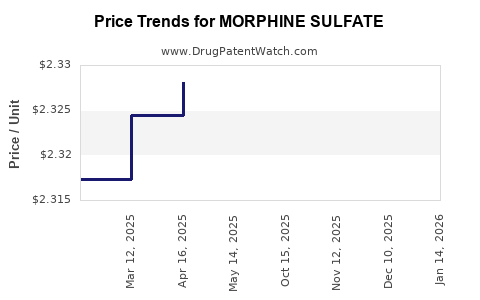
Low to moderate unit pricing, with shortages affecting availability and transaction prices |
| Main commercial risk |
Manufacturing interruption, quota limits, regulatory enforcement, and opioid stewardship |
The market is split between high-volume low-margin generic products and smaller-volume products that command higher prices because they require specialized packaging, sterile manufacturing, preservative control, controlled distribution, or extended-release technology.
How large is the morphine sulfate market?
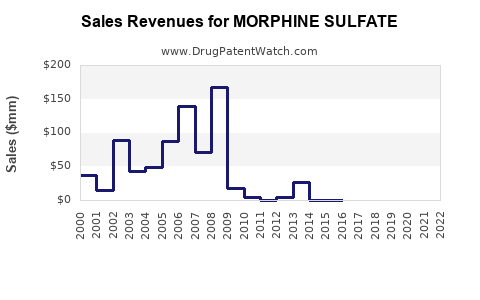
A precise global morphine sulfate market value cannot be derived from public financial filings because manufacturers rarely report revenue by active ingredient. Commercial market databases often combine morphine with broader opioid or injectable categories, producing estimates that are not directly comparable.
The economic profile is clear:
- Immediate-release oral morphine is highly commoditized.
- Sterile injectable morphine has greater supply-chain value than standard oral tablets.
- Extended-release formulations historically generated higher prices but now face generic substitution and lower opioid utilization.
- Hospital contracts concentrate purchasing power and pressure prices.
- Shortages can temporarily increase the commercial value of available inventory.
In the United States, morphine demand has declined from earlier opioid market peaks in several outpatient segments. Hospital and palliative-care demand remains more resilient. The CDC reports that opioid prescribing has fallen materially from its peak, while overdose mortality and opioid-control policy continue to influence prescribing behavior and institutional protocols.[1]
Demand by clinical setting
| Clinical setting |
Demand outlook |
Commercial characteristics |
| Acute hospital pain |
Stable to declining |
Injectable and immediate-release products; tender-driven |
| Surgery and anesthesia |
Stable but competitive |
Morphine competes with fentanyl, hydromorphone, and regional anesthesia |
| Cancer and palliative care |
Relatively resilient |
Oral and injectable products; clinical need remains high |
| Hospice |
Resilient |
Concentrated oral solutions and injectable presentations |
| Chronic noncancer pain |
Declining |
Opioid stewardship and alternative therapies reduce use |
| Emergency medicine |
Stable to declining |
Rapid-onset injectable products; protocol-driven |
| Outpatient retail |
Declining |
Lower prescribing, stigma, monitoring, and substitution |
When did morphine sulfate lose exclusivity?
Morphine sulfate lost meaningful market exclusivity decades ago. Morphine was isolated in the early 19th century, and the active pharmaceutical ingredient has no commercially relevant remaining composition-of-matter exclusivity in the United States.
Historical protection focused on dosage forms, delivery systems, and extended-release technologies rather than the morphine molecule itself. Those patents have expired or no longer prevent ordinary generic competition.
| Protection category |
Current position |
| Morphine compound patent |
Expired |
| Basic morphine sulfate oral products |
Long off-patent |
| Immediate-release tablets and solutions |
Generic competition |
| Standard injectable products |
Generic competition |
| Historical extended-release technologies |
Core patents generally expired |
| New formulation patents |
Possible for a specific product, but not inherent to morphine sulfate |
| Regulatory exclusivity |
No current product-wide exclusivity expected for the mature ingredient |
The commercial question is therefore not whether morphine sulfate is patent protected. It is whether a particular formulation, delivery device, abuse-deterrent system, or manufacturing process has enforceable and commercially relevant protection.
What patents protect morphine sulfate products?
Current patent risk is product-specific rather than ingredient-wide. A company developing a new morphine sulfate product would review:
- Formulation patents covering release profiles, particle size, excipients, coatings, or abuse deterrence.
- Method-of-use patents covering defined dosing regimens or patient populations.
- Device patents covering prefilled syringes, autoinjectors, pumps, or administration systems.
- Manufacturing patents covering crystallization, purification, salt formation, or sterile processing.
- Packaging and controlled-distribution patents where applicable.
Traditional morphine sulfate tablets, oral solutions, and standard injections generally do not depend on an active patent estate. The FDA Orange Book remains the relevant U.S. source for listed patents associated with approved drug products.[2]
Are there formulation patents for morphine sulfate?
Yes, formulation patents have historically covered extended-release morphine products and specialized delivery systems. Examples include products marketed under names such as MS Contin, Kadian, Avinza, and other controlled-release morphine formulations. Their historical patent portfolios addressed technologies such as sustained release, multiparticulate dosage forms, and abuse-deterrent characteristics.
Those patents should not be treated as continuing barriers to ordinary immediate-release morphine sulfate. A current freedom-to-operate review must be performed against the exact product design, jurisdiction, filing date, patent family, terminal disclaimer, and maintenance status.
Are there method-of-use patents for morphine sulfate?
Method-of-use patents may cover particular administration methods or clinical applications, but they are unlikely to create broad exclusivity for morphine sulfate. U.S. generic applicants can use Paragraph IV certifications against listed method-of-use patents and may market an approved product with labeling that omits the protected indication where permitted.
What is the Orange Book status of morphine sulfate?
Morphine sulfate is represented by multiple FDA-approved drug products and dosage forms. The Orange Book does not create a single market-wide patent status for the active ingredient. It lists patents, if any, associated with specific reference products and approved uses.[2]
For standard generic morphine sulfate products:
- The active ingredient is off patent.
- Approval is generally pursued under an abbreviated new drug application.
- Formulation and method-of-use patents must be assessed product by product.
- Many ordinary generic presentations have no material patent barrier.
- Regulatory approval does not guarantee uninterrupted supply because Schedule II manufacturing and distribution controls apply.
The practical Orange Book exposure is highest for newer extended-release or specialty delivery products and lowest for conventional oral and injectable products.
How many patents cover morphine sulfate?
No meaningful single number applies across the market. Patent counts differ depending on whether the review includes expired patents, abandoned applications, foreign family members, formulation patents, device patents, and patents covering specific branded products.
A useful risk classification is:
| Product type |
Patent exposure |
| Generic immediate-release tablet |
Low |
| Generic oral solution |
Low |
| Standard injectable vial or ampule |
Low to moderate, with process and device review required |
| Extended-release tablet |
Moderate, depending on product and jurisdiction |
| Abuse-deterrent formulation |
Moderate to high |
| Drug-device combination |
Moderate to high |
| Novel intrathecal or implantable delivery system |
Potentially high |
Patent age is a major factor. A large historical patent family does not indicate current enforceability. Expired, abandoned, cancelled, or non-maintained patents have no blocking effect.
What FDA regulatory status applies to morphine sulfate?
Morphine sulfate is an FDA-approved prescription opioid and a Schedule II controlled substance under the federal Controlled Substances Act. Its commercial distribution requires compliance with controlled-substance registration, ordering, recordkeeping, security, reporting, and quota requirements.[3]
FDA regulatory requirements vary by dosage form:
- Sterile injections require compliance with current good manufacturing practice and sterile-processing controls.
- Oral solutions require controls over concentration, dosing accuracy, tamper resistance, and accidental exposure.
- Extended-release products are subject to opioid labeling requirements and may carry additional abuse-deterrence claims only when supported by FDA review.
- Opioid manufacturers and sponsors must comply with the FDA Opioid Analgesic Risk Evaluation and Mitigation Strategy, or REMS, where applicable.[4]
Morphine sulfate does not face biosimilar competition because it is a chemically synthesized small molecule. Competition occurs through generic drug applications, product-specific abbreviated approvals, and, for complex products, potentially more demanding formulation and bioequivalence pathways.
Which companies manufacture or sell morphine sulfate?
Supply is fragmented and changes by dosage form, country, and contract award. U.S. suppliers have included large generic and hospital-product companies such as Hikma Pharmaceuticals, Fresenius Kabi, Pfizer-related operations, Par Pharmaceutical, West-Ward, and Mallinckrodt, although product availability and marketing status can change.
| Supplier category |
Typical role |
| Global injectable manufacturers |
Hospital vials, ampules, and prefilled presentations |
| Generic oral manufacturers |
Tablets, capsules, and oral solutions |
| Specialty opioid manufacturers |
Extended-release and abuse-deterrent products |
| Contract manufacturers |
API, sterile fill-finish, and private-label supply |
| Wholesalers |
Controlled distribution to hospitals and pharmacies |
Supplier concentration is often greater for sterile injectable products than for tablets. A nominally competitive market can experience shortages when one or two approved suppliers encounter quality, capacity, raw-material, or regulatory problems.
What causes morphine sulfate shortages and price volatility?
The principal supply constraints are:
- DEA aggregate production quotas for morphine and related controlled substances.
- Limited sterile injectable manufacturing capacity.
- Active pharmaceutical ingredient availability.
- Quality investigations and manufacturing remediation.
- Hospital purchasing contracts and low generic margins.
- Packaging component shortages.
- Distribution restrictions and controlled-substance compliance.
- Demand spikes from trauma, surgery, or public-health events.
The FDA and the American Society of Health-System Pharmacists track drug shortages, including injectable opioid disruptions.[5][6] Shortages can affect one presentation while other morphine products remain available. A shortage of preservative-free injection, for example, does not necessarily indicate a shortage of oral morphine solution.
What patent litigation affects morphine sulfate?
There is no broad, current patent litigation campaign that blocks the conventional morphine sulfate market. Historical litigation involved branded extended-release products and generic challenges to formulation patents. Those disputes were narrower than the market for morphine sulfate as a whole.
Current legal exposure is more likely to arise from:
- ANDA litigation involving a newly developed extended-release product.
- Patent disputes over abuse-deterrent formulations.
- Trade-secret claims involving API production or sterile manufacturing.
- Contract disputes involving controlled-substance supply.
- Regulatory enforcement involving manufacturing, distribution, or marketing conduct.
Opioid settlement agreements involving manufacturers, distributors, and state or local governments are not patent settlements. They address alleged public-health, marketing, distribution, or compliance conduct and can affect corporate finances without changing morphine sulfate patent rights.
Are there Paragraph IV challenges to morphine sulfate?
Paragraph IV litigation is most relevant when a generic applicant challenges an unexpired patent listed for a specific branded formulation. For conventional immediate-release morphine sulfate, the commercial opportunity for a new Paragraph IV challenge is limited because core exclusivity has already expired.
Potential Paragraph IV activity could still arise for:
- Newly approved extended-release formulations.
- Abuse-deterrent morphine products.
- Drug-device combinations.
- Products with recently issued method-of-use patents.
- Reformulated products relying on new clinical or pharmacokinetic claims.
The filing of a Paragraph IV certification does not itself establish that a patent is invalid or unenforceable. Litigation timing, 30-month stays, first-filer status, settlement terms, and potential launch dates depend on the listed patents and the specific ANDA.
What generic entry risks exist for morphine sulfate?
Generic entry risk is high for standard morphine sulfate products and more limited for technically complex formulations.
| Product segment |
Generic entry risk |
Main barrier |
| Immediate-release tablets |
Very high |
Low technical complexity |
| Oral solution |
High |
Concentration, dosing, and packaging controls |
| Standard injection |
High but supply-sensitive |
Sterile manufacturing and quota access |
| Extended-release tablets |
Moderate |
Bioequivalence and formulation complexity |
| Abuse-deterrent formulation |
Moderate |
Technology, clinical data, and patent claims |
| Novel delivery device |
Lower initially |
Device integration and regulatory review |
The key distinction is between legal entry and reliable commercial supply. A product may have no patent barrier but still be difficult to launch because of DEA quota limitations, approved-manufacturer requirements, sterile capacity, or low expected margins.
How does morphine sulfate compare with competing opioids?
Morphine sulfate remains a clinical reference opioid, but other agents have commercial and operational advantages in specific settings.
| Drug |
Relative commercial position |
Competitive advantage |
| Morphine sulfate |
Mature generic |
Broad clinical familiarity and multiple routes |
| Hydromorphone |
Generic, higher potency |
Useful when smaller injection volumes or potency are required |
| Fentanyl |
Generic and high-volume |
Rapid onset, high potency, common anesthesia use |
| Oxycodone |
Large oral market |
Strong outpatient and combination-product presence |
| Methadone |
Generic |
Long duration and specialized opioid-treatment uses |
| Buprenorphine |
Branded and generic |
Opioid-use-disorder treatment and differentiated pharmacology |
Morphine has lower acquisition cost than many branded or specialty alternatives, but renal impairment, histamine release, active metabolites, and slower titration can influence institutional protocols. Fentanyl and hydromorphone often compete directly in hospitals. Oxycodone competes more directly in outpatient oral pain treatment.
What is the financial trajectory for morphine sulfate?
The long-term financial trajectory is mature to declining in volume, with episodic revenue support from shortages and specialty formulations.
Base case
Standard oral morphine revenue continues to decline or remains flat in nominal terms. Price competition, reduced opioid prescribing, and substitution limit growth. Hospital injectable demand remains comparatively stable but produces low margins unless supply is constrained.
Upside case
Revenue can improve for manufacturers with:
- Reliable sterile injectable capacity.
- Access to DEA quota.
- Approved preservative-free or specialized presentations.
- Hospital contracts secured during competitor shortages.
- Higher-value extended-release or abuse-deterrent products.
- Integrated API and finished-dose manufacturing.
Downside case
Revenue and margins can deteriorate through:
- Further opioid-prescribing restrictions.
- Generic price erosion.
- Loss of hospital contracts.
- Manufacturing warning letters or recalls.
- Quota reductions.
- Product discontinuations caused by low profitability.
- Substitution by fentanyl, hydromorphone, regional anesthesia, or non-opioid therapies.
| Financial driver |
Directional effect |
| Generic price competition |
Negative |
| Hospital injectable shortages |
Positive for available suppliers |
| Opioid stewardship |
Negative for volume |
| Palliative-care demand |
Supports baseline demand |
| DEA quota constraints |
Limits volume and can support pricing |
| Extended-release competition |
Negative for legacy branded products |
| Sterile manufacturing reliability |
Positive for qualified suppliers |
| Litigation and compliance costs |
Negative |
| API integration |
Potentially positive for margin and supply security |
The investment case is therefore operational rather than patent-driven. The strongest assets are reliable supply, efficient sterile manufacturing, regulatory compliance, and access to institutional purchasing channels.
What licensing deals affect morphine sulfate?
Licensing activity is limited for conventional morphine sulfate because the molecule is generic and inexpensive. Commercial transactions are more likely to involve:
- Contract manufacturing agreements.
- API supply arrangements.
- Private-label hospital products.
- Regional commercialization rights.
- Specialty formulation licenses.
- Drug-device or abuse-deterrent technologies.
A licensing deal involving a novel delivery system may create a defensible commercial position even when ordinary morphine sulfate is unprotected. The value depends on regulatory approval, reimbursement, manufacturing scale, and the strength of the associated formulation or device patents.
What is the geographic market outlook for morphine sulfate?
Morphine remains strategically important in global pain management, particularly in cancer care, surgery, palliative medicine, and emergency treatment. Access differs sharply by jurisdiction because opioid controls, procurement systems, income levels, and medical infrastructure vary.
- The United States has high regulatory scrutiny, extensive generic competition, and hospital purchasing concentration.
- Europe has mature generic supply and strong national reimbursement controls.
- Canada has established hospital and palliative-care use, with controlled distribution.
- Emerging markets may have unmet medical need but lower prices and tighter opioid access.
- Low- and middle-income countries can face under-treatment because of procurement, training, regulatory, and supply barriers.
The International Narcotics Control Board identifies morphine access as a global policy issue, with uneven availability between high-income and lower-income markets.[7]
How strong is the patent estate for morphine sulfate?
The patent estate is weak for conventional morphine sulfate and potentially moderate or strong only for a differentiated product.
| Asset type |
Patent strength |
Commercial relevance |
| Basic morphine sulfate |
None |
No meaningful exclusivity |
| Immediate-release generic |
Low |
Competition is primarily cost and supply-based |
| Standard injection |
Low to moderate |
Manufacturing and supply barriers matter more |
| Extended-release formulation |
Product-specific |
Patent and bioequivalence review required |
| Abuse-deterrent formulation |
Potentially moderate |
Technology and regulatory claims can differentiate |
| Novel delivery device |
Potentially strong |
Device and formulation claims may be enforceable |
| Manufacturing process |
Variable |
Trade secrets may be more important than patents |
Patent expiration is not the main determinant of market value. Manufacturing quality, quota access, supply continuity, and hospital contracting are more important for conventional products.
Key Takeaways
- Morphine sulfate is a mature, off-patent generic opioid with no meaningful compound exclusivity.
- Standard oral and injectable products face high generic competition.
- Extended-release, abuse-deterrent, and device-enabled products can have product-specific patent protection.
- The FDA Orange Book must be reviewed at the product level, not at the ingredient level.
- Biosimilar risk is irrelevant because morphine sulfate is a small-molecule drug.
- Paragraph IV risk is limited for conventional products and more relevant to newer formulations.
- Hospital injectable supply is more commercially attractive than commoditized oral tablets.
- DEA quotas, sterile manufacturing, quality compliance, and shortages drive financial performance.
- There is no reliable standalone public revenue figure for the global morphine sulfate market.
- The market outlook is flat to declining in volume, with selective margin opportunities for reliable suppliers and differentiated formulations.
FAQs About Morphine Sulfate Market and Exclusivity
Can a company still obtain patents on a morphine sulfate product?
Yes. A company may obtain patents on a new formulation, delivery device, manufacturing process, or specific method of use if the claims satisfy novelty, non-obviousness, written-description, and enablement requirements. It cannot obtain new composition-of-matter protection for the long-known morphine molecule itself.
Is morphine sulfate more profitable in injectable or oral form?
Injectable products generally offer better supply-based economics because sterile manufacturing is more complex and supplier capacity is narrower. Oral tablets and solutions are easier to manufacture and face stronger price competition.
Does morphine sulfate have pediatric exclusivity?
A specific FDA-approved product can receive pediatric exclusivity under applicable statutory conditions, but morphine sulfate as an ingredient does not have product-wide pediatric exclusivity. Any such exclusivity must be assessed against the individual reference product and FDA regulatory record.
Can a generic manufacturer launch morphine sulfate without patent litigation?
For conventional immediate-release products, launch may occur without meaningful patent litigation because the relevant core patents have expired. A manufacturer must still address FDA approval, controlled-substance requirements, manufacturing compliance, quota access, and any patents listed for the selected reference product.
What would most improve the commercial value of a morphine sulfate asset?
The strongest value drivers are a differentiated delivery system, abuse-deterrent technology, dependable sterile supply, an under-served route of administration, or a formulation that solves a recognized clinical or dosing problem. Ordinary morphine sulfate tablets provide limited strategic differentiation.
References
-
Centers for Disease Control and Prevention. (2024). U.S. opioid dispensing rate maps and opioid prescribing data. https://www.cdc.gov/overdose-prevention/data-research/facts-stats/
-
U.S. Food and Drug Administration. (2024). Approved drug products with therapeutic equivalence evaluations: Orange Book. https://www.fda.gov/drugs/drug-approvals-and-databases/approved-drug-products-therapeutic-equivalence-evaluations-orange-book
-
U.S. Drug Enforcement Administration. (2024). Controlled substance schedules and regulatory requirements. https://www.deadiversion.usdoj.gov/
-
U.S. Food and Drug Administration. (2024). Opioid analgesic Risk Evaluation and Mitigation Strategy. https://www.fda.gov/drugs/information-drug-class/opioid-analgesic-risk-evaluation-and-mitigation-strategy-rems
-
U.S. Food and Drug Administration. (2024). Drug shortages. https://www.fda.gov/drugs/drug-safety-and-availability/drug-shortages
-
American Society of Health-System Pharmacists. (2024). Drug shortages database. https://www.ashp.org/drug-shortages
-
International Narcotics Control Board. (2023). Availability of internationally controlled substances: Ensuring adequate access for medical and scientific purposes. United Nations. https://www.incb.org/ineb/en/publications/annual-reports/annual-report.html