Share This Page
METHYLDOPA Drug Patent Profile
✉ Email this page to a colleague
When do Methyldopa patents expire, and what generic alternatives are available?
Methyldopa is a drug marketed by Accord Hlthcare, Chartwell Rx, Duramed Pharms Barr, Halsey, Heritage Pharma, Parke Davis, Pliva, Purepac Pharm, Quagen, Rising, Roxane, Sun Pharm Industries, Superpharm, Teva, Watson Labs, Par Pharm, Dava Pharms Inc, Ivax Sub Teva Pharms, Sandoz, Strides Pharma Intl, Abraxis Pharm, Am Regent, Baxter Hlthcare, Hospira, Marsam Pharms Llc, Smith And Nephew, and Teva Parenteral. and is included in ninety-six NDAs.
The generic ingredient in METHYLDOPA is methyldopate hydrochloride. There are four drug master file entries for this compound. Additional details are available on the methyldopate hydrochloride profile page.
AI Deep Research
Questions you can ask:
- What is the 5 year forecast for METHYLDOPA?
- What are the global sales for METHYLDOPA?
- What is Average Wholesale Price for METHYLDOPA?
Summary for METHYLDOPA
| US Patents: | 0 |
| Applicants: | 27 |
| NDAs: | 96 |
| Finished Product Suppliers / Packagers: | 2 |
| Raw Ingredient (Bulk) Api Vendors: | 82 |
| Clinical Trials: | 20 |
| Patent Applications: | 7,420 |
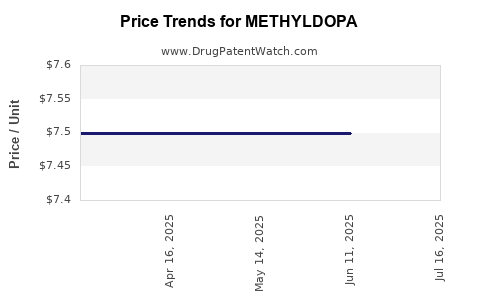
| Drug Prices: | Drug price information for METHYLDOPA |
| What excipients (inactive ingredients) are in METHYLDOPA? | METHYLDOPA excipients list |
| DailyMed Link: | METHYLDOPA at DailyMed |
Recent Clinical Trials for METHYLDOPA
Identify potential brand extensions & 505(b)(2) entrants
| Sponsor | Phase |
|---|---|
| Cairo University | Phase 4 |
| Federal University of Paraíba | Phase 4 |
| Assiut University | Phase 2 |
Pharmacology for METHYLDOPA
| Drug Class | Central alpha-2 Adrenergic Agonist |
| Mechanism of Action | Adrenergic alpha2-Agonists |
Medical Subject Heading (MeSH) Categories for METHYLDOPA
US Patents and Regulatory Information for METHYLDOPA
| Applicant | Tradename | Generic Name | Dosage | NDA | Approval Date | TE | Type | RLD | RS | Patent No. | Patent Expiration | Product | Substance | Delist Req. | Exclusivity Expiration |
|---|---|---|---|---|---|---|---|---|---|---|---|---|---|---|---|
| Sandoz | METHYLDOPA AND HYDROCHLOROTHIAZIDE | hydrochlorothiazide; methyldopa | TABLET;ORAL | 070830-001 | Mar 9, 1987 | DISCN | No | No | ⤷ Start Trial | ⤷ Start Trial | ⤷ Start Trial | ||||
| Smith And Nephew | METHYLDOPATE HYDROCHLORIDE | methyldopate hydrochloride | INJECTABLE;INJECTION | 070841-001 | Jan 2, 1987 | DISCN | No | No | ⤷ Start Trial | ⤷ Start Trial | ⤷ Start Trial | ||||
| Watson Labs | METHYLDOPA | methyldopa | TABLET;ORAL | 070246-001 | Feb 25, 1986 | DISCN | No | No | ⤷ Start Trial | ⤷ Start Trial | ⤷ Start Trial | ||||
| >Applicant | >Tradename | >Generic Name | >Dosage | >NDA | >Approval Date | >TE | >Type | >RLD | >RS | >Patent No. | >Patent Expiration | >Product | >Substance | >Delist Req. | >Exclusivity Expiration |
Methyldopa Market Dynamics, Patent Status, Exclusivity, and Financial Trajectory
Methyldopa is an established, low-cost antihypertensive with no meaningful remaining brand exclusivity in the United States. Its commercial market is driven by generic tablets, limited use in pregnancy-related hypertension, institutional purchasing, and supply availability rather than innovation or premium pricing. The drug has little patent-driven launch risk, no active FDA marketing exclusivity, and limited public product-level revenue disclosure.
What is methyldopa and how is it used?
Methyldopa is a centrally acting alpha-2 adrenergic agonist used to reduce blood pressure. It is converted to alpha-methylnorepinephrine in the central nervous system, reducing sympathetic outflow and vascular resistance.
The drug is marketed primarily as oral tablets in 125 mg, 250 mg, and 500 mg strengths. The original brand, Aldomet, was developed by Merck and approved by the FDA in 1962. Current U.S. supply is predominantly generic methyldopa tablets. FDA-approved labeling identifies hypertension as the indication and includes dosing for adults and pediatric patients under medical supervision.[1]
Methyldopa has particular historical importance in pregnancy-related hypertension because of its long clinical record and substantial pregnancy exposure. Its use has declined because labetalol and extended-release nifedipine are widely used alternatives, while methyldopa can cause sedation, fatigue, depression, orthostatic effects, and hepatotoxicity.[2]
What therapeutic role does methyldopa have?
Methyldopa is no longer a leading first-line drug for general hypertension. Current hypertension treatment generally favors thiazide-type diuretics, angiotensin-converting enzyme inhibitors, angiotensin receptor blockers, and calcium-channel blockers.[3]
In pregnancy, methyldopa remains an accepted option, but clinical guidelines often prioritize labetalol and nifedipine because of efficacy, tolerability, and ease of use. The American College of Obstetricians and Gynecologists identifies labetalol, nifedipine, and methyldopa among medications used for chronic hypertension in pregnancy, with treatment selection based on patient-specific factors.[4]
When did methyldopa lose patent and market exclusivity?
Methyldopa lost meaningful U.S. exclusivity decades ago. The original Aldomet product was approved in 1962, and generic competition has existed for many years. There is no current U.S. new-drug exclusivity period associated with methyldopa.
| Exclusivity category | Current position |
|---|---|
| Original small-molecule patent exclusivity | Expired |
| FDA new chemical entity exclusivity | Expired |
| Orphan-drug exclusivity | None identified |
| Pediatric exclusivity | None currently applicable |
| U.S. brand exclusivity | Expired |
| Generic competition | Established |
| Current commercial model | Multi-source generic supply |
The exact patent history of the original compound is primarily historical. Any foundational composition-of-matter protection would have expired long before the present generic market. The current commercial question is therefore supply continuity, not patent expiration.
What is the Orange Book status of methyldopa?
Methyldopa is listed in FDA-approved drug products, including generic oral tablets. The U.S. Orange Book is relevant for identifying approved products, therapeutic equivalence codes, patent certifications, and exclusivity information.[5]
No active branded patent estate currently controls ordinary methyldopa tablets in the United States. The product is not comparable to recently approved branded drugs that rely on Orange Book-listed formulation or method-of-use patents to delay generic entry.
| Orange Book issue | Methyldopa position |
|---|---|
| Listed dosage form | Oral tablets |
| Reference-brand relevance | Aldomet history; current market is generic |
| Active blocking patent estate | No meaningful estate identified for standard tablets |
| Paragraph IV sensitivity | Low for the established product |
| Therapeutic equivalence | Generic products may receive FDA therapeutic-equivalence designations where applicable |
| Regulatory barrier | Abbreviated New Drug Application pathway for generic products |
FDA’s publication of a product in the Orange Book does not itself create exclusivity. The commercial significance depends on active listed patents, regulatory exclusivity, and the number of approved competitors.[5]
How many patents cover methyldopa?
No meaningful active U.S. patent portfolio covers the basic methyldopa molecule or conventional immediate-release tablets. Historical patents may have covered the compound, synthesis, formulation, or manufacturing processes, but those rights do not create current U.S. market protection.
Potential patent categories include:
- Composition-of-matter patents covering methyldopa.
- Process patents covering synthesis or purification.
- Formulation patents covering tablet excipients or release profiles.
- Method-of-use patents covering treatment of hypertension or specific patient populations.
- Salt, polymorph, or combination-product patents.
These categories have limited current commercial relevance for ordinary methyldopa tablets. A new formulation or combination product could create separate intellectual-property rights, but no major active U.S. product category has displaced the generic tablet market.
What formulation patents protect methyldopa products?
Standard immediate-release methyldopa tablets are mature generic products. No widely recognized active U.S. formulation patent currently provides a material barrier to generic supply.
Manufacturers may still protect manufacturing know-how through trade secrets, process controls, supplier relationships, quality systems, and confidential specifications. Those protections do not prevent regulatory approval of competing products if another manufacturer can independently produce a compliant tablet.
Formulation economics are unfavorable for premium pricing. Methyldopa is chemically established, orally administered, and relatively simple to formulate. A modified-release, fixed-dose combination, or specialized pregnancy formulation could support a differentiated product, but it would need to demonstrate clinical or commercial value against inexpensive generic tablets.
Are there Paragraph IV challenges involving methyldopa?
Paragraph IV litigation is not a major current issue for conventional methyldopa tablets. Paragraph IV certifications typically arise when an abbreviated new drug applicant challenges an unexpired Orange Book patent. Methyldopa’s basic product market has no comparable active patent barrier.
Generic applicants may instead file under certifications that no relevant patents are listed or that patents do not block approval. In a mature market, competition is more likely to arise through ordinary ANDA approvals, manufacturing changes, and supplier substitution than through high-value patent litigation.
What is the FDA regulatory status of methyldopa?
Methyldopa remains an FDA-recognized prescription drug supplied through approved generic products. The original Aldomet product has been discontinued from active commercial marketing, but discontinuation of a brand does not mean that methyldopa itself has been withdrawn for safety reasons.
FDA labeling continues to identify clinically important risks, including:
- Hemolytic anemia and positive direct Coombs tests.
- Hepatic injury, including rare severe hepatitis.
- Sedation and impaired alertness.
- Depression and other central nervous system effects.
- Orthostatic hypotension.
- Fluid retention and edema.
- Interactions with iron products and monoamine oxidase inhibitors.
The label also notes that methyldopa may interfere with certain laboratory tests and can affect interpretation of catecholamine-related testing.[1]
What generic entry risks exist for methyldopa?
The principal risk is not an abrupt patent-driven launch. It is continued price compression and supply instability.
Generic competition
Methyldopa has a mature multi-source generic market. Products may be supplied by several manufacturers, repackagers, and contract manufacturers. Competition limits the ability of any individual supplier to increase prices without risking substitution.
Shortage exposure
Low-margin generic medicines can become vulnerable when manufacturers exit, active pharmaceutical ingredient supply tightens, quality investigations interrupt production, or demand changes unexpectedly. Methyldopa’s relatively small market can make it less attractive to manufacturers than high-volume antihypertensive products.
A shortage can increase near-term revenue for remaining suppliers, but it does not normally create durable pricing power. Hospitals, pharmacies, and group purchasing organizations can shift to labetalol, nifedipine, clonidine, or other therapies where clinically appropriate.
Substitution risk
The main competitive threat is therapeutic substitution. Methyldopa competes with inexpensive and better-established alternatives in general hypertension and with labetalol and nifedipine in pregnancy. That limits volume growth even when methyldopa remains available.
How does methyldopa compare with labetalol and nifedipine?
| Metric | Methyldopa | Labetalol | Nifedipine |
|---|---|---|---|
| Drug class | Central alpha-2 agonist | Alpha/beta blocker | Calcium-channel blocker |
| Pregnancy use | Established option | Commonly preferred option | Commonly preferred option |
| Sedation risk | Relatively high | Lower but may cause fatigue | Generally low |
| Dosing burden | Can require multiple daily doses | Variable | Extended-release formulations simplify dosing |
| Patent status | Mature generic | Mature generic, with some formulation history | Mature generic, with formulation-specific distinctions |
| Commercial growth | Low | Low to moderate by indication | Low to moderate by formulation |
| Main market risk | Therapeutic substitution and supply | Competition and formulation substitution | Generic price pressure and formulation switching |
Methyldopa’s durable niche is based on historical pregnancy experience and physician familiarity. Its disadvantages are slower titration, central nervous system adverse effects, and less favorable use in routine hypertension.
Which companies manufacture or supply methyldopa?
The U.S. market has historically included generic manufacturers and repackagers such as Actavis, Mylan, Par Pharmaceutical, Rising Pharmaceuticals, and other suppliers, depending on product availability and the period reviewed. Manufacturer participation can change as companies discontinue products, transfer ANDAs, or source tablets from contract manufacturers.
For procurement analysis, the relevant entities are:
- ANDA holders.
- Finished-dose manufacturers.
- Active pharmaceutical ingredient suppliers.
- Repackagers and private-label distributors.
- Hospital and pharmacy wholesalers.
The product is vulnerable to manufacturer concentration because low prices reduce incentives to maintain multiple domestic sources. FDA’s Drug Shortages database and product discontinuation records are more useful for current supply analysis than historical brand ownership.[6]
What is the financial trajectory for methyldopa?
Public financial reporting does not usually disclose methyldopa revenue separately because it is sold as a generic product across multiple suppliers. The market therefore has no reliable single-company revenue line comparable with a branded specialty drug.
The financial trajectory has four phases:
| Period | Commercial condition | Financial result |
|---|---|---|
| 1960s to early generic era | Branded Aldomet and limited competition | Higher price and brand margin |
| Generic expansion | Multiple approved suppliers | Rapid price erosion |
| Mature generic period | Low-cost tablets and therapeutic substitution | Low revenue per prescription |
| Current market | Niche pregnancy use, procurement pressure, supply variability | Stable but limited value pool |
Revenue is concentrated in units sold rather than price per unit. A supplier can improve results through manufacturing efficiency, reliable inventory, hospital contracts, or temporary supply tightness. Durable margin expansion is unlikely without a differentiated formulation or combination product.
What is the revenue exposure for manufacturers?
Methyldopa is unlikely to represent a material revenue driver for diversified pharmaceutical companies. Its strategic value is higher for small generic manufacturers and contract suppliers that use established products to maintain portfolio scale.
Potential financial exposures include:
- Low average selling prices.
- Limited brand loyalty.
- High substitution risk.
- Regulatory costs disproportionate to product revenue.
- Inventory and quality costs.
- Dependence on a small number of API or finished-dose suppliers.
- Limited ability to pass through manufacturing inflation.
No major branded pharmaceutical company is publicly known to depend materially on methyldopa revenue.
What patent litigation affects methyldopa?
There is no major current U.S. patent litigation involving the core methyldopa tablet market. The product’s litigation profile is materially less complex than that of newer antihypertensive drugs, long-acting injectables, combination products, or branded products with active Orange Book patents.
Relevant legal risks are more likely to involve:
- ANDA ownership or transfer disputes.
- Manufacturing quality issues.
- Product liability claims.
- Labeling and pharmacovigilance.
- Supply contracts.
- False claims or reimbursement matters involving generic substitution.
These risks are operational and regulatory rather than patent-driven.
What licensing deals involve methyldopa?
No major current licensing transaction centered on methyldopa is publicly prominent. The product is generally obtained through generic manufacturing, distribution, or private-label arrangements rather than innovative licensing.
A transaction involving methyldopa would more likely concern:
- An ANDA transfer.
- A contract manufacturing agreement.
- Regional distribution rights.
- Supply continuity.
- A reformulated or combination product.
The absence of major licensing activity reflects the drug’s low commercial differentiation and expired exclusivity.
What generic launch scenarios are possible?
Three scenarios are commercially relevant.
Base case: continued mature generic supply
Multiple suppliers remain active, prices stay low, and use remains concentrated in selected pregnancy and hypertension cases. Revenue remains stable or gradually declines.
Supply-constrained case: temporary price improvement
One or more suppliers exit or encounter manufacturing problems. Remaining manufacturers gain volume and may obtain short-term price increases. The effect is limited by therapeutic substitution and eventual supplier re-entry.
Product-differentiation case: new formulation or combination
A manufacturer launches a modified-release product, combination product, or pregnancy-focused formulation. The opportunity could support new patents or regulatory differentiation, but clinical adoption would depend on better tolerability, adherence, or outcomes.
What geographic coverage does methyldopa have?
Methyldopa has broad historical global coverage as an older antihypertensive. Current commercial availability varies substantially by country, procurement system, local treatment guidelines, and manufacturer participation.
In the United States, the market is generic and prescription-based. In other countries, methyldopa may remain more prominent in public-sector maternal-health programs or markets where its pregnancy history supports continued use. International markets may have different patent records, regulatory approvals, labels, and procurement prices.
The principal geographic barrier is not patent coverage. It is manufacturing economics, regulatory maintenance, and the ability to secure reliable API and finished-dose supply.
How strong is the methyldopa patent estate?
The patent estate is weak for the core product and has little ability to delay generic entry. Its current strength can be summarized as follows:
| Patent factor | Assessment |
|---|---|
| Core molecule protection | Expired |
| Standard tablet protection | No material active barrier identified |
| Method-of-use protection | No meaningful blocking estate identified |
| Formulation protection | Limited relevance to standard product |
| Manufacturing know-how | Potentially valuable but generally confidential |
| Litigation leverage | Low |
| Generic launch resistance | Low |
Key Takeaways
- Methyldopa is a mature generic antihypertensive with no meaningful remaining U.S. exclusivity.
- Aldomet’s original brand position has ended, and current supply is primarily generic.
- The Orange Book and Paragraph IV issues are low-risk for conventional methyldopa tablets.
- The main clinical niche is pregnancy-related hypertension, although labetalol and nifedipine are common alternatives.
- Revenue is fragmented across generic manufacturers and is not generally reported at the product level.
- Pricing power is weak because of therapeutic substitution and multiple generic suppliers.
- The principal commercial risk is supply disruption, not patent expiry.
- Manufacturing economics, API sourcing, quality compliance, and procurement contracts matter more than patent ownership.
- A differentiated formulation or combination product would be required to create a new high-value commercial opportunity.
FAQs
Is methyldopa still available in the United States?
Yes. Methyldopa remains available through approved generic products, although specific strengths and manufacturers can change with supply conditions.
Is methyldopa a branded drug or a generic drug?
The original branded product was Aldomet. Current U.S. use is primarily supplied by generic manufacturers.
Can a generic company still obtain a methyldopa patent?
A company could seek patents on a genuinely novel formulation, manufacturing process, delivery system, or combination product. A patent on the old methyldopa molecule would not be available as a new invention.
Does methyldopa have biosimilar competition?
No. Methyldopa is a chemically synthesized small molecule, not a biologic. Competition occurs through generic drug applications, not biosimilar applications.
Is methyldopa commercially attractive for pharmaceutical licensing?
The conventional tablet is generally unattractive for high-value licensing because of low prices, mature competition, and limited exclusivity. Commercial interest would be stronger for a differentiated formulation, combination, or supply-constrained regional opportunity.
References
- U.S. Food and Drug Administration. (2024). Methyldopa tablets prescribing information. DailyMed.
- Briggs, G. G., Freeman, R. K., & Towers, C. V. (2021). Drugs in pregnancy and lactation (12th ed.). Wolters Kluwer.
- Whelton, P. K., Carey, R. M., Aronow, W. S., et al. (2018). 2017 ACC/AHA guideline for the prevention, detection, evaluation, and management of high blood pressure in adults. Hypertension, 71(6), e13-e115.
- American College of Obstetricians and Gynecologists. (2020). Chronic hypertension in pregnancy: ACOG practice bulletin, number 203. Obstetrics & Gynecology, 135(6), e237-e260.
- U.S. Food and Drug Administration. (2024). Approved drug products with therapeutic equivalence evaluations: Orange Book.
- U.S. Food and Drug Administration. (2024). Drug shortages database.
More… ↓
