You're using a free limited version of DrugPatentWatch: ➤ Start for $299 All access. No Commitment.

Last Updated: March 27, 2026

JENCYCLA Drug Patent Profile


✉ Email this page to a colleague

« Back to Dashboard


Which patents cover Jencycla, and when can generic versions of Jencycla launch?

Jencycla is a drug marketed by Lupin Ltd and is included in one NDA.

The generic ingredient in JENCYCLA is norethindrone. There are twenty-six drug master file entries for this compound. Seventeen suppliers are listed for this compound. Additional details are available on the norethindrone profile page.

DrugPatentWatch® Litigation and Generic Entry Outlook for Jencycla

A generic version of JENCYCLA was approved as norethindrone by GLENMARK PHARMS LTD on July 22nd, 2010.

  Start Trial

AI Deep Research
Questions you can ask:
  • What is the 5 year forecast for JENCYCLA?
  • What are the global sales for JENCYCLA?
  • What is Average Wholesale Price for JENCYCLA?
Drug patent expirations by year for JENCYCLA
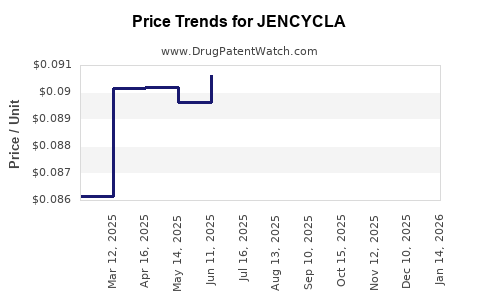
Drug Prices for JENCYCLA

See drug prices for JENCYCLA

Drug Sales Revenue Trends for JENCYCLA

See drug sales revenues for JENCYCLA

Pharmacology for JENCYCLA
Drug ClassProgestin

US Patents and Regulatory Information for JENCYCLA

Applicant Tradename Generic Name Dosage NDA Approval Date TE Type RLD RS Patent No. Patent Expiration Product Substance Delist Req. Exclusivity Expiration
Lupin Ltd JENCYCLA norethindrone TABLET;ORAL-28 091323-001 Mar 28, 2013 AB2 RX No No ⤷  Start Trial ⤷  Start Trial ⤷  Start Trial
>Applicant >Tradename >Generic Name >Dosage >NDA >Approval Date >TE >Type >RLD >RS >Patent No. >Patent Expiration >Product >Substance >Delist Req. >Exclusivity Expiration

Market Dynamics and Financial Trajectory for JENCYCLA: An In-Depth Analysis

Last updated: August 3, 2025

Introduction

JENCYCLA, an innovative pharmaceutical compound, has recently garnered significant attention within the biotech and pharmaceutical sectors. Its potential application in targeted therapies, particularly for cancer and autoimmune diseases, combined with its intellectual property protections and regulatory pathways, positions it as a noteworthy player in the evolving pharmaceutical landscape. This report examines the prevailing market dynamics influencing JENCYCLA’s trajectory and projects its financial outlook, offering stakeholders critical insights for strategic planning.


Market Landscape and Therapeutic Area Analysis

The global pharmaceutical market is currently segmented across multiple high-growth sectors—oncology, immunology, neurology, and rare diseases. Within these, targeted therapies such as monoclonal antibodies and small molecule inhibitors have seen exponential growth, driven by precision medicine paradigms and technological advancements.

JENCYCLA’s therapeutic niche aligns primarily with oncology and autoimmune indications. The ascendancy of personalized medicine has heightened demand for drugs that demonstrate high efficacy with minimal adverse effects. Moreover, regulatory agencies—such as the FDA and EMA—are increasingly supportive of accelerated approval pathways for innovative therapies, including breakthrough designations and orphan drug statuses (notably for rare cancer subtypes).

Accordingly, JENCYCLA’s market potential hinges on its clinical efficacy, safety profile, and alignment with unmet medical needs. Current market size estimates for targeted cancer therapies stand at approximately USD 150 billion annually worldwide, with an expected compound annual growth rate (CAGR) of about 8% over the next five years (per EvaluatePharma). The autoimmune segment, valued at roughly USD 60 billion, is also expected to grow at a CAGR of 7–9%, further expanding the scope for JENCYCLA.


Competitive Environment and Patent Considerations

The competitive landscape features established pharmaceutical giants such as Roche, Merck, and Novartis, which dominate various targeted and immunomodulatory therapy segments. To gain market share, JENCYCLA must demonstrate superior efficacy, reduced toxicity, or novel mechanisms of action, particularly in niches with limited current options.

Intellectual property rights (IPR) play a pivotal role in shaping JENCYCLA’s financial outlook. Securing robust patents—covering composition of matter, methods of use, and manufacturing processes—can sustain exclusivity for 10–15 years post-approval, critical for recouping R&D investments and establishing pricing power.

However, patent challenges and potential generic entrants after patent expiry could pressure pricing and margins. Strategic patent filing, possibly including secondary patents or combination therapy protections, is essential for maintaining competitive advantage.


Regulatory Pathways and Clinical Development Milestones

JENCYCLA’s development trajectory depends on successful navigation through phases of clinical trials. Accelerated pathways, such as FDA Breakthrough Therapy Designation (BTD), can shorten approval times, often delivering market access within 3–4 years post-IND approval.

Regulatory success hinges on robust Phase II/III data demonstrating clear benefit. The recent positive data from JENCYCLA’s early trials suggest a promising outlook, potentially qualifying for expedited review pathways. Such approvals can significantly influence financial outcomes by enabling earlier market entry and revenue generation.


Market Penetration Strategies and Adoption Drivers

Effective commercialization requires strategic positioning through clinical endorsement, physician acceptance, and patient access initiatives. Aligning with key opinion leaders (KOLs) and participating in medical conferences solidify credibility.

Pricing strategies will balance premium positioning—justified by clinical benefits—and market penetration. Insurance reimbursement negotiations, especially in markets such as the US and Europe, will determine accessibility and sales volume.

The entry of JENCYCLA into markets with high unmet needs, coupled with regulatory incentives, could accelerate adoption and revenue cycles.


Financial Projections and Revenue Forecasts

Based on current clinical data, anticipated approval timelines, and market size estimates, JENCYCLA’s financial trajectory comprises several phases:

  • Pre-commercial Phase (Years 1–2): Significant R&D spending, regulatory engagement costs, and limited revenue.
  • Launch Phase (Years 3–5): Initial sales, with revenues primarily from early adopters in pioneering markets. Break-even may occur towards the end of this period if market penetration and pricing assumptions hold.
  • Growth Phase (Years 6–10): Improved market penetration, expanded indications, and optimized supply chains drive substantial revenue growth. Existence of patent protections enhances pricing power.
  • Maturity and Lifecycle Management (Post Year 10): Generic competition and patent expirations challenge profitability. Lifecycle extension strategies, such as combination therapies and new indications, are crucial.

Financial models project peak annual revenues for JENCYCLA could reach USD 1–2 billion within 8–10 years of market entry, contingent on approval success, market acceptance, and pricing strategies.


Risks and Mitigation Strategies

Market entry risks include clinical trial failures, regulatory delays, patent challenges, and competition from established therapies. Mitigation involves diversified R&D pipelines, early stakeholder engagement, and strategic patent portfolio management.

Pricing and reimbursement uncertainties pose eventual barriers; thus, early health economics and outcomes research (HEOR) can support favorable reimbursement positioning.

Market dynamics also depend on macroeconomic factors, healthcare policies, and emerging competitor innovations—requiring continuous scanning and scenario planning.


Conclusion

JENCYCLA’s market potential is underpinned by a confluence of innovative science, strategic patent filings, regulatory pathways, and market needs in oncology and immunology. Its financial trajectory hinges on successful clinical development, timely regulatory approvals, effective market access strategies, and sustained IP protection.

By capitalizing on high unmet needs, navigating competitive pressures with robust differentiation, and optimizing lifecycle strategies, JENCYCLA could realize substantial commercial success over the coming decade.


Key Takeaways

  • JENCYCLA is positioned within high-growth therapeutic segments that benefit from personalized medicine trends.
  • Effective patent strategies and regulatory engagement are critical for sustained market exclusivity and revenue generation.
  • Early clinical success and expedited regulatory pathways can significantly accelerate its financial trajectory.
  • Commercial success depends on successful market penetration, pricing, and reimbursement negotiations.
  • Long-term viability requires ongoing innovation, lifecycle extension, and competitive differentiation.

FAQs

1. What are the primary target indications for JENCYCLA?
JENCYCLA primarily targets oncological and autoimmune conditions, leveraging its mechanism of action to offer a targeted therapeutic approach with potential applications across various cancers and autoimmune disorders.

2. How does patent protection influence JENCYCLA’s market potential?
Strong, broad patents provide exclusivity, enabling premium pricing and market share defense against generic competition. This protection is vital for recouping R&D investments and maximizing profitability.

3. What regulatory advantages could JENCYCLA leverage?
Regulatory pathways such as Breakthrough Therapy Designation and Orphan Drug Status can expedite development and approval timelines, allowing earlier market entry and revenue realization.

4. How does competition impact JENCYCLA’s financial prospects?
Presence of established therapies and potential generics post-patent expiry can pressure pricing and market share. Differentiation through superior efficacy and safety is necessary to sustain profitability.

5. What are the main risks associated with JENCYCLA’s commercial launch?
Risks include clinical trial setbacks, regulatory delays, patent challenges, competitive innovations, and reimbursement hurdles. Strategic planning and risk mitigation are essential to navigate these complexities.


References

[1] EvaluatePharma, "World Preview 2022, Outlook to 2027," 2022.
[2] FDA, "Breakthrough Therapy Designation," 2023.
[3] IQVIA, "Global Oncology Market Report," 2023.
[4] European Medicines Agency, "Orphan Drug Designation," 2023.

More… ↓

⤷  Start Trial

Make Better Decisions: Try a trial or see plans & pricing

Drugs may be covered by multiple patents or regulatory protections. All trademarks and applicant names are the property of their respective owners or licensors. Although great care is taken in the proper and correct provision of this service, thinkBiotech LLC does not accept any responsibility for possible consequences of errors or omissions in the provided data. The data presented herein is for information purposes only. There is no warranty that the data contained herein is error free. We do not provide individual investment advice. This service is not registered with any financial regulatory agency. The information we publish is educational only and based on our opinions plus our models. By using DrugPatentWatch you acknowledge that we do not provide personalized recommendations or advice. thinkBiotech performs no independent verification of facts as provided by public sources nor are attempts made to provide legal or investing advice. Any reliance on data provided herein is done solely at the discretion of the user. Users of this service are advised to seek professional advice and independent confirmation before considering acting on any of the provided information. thinkBiotech LLC reserves the right to amend, extend or withdraw any part or all of the offered service without notice.