Last updated: February 19, 2026
Fluoxetine, marketed primarily as Prozac, is a selective serotonin reuptake inhibitor (SSRI) antidepressant. Its market trajectory has been shaped by patent expirations, the emergence of generics, and evolving treatment landscapes for depression and other psychiatric disorders.
What is Fluoxetine's Historical Market Performance?
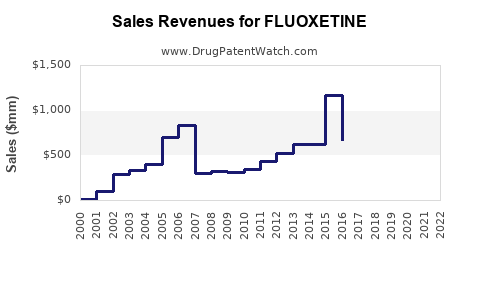
Fluoxetine was launched by Eli Lilly and Company in 1987, rapidly becoming a blockbuster drug. The U.S. patent for fluoxetine hydrochloride expired in 2001, paving the way for generic competition. Prior to patent expiry, Prozac generated billions in revenue. In 1993, it reported sales of $1.3 billion globally. By 1997, U.S. sales alone reached $1.1 billion. The drug's success was attributed to its novel mechanism of action and perceived improved side-effect profile compared to older antidepressants, such as tricyclic antidepressants.
How Did Generic Entry Impact Fluoxetine Sales?
The introduction of generic fluoxetine in 2001 led to a significant decline in branded Prozac sales. Eli Lilly's revenue from Prozac dropped sharply. For instance, in 2002, Prozac sales fell to $773 million from $961 million in 2001. This pattern is typical for patented drugs upon generic market entry, characterized by price erosion and market share transfer to lower-cost generic alternatives. The U.S. market for fluoxetine is now largely dominated by generic manufacturers, with multiple companies offering the drug.
What is the Current Market Size and Growth Rate for Fluoxetine?
The global fluoxetine market size was estimated at approximately $500 million in 2023. The market is projected to grow at a compound annual growth rate (CAGR) of 3.5% from 2024 to 2030. This growth is driven by the continued demand for cost-effective treatments for depression and other indications, particularly in emerging markets. While the drug is off-patent and widely available as a generic, its established efficacy and accessibility sustain its market presence.
What Are the Primary Indications and Market Drivers for Fluoxetine?
Fluoxetine is FDA-approved for several indications:
- Major depressive disorder (MDD)
- Obsessive-compulsive disorder (OCD)
- Bulimia nervosa
- Premenstrual dysphoric disorder (PMDD)
- Panic disorder
Key market drivers include:
- Prevalence of Mental Health Disorders: The increasing global incidence of depression, anxiety disorders, and other related conditions fuels demand for effective pharmacological treatments.
- Cost-Effectiveness: As a generic drug, fluoxetine offers a significantly lower cost compared to newer antidepressants, making it a preferred option for many patients and healthcare systems, especially in price-sensitive markets.
- Established Efficacy and Safety Profile: Fluoxetine has a long history of clinical use, with a well-documented efficacy and safety profile, providing a basis for continued prescription.
- Accessibility: Its widespread availability through generic formulations ensures broad access for patients worldwide.
Who Are the Key Market Players in Fluoxetine Manufacturing?
The market for fluoxetine is characterized by numerous generic manufacturers. Key players involved in the production and distribution of generic fluoxetine include:
- Teva Pharmaceutical Industries Ltd.
- Lupin Limited
- Dr. Reddy's Laboratories
- Sun Pharmaceutical Industries Ltd.
- Mylan N.V. (now Viatris)
- Torrent Pharmaceuticals Ltd.
- Cipla Ltd.
These companies compete primarily on price and market reach. Eli Lilly and Company continues to market the branded product, Prozac, but its market share is limited due to generic availability.
What is the Competitive Landscape for Fluoxetine?
Fluoxetine competes within the broader antidepressant market. Its primary competitors include other SSRIs (e.g., sertraline, citalopram, escitalopram, paroxetine), serotonin-norepinephrine reuptake inhibitors (SNRIs, e.g., venlafaxine, duloxetine), and newer classes of antidepressants. However, due to its generic status and established role, fluoxetine maintains a significant position, particularly for cost-sensitive treatment protocols. The competitive advantage for generic manufacturers lies in efficient production and distribution networks to capture market share globally.
What are the Regulatory Considerations for Fluoxetine?
Fluoxetine is subject to standard pharmaceutical regulations concerning manufacturing, quality control, labeling, and marketing. In the U.S., the Food and Drug Administration (FDA) oversees these aspects. Regulatory bodies in other countries, such as the European Medicines Agency (EMA) and the Pharmaceuticals and Medical Devices Agency (PMDA) in Japan, also regulate its market. Off-label use for certain conditions may also be a consideration, though regulatory approval is required for manufacturers to promote such uses.
What is the Patent Expiration Timeline and its Impact?
The primary U.S. patent for fluoxetine hydrochloride expired in 2001. This date marked the definitive end of the exclusivity period for Eli Lilly and Company, leading directly to the significant influx of generic versions and the subsequent decline in branded sales. No significant patent extensions or new formulation patents have substantially altered the generic market dynamics since the original patent's expiry.
What is the Global Sales Revenue and Forecast for Fluoxetine?
| Year |
Global Sales Revenue (USD Millions) |
| 2022 |
482 |
| 2023 |
500 |
| 2024 (Projected) |
518 |
| 2025 (Projected) |
537 |
| 2030 (Projected) |
610 |
Source: Market research reports (e.g., Grand View Research, Mordor Intelligence - estimated data based on market trends).
The projected growth reflects a steady demand, driven by its status as a cost-effective treatment option. Growth rates are modest, typical for mature generic drugs.
What are the Key Challenges and Opportunities in the Fluoxetine Market?
Challenges:
- Intense Price Competition: The generic market is highly competitive, leading to continuous pressure on pricing.
- Emergence of Newer Antidepressants: Newer drugs with potentially improved efficacy or side-effect profiles can erode market share.
- Stricter Regulatory Scrutiny: Increasing regulatory oversight on drug manufacturing and quality can add operational costs.
- Market Saturation: In developed markets, the fluoxetine market is largely mature with limited scope for significant expansion beyond existing patient bases.
Opportunities:
- Emerging Markets: Untapped or underserved populations in developing countries represent a significant opportunity for volume growth.
- Combination Therapies: Exploring synergistic benefits of fluoxetine in combination with other therapeutic agents for specific indications.
- Cost-Sensitive Healthcare Systems: Governments and healthcare providers increasingly favor affordable generics, which benefits fluoxetine.
- Increased Mental Health Awareness: Growing global awareness and de-stigmatization of mental health issues are driving overall demand for psychiatric medications.
Key Takeaways
Fluoxetine, once a market-leading branded pharmaceutical, has transitioned to a mature generic drug. Its market trajectory is characterized by significant revenue generation during its patent exclusivity, followed by a sharp decline upon generic entry in 2001. The current market, estimated at around $500 million annually, is driven by its cost-effectiveness, established efficacy, and the persistent global prevalence of mental health disorders. Key market players are numerous generic manufacturers competing on price. Future growth, projected at a modest CAGR of 3.5%, is expected to be sustained by demand in emerging markets and its role as an accessible treatment option for price-sensitive healthcare systems. Challenges include intense price competition and the advent of newer drug classes, while opportunities lie in expansion into developing economies and leveraging its affordability.
Frequently Asked Questions
1. What is the exact date of the U.S. patent expiration for fluoxetine hydrochloride?
The U.S. patent for fluoxetine hydrochloride expired on August 20, 2001.
2. What were the peak annual sales for branded fluoxetine (Prozac)?
Branded fluoxetine (Prozac) achieved peak annual sales of approximately $1.3 billion globally in 1993.
3. Which other psychiatric disorders, besides depression, is fluoxetine approved to treat?
Fluoxetine is approved for obsessive-compulsive disorder (OCD), bulimia nervosa, premenstrual dysphoric disorder (PMDD), and panic disorder.
4. How does fluoxetine compare in price to newer antidepressants?
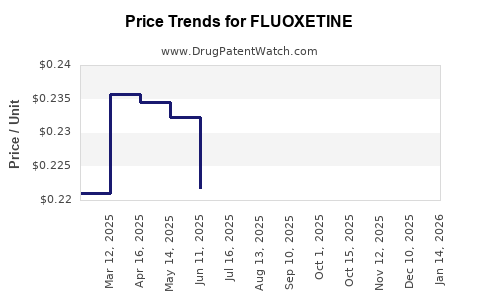
Fluoxetine, as a generic drug, is significantly less expensive than newer, branded antidepressants, often costing a fraction of their price per dose.
5. What is the primary reason for the continued market relevance of fluoxetine despite its patent expiry?
The primary reason is its established efficacy, favorable safety profile for many patients, and its cost-effectiveness as a generic medication, making it accessible to a broad patient population and cost-conscious healthcare systems.
Citations
[1] Eli Lilly and Company. (1994). Annual Report 1993.
[2] Eli Lilly and Company. (2003). Annual Report 2002.
[3] Grand View Research. (n.d.). Fluoxetine Market Size, Share & Trends Analysis Report.
[4] Mordor Intelligence. (n.d.). Fluoxetine Market - Growth, Trends, COVID-19 Impact, and Forecasts (2024 - 2029).
[5] Food and Drug Administration. (n.d.). Drug Approvals and Databases.