Last updated: August 27, 2026
Fluocinonide is a mature, prescription topical corticosteroid with little remaining intellectual-property protection and broad generic availability. Its commercial trajectory is volume-driven rather than innovation-driven. Revenue is distributed across multiple manufacturers, strengths, dosage forms, wholesalers and pharmacy channels. The market has low regulatory barriers for established products but remains exposed to supply disruptions, payer substitution and price compression.
What is the current market position of fluocinonide?
Fluocinonide is a high-potency topical corticosteroid used for inflammatory and pruritic corticosteroid-responsive dermatoses, including eczema, dermatitis and psoriasis. U.S. products generally contain fluocinonide at 0.05%, with some products using 0.1% formulations. Available dosage forms include:
| Dosage form |
Typical strength |
Market role |
| Cream |
0.05%; 0.1% for selected products |
Mainstream generic form |
| Ointment |
0.05% |
Higher-occlusion treatment |
| Gel |
0.05% |
Specialized topical delivery |
| Solution |
0.05% |
Scalp and hair-bearing areas |
| Emollient cream |
0.05% |
Premium formulation within the generic category |
The historical branded products include Lidex and Vanos. Generic fluocinonide products now account for most U.S. prescription volume. FDA-approved labels identify the drug as a topical corticosteroid rather than a new molecular entity with current exclusivity protection (U.S. Food and Drug Administration [FDA], n.d.-a).
The market is commercially mature. Prescribers typically select among fluocinonide, clobetasol, betamethasone dipropionate and other topical corticosteroids based on potency, body site, formulation, patient age and payer coverage.
When did fluocinonide lose patent and regulatory exclusivity?
Fluocinonide’s original product and formulation protection expired decades ago. The active ingredient is no longer protected by a live composition-of-matter patent in the U.S. generic market, and the drug has no remaining new-drug exclusivity comparable to the exclusivity periods available for recently approved products.
The principal commercial consequences are:
- Multiple ANDA-approved generic manufacturers.
- No effective market-wide patent barrier to abbreviated new drug applications.
- Substitution based primarily on formulary status, acquisition cost, availability and dosage form.
- Limited ability for a manufacturer to sustain premium pricing without a differentiated vehicle, packaging system or contracting position.
Because fluocinonide is an old topical corticosteroid, the key competitive issue is not the expiration date of a single blocking patent. It is the cumulative effect of long-expired active-ingredient and product patents, FDA-approved generic alternatives and pharmacy-level substitution.
What patents protect fluocinide products today?
No active core patent estate appears to protect fluocinide as an active pharmaceutical ingredient in the U.S. generic market. Current commercial protection, where present, is more likely to relate to a specific formulation, vehicle, packaging configuration or branded product than to fluocinide itself.
The FDA Orange Book is the principal U.S. source for patents and regulatory exclusivities associated with approved drug products. It is not a complete global patent database and does not capture every possible formulation or manufacturing patent. For an old generic active ingredient such as fluocinide, the Orange Book generally provides little evidence of a commercially meaningful, drug-wide patent barrier (FDA, n.d.-b).
Are formulation patents important for fluocinide?
Formulation patents can matter at the product level but usually do not prevent generic entry across the entire fluocinide market. Potentially differentiated areas include:
- Emollient vehicles.
- Non-greasy creams and gels.
- Solvent systems for scalp solutions.
- Enhanced skin penetration systems.
- Preservative and stability systems.
- Metered-dose or controlled-dispensing packages.
- Combination products with moisturizers or other dermatologic agents.
A formulation patent may protect one vehicle while leaving conventional cream, ointment, gel or solution products open to competition. The commercial value depends on whether the formulation delivers measurable clinical or adherence benefits that support formulary placement or premium reimbursement.
What is the FDA regulatory status of fluocinide?
Fluocinide is an FDA-approved prescription topical corticosteroid. Its regulatory status is established through approved new drug applications and abbreviated new drug applications for therapeutically equivalent products.
The relevant FDA pathways are:
| Regulatory route |
Relevance to fluocinide |
| Original NDA |
Historical approval of branded products |
| ANDA |
Primary route for current generic competition |
| 505(b)(2) NDA |
Potential route for materially different formulation or delivery system |
| OTC switch |
Not the current basis of the principal fluocinide market |
Fluocinide remains a prescription product because high-potency topical corticosteroids carry risks that include skin atrophy, hypothalamic-pituitary-adrenal axis suppression, local irritation, infection risk and systemic absorption under certain conditions. FDA labeling limits duration, treated surface area and use in vulnerable populations (FDA, n.d.-a).
What is the Orange Book status of fluocinide?
The Orange Book does not create exclusivity. It records approved products, therapeutic equivalence evaluations and, where applicable, listed patents and exclusivities.
For fluocinide, the commercial Orange Book profile is consistent with a mature generic product:
- Multiple approved generic equivalents.
- No current new chemical entity exclusivity.
- No meaningful remaining market-wide exclusivity.
- Product-specific listings rather than a single controlling patent estate.
- Therapeutic-equivalence competition among common dosage forms.
Orange Book entries should be reviewed by strength and dosage form. A generic cream does not automatically establish equivalence to every ointment, gel, solution or emollient product. Substitution depends on the specific FDA therapeutic-equivalence designation and state pharmacy rules.
How many patents cover fluocinide?
No defensible current market-wide patent count exists without a product-by-product and jurisdiction-by-jurisdiction search. The relevant business conclusion is more direct: fluocinide has no known active U.S. composition patent that blocks generic competition.
Patent counts can be misleading because they may include:
- Expired compound patents.
- Abandoned applications.
- Foreign patents with no U.S. enforcement value.
- Formulation patents that cover only one product.
- Packaging or manufacturing patents.
- Patents not listed in the Orange Book.
- Patents with claims that do not survive validity or infringement review.
For diligence purposes, the correct unit of analysis is the specific manufacturer, strength, dosage form, formulation and jurisdiction.
What method-of-use patents apply to fluocinide?
Fluocinide’s principal indications are longstanding and generally described in established topical corticosteroid labeling. No broad, commercially controlling method-of-use patent is associated with the standard treatment of corticosteroid-responsive dermatoses.
Potential method-of-use claims could address:
- A particular dosing schedule.
- Treatment of a defined patient subgroup.
- A specific body site.
- A combination regimen.
- A formulation-specific clinical benefit.
Such claims would not normally prevent ordinary generic use for the labeled indications unless they were valid, enforceable and sufficiently broad. Generic manufacturers may also use labeling strategies that omit patented indications where applicable, subject to FDA requirements and litigation risk.
Which companies compete with fluocinide?
Competition comes from both fluocinide manufacturers and alternative topical corticosteroid suppliers.
Generic fluocinide manufacturers
The U.S. market has historically included products supplied by manufacturers such as:
- Taro Pharmaceutical Industries.
- Fougera Pharmaceuticals, a division of Sandoz.
- Perrigo.
- Glenmark Pharmaceuticals.
- Amneal Pharmaceuticals.
- Teva Pharmaceuticals.
- Other FDA-approved ANDA sponsors and authorized distributors.
Supplier participation changes over time because companies enter, exit, transfer ANDAs or discontinue specific presentations. Manufacturing may occur through affiliated or contract facilities outside the United States.
Therapeutic competitors
| Drug |
Relative positioning |
| Clobetasol propionate |
Very high potency; often competes for severe localized disease |
| Betamethasone dipropionate |
High potency; multiple formulations and generic suppliers |
| Triamcinolone acetonide |
Lower or medium potency depending on formulation; broader routine use |
| Mometasone furoate |
Medium-to-high potency; strong branded and generic history |
| Hydrocortisone |
Lower potency; broader safety and OTC exposure |
| Desonide |
Lower potency; pediatric and sensitive-site positioning |
Fluocinide’s position is strongest where prescribers want high potency without selecting the most potent class, particularly clobetasol. The product remains vulnerable to substitution when formularies prefer another corticosteroid with a lower net cost.
What generic entry risks exist for fluocinide?
Traditional generic entry risk is already realized. The market has moved beyond a branded-to-generic transition and into mature generic competition.
The principal risks are:
- Price erosion from multiple suppliers.
- Pharmacy and wholesaler substitution.
- Formulary preference for competing corticosteroids.
- Product discontinuations caused by low net pricing.
- Short-term shortages if manufacturing becomes concentrated.
- Limited differentiation among conventional dosage forms.
- Therapeutic substitution from alternative topical steroids.
- Low reimbursement for low-volume presentations.
Paragraph IV litigation is therefore more relevant to a new formulation or repurposed fluocinide product than to the established active ingredient. An ANDA sponsor seeking approval for a conventional generic product would generally face an expired-patent or nonblocking-patent environment rather than a high-value first-wave patent dispute.
What patent litigation and settlement agreements affect fluocinide?
No major current patent litigation or settlement structure is central to the ordinary U.S. fluocinide generic market. The absence of an active branded franchise reduces the economic incentive for large reverse-payment settlements.
Litigation risk could still arise from:
- A proprietary vehicle.
- A 505(b)(2) formulation.
- A device or dispensing system.
- Trade-secret allegations involving manufacturing.
- Trademark or trade-dress disputes.
- Product liability claims.
- ANDA disputes involving a newly listed formulation patent.
Those risks are product-specific. They do not recreate exclusivity for conventional fluocinide cream, ointment, gel or solution.
How strong is the fluocinide patent estate?
The patent estate is weak as a market-wide barrier and potentially moderate for a narrowly differentiated formulation.
| Estate component |
Current strategic value |
| Active ingredient patent |
Negligible |
| Original indication patent |
Negligible |
| Conventional cream formulation |
Low |
| Conventional ointment formulation |
Low |
| Novel vehicle |
Potentially moderate |
| Delivery device |
Potentially moderate |
| Combination formulation |
Product-specific |
| Manufacturing process |
Usually limited unless difficult to design around |
| Trademark |
Brand protection only, not generic exclusion |
A company seeking to build value around fluocinide would need to rely on formulation science, supply reliability, channel access, dermatology promotion or a differentiated patient-use profile. Patent protection alone is unlikely to support a large premium unless the product provides a clear and defensible technical advantage.
What is the financial trajectory of fluocinide?
Fluocinide has the financial profile of a mature generic dermatology product:
- Low development risk.
- Low commercial growth potential for standard presentations.
- High price sensitivity.
- Fragmented supplier revenue.
- Limited branded pricing power.
- Potentially attractive gross margins during supply shortages.
- Declining or flat nominal revenue in ordinary competitive conditions.
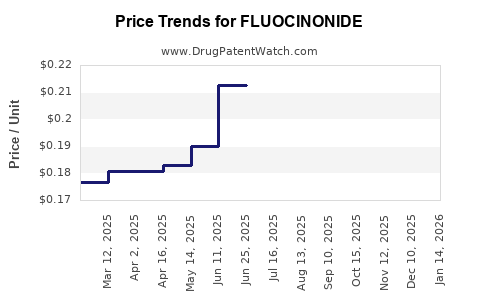
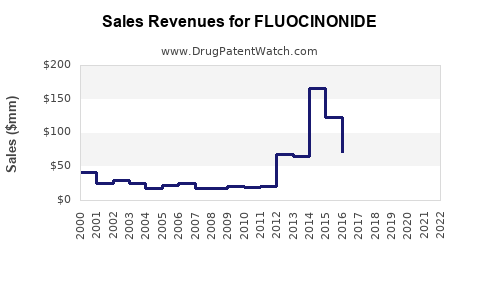
Public companies generally do not disclose fluocinide revenue separately. It is usually included in broader portfolios such as topical dermatology, generic medicines or North American pharmaceuticals. As a result, a precise drug-level market size or manufacturer revenue ranking cannot be established from public company filings alone.
Revenue drivers
The main revenue drivers are:
- Prescription volume.
- Number of active suppliers.
- Net price after rebates and wholesaler discounts.
- Formulation mix.
- Payer tier placement.
- Retail versus institutional distribution.
- Manufacturing cost and active pharmaceutical ingredient availability.
- Temporary competitor shortages.
The cream formulation is likely to account for the broadest use, while ointment, gel and solution products have narrower volume but may face less direct supplier competition. Emollient and specialized formulations can command higher gross-to-net economics if they obtain favorable formulary treatment.
Margin outlook
Margins for standard generic fluocinide are structurally constrained. A manufacturer may achieve acceptable returns through:
- Efficient high-volume manufacturing.
- Low-cost sourcing.
- Automated packaging.
- Portfolio bundling with other dermatology products.
- Reliable supply during competitor disruptions.
- Contract manufacturing scale.
Standalone investment in a conventional fluocinide generic is unlikely to support substantial research spending. The more defensible opportunity lies in a new topical vehicle, combination product, adherence-enhancing package or supply-chain advantage.
How does fluocinide compare with clobetasol and triamcinolone?
Fluocinide occupies an intermediate commercial position between very-high-potency clobetasol and more broadly used lower-potency products such as triamcinolone.
| Attribute |
Fluocinide |
Clobetasol |
Triamcinolone |
| Potency |
High |
Very high |
Low to high, formulation-dependent |
| Generic competition |
Extensive |
Extensive |
Extensive |
| Typical use |
Localized inflammatory dermatoses |
Severe localized disease |
Broad routine dermatology |
| Differentiation |
Formulation and potency balance |
Potency |
Breadth of use and familiarity |
| Pricing power |
Low |
Low to moderate by presentation |
Low |
| Patent barrier |
Minimal |
Minimal for standard products |
Minimal |
Fluocinide can retain demand where clinicians want strong activity but avoid the highest-potency corticosteroid. Its commercial ceiling is limited by the availability of therapeutically similar alternatives.
What geographic coverage does fluocinide have?
Fluocinide is commercially available in the United States and has had use in other markets under different regulatory classifications, brand names and formulation conventions. Patent and regulatory conclusions are jurisdiction-specific.
Key geographic considerations include:
- U.S. generic competition is well established.
- European availability may be more limited or organized under different corticosteroid naming and classification systems.
- Canadian and other national markets may use different approved strengths and brands.
- Local reimbursement policies determine commercial value.
- Manufacturing and API supply are global even when the finished product is sold domestically.
A U.S. FDA approval does not establish approval, patent freedom or reimbursement in another country.
What manufacturing and intellectual-property barriers remain?
Manufacturing barriers are more relevant than patent barriers. The active ingredient is established, but finished-product performance depends on:
- Particle size and suspension uniformity.
- Vehicle rheology.
- Microbial control.
- Preservative compatibility.
- Stability over shelf life.
- Tube or bottle compatibility.
- Filling and packaging equipment.
- Consistent topical bioavailability.
For conventional products, these requirements are manageable for experienced generic manufacturers. The main risk is operational: a small number of qualified suppliers for a specific dosage form can create temporary shortages and price increases.
What is the outlook for fluocinide generic launches?
A conventional fluocinide launch would face limited market whitespace. The most credible launch opportunities are:
- A formulation with a meaningful usability advantage.
- A dosage form with limited existing competition.
- A private-label or pharmacy-channel supply agreement.
- A reliable low-cost product supported by manufacturing scale.
- A product targeting a poorly supplied strength or package size.
- A combination or delivery system eligible for differentiated regulatory treatment.
A standard cream launch without a supply or contracting advantage would likely encounter rapid price competition and modest market share.
Key Takeaways
- Fluocinide is a mature, prescription high-potency topical corticosteroid.
- Core U.S. patent and regulatory exclusivity expired decades ago.
- The market is dominated by generic competition across creams, ointments, gels and solutions.
- No market-wide patent barrier currently supports premium pricing.
- Formulation, packaging and manufacturing patents may protect individual products but not the active ingredient broadly.
- Public companies generally do not report fluocinide revenue separately.
- Financial performance depends on volume, net price, formulation mix and supply reliability.
- The largest risks are price erosion, therapeutic substitution and manufacturing concentration.
- The strongest commercial opportunity is a differentiated formulation or dependable supply platform, not a conventional undifferentiated generic.
FAQs
Is fluocinide available over the counter?
Standard fluocinide products are prescription medicines in the United States because of their high topical corticosteroid potency and associated safety considerations.
Can a generic manufacturer launch fluocinide without a Paragraph IV challenge?
Yes. Because the core patent barriers are expired or nonblocking, a conventional ANDA applicant may rely on certifications other than Paragraph IV where the relevant listed patents do not block approval.
Does fluocinide have biosimilar competition?
No. Fluocinide is a chemically synthesized small-molecule drug, not a biologic. Its competitors are generic drugs and therapeutically substitutable topical corticosteroids, not biosimilars.
Which fluocinide formulation has the greatest commercial value?
Cream generally has the broadest prescription applicability. Emollient cream, gel and solution products may offer better differentiation but usually address narrower patient or body-site segments.
Is fluocinide an attractive licensing asset?
A conventional fluocinide product has limited licensing value because of generic competition. A proprietary vehicle, combination product, delivery system or manufacturing platform could have greater value if supported by enforceable intellectual property and a clear clinical or adherence advantage.
References
-
U.S. Food and Drug Administration. (n.d.-a). Fluocinonide topical prescribing information. DailyMed. https://dailymed.nlm.nih.gov/
-
U.S. Food and Drug Administration. (n.d.-b). Approved drug products with therapeutic equivalence evaluations: Orange Book. https://www.accessdata.fda.gov/scripts/cder/ob/
-
U.S. Food and Drug Administration. (n.d.-c). Abbreviated new drug application approvals and therapeutic equivalence. https://www.fda.gov/drugs
-
National Library of Medicine. (n.d.). Fluocinonide. MedlinePlus. https://medlineplus.gov/druginfo/meds/
-
U.S. Securities and Exchange Commission. (n.d.). Company filings and annual reports. https://www.sec.gov/edgar/searchedgar/companysearch.html