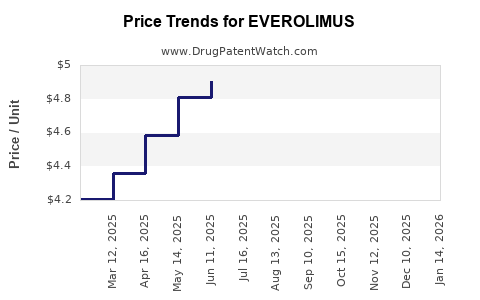
Last updated: June 19, 2026
Everolimus is a commercially established oncology and renal therapy with a concentrated patent and exclusivity timeline shaped by multiple indications and dosage forms. Revenue has been driven by (1) sustained use in breast cancer (HR+/HER2−), renal cell carcinoma (RCC), and pancreatic neuroendocrine tumors (NET), and (2) competitive substitution pressure from other pathway inhibitors and, in select contexts, from end of exclusivity for specific formulation or method-of-use IP layers. Financial trajectory also reflects net-price pressure, channel mix (hospital vs. specialty pharmacy), and guideline positioning against VEGF TKIs and mTOR-adjacent regimens.
How has Everolimus performed financially by indication (oncology and renal use cases)?
Everolimus’ financial profile is best understood as a blended outcome of three major demand engines:
- RCC (advanced RCC after prior VEGF-targeted therapy; also used across related renal indications)
- Breast cancer (HR+/HER2−, usually with aromatase inhibitors)
- Pancreatic NET and other NET subsets (where mTOR inhibition fits specific sequencing)
Key demand drivers
- Treatment sequencing: mTOR inhibitors typically sit after initial lines (commonly post-VEGF TKI in RCC and post-progression in HR+ breast cancer combination strategies).
- Patient selection: benefits concentrate in populations aligned with clinical inclusion criteria (performance status, prior therapy constraints, and biomarker-relevant clinical features).
- Dose continuity: fixed oral dosing and long-cycle administration supports durability, but dose reductions and interruptions occur due to stomatitis, infections, hyperglycemia, pneumonitis, and cytopenias.
What the market cares about
- durable prescribing by line of therapy
- tolerability management protocols
- payer access and formulary placement versus alternative kinase inhibitors and antibody-drug conjugates (ADC) in breast cancer lines
What market dynamics shape Everolimus pricing and net revenue?
Everolimus is exposed to typical specialty drug economics, but the price/net realization is modulated by indication mix and regional payer behavior.
Hospital procurement vs. specialty pharmacy dynamics
- Oncology settings in major markets often route through hospital formularies and specialty pharmacy chains.
- NET and RCC use tends to concentrate in specialty centers with stable prescribing workflows.
Net price pressure mechanics
- Annual contract renewals and rebundling pressures in US commercial and Medicare Part D settings.
- International tender mechanisms in EU and ROW that can force price resets.
Competitive substitution pressures
Everolimus faces two broad competitive classes:
- Within oncology pathways: VEGF inhibitors and other targeted agents in RCC; CDK4/6 inhibitors, SERDs, and ADCs in HR+ breast cancer over time.
- Within mTOR-class alternatives and sequencing changes: shifts in guidelines can reduce incremental share even if the drug remains an option.
Real-world adherence and dose management
Everolimus net revenue is affected by:
- discontinuation rates from adverse events
- dose interruption patterns during grade 2-4 events
- cost-offset dynamics when dose reductions are adopted rather than switching therapies
When does Everolimus exclusivity end and how does it affect financial trajectory?
Everolimus commercial continuity is driven by a multi-layer exclusivity stack:
- drug substance/exposure period
- formulation and polymorph layers
- method-of-use protections by indication
- regulatory exclusivities tied to specific labeling
Because the financial impact is indication-dependent, generic or biosimilar entry risk is not uniform. The most material effect comes from exclusivity loss for specific tablet strengths and line-specific method-of-use claims (and any FDA “Orange Book” active patent coverage that blocks/limits generic labeling).
Exclusivity timing: why it is not a single date
For oral oncology agents, market access barriers are usually layered. Even when one IP layer expires, others can delay:
- first generic approval in the same strength and dosing regimen
- label carve-outs or litigation settlement-driven “at-risk” entries
Financial consequence
- revenue usually plateaus until the dominant Orange Book blocking patents lapse, then declines more abruptly during first generic launches that align to label and dosing.
What is the Orange Book status for Everolimus, and which patent barriers matter most?
Everolimus’ Orange Book status is assessed by:
- listed patents tied to the NDA and specific dosage forms
- patent expiration dates and any statutory exclusivity codes (where applicable)
- whether key claims are method-of-use (indication) or formulation/manufacturing-related
Practical market effect
- If Orange Book listings include method-of-use claims for core indications (RCC, breast, NET), generics may file with label carve-outs or enter after litigation resolution.
- If formulation/manufacturing patents remain in force, launch may be delayed even when method-of-use patents are not asserted.
Which companies control Everolimus supply and how do their strategies influence revenue?
Everolimus is marketed through established specialty product channels and, in later periods, also via authorized generics where legal and regulatory pathways allow. Competitive dynamics typically include:
- maintaining formulary coverage through contracting
- supporting payer evidence packages and real-world outcomes
- lifecycle management through label expansions and dose optimization
Strategy patterns that affect financial trajectory
- aggressive tender/contract renegotiation
- specialty pharmacy distribution agreements
- bundling with patient support programs that improve persistence
- REMS and safety monitoring infrastructure for oral oncology adherence
What patent litigation and Paragraph IV challenges affect Everolimus revenue risk?
Generic entry risk is shaped by:
- the number of Orange Book blocking patents
- the scope and strength of asserted claims
- settlement outcomes (which often include “no-authorization” periods, launch date constraints, and/or market allocation terms)
Financial trajectory impact pathways
- At-risk litigation can cause a delayed launch if courts issue injunctions tied to claim scope.
- Settlements can create a predictable post-expiry entry date that compresses revenue in a narrower window.
- Label carve-outs can reduce the addressable patient population, slowing revenue erosion even after approval.
How does Everolimus compare with competing oncology drugs in market resilience?
Everolimus competes against agents with different risk-reward profiles. The resilience of everolimus revenue depends on how clinicians sequence mTOR inhibition versus:
- VEGF pathway inhibitors in RCC
- endocrine combinations, SERDs, and targeted therapies in HR+ breast cancer
- other targeted agents and chemotherapy regimens in NET sequencing
Comparison dimensions that matter commercially
- OS/PFS relative positioning in guidelines over time
- tolerability and monitoring burden
- ability to integrate with existing regimens without major contraindication overlap
- payer acceptance and net-price contracting
What biosimilar risk applies to Everolimus?
Everolimus is a small-molecule drug, so biosimilar risk does not apply. Competitive risk is primarily from:
- small-molecule generics
- authorized generics
- label carve-out strategies tied to remaining method-of-use or formulation patents
Which dosage forms and strengths drive substitution dynamics for Everolimus generics?
Substitution is driven by whether a generic can match:
- strength and dosing flexibility
- release profile and excipient formulation that meets bioequivalence standards
- ability to carry the same label for key indications without carve-outs
Financial implication
- a generic that can only reference a subset of strengths or must narrow indications tends to capture less revenue initially.
- full label and strength matching is usually required for a steep revenue decline.
How do revenue drivers shift over time as indications mature?
Everolimus demand tends to evolve as:
- treatment algorithms change
- newer lines of therapy gain uptake
- payer restrictions tighten around high-cost oral therapies
Mature-indication patterns
- breast cancer share can be diluted by newer endocrine and targeted options that move earlier in the line sequence
- RCC remains a long-lived oncology market with continuing progression-driven need for options, sustaining demand even as competitors expand
NET-specific patterns
- NET is sensitive to sequencing and local care pathways
- longer-term chronic administration supports persistence if patients tolerate therapy
What are the most plausible generic launch scenarios for Everolimus and their financial impact?
Three launch pathways govern revenue outcomes:
Scenario A: Early full-label generic entry
- High revenue compression soon after exclusivity/Orange Book barriers lapse.
- Often results from favorable litigation outcomes or absence of blocking patents for core indications.
Scenario B: Delayed or partial-label entry
- Launch occurs but with label carve-outs for the dominant indications.
- Revenue erosion is slower because prescribers remain with the originator for the covered populations.
Scenario C: Settlement-constrained entry dates
- Delay persists until a settlement-driven launch date.
- Revenue declines begin around that date rather than at the earliest legal patent expiry.
Market pattern
- Scenario B is the most common in complex oncology labeling when multiple method-of-use patents remain in force.
Key timeline: what to watch in Everolimus exclusivity and entry windows
Because Everolimus’ exclusivity is layered across NDA-linked patents and possibly multiple dosage forms, revenue inflection typically aligns with one of these event types:
- expiration of the last Orange Book blocking patent for the core commercial label
- resolution of litigation via court decision or settlement that removes injunction risk
- FDA approval of a generic with label that covers the key indications
- uptake of competing therapies that changes guideline sequencing
Key Takeaways
- Everolimus revenue is driven by core oncology and renal indications, with financial durability tied to treatment sequencing and patient selection.
- Market dynamics include net price pressure from contracting and substitution pressure from newer targeted agents that shift earlier line utilization.
- Generic revenue risk is not one-date; it depends on layered Orange Book patent coverage across method-of-use and formulation/manufacturing protections.
- The magnitude and speed of revenue erosion depends on whether generic entrants can launch with full label coverage and matching dosage strengths, or whether they face litigation-driven delays or label carve-outs.
- Biosimilar risk does not apply because everolimus is a small molecule; competitive threats are primarily from small-molecule generics and authorized generics.
FAQs
1) What is the main commercial exposure for Everolimus across its labeled indications?
Commercial exposure concentrates in RCC, HR+/HER2− breast cancer, and pancreatic NET subsets, where sequencing and payer access determine net revenue.
2) Do Everolimus generics typically launch with full label for RCC and breast cancer?
Not necessarily. Method-of-use patent coverage often leads to label carve-outs or delayed full-label entry.
3) What patents usually block generic entry for oncology oral mTOR inhibitors like Everolimus?
Blocking patents commonly include method-of-use claims tied to specific indications and formulation/manufacturing patents tied to dosage forms and strengths.
4) How does patient tolerability affect Everolimus long-term sales?
Adverse event management drives adherence and persistence, which affects treatment duration and pharmacy fills, especially in chronic NET use.
5) What competitive developments most threaten Everolimus revenue over a multi-year horizon?
Guideline shifts that move competing agents earlier in line of therapy, plus payer-driven net price pressure and formulary competition from newer targeted regimens.
References
- FDA. Approved Drug Products: Everolimus (NDA database and Orange Book listings). U.S. Food and Drug Administration.
- FDA. Drugs@FDA: Everolimus labeling history and approval records. U.S. Food and Drug Administration.
- Orange Book. Approved Drug Products with Therapeutic Equivalence Evaluations (Orange Book) entries for everolimus-linked products. U.S. FDA.
- Published clinical label and prescribing information for everolimus by indication (RCC, breast cancer, NET). U.S. FDA-approved labeling.