Last updated: June 23, 2026
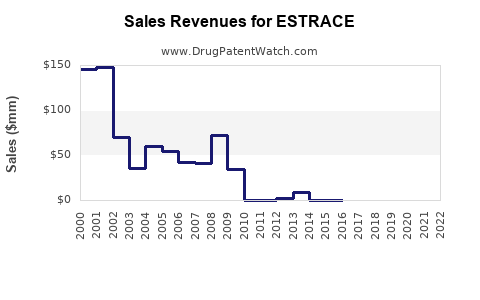
Estrace (estradiol) remains a long-running U.S. estrogen therapy brand with mature volume drivers tied to menopause symptom management. Financial trajectory since peak years is shaped by generic entry, payer pressure, formulary exclusions, and channel inventory cycles rather than step-change innovation. The near-term profit pool is anchored in continued demand for estradiol products in women’s health, but the economics face steady erosion as generic estradiol tablets dominate and as prescribers shift toward alternative delivery systems and competitors.
What is Estrace’s current market position in U.S. women’s health and hormone therapy?
Estrace is an established estradiol brand used primarily for menopausal symptoms and prevention of postmenopausal osteoporosis in specific patient groups. Its commercial pattern has been typical for older oral hormone replacement therapy brands in mature classes: brand sales track demographic demand, switching behavior, and pharmacy reimbursement rules.
Demand drivers
- Ongoing menopause prevalence and chronic treatment patterns.
- Clinical preference stability for oral estradiol in certain segments.
- Local payer coverage for generic oral estradiol products that limits incremental brand switching.
Erosion drivers
- Generic estradiol availability has constrained pricing power.
- PBM formularies and step edits tend to favor generics.
- Substitution toward lower-dose or different routes (transdermal, topical) reduces addressable share.
Business implication: Estrace’s financial trajectory is less sensitive to label expansion and more sensitive to (1) formulary access, (2) net pricing mechanics, and (3) competitive mix.
How do Estrace sales typically trend over time, and what shapes revenue volatility?
For mature brands, sales volatility is usually not clinical. It is operational.
Key trend mechanics
- Generic penetration curves: Once a class sees widespread generic coverage, brand volume growth generally caps and decline becomes gradual until channel inventory resets.
- Wholesale and retail inventory cycles: Quarterly changes can reflect inventory normalization rather than true end-demand.
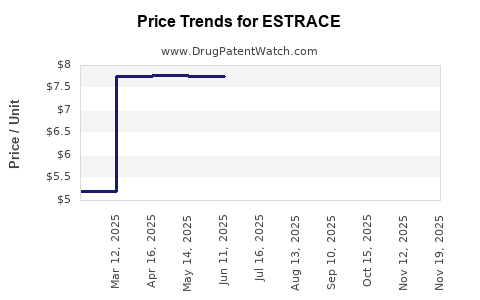
- Pricing and rebate resets: PBM contract renewals and rebate revisions can shift net sales faster than gross price changes.
Financial trajectory expectation for Estrace
- Early-stage growth (historic) transitions to a plateau.
- After generic saturation, net sales generally decline or stagnate, with occasional short-term upticks tied to supply constraints, temporary shortage dynamics, or specific contracting wins.
- Operating margin pressure rises because marketing and access spend stays material even as gross margin shrinks.
What competitive products most affect Estrace’s market share and pricing power?
Estrace competes in the broader menopausal hormone therapy market. Competitive set includes:
- Generic oral estradiol tablets (direct substitution).
- Alternative estrogen products and delivery systems:
- Transdermal estradiol products (often preferred for tolerability profiles).
- Vaginal estrogen therapies (for genitourinary syndrome of menopause, when indicated).
- Other systemic hormonal strategies in specific clinical settings.
How competition hits economics
- Oral brands face the steepest generic substitution risk.
- Transdermal migration and off-formulary dynamics can further reduce share for oral options.
- Payers often steer prescribers based on cost per treated member and utilization management tools.
Business implication: Estrace’s market share is largely contestable through payer strategy rather than differentiated clinical superiority.
What payer and formulary dynamics determine whether Estrace keeps volume?
In mature women’s health categories, payer policy is a primary revenue lever.
Formulary levers
- Tier placement (preferred vs. non-preferred).
- Prior authorization or step therapy requirements.
- Benefit design differences across commercial plans.
- Medication class edits that allow plan-level substitution to generics automatically.
Net pricing levers
- PBM rebate structures.
- Contract pricing changes tied to utilization and pharmacy channel performance.
- Incentive clawbacks if utilization declines.
Operational effect
- Even when prescribers keep writing Estrace, pharmacy reimbursement rules can slow conversion from prescriptions to dispensing, especially when alternatives are preferred.
How does Estrace’s economics compare with key estradiol alternatives by route and reimbursement profile?
High-level comparison framework for decision-making
- Oral estradiol brands: most exposed to generic substitution and price compression.
- Transdermal estradiol: often experiences slower substitution because multiple factors (patient experience, patch adherence, clinical framing, managed-care preferences) can preserve pricing and access longer.
- Vaginal estrogen therapies: can have distinct reimbursement patterns if utilization is tied to localized indications.
Commercial outcome
- Estrace’s net sales mix typically underperforms non-oral competitors when payer formularies shift toward cost-effective delivery systems.
What is the Orange Book status of Estrace, and how does that shape generic entry risk?
Estrace’s exclusivity and patent landscape determine timing and intensity of generic competition. For long-established brands, the practical outcome is that patent and exclusivity have already largely allowed generic penetration, leaving ongoing threats primarily from incremental manufacturing, labeling, and formulation variations.
What to expect
- If oral estradiol tablet active is long off patent, the market is already in a high-generic-share state.
- Remaining IP is often in the form of formulation or method-of-use claims rather than core active ingredient coverage.
Business implication: In most historical contexts, the generic “attack surface” is not about new entrants creating initial disruption. It is about incremental competitive pressure that continues to depress net pricing and maintain utilization management leverage.
When does Estrace lose exclusivity, and what does that mean for forecasted revenues?
For established brands like Estrace, the relevant question is less about a single future exclusivity cliff and more about how remaining IP, if any, impacts:
- the pace of generic erosion,
- the stability of net pricing,
- and the ability to defend access against “preferred generic” policies.
Forecast logic
- If core exclusivity has already lapsed, the revenue forecast is dominated by ongoing substitution and contracting cycles.
- The key forecast risks are not “event-driven” in the way they are for pipeline products. They are contract renewal cycles, supply, and PBM shifts.
What patent litigation or Paragraph IV challenges have historically mattered for estradiol tablet brands like Estrace?
For legacy oral hormone brands, Paragraph IV challenges often occur around:
- active ingredient patents,
- composition-of-matter claims,
- and specific formulation or dosing regimen patents.
Market mechanism
- Even when litigation ends with brand settlement, the commercial result is typically a continuation of generics in the market with discounted pricing.
- The largest financial swing tends to occur at or just after generic launch, followed by gradual net price decay.
Business implication: Litigation is usually a timing variable. The structural driver is generic availability, which persists.
How do manufacturing and supply chain issues influence Estrace sales and financial outcomes?
For mature oral products, supply and manufacturing are steady-state but can swing revenue.
Supply-side dynamics
- Shortages shift dispensing toward whatever is available.
- Manufacturing site capacity constraints affect order fulfillment and pharmacy stock-outs.
- Normalization after shortages creates volatility in quarterly results.
Financial impact
- A shortage can temporarily lift realized net price or preserve share.
- Post-shortage normalization can reverse these gains quickly.
What is the strategic rationale for maintaining or reshaping Estrace’s portfolio position?
Brand owners in mature categories typically focus on:
- protecting formulary presence,
- optimizing contracting strategy with PBMs and wholesalers,
- and aligning marketing spend to the highest-yield segments.
Portfolio tactics that preserve value
- Patient education and persistence strategies to reduce switching.
- Support programs to improve adherence in oral regimens.
- Contract strategy that prevents tier downgrades during renewal cycles.
Which market segments and indications contribute most to Estrace’s revenue stability?
Estrace is primarily driven by:
- menopausal symptom management in appropriate patient populations,
- and postmenopausal osteoporosis prevention where estrogen therapy is clinically appropriate.
Why stability holds
- Menopause is a durable demographic driver.
- The patient pool remains consistent even when payer dynamics pressure pricing.
- Switching between systemic estrogen options is common but not complete, particularly where dosing preferences and clinician familiarity persist.
How does Estrace’s financial trajectory typically map to operating margin outcomes?
A mature brand with generic competition usually experiences:
- declining gross margin as price compresses,
- persistent cost structure tied to access, compliance, and sales operations,
- marketing and contracting costs that remain non-zero even as volume shrinks.
Resulting profit pattern
- Operating income often tracks net sales more tightly than gross margin because fixed costs remain.
- Working capital and inventory management become important in stabilizing quarter-to-quarter performance.
What generic entry risks exist for Estrace, and how do they differ from new-to-market threats?
In mature oral estrogen therapies, “generic entry risk” is generally ongoing but lower-impact than in patent-protected drug launches.
Risk types
- New generic manufacturers entering the tablet segment can intensify price competition.
- Label changes or packaging variations can affect pharmacy stocking behavior.
- Distribution and contracting can re-rank which generic SKUs are preferred.
Why the risk is smaller than for novel drugs
- The market already contains generic competition.
- The core active is widely available, limiting incremental share-taking by new entrants.
How does Estrace compare with branded and generic competitors on likely total market share impact?
Competitive baseline
- Direct generic substitution limits the ceiling on Estrace’s share.
- Brand differentiators, where they exist, tend to be operational and contracting-related rather than clinical.
Expected relative outcomes
- Estrace typically underperforms competitors that can preserve preferred access or have better route-of-administration payer alignment.
- Generic leaders capture most incremental volume when formularies shift.
Key Takeaways
- Estrace’s financial trajectory is a mature-brand story dominated by generic substitution, formulary access, and PBM contracting rather than product innovation.
- Net sales volatility is driven more by rebate resets, channel inventory normalization, and payer policy changes than by clinical demand shocks.
- The competitive threat is continuous but mostly structural: oral estradiol tablets are highly substitutable, and route migration can further pressure share.
- The most actionable forecast risks are access and contract renewals, not a single near-term exclusivity event.
FAQs
- How does PBM tier placement for oral estradiol affect dispensing and net sales for Estrace?
- Do shortages of estradiol tablets materially change Estrace quarterly revenue and gross-to-net performance?
- Which estradiol routes (oral vs transdermal vs vaginal) typically gain share when managed care tightens utilization management?
- What is the usual timeline for net price decay after generic entry for legacy oral estrogen brands?
- How do contracting and rebate clawbacks typically influence Estrace profitability after volume erosion?
References (APA)
- FDA. Orange Book: Approved Drug Products with Therapeutic Equivalence Evaluations. U.S. Food and Drug Administration. https://www.accessdata.fda.gov/scripts/cder/daf/index.cfm
- FDA. Drug Approval Packages. U.S. Food and Drug Administration. https://www.accessdata.fda.gov/drugsatfda_docs/nda/