Last updated: July 31, 2026
Efavirenz has moved from a high-value branded HIV treatment to a mature, low-margin generic antiretroviral. Merck’s Sustiva and the fixed-dose combination Atripla generated substantial revenue during the 2000s and early 2010s, but patent expiry, generic competition, declining use of efavirenz-based regimens, and migration to integrase-inhibitor therapies sharply reduced commercial value. Efavirenz remains clinically relevant in selected treatment settings, especially where cost, procurement access, or treatment-program protocols favor older regimens, but it no longer has a strong branded growth profile.
What is efavirenz and where is it used?
Efavirenz is a non-nucleoside reverse transcriptase inhibitor, or NNRTI, used with other antiretroviral agents to treat HIV-1 infection. It was developed by DuPont Pharmaceuticals and later commercialized by Bristol-Myers Squibb and Merck.
The principal branded products were:
| Product |
Active ingredients |
Original commercial parties |
Main market role |
| Sustiva |
Efavirenz |
DuPont, then Bristol-Myers Squibb and Merck |
Stand-alone efavirenz product |
| Stocrin |
Efavirenz |
Merck |
Non-U.S. brand |
| Atripla |
Efavirenz, emtricitabine, tenofovir disoproxil fumarate |
Gilead, Bristol-Myers Squibb, Merck |
Once-daily fixed-dose HIV regimen |
| Generic efavirenz |
Efavirenz |
Multiple manufacturers |
Low-cost treatment and public-health procurement |
The U.S. Food and Drug Administration approved Sustiva in September 1998. Atripla received FDA approval in July 2006 as the first once-daily, single-tablet HIV regimen combining three antiretroviral agents from different companies (FDA, 1998, 2006).
Efavirenz was important because it offered once-daily dosing and became part of early standard-of-care regimens. Its commercial position weakened as clinicians shifted toward regimens with fewer central nervous system adverse effects, fewer drug interactions, higher resistance barriers, and better tolerability.
When did efavirenz lose exclusivity?
Efavirenz lost meaningful U.S. market exclusivity in the early 2010s. The original U.S. compound patent, commonly identified as U.S. Patent No. 5,519,021, expired in 2013, subject to applicable regulatory adjustments and pediatric exclusivity. Generic approvals followed, including approvals for efavirenz tablets and capsules from manufacturers such as Teva, Mylan, Aurobindo, and others.
Efavirenz exclusivity timeline
| Event |
Date |
Commercial effect |
| Sustiva FDA approval |
September 1998 |
Began branded U.S. commercialization |
| U.S. new chemical entity exclusivity |
Approximately 2003 |
Blocked abbreviated new drug applications during the statutory period |
| Atripla FDA approval |
July 2006 |
Expanded efavirenz through a single-tablet combination |
| U.S. compound patent expiration |
2013 |
Opened the principal U.S. market to generic efavirenz |
| Generic efavirenz launches |
2013 onward |
Reduced branded pricing and share |
| Progressive movement to integrase-based regimens |
2010s onward |
Reduced demand for efavirenz-containing products |
| Atripla commercial decline |
Late 2010s onward |
Accelerated by Biktarvy, Triumeq, and other newer regimens |
The relevant commercial question is no longer whether a competitor can enter the efavirenz active-ingredient market. Generic entry has already occurred. The remaining questions concern procurement contracts, formulation economics, country-specific registration, combination-product access, and the pace of treatment-program substitution.
What patents protect efavirenz and Atripla?
The principal efavirenz compound patent estate is expired in the United States. Remaining rights historically involved formulation, combination products, manufacturing processes, and specific dosage forms rather than broad control over the efavirenz molecule.
Core patent categories
| Patent category |
Typical protection |
Current commercial relevance |
| Compound patents |
Efavirenz molecule and related chemical structure |
Expired in major markets |
| Salt and polymorph patents |
Solid-state forms and pharmaceutical salts |
Limited where relevant claims remain enforceable |
| Formulation patents |
Tablets, capsules, excipients, dissolution profiles |
Potentially relevant to specific products |
| Combination patents |
Efavirenz with emtricitabine and tenofovir |
More relevant to Atripla-specific products |
| Method-of-use patents |
HIV treatment regimens and dosing |
Generally weak against standard generic substitution |
| Manufacturing patents |
Synthetic processes and intermediates |
Can affect cost and supply but rarely block all entry |
Atripla did not rely only on the efavirenz compound patent. Its commercial position also depended on combination-product and formulation rights associated with efavirenz, emtricitabine, and tenofovir disoproxil fumarate. Those rights had expiration dates that varied by patent and jurisdiction. The practical barrier to generic Atripla weakened substantially after the underlying component and combination patents expired or became commercially irrelevant.
The FDA Orange Book should be used for product-specific listing status because patent listings can differ by dosage form, strength, and product holder. Orange Book entries for Sustiva and Atripla have historically included patents directed to the active ingredient, compositions, and combination products, but the principal commercial exclusivity associated with these products has ended (FDA, 2024a).
What is the Orange Book status of efavirenz?
Efavirenz is a small-molecule drug, so the relevant U.S. pathway is an abbreviated new drug application, or ANDA, rather than a biosimilar application. The Orange Book remains relevant for listed patents and regulatory exclusivity, but it does not provide continuing market protection for the expired efavirenz compound patent.
Generic applicants may certify under Paragraph IV when they assert that a listed patent is invalid, unenforceable, or will not be infringed. For efavirenz, the major Paragraph IV-driven market event was the opening of the market to generic competition after expiration of the core patents. Current competition is primarily a post-exclusivity supply and pricing issue rather than an unresolved patent-entry dispute.
Which companies challenged efavirenz patents?
Generic manufacturers that entered or sought to enter the efavirenz market included Teva Pharmaceuticals, Mylan, Aurobindo Pharma, and other international suppliers. The exact applicant pool varied by dosage form, strength, and jurisdiction.
Patent challenges were commercially important before 2013 because early generic entry could have materially reduced Sustiva and Atripla revenue. After expiration of the main compound protection, the market shifted from litigation over molecule access to competition over:
- ANDA approval and product-specific patents;
- bioequivalence;
- manufacturing scale;
- government procurement;
- supply reliability;
- fixed-dose combination registration;
- country-level regulatory requirements.
The litigation risk for generic efavirenz is now materially lower than it was during the branded period. Litigation can still arise over formulation or combination patents, but those disputes are unlikely to restore broad exclusivity for the active ingredient.
How did efavirenz revenue change over time?
Efavirenz revenue followed a classic pharmaceutical maturity curve: rapid growth after launch, expansion through combination therapy, a plateau during widespread HIV use, and sustained decline after generic entry and therapeutic substitution.
Sustiva and Atripla revenue trajectory
Merck reported Sustiva and related efavirenz revenue as part of its established HIV franchise. Revenue was strongest before generic entry and before newer antiretroviral classes displaced NNRTI-based treatment. Atripla then became the larger commercial vehicle for efavirenz, particularly in the United States.
Gilead’s Atripla sales reached several billion dollars annually during the early and mid-2010s, then declined sharply as patients moved to newer single-tablet regimens. Public company reporting indicates the following broad pattern:
| Period |
Revenue direction |
Main driver |
| 1998-2005 |
Growth |
Sustiva adoption and expansion of combination therapy |
| 2006-2012 |
Strong growth and peak value |
Atripla launch and single-tablet positioning |
| 2013-2015 |
Early decline |
U.S. generic efavirenz and rising treatment competition |
| 2016-2018 |
Accelerated decline |
Biktarvy, Triumeq, and other integrase-based therapies |
| 2019-2021 |
Steep erosion |
Broad treatment switching and lower branded demand |
| 2022 onward |
Mature residual market |
Generic supply, public-health procurement, and limited clinical use |
Atripla’s decline was especially significant for Gilead. Gilead’s HIV portfolio moved toward newer products, including Stribild, Genvoya, Odefsey, Biktarvy, and Descovy-based combinations. Biktarvy became the central growth product while Atripla transitioned into a legacy product category (Gilead Sciences, 2013-2023).
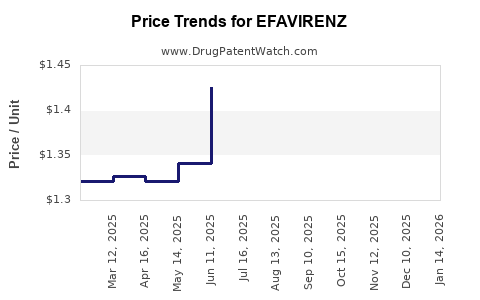
Merck’s financial exposure to efavirenz also diminished as the company’s HIV commercialization arrangements changed and the product entered generic competition. The economic value of efavirenz shifted away from originator margins and toward high-volume, low-price generic supply.
How does efavirenz compare with newer HIV drugs?
Efavirenz has been commercially displaced by integrase strand transfer inhibitor, or INSTI, regimens. The competitive difference is clinical as well as financial.
| Attribute |
Efavirenz-based regimen |
Modern INSTI-based regimen |
| Drug class |
NNRTI |
Integrase inhibitor plus backbone |
| Dosing |
Often once daily |
Often once daily |
| CNS tolerability |
More sleep, mood, and neuropsychiatric concerns |
Generally more favorable |
| Drug interactions |
Significant, including CYP-mediated interactions |
Product-dependent, often more manageable |
| Resistance barrier |
Lower than many modern INSTI regimens |
Generally higher |
| Generic price |
Very low |
Higher, though prices are declining |
| Use in low-income programs |
Still relevant |
Increasingly preferred |
| Commercial growth |
Mature or declining |
Concentrated in branded INSTI products |
The World Health Organization has moved global HIV treatment guidance toward dolutegravir-based regimens because of efficacy, tolerability, resistance characteristics, and cost reductions. Efavirenz retained a role in specific circumstances, including selected patients with contraindications or access limitations, but it lost first-line status in many treatment settings (WHO, 2019, 2022).
What formulations are protected by efavirenz patents?
The commercially important formulations include:
- Efavirenz tablets;
- Efavirenz capsules;
- Efavirenz oral dosage forms in multiple strengths;
- Efavirenz/emtricitabine/tenofovir disoproxil fumarate tablets;
- Pediatric and lower-strength presentations;
- Fixed-dose combinations developed for public-health programs.
Formulation patents can protect excipient combinations, dissolution behavior, particle size, compression properties, and stability. These rights do not necessarily prevent competitors from marketing efavirenz in a different formulation. Generic manufacturers can often design around formulation claims if the active ingredient is no longer protected.
Atripla created a more difficult technical and regulatory product than stand-alone efavirenz because a single tablet had to maintain acceptable stability and bioavailability for three active ingredients. That complexity supported commercial differentiation during the protected period. It became less valuable after alternative fixed-dose combinations and generic versions became available.
Is there biosimilar risk for efavirenz?
Biosimilar risk does not apply to efavirenz because efavirenz is a chemically synthesized small molecule, not a biologic. The relevant competitive risk is generic substitution through the ANDA pathway.
This distinction matters for market forecasting:
- No biologic reference-product exclusivity applies.
- No biosimilar interchangeability analysis is required.
- Generic manufacturers can rely on bioequivalence rather than clinical similarity studies.
- Price erosion typically occurs faster after compound-patent expiry.
- Public procurement can accelerate volume migration to low-cost suppliers.
What licensing deals affected efavirenz?
Efavirenz’s commercial history depended on licensing and co-promotion arrangements among DuPont, Bristol-Myers Squibb, Merck, and Gilead.
The key commercial structure was the Atripla collaboration. Gilead combined its nucleotide backbone, tenofovir disoproxil fumarate and emtricitabine, with Merck’s efavirenz. Gilead and Bristol-Myers Squibb developed and commercialized Atripla in the United States, while Merck retained commercial rights to efavirenz in other contexts under the parties’ agreements. The collaboration allowed three separate assets to be sold as one once-daily regimen.
The economic value of those arrangements declined as:
- Atripla lost exclusivity;
- efavirenz became generic;
- tenofovir alafenamide products replaced tenofovir disoproxil fumarate in many regimens;
- INSTI-based products gained market share;
- originator companies redirected promotion toward newer products.
What is the generic launch outlook for efavirenz?
Generic efavirenz is already commercially available in major markets, and further originator-style exclusivity is unlikely. The main launch scenarios concern product economics rather than patent access.
Generic market scenarios
| Scenario |
Market outcome |
| High-volume public procurement |
Continued large unit demand at low prices |
| Stable treatment-program use |
Predictable but declining volumes |
| Faster switch to dolutegravir |
Accelerated efavirenz erosion |
| Supply disruption |
Temporary price increases or regional shortages |
| New pediatric or low-dose registration |
Niche opportunities for specialized manufacturers |
| Generic fixed-dose combination expansion |
Further reduction in Atripla-related branded demand |
The strongest remaining commercial opportunities are in countries where treatment guidelines, tender pricing, local registration, or supply constraints preserve efavirenz demand. Margins are likely to remain low because multiple suppliers can compete on the active ingredient.
What manufacturing and intellectual-property barriers remain?
Manufacturing is more important than molecule-level intellectual property. Efavirenz synthesis requires control of intermediates, impurity profiles, particle characteristics, and consistent dissolution performance. Fixed-dose combinations add stability and process-control requirements.
Remaining barriers include:
- validated active pharmaceutical ingredient production;
- regulatory documentation;
- bioequivalence testing;
- stability data;
- supply-chain qualification;
- quality-system compliance;
- country-specific product registration;
- tender eligibility;
- pediatric dosage development.
These barriers can exclude smaller manufacturers even when patents no longer block entry. They do not, however, support the high pricing associated with an active compound patent.
How strong is the efavirenz patent estate?
The patent estate is weak as a platform for extending branded exclusivity. The broad compound protection has expired, generic competition is established, and the principal clinical market has shifted to other drug classes.
| Patent-estate factor |
Assessment |
| Core molecule |
Expired |
| Stand-alone generic entry |
Open |
| Fixed-dose combination barriers |
Largely eroded |
| Formulation claims |
Product-specific and limited |
| Method-of-use claims |
Limited commercial blocking power |
| Manufacturing claims |
Potentially relevant but design-around risk is high |
| Litigation leverage |
Low relative to the branded period |
| Long-term pricing power |
Minimal |
What is the FDA regulatory status of efavirenz?
Efavirenz remains an FDA-approved active ingredient, and generic efavirenz products have been approved through ANDAs. Sustiva was approved for HIV-1 infection in combination with other antiretroviral agents. Atripla was approved as a complete regimen for HIV-1 infection in patients meeting the product’s labeling conditions.
Efavirenz carries clinically important warnings and limitations involving central nervous system effects, psychiatric symptoms, rash, hepatic toxicity, pregnancy considerations, and drug interactions. Updated treatment guidelines generally favor dolutegravir- or bictegravir-based regimens for initial therapy, reducing the likelihood of a branded efavirenz recovery (FDA, 2024b; U.S. Department of Health and Human Services, 2024).
What generic entry risks exist for efavirenz investors?
For investors, efavirenz has limited upside and substantial structural erosion risk.
The principal risks are:
- continued switching to INSTI-based therapy;
- price compression in public tenders;
- declining branded availability;
- reduced physician familiarity;
- lower reimbursement preference;
- supplier consolidation;
- regulatory scrutiny of older manufacturing sites;
- substitution by newer fixed-dose combinations.
Potential value remains in high-volume procurement, contract manufacturing, and country-specific registrations. The asset is unlikely to support a premium acquisition based on patent exclusivity or branded growth.
What is the competitive landscape for efavirenz?
Efavirenz competes against generic NNRTIs, integrase inhibitors, and fixed-dose combination products.
Principal competing therapies
- Dolutegravir-based regimens;
- Bictegravir/emtricitabine/tenofovir alafenamide;
- Darunavir-based regimens;
- Rilpivirine-based regimens;
- Generic nevirapine and etravirine in selected settings;
- Generic tenofovir/emtricitabine combinations;
- Long-acting injectable cabotegravir and rilpivirine in eligible markets.
Efavirenz retains a cost advantage against many branded products, but that advantage is less decisive where generic dolutegravir is available. The shift to dolutegravir has changed the global procurement baseline and reduced the strategic importance of efavirenz in HIV portfolios.
Key Takeaways
- Efavirenz is a mature generic antiretroviral with limited branded commercial value.
- The core U.S. compound patent expired in 2013, and generic entry is established.
- Sustiva and Atripla generated substantial historical revenue but have experienced prolonged decline.
- Atripla’s erosion reflects both patent expiry and replacement by newer integrase-based regimens.
- Efavirenz is not subject to biosimilar competition; generic competition is the relevant risk.
- Remaining IP relates mainly to formulations, combinations, and manufacturing processes.
- The strongest residual market is public-health procurement and price-sensitive international treatment programs.
- Efavirenz has low patent strength, limited pricing power, and declining long-term demand.
- Manufacturing capability, regulatory registration, and tender access now matter more than molecule-level patent protection.
FAQs
Is efavirenz still sold in the United States?
Generic efavirenz remains an FDA-approved product, but use is substantially lower than during the Sustiva and Atripla peak years. Current HIV treatment guidelines generally favor integrase-inhibitor regimens.
Did Atripla patents expire before Sustiva patents?
Atripla depended on several patents covering its component drugs and combination product. Expiration dates varied by patent and jurisdiction, so the commercial analysis requires product-specific Orange Book review rather than a single Atripla expiration date.
Can a generic company launch efavirenz without a Paragraph IV lawsuit?
Yes. Once relevant patents expire or are no longer blocking, a generic applicant can enter through the ANDA pathway without relying on a successful Paragraph IV challenge.
Why did efavirenz sales decline after generic entry?
Sales declined because generic competition reduced price and because physicians and treatment programs shifted toward dolutegravir- and bictegravir-based regimens with improved tolerability and resistance profiles.
Does efavirenz have licensing value today?
Licensing value is generally limited to manufacturing, regional distribution, fixed-dose combinations, or public-health procurement. The expired compound patent does not support significant royalty economics for a new branded license.
References
-
Food and Drug Administration. (1998). FDA approves Sustiva for HIV-1 infection. U.S. Department of Health and Human Services.
-
Food and Drug Administration. (2006). FDA approves Atripla, the first once-daily, single-tablet HIV treatment regimen. U.S. Department of Health and Human Services.
-
Food and Drug Administration. (2024a). Approved drug products with therapeutic equivalence evaluations: Orange Book. U.S. Department of Health and Human Services.
-
Food and Drug Administration. (2024b). Efavirenz prescribing information. U.S. Department of Health and Human Services.
-
Gilead Sciences, Inc. (2013-2023). Annual reports and Form 10-K filings. U.S. Securities and Exchange Commission.
-
Merck & Co., Inc. (1998-2013). Annual reports and Form 10-K filings. U.S. Securities and Exchange Commission.
-
U.S. Department of Health and Human Services. (2024). Guidelines for the use of antiretroviral agents in adults and adolescents with HIV. National Institutes of Health.
-
World Health Organization. (2019). Update of recommendations on first- and second-line antiretroviral regimens. WHO.
-
World Health Organization. (2022). Consolidated guidelines on HIV prevention, testing, treatment, service delivery and monitoring. WHO.