Last updated: July 29, 2026
Depakote ER (divalproex extended-release) Market Dynamics and Financial Trajectory: What Drives Revenue, Switching, and Share
Executive summary
- Depakote ER (divalproex sodium extended-release) is a long-established, branded antiepileptic with shrinking brand economics driven by generic substitution and limited remaining exclusivity.
- Revenue trajectory is shaped by (1) formularies and switch-to-generic patterns in epilepsy, (2) loss of leverage after patent/generic entry, (3) buy-and-build competition within the divalproex ER “class”, and (4) pharmacy benefit design that favors lowest acquisition cost.
- Near- to mid-term outlook is dominated by volume pressure rather than price expansion, with any upside coming from patient retention, payer coverage management, and managed switching friction.
What is Depakote ER’s market position vs other valproate products and generic divalproex ER?
Featured snippet answer: Depakote ER competes primarily against generic divalproex ER and, to a lesser extent, other antiepileptic valproate formats. Market share is typically constrained by rapid generic uptake once branded patents and exclusivities expire.
Competitive set that affects pricing and volume
- Generic divalproex sodium ER tablets (multiple ANDA products)
- Other divalproex formats (e.g., immediate-release divalproex sodium; separate competitive bucket driven by prescriber preference and switching tolerance)
- Non-valproate antiepileptics for epilepsy and bipolar disorder where prescriber/payer initiatives push therapeutic alternatives
How to think about share erosion
- In epilepsy and bipolar disorder, where chronic daily therapy is standard, share typically erodes as:
- molecules go generic,
- PBMs add tier and prior authorization (PA) controls,
- wholesale and pharmacy channels shift acquisition to lowest-cost equivalents, and
- patients cycle through neurologist and pharmacy workflows that normalize substitution.
What market dynamics explain Depakote ER revenue declines once generics take over?
Featured snippet answer: The main drivers are switching to generics, payer cost management, and reduced branded differentiation once equivalent products are available.
Payer mechanics
- Formulary tiering: branded tends to migrate to higher tiers; generics are favored.
- Step edits and PA: where used, they reduce brand script conversion unless “medical necessity” is documented.
- MAC dynamics: for retail chains and some PBM arrangements, maximum allowable cost pushes dispensing toward the lowest-priced equivalent.
Provider behavior
- Neurologist switching inertia exists, but over time:
- patients may remain on the branded product if stabilized,
- but pharmacy substitution and policy pressure increase the probability of switching, especially at refill points.
Retail vs 340B and institutional
- Institutional formularies and program pricing often accelerate generic substitution compared with individual retail retention.
When did Depakote ER lose exclusivity and what does that mean for launch of generics?
Featured snippet answer: Depakote ER’s branded economics have been under sustained pressure from generic divalproex ER availability, reflecting the post-exclusivity environment where ANDA entrants compete on price and distribution.
Exclusivity vs patent landscape: what matters commercially
- Key commercial effect is not only a single patent expiry date, but the combined impact of:
- primary composition and formulation patents, and
- method/use patents (where they exist) that can delay certain entry strategies.
- In practice, product-level equivalents drive revenue more than niche claims.
Commercial implication
- After a period of branded coverage, generic availability changes channel behavior:
- gross-to-net compresses,
- net price declines after rebates and channel incentives,
- marketing leverage shifts from acquisition to defensibility through coverage.
How many generics compete with Depakote ER, and what is the impact on pricing?
Featured snippet answer: Depakote ER faces multiple ANDA competitors once branded protection ends, leading to fast price compression and reduced branded premium.
What “more generics” typically does to economics
- Average selling price falls because:
- payers drive the market to lowest WAC and net cost alternatives,
- PBMs negotiate more aggressive rebate structures for branded retention,
- distributors and pharmacy chains standardize purchasing.
Market-level outcome
- Even without dramatic volume collapse, revenue declines often accelerate as branded net pricing approaches generic cost ceilings.
What is the Orange Book status of Depakote ER, and how does it affect Paragraph IV risk?
Featured snippet answer: Depakote ER is primarily constrained by a long-expired branded patent regime in the mainstream commercial timeline; Paragraph IV risk matters mainly for later-remaining patents (formulation or method-of-use) rather than the core product.
How Orange Book events map to business risk
- For established small molecules like divalproex ER:
- most patent-linked exclusionary outcomes are already realized in the market,
- the remaining relevance is whether later-expiring patents still constrain certain generic designs or formulations.
- Paragraph IV challenges typically become a strategic lever for generic entrants that believe they can avoid infringement and launch earlier.
Implication
- The business question shifts from “will generics launch” to “how fully will the market switch and how aggressively will payers steer.”
What formulations and delivery-system patents could still matter for Depakote ER economics?
Featured snippet answer: For extended-release products, formulation and manufacturing-related patents can matter for entry timing, but once multiple generics are in-market, the pricing effect dominates.
Extended-release-specific drivers
- Differences in:
- release profile,
- excipients and tablet matrix,
- dose stability and bioequivalence performance,
can shape:
- clinician acceptance,
- payer skepticism,
- switching friction.
What usually dominates post-entry
- Once multiple generic ER products are approved, the market tends to treat them as therapeutically equivalent substitutes, so revenue impact becomes primarily a function of rebate pressure and payer steering.
How do litigation and settlements around divalproex ER affect market access?
Featured snippet answer: In mature markets, litigation typically shapes the timing and design of generics more than long-term branded pricing, once stable generic supply is established.
Litigation channels that can delay entry
- Claims related to:
- formulation,
- extended-release mechanics,
- manufacturing methods,
- method of use (if asserted).
- Even a partial settlement can trigger “carve-outs” that delay some entrants while other competitors proceed.
Business impact
- Litigation tends to create step-changes:
- delayed entrant months to years,
- then a step down in net revenue after generic launch.
What is the FDA regulatory status of Depakote ER and its generic equivalents?
Featured snippet answer: Depakote ER is an approved NDA product, with the competitive set largely represented by ANDA-approved generic divalproex ER equivalents that are bioequivalent to the reference product.
Pathway implications
- ANDA entrants succeed when:
- they can establish bioequivalence and comply with any applicable exclusivity constraints.
- Once approved, they gain the ability to compete on:
- acquisition cost,
- contracting terms with payers.
How does Depakote ER compare with other epilepsy drugs in payer contracting and utilization?
Featured snippet answer: Valproate-based therapy faces ongoing payer pressure to use cost-effective options, but it maintains a durable base due to clinical utility, especially for certain patient populations.
Utilization drivers
- Chronic use patterns reduce churn but do not stop switching:
- patients refill,
- pharmacies substitute,
- payers enforce step edits.
Contracting dynamics
- PBMs increasingly design coverage to minimize branded premium:
- brand retention typically requires:
- documented intolerance,
- prior failures,
- stability considerations.
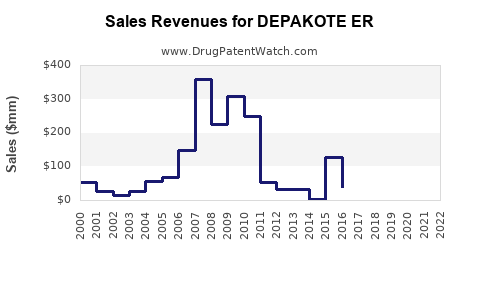
What is the financial trajectory for Depakote ER: revenue exposure and margin pressure?
Featured snippet answer: The financial trajectory is consistent with a branded decline curve driven by generic substitution and gross-to-net compression rather than demand growth.
Key financial line-items that move in this category
- Net sales: downtrend from volume erosion and price compression
- Gross-to-net: increases as rebates and incentives rise to preserve share
- Commercial costs: often do not fall proportionally, worsening operating leverage
- Channel inventories: generic supply stability can reduce any temporary branded inventory-related spikes
Where upside could come from
- Slow switching in specific subpopulations
- Limited formulary restrictions for brand in certain plans
- Any payer-specific contracts that reduce differential cost
Which factors could change Depakote ER’s trajectory over the next 3–5 years?
Featured snippet answer: The biggest swing factors are payer management intensity, generic price floors, and any remaining brand-protecting legal/technical constraints on certain generic designs.
Scenario map
- Base case (most likely): continued brand revenue decline at a slowing rate as the market normalizes to generics.
- Downside: faster formulary tightening, stronger MAC enforcement, and increased generics reduce net price further.
- Upside: selective plan coverage for brand and slower switching in stabilized populations.
Non-commercial shocks to watch
- Supply disruptions among key generics (rare but can briefly lift branded demand)
- Policy changes to substitution rules at pharmacy level
Key Takeaways
- Depakote ER’s market dynamics are dominated by generic substitution and payer cost management, creating sustained net price pressure and gradual volume erosion.
- The post-exclusivity environment turns the business model into a contest for patient retention through coverage strategy and switching friction.
- Litigation and patent events in mature divalproex ER markets typically matter most for timing of specific entrants. Once multiple generics are established, economics become governed by rebates, tiering, MAC, and contract structure.
- The forward financial trajectory is best characterized as a declining branded revenue profile with limited upside unless payer coverage favors the brand or generic supply/price dynamics shift.
FAQs
- How do MAC and step edits influence Depakote ER prescribing and dispensing?
- Do patients switch from Depakote ER to generic divalproex ER, and how fast does it happen?
- Which payers are most likely to require prior authorization for branded divalproex ER?
- What generic market share outcomes typically follow major patent settlements for extended-release small molecules?
- How do product discontinuations or supply interruptions among generic divalproex ER affect brand demand?
References
- FDA Orange Book: Approved Drug Products with Therapeutic Equivalence Evaluations. U.S. Food and Drug Administration. https://www.accessdata.fda.gov/scripts/cder/daf/ (accessed 2026-07-30)
- U.S. FDA Prescribing Information for Depakote ER (divalproex sodium extended-release). U.S. Food and Drug Administration. https://www.accessdata.fda.gov/scripts/cder/daf/ (accessed 2026-07-30)