Last updated: September 24, 2026
Combigan is AbbVie’s fixed-dose ophthalmic combination of brimonidine tartrate 0.2% and timolol maleate 0.5% for lowering elevated intraocular pressure in patients with glaucoma or ocular hypertension. The product remains commercially relevant in ophthalmology, but its financial profile has shifted from branded growth to mature, price-sensitive cash generation following loss of primary patent protection and generic entry.
AbbVie does not disclose Combigan revenue as a standalone line item. The company reports broader pharmaceutical and eye-care categories, so product-level revenue, operating margin, and geographic sales are not publicly identifiable with precision. The main financial drivers are generic competition, reimbursement pressure, physician familiarity, and the continued use of combination therapy in patients who require more than one mechanism of action.
What is Combigan and how does it work?
Combigan combines two established intraocular-pressure-lowering agents:
| Component |
Pharmacologic class |
Main action |
| Brimonidine tartrate 0.2% |
Alpha-2 adrenergic agonist |
Reduces aqueous humor production and increases uveoscleral outflow |
| Timolol maleate 0.5% |
Nonselective beta-adrenergic blocker |
Reduces aqueous humor production |
The product is administered as one ophthalmic drop in the affected eye, generally twice daily. Its commercial value comes from replacing separate brimonidine and timolol bottles with a single fixed-dose product, which can reduce administration complexity and improve adherence.
Combigan is indicated for elevated intraocular pressure associated with open-angle glaucoma or ocular hypertension. Its label includes contraindications related to neonatal use, nursing, and patients with certain respiratory or cardiac conditions, including bronchial asthma, severe chronic obstructive pulmonary disease, sinus bradycardia, second- or third-degree atrioventricular block, and overt cardiac failure. [1]
What is the FDA regulatory status of Combigan?
The FDA approved Combigan in October 2007. The product was developed and commercialized by Allergan, which became part of AbbVie in 2020. The FDA-approved dosage form is an ophthalmic solution containing brimonidine tartrate 0.2% and timolol maleate 0.5%. [1]
FDA regulatory milestones
| Event |
Date |
Significance |
| FDA approval of Combigan |
October 2007 |
Established the branded fixed-dose combination |
| Allergan acquisition by AbbVie |
May 2020 |
Transferred commercial ownership to AbbVie |
| Generic ANDA approvals |
Primarily 2022 onward |
Increased price and share pressure |
| Current regulatory position |
Approved prescription ophthalmic product |
Mature product with generic competition |
Combigan is not a biologic and does not face biosimilar substitution. Its competitive threat comes from ANDA-approved generic ophthalmic solutions rather than from the abbreviated pathway used for biosimilars.
What patents protect Combigan?
Combigan’s principal patent estate covered the fixed-dose ophthalmic combination and related formulation technology. The main United States patent commonly associated with the product is U.S. Patent No. 7,323,463, assigned to Allergan. The patent was directed to ophthalmic compositions containing brimonidine and timolol and was listed in the FDA Orange Book. [2]
Public patent records and Orange Book listings indicate that the core United States patent protection expired in the early 2020s, subject to patent-term adjustment and any applicable pediatric exclusivity. The precise commercial impact depended on the timing of generic approvals and the expiration dates of individual listed patents.
Key patent and exclusivity considerations
| Protection type |
Relevance to Combigan |
| Composition or combination patent |
Protected the brimonidine-timolol fixed-dose product |
| Formulation claims |
Could cover concentration, vehicle, stability, or delivery characteristics |
| Method-of-use claims |
May cover treatment of elevated intraocular pressure or glaucoma |
| Pediatric exclusivity |
Could add six months to qualifying listed patent protection |
| Regulatory exclusivity |
Not the primary long-term barrier for this mature product |
| Trade-secret protection |
May remain relevant to manufacturing process and quality control |
The patent estate is now materially weaker than during Combigan’s exclusivity period because generic manufacturers can compete using the same active ingredients and an equivalent ophthalmic dosage form after expiration of relevant claims.
When did Combigan lose exclusivity?
Combigan lost effective market exclusivity in the early 2020s. Generic brimonidine tartrate and timolol maleate ophthalmic solutions began entering the U.S. market after FDA approval of abbreviated new drug applications. FDA’s publication of approved generic products confirms the availability of therapeutically equivalent alternatives. [3]
The timing of generic entry was more important commercially than the nominal expiration of a single patent. For a mature ophthalmic product, market erosion can begin rapidly once multiple suppliers receive approval because pharmacy substitution, payer formulary controls, and contracting reduce the branded product’s pricing power.
Exclusivity timeline
| Period |
Market condition |
Financial effect |
| 2007 to mid-2010s |
Branded fixed-dose combination with limited direct generic competition |
Higher price realization and stronger brand retention |
| Late 2010s |
Mature product with growing payer pressure |
Slower growth and declining pricing leverage |
| Early 2020s |
Core patent protection ended and generics entered |
Share erosion and price compression |
| 2023 onward |
Multi-source generic market |
Brand becomes a lower-growth, retention-focused product |
The exact first generic launch date can vary by strength, manufacturer, and product presentation. Generic entry also may occur through authorized-generic or multisource distribution arrangements that are not always visible as a single commercial event.
How many patents cover Combigan?
The number of patents associated with Combigan depends on whether the analysis includes only Orange Book-listed patents or the broader patent family covering formulations, methods, manufacturing, and international rights.
For U.S. regulatory purposes, the commercially important estate was relatively concentrated compared with newer specialty medicines. The key protection centered on the fixed-dose brimonidine-timolol combination and related ophthalmic formulations. The estate did not resemble the large, layered patent portfolios common for biologics, long-acting injectables, or complex oral solid-dose products.
Patent-strength assessment
| Factor |
Assessment |
| Core active ingredients |
Weak protection because both ingredients are long-established generics |
| Fixed-dose combination |
Historically meaningful, but expired or no longer commercially blocking |
| Ophthalmic formulation |
Moderate historical value; vulnerable where claims were narrow |
| Manufacturing process |
Potentially useful operationally, but less likely to block ordinary generic entry |
| Method of use |
Limited ability to preserve broad commercial exclusivity after active-ingredient patents expired |
| Overall current strength |
Low to moderate for blocking market entry; higher for quality and supply differentiation |
The remaining practical barriers are more likely to involve sterile manufacturing, preservative control, container-closure systems, product consistency, and regulatory compliance than broad patent exclusion.
Are there Paragraph IV challenges to Combigan?
Generic entrants typically use ANDA pathways and may certify that listed patents are expired, will expire before launch, are not infringed, or are invalid. A Paragraph IV certification can trigger patent litigation under the Hatch-Waxman Act, but not every generic entrant produces a major public patent dispute.
For Combigan, the commercial transition indicates that listed patent protection did not prevent generic entry in the early 2020s. Publicly available regulatory and litigation records do not establish an ongoing, market-defining patent case that preserves broad exclusivity for AbbVie’s branded product.
Paragraph IV commercial implications
A Paragraph IV challenge can create a 30-month FDA approval stay if the patent holder files suit within the statutory period. That mechanism can delay approval, but it does not guarantee a durable launch barrier. In a product with old active ingredients and a relatively narrow formulation estate, invalidity and non-infringement risks can limit the value of litigation.
The absence of a continuing blocking dispute means generic manufacturers can compete primarily on price, supply reliability, wholesaler access, and payer contracts.
What is the Orange Book status of Combigan?
Combigan is listed in the FDA Orange Book as a prescription ophthalmic product. The Orange Book historically identified patents associated with the product and provided the reference-product framework for ANDA applicants. [2]
The practical Orange Book position is now one of mature branded-product protection rather than active patent exclusivity. Listed patents that have expired no longer provide a meaningful barrier to approved generic substitution. The Orange Book remains relevant for determining certification pathways and patent metadata, but it is not a current indicator of strong commercial exclusivity.
Which companies are challenging Combigan?
The competitive challenge comes from generic manufacturers rather than from a branded rival with a materially differentiated fixed-dose combination.
Generic ophthalmic manufacturers that have participated in the broader brimonidine and timolol market include companies such as Sandoz, Dr. Reddy’s Laboratories, Apotex, and other ANDA sponsors, depending on product strength, market year, and FDA approval status. The relevant competitors are product-specific, and manufacturer participation can change as suppliers enter, exit, or transfer approvals.
Competitive structure
| Competitor category |
Competitive effect |
| Generic brimonidine/timolol combinations |
Direct substitution and price erosion |
| Separate generic brimonidine and timolol bottles |
Lower-cost therapeutic alternative, but higher administration burden |
| Other glaucoma combinations |
Indirect competition for patients requiring multiple agents |
| Prostaglandin analogs |
Compete for first-line or add-on treatment |
| Preservative-free products |
Compete where ocular-surface tolerability is important |
| Surgical and laser treatments |
Reduce long-term dependence on topical medicines in selected patients |
The most direct competitive threat is the generic fixed-dose combination. Separate generic components also constrain Combigan pricing even when a pharmacy cannot substitute an exact fixed-dose equivalent.
What formulations are protected by Combigan patents?
Combigan’s commercial formulation contains brimonidine tartrate and timolol maleate in an ophthalmic vehicle designed for topical ocular delivery. Formulation-related protection may cover active-ingredient concentrations, pH, preservative systems, excipients, viscosity, stability, and container compatibility.
The formulation has practical manufacturing complexity because ophthalmic solutions must meet sterile-product requirements and maintain consistent potency throughout shelf life. These requirements can slow new supplier entry, but they generally do not preserve the high margins associated with patent exclusivity once equivalent generic products are approved.
Manufacturing and intellectual-property barriers
Sterile ophthalmic manufacturing requires:
- Validated aseptic processing or sterilization controls
- Low particulate and microbial contamination
- Consistent drop size and fill volume
- Container-closure integrity
- Stability under labeled storage conditions
- Reliable sourcing of active pharmaceutical ingredients
- FDA compliance for facility, quality, and batch-release systems
These barriers can create temporary supply constraints and favor established manufacturers. They are not equivalent to a durable patent moat. A qualified generic supplier can overcome them through regulatory investment and manufacturing scale.
How does Combigan compare with competing glaucoma drugs?
Combigan occupies the fixed-dose combination segment of the glaucoma market. Prostaglandin analogs such as latanoprost, travoprost, and bimatoprost are often important alternatives, particularly because they can provide strong intraocular-pressure reduction with once-daily dosing.
| Product category |
Main advantage |
Main limitation versus Combigan |
| Combigan |
Two mechanisms in one bottle |
Twice-daily dosing and beta-blocker contraindications |
| Generic brimonidine plus timolol |
Lowest ingredient cost |
Two bottles and greater adherence burden |
| Latanoprost |
Once-daily dosing and broad use |
Different tolerability and efficacy profile |
| Bimatoprost |
Potent pressure reduction |
Higher cost in some markets and local adverse effects |
| Dorzolamide/timolol |
Alternative fixed-dose combination |
Different tolerability and dosing considerations |
| Netarsudil combinations |
Newer mechanism |
Higher price and narrower reimbursement access |
Combigan’s clinical and commercial position depends on whether the prescriber values single-bottle convenience and the patient can tolerate both active ingredients. Its value is weaker where payers prioritize the least expensive generic components.
What is Combigan’s financial trajectory?
Combigan’s financial trajectory is best described as a transition from branded growth to mature-product decline.
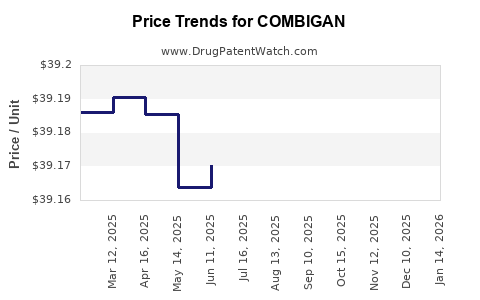
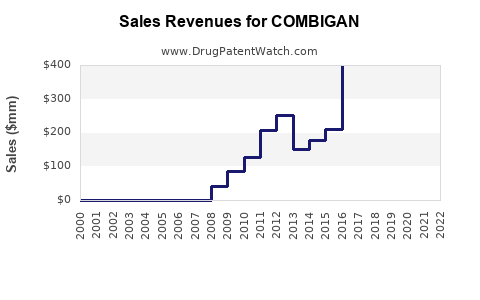
AbbVie does not report Combigan as a separate revenue line. The product is included within broader pharmaceutical or eye-care reporting, preventing a reliable public calculation of annual sales, gross margin, or regional revenue. [4]
Revenue trajectory
| Phase |
Revenue characteristics |
| Launch and adoption |
Growth from physician uptake of a fixed-dose combination |
| Brand maturity |
Stable demand supported by clinical familiarity and convenience |
| Pre-generic period |
Slower growth, with pricing and reimbursement pressure |
| Post-generic period |
Declining branded volume, lower net price, and reduced formulary access |
| Mature tail |
Residual revenue from loyal prescribers, patients, and markets with slower generic penetration |
The key financial variables are:
- Generic penetration rate.
- Net price after rebates and discounts.
- Brand retention among ophthalmologists.
- Payer restrictions and pharmacy substitution.
- International patent and regulatory timing.
- Supply reliability across branded and generic channels.
Combigan can continue to produce cash flow after generic entry, but its strategic value is lower than that of newer products with active patent protection. AbbVie’s incentives are likely to center on maintaining supply, managing price architecture, protecting brand recognition, and using the broader eye-care portfolio to retain customers.
What generic launch scenarios exist for Combigan?
Three scenarios define the post-exclusivity market.
Rapid generic conversion
Multiple generic manufacturers enter quickly. Pharmacy substitution rises, payer coverage shifts to the lowest-cost supplier, and Combigan’s volume and net price fall sharply.
Gradual generic erosion
Only a limited number of suppliers enter or face manufacturing constraints. Combigan retains a larger share among established prescribers, while price declines occur more slowly.
Brand-retention niche
Patients with tolerability, supply, or prescriber-preference considerations remain on Combigan. The brand retains a smaller but stable segment, particularly where insurance coverage does not impose a substantial brand penalty.
The most likely long-term outcome is continued erosion rather than complete immediate displacement. Ophthalmic markets often retain branded demand because physicians and patients value continuity, but the price differential eventually becomes decisive for payers.
What is the geographic coverage of Combigan?
Combigan has been marketed in the United States and selected international markets under Allergan and later AbbVie ownership. Patent expiration, generic approval, reimbursement, and distribution timing differ by country.
The United States is the most important market for Orange Book and Hatch-Waxman analysis. In Europe and other regions, generic entry is governed by national and regional regulatory systems, including centralized or decentralized procedures, local reimbursement decisions, and country-specific substitution rules.
International revenue exposure cannot be calculated from public disclosures because AbbVie does not identify Combigan sales by country. The product’s remaining commercial life is likely longer in markets where generic registration, reimbursement substitution, or pharmacy switching is slower.
What litigation and settlement agreements affect Combigan?
The main commercial litigation issue is historical patent enforcement against ANDA applicants. Available public information does not indicate that a current settlement agreement preserves broad U.S. exclusivity for Combigan.
Where a settlement existed, its effect would depend on the agreed generic launch date, authorized-generic provisions, royalty terms, and restrictions on formulation or manufacturing. Those terms are not reflected in AbbVie’s consolidated financial statements and cannot be used to calculate current product revenue.
The current risk profile is commercial rather than litigation-driven. Generic manufacturers have an established regulatory pathway, and the product’s active ingredients are long genericized.
How strong is the Combigan patent estate?
Combigan’s patent estate was commercially useful during the protected period but is weak as a current entry barrier.
The product has greater residual protection in manufacturing know-how, brand recognition, supply-chain execution, and physician familiarity than in enforceable market exclusivity. Those assets can support residual sales but cannot prevent approved generic competition.
Overall risk assessment
| Risk |
Current level |
Business impact |
| Generic price erosion |
High |
Reduces net sales and margin |
| Patent-based blocking risk to generics |
Low |
Limited ability to delay entry |
| Supply disruption |
Moderate |
Could affect branded and generic availability |
| Regulatory quality risk |
Moderate |
Sterile ophthalmic products require strict controls |
| Brand abandonment risk |
Moderate |
Long-term demand declines as payers favor generics |
| Biosimilar risk |
None |
Combigan is a small-molecule ophthalmic product |
| Litigation risk |
Low to moderate |
Mainly historical or applicant-specific |
Key Takeaways
- Combigan is a fixed-dose ophthalmic combination of brimonidine tartrate 0.2% and timolol maleate 0.5%.
- The FDA approved the product in 2007, and AbbVie became its owner through the acquisition of Allergan.
- Core U.S. patent protection ended in the early 2020s, enabling generic competition.
- The product has no biosimilar risk because it is not a biologic.
- Generic fixed-dose combinations and separate generic components are the principal competitive threats.
- AbbVie does not disclose Combigan revenue separately, so standalone financial performance cannot be verified from company filings.
- The product’s financial trajectory is a mature-brand decline characterized by lower price realization, payer substitution, and residual demand from physician and patient preference.
- Current commercial protection comes mainly from brand familiarity, supply reliability, and manufacturing execution rather than active patent exclusivity.
- The principal market risk is rapid generic conversion, although ophthalmic products can retain a branded niche after generic entry.
FAQs
Is Combigan still under patent protection?
Core U.S. patent protection has expired or no longer provides a practical barrier to approved generic entry. Product-specific Orange Book records should be reviewed for the applicable patent history and certification status.
Is generic Combigan available?
Yes. Generic brimonidine tartrate and timolol maleate ophthalmic solutions have received FDA approvals, creating direct competition with the branded product.
Does AbbVie still manufacture Combigan?
Combigan remains associated with AbbVie’s ophthalmic portfolio, although manufacturing, packaging, and distribution arrangements can vary by market and time period.
Why might a doctor prescribe Combigan instead of two generic eye drops?
A physician may prefer the single-bottle regimen to reduce administration complexity, improve adherence, or avoid the inconvenience of using separate bottles. Clinical suitability remains limited by the contraindications and adverse-effect profiles of brimonidine and timolol.
Can Combigan generate meaningful revenue after generic entry?
Yes, but at a lower level and margin than during the protected period. Residual branded sales can persist through physician preference, patient continuity, limited generic availability, and markets with slower substitution.
References
- U.S. Food and Drug Administration. (2007). Combigan prescribing information: Brimonidine tartrate and timolol maleate ophthalmic solution. FDA.
- U.S. Food and Drug Administration. (2024). Approved drug products with therapeutic equivalence evaluations, Orange Book. FDA.
- U.S. Food and Drug Administration. (2024). Drugs@FDA: FDA-approved drug products. FDA.
- AbbVie Inc. (2024). Annual report pursuant to Section 13 or 15(d) of the Securities Exchange Act of 1934. AbbVie.