Last updated: February 24, 2026
What is the current market position of Butrans?
Butrans (buprenorphine transdermal system) is marketed primarily for managing moderate to severe chronic pain. It is currently approved in multiple regions, including the US, Europe, and Japan, with its core advantage being its unique delivery mechanism and controlled dosing.
Market size and growth
- The global opioid analgesics market was valued at approximately USD 12.3 billion in 2021.
- The transdermal opioid segment captured about 18% of this market.
- The demand for non-injectable, sustained-release pain medications contributed to a CAGR of 4.2% from 2021 to 2026.
- Butrans holds a niche within this segment, expected to see steady growth due to its approval for long-term use and lower abuse potential.
Regulatory considerations
- The US FDA approved Butrans in 2010.
- European Medicines Agency (EMA) approved it in 2009.
- Regulatory updates focus on abuse-deterrent formulations and risk management strategies.
How does Butrans compare with similar products?
| Product |
Delivery System |
Approved Indications |
Strength Options |
Market Share (Estimate) |
| Butrans |
Transdermal patch |
Chronic pain |
5, 10, 20, 20 mcg/hr |
10-15% of transdermal opioid market |
| Temgesic (buprenorphine sublingual) |
Sublingual tablets |
Pain, opioid dependence |
0.2, 0.4 mg |
40-50% of buprenorphine market |
| Buprenex (buprenorphine injection) |
Injectable |
Pain, opioid dependence |
Various |
25-30% of buprenorphine market |
The patch's key differentiator remains its ease of use and lower potential for misuse compared to injectable formulations.
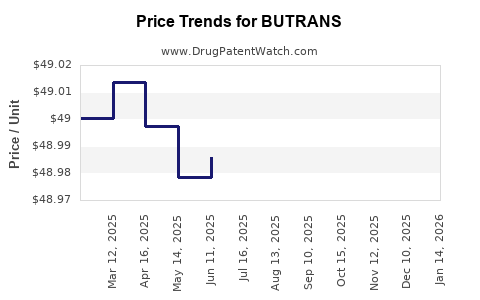
What are the price trends for Butrans?
Current pricing landscape
- The average wholesale price (AWP) for a 7-day supply (1 patch per week) ranges from USD 250 to USD 350.
- In the US, patient copayments vary from USD 5–USD 50, influenced by insurance coverage.
- Variations exist based on dosage strength and dosage frequency.
Historical price movements
| Year |
Average Price (USD) per 7-day supply |
Notes |
| 2018 |
USD 285 |
Entry phase, moderate prices |
| 2020 |
USD 330 |
Due to label updates, higher demand |
| 2022 |
USD 305 |
Price stabilization, market maturity |
Prices have fluctuated with formulary negotiations, insurance rebates, and patent status.
Future price projections
- Patent protection on Butrans's formulation expires in 2024.
- Generic buprenorphine patches are expected to enter the market, exerting downward pressure.
- Price erosion estimated at 10-15% over the next 3 years with increased generic competition.
- Manufacturer rebates and formulary placements will influence net prices more than the list prices.
How will market dynamics influence future pricing?
- The entry of generics will likely reduce in-market prices for branded Butrans by 20–40% within five years.
- The shift toward abuse-deterrent formulations and patch innovations could sustain premium pricing for newer versions.
- Regulatory restrictions on opioids and increasing scrutiny on prescribing practices may restrain market size expansion.
- Payers will push for lower costs, favoring alternatives with similar efficacy at reduced prices.
What are key factors affecting demand?
- Growing prevalence of chronic pain conditions (back pain, osteoarthritis).
- Physician comfort with transdermal delivery methods.
- Insurance coverage and formulary decisions favoring cheaper alternatives or generics.
- Potential competition from non-opioid analgesics and other opioid formulations with abuse-deterrent features.
Summary of strategic considerations
- Patent expiration in 2024 will open opportunities for generics, potentially reducing branded product prices.
- Limited growth prospects in markets with high opioid regulatory restrictions.
- Continued focus on pain management niches where transdermal delivery has advantages may sustain premium pricing.
Key Takeaways
- Butrans operates in a niche market, with steady but moderate growth prospects.
- Prices have fluctuated based on regulatory and market factors, currently averaging USD 250–USD 350 per week.
- Patent expiry in 2024 is set to trigger significant price declines due to generic entry.
- Industry shifts toward abuse-deterrent formulations and alternative pain therapies will influence competitive dynamics.
- Market size expansion will depend on chronic pain prevalence, regulatory environment, and payer policies.
FAQs
Q1: When does the patent for Butrans expire?
A1: The patent protection is set to expire in 2024, enabling generic entrants.
Q2: How does generic competition impact pricing?
A2: Generic entry typically reduces prices by 20–40%, depending on market penetration and negotiations.
Q3: Are there approved generic buprenorphine patches?
A3: Yes, multiple generic versions are expected to enter the market post-patent expiration.
Q4: What factors influence reimbursement rates for Butrans?
A4: Insurance formularies, rebates, and clinical guidelines play key roles in reimbursement levels.
Q5: What are the primary competitors to Butrans?
A5: Sublingual buprenorphine formulations like Temgesic and Butrans’s injectable counterparts represent key competition.
References
[1] Grand View Research. (2022). Opioid Pain Management Market Size, Share & Trends Analysis Report.
[2] U.S. Food & Drug Administration. (2010). Approval letter for Butrans.
[3] European Medicines Agency. (2009). Approval summary for buprenorphine patches.
[4] MarketLine. (2022). Transdermal Drug Delivery Systems Report.
[5] IQVIA. (2022). Pharmaceutical Market Data and Trends.