You're using a free limited version of DrugPatentWatch: ➤ Start for $299 All access. No Commitment.

Last Updated: December 11, 2025

BETIMOL Drug Patent Profile


✉ Email this page to a colleague

« Back to Dashboard


When do Betimol patents expire, and when can generic versions of Betimol launch?

Betimol is a drug marketed by Thea Pharma and is included in one NDA.

The generic ingredient in BETIMOL is timolol. There are fifteen drug master file entries for this compound. Two suppliers are listed for this compound. Additional details are available on the timolol profile page.

DrugPatentWatch® Litigation and Generic Entry Outlook for Betimol

A generic version of BETIMOL was approved as timolol by SOMERSET on October 10th, 2024.

  Get Started Free

AI Deep Research
Questions you can ask:
  • What is the 5 year forecast for BETIMOL?
  • What are the global sales for BETIMOL?
  • What is Average Wholesale Price for BETIMOL?
Drug patent expirations by year for BETIMOL
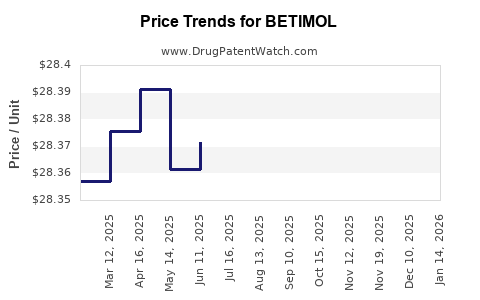
Drug Prices for BETIMOL

See drug prices for BETIMOL

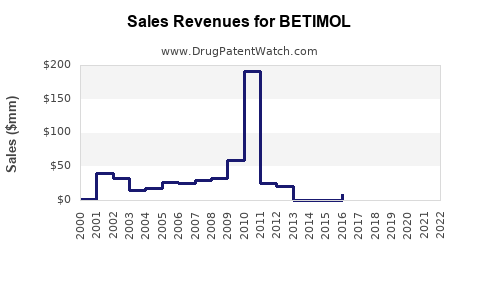
Drug Sales Revenue Trends for BETIMOL

See drug sales revenues for BETIMOL

Pharmacology for BETIMOL

US Patents and Regulatory Information for BETIMOL

Applicant Tradename Generic Name Dosage NDA Approval Date TE Type RLD RS Patent No. Patent Expiration Product Substance Delist Req. Exclusivity Expiration
Thea Pharma BETIMOL timolol SOLUTION/DROPS;OPHTHALMIC 020439-001 Mar 31, 1995 DISCN Yes No ⤷  Get Started Free ⤷  Get Started Free ⤷  Get Started Free
Thea Pharma BETIMOL timolol SOLUTION/DROPS;OPHTHALMIC 020439-002 Mar 31, 1995 AT RX Yes Yes ⤷  Get Started Free ⤷  Get Started Free ⤷  Get Started Free
>Applicant >Tradename >Generic Name >Dosage >NDA >Approval Date >TE >Type >RLD >RS >Patent No. >Patent Expiration >Product >Substance >Delist Req. >Exclusivity Expiration

Expired US Patents for BETIMOL

Applicant Tradename Generic Name Dosage NDA Approval Date Patent No. Patent Expiration
Thea Pharma BETIMOL timolol SOLUTION/DROPS;OPHTHALMIC 020439-001 Mar 31, 1995 ⤷  Get Started Free ⤷  Get Started Free
Thea Pharma BETIMOL timolol SOLUTION/DROPS;OPHTHALMIC 020439-002 Mar 31, 1995 ⤷  Get Started Free ⤷  Get Started Free
>Applicant >Tradename >Generic Name >Dosage >NDA >Approval Date >Patent No. >Patent Expiration

International Patents for BETIMOL

See the table below for patents covering BETIMOL around the world.

Country Patent Number Title Estimated Expiration
Denmark 72591 ⤷  Get Started Free
Hungary 221618 (S)-timolol-hemihidrátot tartalmazó, helyileg alkalmazható szemgyógyászati készítmény (OPHTHALMIC TOPICAL COMPOSITION CONTAINING (S)-TIMOLOL HEMIHYDRATE) ⤷  Get Started Free
New Zealand 231057 S-TIMOLOL HEMIHYDRATE AND PHARMACEUTICAL COMPOSITIONS ⤷  Get Started Free
Austria 112277 ⤷  Get Started Free
New Zealand 253164 OPHTHALMIC TOPICAL COMPOSITION PREPARED FROM (S)-TIMOLOL HEMIHYDRATE ((S-(-)-3-MORPHOLINO-4-(3-TERT-BUTYLAMINO-2-HYDROXYPROPOXY)-1,2,5-THI ADIAZOLE.1\2H2O ⤷  Get Started Free
Finland 112321 ⤷  Get Started Free
Norway 950059 ⤷  Get Started Free
>Country >Patent Number >Title >Estimated Expiration

Supplementary Protection Certificates for BETIMOL

Patent Number Supplementary Protection Certificate SPC Country SPC Expiration SPC Description
0227494 95C0013 Belgium ⤷  Get Started Free PRODUCT NAME: TIMOLOLI MALEAS EQ. TIMOLOLUM; NATIONAL REGISTRATION/DATE: 922 IS 166 F 13 19950627; FIRST REGISTRATION: SE 11901 19930910
0509752 49/1999 Austria ⤷  Get Started Free PRODUCT NAME: DORZOLAMID ODER EIN OPHTHALMOLOGISCH ANNEHMBARES SALZ DAVON, VORZUGSWEISE DORZOLAMIDHYDROCHLORID, UND TIMOLOL ODER EIN OPHTHALMOLOGISCH ANNEHMBARES SALZ DAVON, VORZUGSWEISE TIMOLOLMALEAT; NAT. REGISTRATION NO/DATE: 1-22701, 1-22702 19980828; FIRST REGISTRATION: DK 9794 19980306
0509752 SPC/GB99/043 United Kingdom ⤷  Get Started Free PRODUCT NAME: DORZOLAMIDE OR AN OPHTHALMOLOGICALLY ACCEPTABLE SALT THEREOF, PREFERABLY DORZOLAMIDE HYDROCHOLORIDE, PLUS TIMOLOL OR AN OPHTHAMOLOGICALLY ACCEPTABLE SALT THEREOF, PREFERABLY TIMOLOL MALEATE; REGISTERED: DK 19045 19980306; UK PL 00025/0373 19980804
0509752 C990041 Netherlands ⤷  Get Started Free PRODUCT NAME: DORZOLAMIDE, DESGEWENST IN DE VORM VAN EEN OFTALMOLOGISCH AAN- VAARDBAAR ZOUT, EN TIMOLOL, DESGEWENST IN DE VORM VAN EEN OFTAL -MOLOGISCH AANVAARDBAAR ZOUT, IN HET BIJZONDER DORZOLLAMIDEHY- DROCHLORIDE EN TIMOLOLMALEAAT, EEN EN ANDER ZODANIG DAT 0,05; NATL REGISTRATION NO/DATE: VG 22871 19980805; FIRST REGISTRATION: DK 19045 19980306
0509752 2000C/001 Belgium ⤷  Get Started Free PRODUCT NAME: DORZOLAMIDI HYDROCHLORIDUM EQ. DORZOLAMIDUM, TIMOLOLI MALEAS EQ. TIMOLOLUM; NAT. REGISTRATION NO/DATE: 922 IS 180 F 13 19981110; FIRST REGISTRATION: DK 19045 19980306
>Patent Number >Supplementary Protection Certificate >SPC Country >SPC Expiration >SPC Description

Market Dynamics and Financial Trajectory for BETIMOL

Last updated: August 3, 2025

Introduction

BETIMOL, the brand name for timolol maleate ophthalmic solution, stands as a prominent contender within the glaucoma treatment landscape. Since its FDA approval in the mid-1970s, BETIMOL has maintained a significant market presence due to its efficacy in reducing intraocular pressure (IOP) and its favorable safety profile. As the global ophthalmic pharmaceuticals sector evolves, understanding the market dynamics and financial trajectory of BETIMOL becomes essential for stakeholders aiming to evaluate its positioning, competitive landscape, and future growth potential.

Market Overview and Historical Context

BETIMOL's primary indication is for the reduction of elevated intraocular pressure in conditions such as open-angle glaucoma and ocular hypertension. Its mechanism, a non-selective beta-adrenergic receptor blocker, decreases aqueous humor production, thereby alleviating IOP. Historically, BETIMOL benefited from early adoption, owing to its proven efficacy and safety. However, its dominance faced challenges with the advent of newer agents, such as prostaglandin analogs, which offered alternative modes of action and improved compliance profiles.

The pharmaceutical market for ophthalmic anti-glaucoma agents has experienced significant shifts over the last decade, driven by demographic aging, increasing prevalence of glaucoma, and technological innovation. Globally, the glaucoma treatment market was valued at approximately USD 4 billion in 2022 and is expected to grow at a compound annual growth rate (CAGR) of around 5% through 2030 [1].

Key Market Drivers

Aging Population and Rising Glaucoma Prevalence

An aging global population has propelled the incidence of glaucoma, notably in North America, Europe, and parts of Asia. According to the World Health Organization, glaucoma remains the second leading cause of blindness worldwide, with an estimated 76 million affected individuals projected to reach 111 million by 2040 [2]. This demographic trend naturally sustains demand for effective IOP-lowering agents like BETIMOL.

Established Efficacy and Prescriber Familiarity

Being one of the earliest beta-blocker eye drops, BETIMOL benefits from prescriber familiarity, often serving as a first-line therapy. Its established safety profile bolsters its use, especially in cases where prostaglandin intolerance occurs.

Market Penetration in Developing Markets

BETIMOL's cost-effective profile makes it attractive in emerging economies where healthcare spending remains constrained. Generic formulations further bolster accessibility, driving adoption in these regions.

Competitive Landscape and Market Challenges

Emerging Alternatives and Market Share Decline

The ophthalmic glaucoma treatment sector has seen a surge in alternatives, particularly prostaglandin analogs like latanoprost and bimatoprost. These agents generally require fewer daily doses and have demonstrated superior IOP reduction, leading to shifts in prescribing patterns and erosion of BETIMOL’s market share.

Generic Competition

Patent expirations and regulatory approvals for multiple generic versions of timolol maleate have intensified price competition. While this enhances affordability and broadens access, it compresses profit margins for branded BETIMOL products.

Concerns Over Side Effects and Safety Profile

Beta-blockers like timolol are associated with systemic side effects—bradycardia, bronchospasm—that may limit their use in patients with cardiovascular or respiratory comorbidities. These safety considerations restrict BROADER utilization, especially in polypharmacy scenarios.

Regulatory and Reimbursement Dynamics

Regulatory landscapes have become increasingly complex, emphasizing safety and efficacy. Stringent approval processes for biosimilars or generics, especially in major markets like the U.S., European Union, and Japan, influence market entry strategies and pricing.

Reimbursement policies further shape financial trajectories. In regions with strong insurance coverage or government funding, BETIMOL remains accessible. Conversely, in markets favoring newer treatments with superior convenience or efficacy, reimbursement favorability may decline, impacting sales.

Financial Trajectory and Revenue Projections

Historical Revenue Performance

While specific data for BETIMOL is proprietary, the product historically generated hundreds of millions of dollars annually at its peak, driven by broad global distribution and entrenched prescriber use [3]. Over the past decade, revenues have plateaued or declined marginally due to increased generic competition and evolving treatment paradigms.

Projected Growth and Market Share Evolution

Given the expanding glaucoma population, the potential remains for steady but modest growth. However, the incremental influence of new pharmacotherapies and multifocal devices suggests that BETIMOL's revenue is likely to stabilize or decline gradually unless it adapts strategically.

Strategic Opportunities

  • Formulation Innovations: Incorporating sustained-release or combination formulations could rejuvenate interest.
  • Geographic Expansion: Targeting underserved markets with high glaucoma prevalence.
  • Partnerships and Licensing: Collaborations with generic manufacturers or biosimilar entrants could expand distribution.

Risks and Limitations

  • Market Saturation: Limited room for growth in mature markets.
  • Regulatory Hurdles: Delays or restrictions on new formulations.
  • Practitioner Preference: Shift towards agents with better side effect profiles and less dosing frequency.

Emerging Trends Influencing Financial Trajectory

Digital Health and Personalized Medicine

Use of telemedicine and AI-driven diagnosis influence treatment initiation patterns. Personalized therapy footprint may favor newer agents, affecting BETIMOL’s market penetration.

Generic and Biosimilar Competition

The entry of biosimilars and generics has driven down prices, impacting profit margins. Patent cliffs for BETIMOL’s formulations could accelerate revenue declines unless new patents or formulations are introduced.

Patient Compliance and Dosing Convenience

Simpler dosing regimens favored by prostaglandin analogs or combination therapies threaten BETIMOL's market share. Improving adherence remains a critical factor influencing sales.

Conclusion

BETIMOL remains a relevant, cost-effective option in glaucoma management, buoyed by its long-standing efficacy and safety profile. Nonetheless, the evolving pharmaceutical environment, characterized by innovative therapies, shifting prescriber preferences, and intense price competition, constrains its growth trajectory. Its financial future hinges on strategic adaptation—through formulation innovation, market expansion, and navigating regulatory landscapes—to sustain its role within the broader ophthalmic therapeutic ecosystem.


Key Takeaways

  • Market Dynamics are Shifting: The glaucoma treatment landscape is increasingly competitive, with newer agents challenging BETIMOL’s market share due to convenience, efficacy, and safety advantages.

  • Revenue Trends are Stabilizing or Declining: Despite a large patient base, BETIMOL’s revenues face downward pressure from generic competition and treatment paradigm shifts.

  • Growth Opportunities Exist in Emerging Markets: Cost-effectiveness and broad accessibility position BETIMOL favorably in developing economies, offering pathways for expansion.

  • Innovations and Strategic Alliances are Critical: To sustain financial viability, BETIMOL manufacturers should invest in new formulations, geographic expansion, and collaborations.

  • Regulatory and Reimbursement Factors are Pivotal: Navigating evolving policies will be essential for preserving market share and profitability.


FAQs

1. How does BETIMOL compare to newer glaucoma medications in terms of efficacy?
BETIMOL effectively lowers intraocular pressure, but prostaglandin analogs often achieve greater IOP reduction with less dosing frequency, influencing prescriber preferences. Nonetheless, BETIMOL remains suitable for certain patient populations due to its safety and cost profile.

2. What are the primary factors affecting BETIMOL’s market share?
The main factors include emergence of newer medications, generic competition leading to price erosion, side effect profiles, and dosing convenience.

3. Can BETIMOL benefit from upcoming ophthalmic innovations?
Yes. Formulation advancements such as sustained-release formulations and combination therapies can reinvigorate its market potential if they address current limitations.

4. What is the outlook for BETIMOL's revenues in the next five years?
Revenues are expected to stabilize or decline modestly unless strategic measures are adopted. Growth prospects are stronger in emerging markets where affordability remains key.

5. How do regulatory policies impact BETIMOL’s financial trajectory?
Regulatory approval processes influence market entry for generics and biosimilars, directly affecting pricing and market share. Stringent policies may slow innovation but also protect branded formulations.


References

[1] MarketResearch.com, “Global Glaucoma Medication Market Analysis,” 2022.
[2] WHO, “Glaucoma Fact Sheet,” 2021.
[3] Pharmaceutical Market Reports, “Historical Revenue Data for BETIMOL,” 2022.

More… ↓

⤷  Get Started Free

Make Better Decisions: Try a trial or see plans & pricing

Drugs may be covered by multiple patents or regulatory protections. All trademarks and applicant names are the property of their respective owners or licensors. Although great care is taken in the proper and correct provision of this service, thinkBiotech LLC does not accept any responsibility for possible consequences of errors or omissions in the provided data. The data presented herein is for information purposes only. There is no warranty that the data contained herein is error free. We do not provide individual investment advice. This service is not registered with any financial regulatory agency. The information we publish is educational only and based on our opinions plus our models. By using DrugPatentWatch you acknowledge that we do not provide personalized recommendations or advice. thinkBiotech performs no independent verification of facts as provided by public sources nor are attempts made to provide legal or investing advice. Any reliance on data provided herein is done solely at the discretion of the user. Users of this service are advised to seek professional advice and independent confirmation before considering acting on any of the provided information. thinkBiotech LLC reserves the right to amend, extend or withdraw any part or all of the offered service without notice.