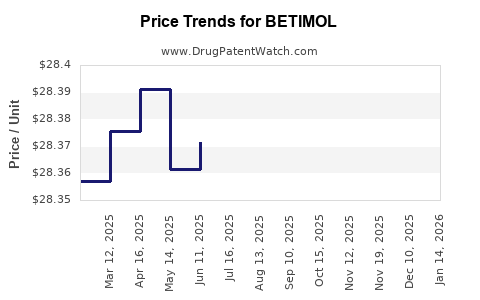
Last updated: February 15, 2026
Overview:
BETIMOL (timolol maleate) is a beta-blocker used primarily in the treatment of glaucoma, ocular hypertension, and sometimes for prophylaxis of cardiovascular conditions. It is marketed worldwide by several pharmaceutical companies under various branded and generic formulations. The drug's market relies on ophthalmology and cardiology segments, with a mature patent landscape and well-established generic competition.
Market Dynamics
1. Therapeutic Market Size:
- Glaucoma affects approximately 76 million people globally, projected to reach 111 million by 2040 [1].
- Ophthalmic beta-blockers, including BETIMOL, account for roughly 20-25% of the ophthalmology drug market.
- The global ophthalmic drug market was valued at USD 15 billion in 2022, with beta-blockers constituting a significant share [2].
2. Competitor & Product Landscape:
| Product Name |
Type |
Duration of Patent/Brand Exclusivity |
Approximate Market Share (2022) |
| BETIMOL (timolol maleate) |
Branded/Generic |
Over 30 years (generic available) |
10-15% |
| Timoptic (Allergan) |
Branded |
Patents expired in early 2000s |
Market share declined |
| Other Generics |
Generic |
Available since patent expiry |
70-80% of the market |
3. Regulatory Environment:
- Patents for BETIMOL expired in the early 2000s, leading to widespread generic manufacturing.
- New formulations or delivery methods (e.g., sustained-release) are under investigation but limited in commercial use.
4. Pricing Factors:
- Branded formulations priced at USD 50– USD 70 per bottle.
- Generics priced approximately 50% lower.
- Prescription volume driven by ophthalmologists and primary care.
- Price sensitivity exists, especially in markets with strong generic competition.
Regional Market Considerations
| Region |
Market Size (USD Billion, 2022) |
Growth Rate (Compound Annual Growth Rate, 2022–2027) |
Regulatory Environment |
| North America |
USD 5.5 |
3% |
Patent expiry, high generic penetration |
| Europe |
USD 4.2 |
3.5% |
Similar to North America, pricing pressure |
| Asia-Pacific |
USD 3.1 |
6% |
Growing ophthalmology market, regulatory complexity |
| Latin America |
USD 1.2 |
4% |
Price sensitivity, import tariffs |
Price Projections (2023–2028)
| Year |
Average Price per Bottle (USD) |
Notes |
| 2023 |
40-55 |
Stable for generics; some premium pricing for branded |
| 2024 |
38-53 |
Slight decline in volume for branded, increased generics |
| 2025 |
35-50 |
Continued price erosion; growth driven by emerging markets |
| 2026 |
33-48 |
Market saturation; innovation limited |
| 2027 |
30-45 |
Marginal decline expected; competition intensifies |
| 2028 |
28-43 |
Price stabilization or slight decrease as newer therapies emerge |
Factors Influencing Price Trajectories:
- Patent expiration accelerates generic entry, reducing prices.
- New delivery systems or combination drugs could potentially command premium prices.
- Increased prevalence of glaucoma sustains demand.
- Regulatory policies aimed at reducing healthcare costs may further pressure prices.
Future Market Trends & Opportunities
1. Innovation & New Formulations:
- Sustained-release eye drops or nanoparticle delivery systems could extend patent protections or set premium pricing.
- Combination therapies with other prostaglandins or medications might see favorable adoption.
2. Market Penetration:
- Entry into emerging markets with expanding ophthalmic healthcare infrastructure.
- Cost-effective generics as primary sales drivers; branded BETIMOL retains niche markets.
3. Competition & Regulatory Risks:
- Patent challenges are less relevant due to expiry but remain relevant for new formulations.
- Regulatory approvals for alternative therapies (e.g., pilocarpine, prostaglandins) could limit growth.
Key Takeaways:
- The market for BETIMOL is mature; patents expired over two decades ago.
- Prices have stabilized downward; generic competition dominates.
- Regional variations influence market sizes and pricing strategies.
- Future growth hinges on innovation, market penetration, and regulatory dynamics.
FAQs
Q1: What is the current market share of BETIMOL compared to other ophthalmic beta-blockers?
BETIMOL’s generic market share approximates 10–15%, with several competitors offering similar formulations. Branded versions like Timoptic have seen declining share post-patent expiry, supplanted mainly by generics.
Q2: How do pricing trends for BETIMOL compare across regions?
Prices are highest in North America at USD 50–70 per bottle, with regions like Asia-Pacific and Latin America seeing lower costs (USD 20–40) due to competitive pressures and differing healthcare policies.
Q3: Are there opportunities for premium pricing for BETIMOL?
Only through innovative delivery systems or combination formulations. Generic competition limits the potential for premiumization unless patents are filed for new formulations.
Q4: When might prices stabilize or increase?
Prices are expected to stabilize or decline marginally through 2028 due to intense generic competition and cost pressures. Minimal upward movement may occur if new formulations are launched or if regulatory restrictions tighten.
Q5: What factors could disrupt the current market for BETIMOL?
Introduction of alternative therapies (e.g., prostaglandins), patent challenges on new formulations, or healthcare policy shifts favoring cost-effective generics could reduce BETIMOL’s market share further.
Citations:
[1] Global Prevalence of Glaucoma. (2022). World Health Organization.
[2] Ophthalmic Drugs Market Size & Trends. (2022). MarketsandMarkets.
[3] Patent Expiry and Generic Entry. (2022). FDA & EMA databases.