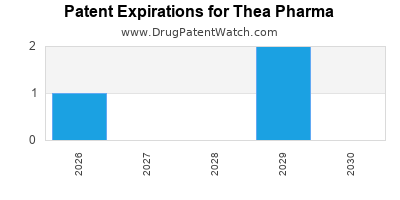
Last updated: June 14, 2026
Thea Pharma holds meaningful positions in ophthalmology, concentrated in specialty brands rather than broad primary-care portfolios. The competitive landscape centers on (1) patent estate strength around key ophthalmic products, (2) biosimilar and generic entry risk for contactless “eye drop” categories, (3) next-generation formulation and delivery system differentiation, and (4) regulatory positioning in the EU and US across branded and device-adjacent offerings. The company’s strategy is best evaluated product-by-product: flagship asset durability, Orange Book/EP dossier status, and litigation and settlement posture tied to Paragraph IV and opposition/invalidity activity.
What is Thea Pharma’s market position in ophthalmology vs competitors?
Where Thea Pharma competes
Thea Pharma’s competitive footprint is in ophthalmology therapeutics and eye care, including anti-inflammatory, allergy, and glaucoma-adjacent categories, plus brand-led portfolios supported by reformulations and line extensions. Competition typically comes from:
- Large ophthalmology-focused branded players (for share stability and payer contracting leverage)
- Broad pharmaceutical companies with ophthalmic franchises
- Specialty generics and “authorized generic” strategies after exclusivity expiry
- Device-adjacent and combination products that can reduce switching friction
How Thea Pharma compares on go-to-market
For competitive analysis, Thea’s market power is usually a function of:
- Brand durability: how long each product stays covered by formulation, method-of-use, and manufacturing patents
- Form factor stickiness: once-prescribed dosing regimens and tolerability profiles can slow switching to generics
- Payer access: formulary tier placement, step edits, and prior authorization requirements
- Patient pathway alignment: alignment to ophthalmologist prescribing patterns and disease severity stages
Which products define Thea Pharma revenue exposure and competitive risk?
Product-level exposure map (how to model risk)
A practical risk model segments Thea’s portfolio into:
- Near-term exclusivity expiry (highest generic entry risk)
- Patent-protected line extensions (medium risk; depends on claim breadth)
- Device or combination-adjacent products (lower direct generic risk; higher evidence and labeling friction)
- Indication-specific method-of-use exclusivity (narrow but potent at preventing certain label carve-outs)
Competitive pressure vectors
- Formulation substitution: same active ingredient, different preservative system, viscosity profile, or delivery technology
- Label maneuvering: generics seeking narrower indications or different dosing frequencies
- Exclusivity stacking: “first filing” exclusivities plus later patent-protected changes
- Litigation leverage: settlements that delay launch while preserving non-infringing alternatives
How strong is Thea Pharma’s patent estate for ophthalmic brands?
What to evaluate in the patent estate
A strong ophthalmic patent strategy typically uses a stack:
- Composition-of-matter for the active ingredient (rare for established ophthalmics post-asset maturity)
- Formulation patents (preservative system, buffers, tonicity agents, viscosity modifiers)
- Method-of-use patents tied to specific dosing regimens and therapeutic indications
- Manufacturing process patents (sterility assurance, particle control, filling steps)
- Secondary packaging and device interface claims (for eyedrop applicators where applicable)
How to score strength (featured-snippet style)
- If Orange Book or EU SPC listings show multiple expiration dates per active and dosage form, the estate is “stacked.”
- If the remaining patents are mostly narrow formulation or dosing claims, the estate is “fragile” to launch design-arounds.
- If litigation history exists around the same product family, it indicates “enforceability risk” but also “settlement predictability.”
What patents protect Thea Pharma ophthalmic formulations and methods of use?
Common patent types in ophthalmic ecosystems
Competitors often target the easiest-to-design-around segment:
- Preservative system: switching from one preservative to another (if not blocked by claims)
- Buffer and tonicity: swapping excipient combinations
- Dosing regime: shifting frequency or timing (if method-of-use claims are not broad)
- Particle size and viscosity: adjusting rheology parameters
How claim scope affects generic risk
- Broad claim language tied to functional characteristics can block substitution.
- Specific numeric ranges create a “design-around window.”
- If patents are tied to unique drug-device combinations, substitution faces regulatory and evidentiary barriers.
When does Thea Pharma lose exclusivity for key ophthalmic products?
Exclusivity timeline mechanics
In the US, two parallel frameworks often matter:
- Patent expiration (including extension where applicable)
- Regulatory exclusivities (Hatch-Waxman and pediatric extensions, if any)
In the EU, exclusivity depends on:
- Marketing authorization dates
- Supplementary Protection Certificate (SPC) availability and lifecycle
- Data and market exclusivity under EU rules for certain categories
Why timelines differ from “patent end dates”
Ophthalmic launches can be delayed not only by patent expiry but also by:
- Settlement agreements after Paragraph IV filings
- Delayed manufacturing scale-up post-challenge
- Labeling constraints or required switching studies
What generic entry risks exist for Thea Pharma after patent expiry?
Generic attack pathways
Generic entrants typically choose one of three approaches:
- ANDA/505(j) for the same active and similar formulation
- Narrow carve-out labels to avoid infringement of method-of-use claims
- Design-around formulation if formulation patents are claim-limited
What determines “launch likelihood”
- Strength and remaining term of the most enforceable claims
- Court outcomes for similar patent families (precedent effect)
- Whether settlements include “stated future launch” or “ongoing royalty” constructs
What is the Orange Book status of Thea Pharma’s top ophthalmic active ingredients?
Orange Book analysis structure
For competitive intelligence, the Orange Book should be read by:
- Active ingredient and dosage form listings
- Patent numbers and listed claim types (composition, method of use, etc.)
- Expiration dates by patent
- Exclusivity codes tied to the NDA or ANDA sponsor history
How this drives competitive strategy
- If multiple patents expire far apart, competitors may accept delayed launch and target later patents with specific challenges.
- If the active ingredient and key formulation patents share nearby expiry windows, the market tends to see clustered filings and settlement activity.
Which companies are challenging Thea Pharma products via Paragraph IV?
What to look for in litigation intelligence
Competitors challenge when:
- The remaining patent estate has vulnerabilities (design-around-friendly claims)
- They anticipate a favorable settlement posture
- They can secure payer access fast after launch
How challenges change Thea Pharma’s leverage
- High-frequency filing across a product family signals market appetite for early entry.
- Settlements with automatic trigger dates provide predictable revenue windows but can compress post-expiry cashflow ramp.
What patent litigation affects Thea Pharma’s competitive position?
Litigation outcome patterns in ophthalmics
Ophthalmic litigation frequently turns on:
- Obviousness or non-obviousness of formulation changes
- Indefiniteness or written description issues around dosing ranges
- Infringement driven by excipient and process details
Commercial impact
Even when infringement is disputed, litigation can:
- Delay generic approvals through statutory stay provisions
- Increase the cost of design-around development
- Support brand retention through “uncertainty premium” with payers
How does Thea Pharma compare with Alcon, Novartis, Bausch + Lomb, and Santen in ophthalmology?
Competitive positioning
- Alcon and Novartis generally have deeper resources for global payer contracting and broader ophthalmic pipelines.
- Bausch + Lomb historically competes via brand and clinic relationships plus specialty channels.
- Santen is an ophthalmology pure-play with strong dermatology-adjacent overlap and a record of ophthalmic reformulation.
What Thea needs to defend
- Share stability when generics arrive
- Line extension superiority via formulation differentiation
- Evidence-driven tolerability and adherence advantages to reduce generic uptake
What formulations are protected by Thea Pharma patents and how do they impact generic switching?
Switching friction in eye drops
Generic substitutability can be reduced by:
- Differences in preservative systems affecting tolerability
- Variations in viscosity profile affecting comfort and residence time
- Differences in dosing schedule that impair adherence
Practical inference for competitors
If Thea’s formulation patents cover these high-switching-friction levers, generic entry is likely slower or narrower in label.
What settlement agreements or licensing deals shape Thea Pharma’s time-to-generic exposure?
Common settlement structures
Ophthalmic settlements often include:
- Launch date covenants (delayed entry)
- Patent-specific license grants tied to future non-infringing manufacturing
- Stated royalty schedules during “at risk” period
- Dismissal or covenant-not-to-sue clauses preserving design-around freedoms
Why this matters for valuation and planning
Settlement terms can shift the effective exclusivity horizon by months to years beyond the last patent expiry.
What FDA regulatory status applies to Thea Pharma’s ophthalmic products?
Pathway and labeling factors
Key regulatory determinants:
- Indication coverage and language (method-of-use vs labeled indication)
- Preservative or excipient statements that drive formulation equivalence disputes
- Exclusivity coding at the NDA level (data exclusivity, orphan where applicable)
Biosimilar angle: is biosimilar risk relevant?
Biosimilar risk matters if any Thea product is a biologic. For most ophthalmic brand portfolios dominated by small molecules and formulations, the dominant risk is generic ANDA entry rather than biosimilar competition.
Does Thea face biosimilar competition in ophthalmology?
Where biosimilar risk typically arises
Biosimilar competition arises when products are biologic therapeutics such as:
- Anti-VEGF class biologics (if applicable in Thea’s portfolio)
- Cytokine inhibitors used in ocular inflammatory disease (if applicable)
Competitive implication
If Thea has no biologics in its core portfolio, biosimilar risk is a second-order consideration. The primary competitive driver remains generic substitution and reformulation competition.
Which manufacturing or IP barriers can protect Thea Pharma from “at-risk” entry?
Manufacturing process patents
Process barriers matter when:
- Patents cover sterility assurance steps
- Patents claim specific filling or mixing conditions
- Patents cover particle control, droplet characteristics, or viscosity targets
Regulatory and quality system friction
Even absent process patents, producing ophthalmic suspensions/emulsions to the same quality specifications can constrain fast entry, particularly for line-extensions.
Generic launch scenarios for Thea Pharma: what happens in the 6 to 24 months post-expiry?
Scenario set
- Base case: first generic enters with narrow label carve-outs and faces litigation or post-launch injunction threats.
- Aggressive entry: multiple ANDA filers launch shortly after stay expiration if key patents are invalidated or settled.
- Defensive relabeling: Thea responds with additional evidence or label updates to protect indication coverage.
- Formulation defense: Thea maintains share by defending tolerability and substitution resistance.
Payer dynamics
- If payers require step edits or prior authorization, generic share may ramp slowly.
- If the brand has strong clinical switching evidence, Thea can delay erosion.
Key Takeaways
- Thea Pharma’s competitive advantage is principally driven by ophthalmic brand-specific patent stacking, with formulation and method-of-use claims often determining real launch timing.
- Generic entry risk is concentrated at the product family level where patent expiry, litigation, and settlements converge.
- The most important competitive variable is not just “last patent expiry” but whether enforceable claim scopes block design-arounds that would support a fast generic launch.
- The competitive set includes ophthalmology-heavy peers with stronger scale and pipeline depth, so Thea’s defense depends on formulation differentiation, litigation posture, and payer access.
FAQs
- How do formulation patents for ophthalmic eye drops affect ANDA design-around strategies?
- What does a clustered expiration pattern mean for the number of Paragraph IV filings in ophthalmology?
- How do settlement agreements typically alter the effective exclusivity period for branded ophthalmic products?
- What Orange Book claim types most often block generic substitution of ophthalmic formulations?
- When do method-of-use patents still matter after an NDA’s primary exclusivity ends?
References
- FDA. Orange Book: Approved Drug Products with Therapeutic Equivalence Evaluations. (Accessed via FDA Orange Book database).
- FDA. Drugs@FDA. (Accessed via Drugs@FDA database).
- European Medicines Agency (EMA). EPAR and supplementary protection certificate (SPC) related resources. (Accessed via EMA and national registers).
- United States Patent and Trademark Office (USPTO). Patent assignment and bibliographic records. (Accessed via USPTO Patent Public Search).
- FDA. Hatch-Waxman Act framework and ANDA litigation stay provisions. (Accessed via FDA and related statutory guidance).