Last updated: August 31, 2026
Auryxia, Akebia Therapeutics’ brand of ferric citrate, is a mature but commercially durable phosphate binder with a second demand base in chronic kidney disease patients with iron deficiency anemia. U.S. sales have generally remained near the $200 million annual level, supported by chronic treatment, an established nephrology sales channel and differentiated iron delivery. The principal risks are generic entry, payer controls, lower dialysis-market growth and competition from established binders such as sevelamer, calcium-based products, sucroferric oxyhydroxide and lanthanum carbonate.
Akebia’s commercial strategy is shifting from reliance on Auryxia toward a broader kidney-disease portfolio following FDA approval of vadadustat, marketed as Vafseo, for anemia associated with chronic kidney disease in adults on dialysis. Auryxia remains the company’s cash-generating product, but its growth profile is limited by market maturity and patent exposure.
What is Auryxia and how is it used?
Auryxia contains ferric citrate, an oral iron compound approved for two U.S. indications:
| Attribute |
Auryxia detail |
| Active ingredient |
Ferric citrate |
| Dosage form |
Oral tablets |
| Initial FDA approval |
Sept. 5, 2014 |
| Initial indication |
Control of serum phosphorus levels in adults with chronic kidney disease on dialysis |
| Expanded indication |
Treatment of iron deficiency anemia in adults with chronic kidney disease not on dialysis |
| Manufacturer |
Akebia Therapeutics |
| Original commercial company |
Keryx Biopharmaceuticals |
| Key mechanism |
Phosphate binding in the gastrointestinal tract and absorption of iron |
The phosphate-binding indication creates demand in dialysis patients, while the iron-deficiency indication targets earlier-stage CKD patients who are not yet on dialysis. That dual-indication structure is central to Auryxia’s commercial resilience.
The FDA label recommends administration with meals for control of serum phosphorus. The tablet burden can be substantial because dosing is titrated to serum phosphorus levels, a characteristic shared by competing phosphate binders.[1]
How large is the Auryxia market?
Auryxia competes in the U.S. phosphate-binder market, which is driven by the prevalence of end-stage kidney disease, dialysis enrollment, nephrologist prescribing behavior and reimbursement policy. The dialysis population is relatively stable compared with many primary-care drug markets, but treatment is chronic and switching rates are limited.
Auryxia’s principal competitors include:
| Product |
Active ingredient |
Company or major commercial owner |
Competitive position |
| Renvela, Renagel |
Sevelamer carbonate, sevelamer hydrochloride |
Sanofi historically; multiple generic suppliers |
Broad use, strong generic pressure |
| Velphoro |
Sucroferric oxyhydroxide |
Vifor Pharma / CSL Vifor |
Lower pill burden, dialysis-focused |
| Fosrenol |
Lanthanum carbonate |
Takeda historically; generic suppliers |
Established alternative |
| Phoslyra and calcium acetate products |
Calcium acetate |
Multiple manufacturers |
Low-cost option |
| Auryxia |
Ferric citrate |
Akebia Therapeutics |
Phosphate binding plus iron delivery |
| Tenapanor, Xphozah |
Tenapanor |
Ardelyx |
Adjunct or alternative mechanism for dialysis hyperphosphatemia |
Auryxia’s differentiation is clinical rather than purely pharmacologic. It binds phosphate while delivering iron, which can reduce the need for separate oral iron in some patients. The commercial value is strongest in patients for whom iron management and phosphate control are both relevant.
Its limitations include gastrointestinal adverse events, pill burden, iron-related monitoring and competition from lower-cost generic binders.
What has been Auryxia’s financial trajectory?
Auryxia has been Akebia’s primary commercial revenue source since the company’s merger with Keryx in 2019. Product revenue has generally been in the high hundreds of millions of dollars rather than approaching blockbuster scale.
Akebia’s public filings describe Auryxia as the company’s principal source of product revenue. Reported revenue has fluctuated with prescription volume, payer mix, gross-to-net deductions, commercial contracting and patient access programs.[2][3]
| Period |
Financial trajectory |
Main drivers |
| 2014-2017 |
Commercial launch and indication expansion |
Initial dialysis uptake and 2017 CKD iron-deficiency approval |
| 2018-2019 |
Revenue expansion |
Broader prescribing and Keryx-Akebia combination |
| 2020-2021 |
Resilient chronic-product sales |
Stable dialysis use despite pandemic disruption |
| 2022-2023 |
Mature-product normalization |
Payer pressure, market maturity and competitive alternatives |
| 2024 onward |
Strategic cash-flow product |
Continued Auryxia sales alongside Vafseo launch preparation |
Auryxia’s sales model has three financial characteristics:
- It produces recurring prescription revenue because phosphate binding and CKD-related anemia management are chronic therapies.
- It requires meaningful gross-to-net deductions because U.S. reimbursement is concentrated in government programs, dialysis organizations and managed-care channels.
- It has limited volume growth because the addressable dialysis population is established and the non-dialysis anemia market is clinically selective.
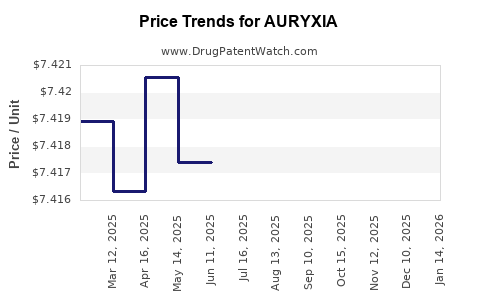
Auryxia should therefore be valued as a durable specialty product rather than a high-growth asset. Its cash contribution depends more on maintaining market share and net price than on expanding diagnosis rates.
When does Auryxia lose exclusivity?
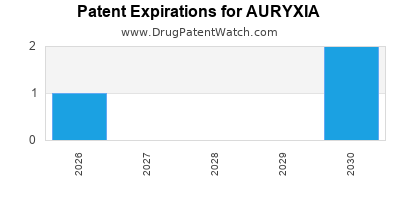
Auryxia does not have one single exclusivity date. Its commercial protection is a combination of small-molecule patents, formulation claims, method-of-use claims, regulatory exclusivity and patent litigation outcomes.
The initial Auryxia composition and formulation estate has been supplemented by later patents covering dosing, treatment methods and specific uses. FDA Orange Book listings are the primary reference for patents asserted to cover the approved product and labeling.[4]
| Protection category |
Commercial relevance |
| Ferric citrate composition claims |
Protect the active pharmaceutical ingredient and core product |
| Tablet formulation claims |
Address stability, excipients and pharmaceutical composition |
| Phosphate-control methods |
Protect use in dialysis-related hyperphosphatemia |
| Iron-deficiency treatment methods |
Support the non-dialysis CKD indication |
| Manufacturing claims |
Can increase the cost and complexity of generic development |
| Regulatory exclusivity |
Provides time-limited FDA protection separate from patent rights |
The practical generic-entry date depends on which listed patents remain enforceable, whether an ANDA applicant makes a Paragraph IV certification, the outcome of infringement litigation and any settlement terms. A patent expiration date alone does not establish the actual launch date.
The commercial risk is greater for the phosphate-binding indication because generic applicants may target the mature dialysis market. Method-of-use patents can still create litigation leverage, but they are vulnerable to labeling strategies that omit a patented indication.
Which companies have challenged Auryxia patents?
Generic competition is expected to come from ANDA applicants rather than biosimilar developers. Auryxia is a chemically synthesized oral tablet, so the relevant regulatory pathway is an ANDA under Section 505(j), not the biosimilar pathway under the Public Health Service Act.
Akebia and Keryx have engaged in patent litigation involving generic applicants seeking approval of ferric citrate tablets. Public litigation records and company filings identify Paragraph IV disputes involving multiple generic manufacturers over Orange Book-listed Auryxia patents.[2][5]
The key commercial questions in each case are:
- Whether the generic applicant challenges all listed patents or only selected claims.
- Whether the applicant seeks approval for both labeled indications.
- Whether the generic label omits the patented iron-deficiency use.
- Whether a court finds infringement and validity.
- Whether Akebia agrees to a licensed entry date or other settlement terms.
A settlement can preserve branded sales for several years while allowing a generic launch before the final expiration of every patent. The financial impact depends on whether the settlement permits an authorized generic, a limited-volume launch or unrestricted competition.
What is the FDA regulatory status of Auryxia?
Auryxia is FDA-approved and marketed in the United States. Its original approval covered phosphorus control in adults with CKD on dialysis. The FDA later approved the iron-deficiency anemia indication in adults with CKD not on dialysis.[1]
Auryxia is not a biologic and has no biosimilar exposure. Its principal regulatory risks involve:
- ANDA approval for ferric citrate tablets.
- Labeling carve-outs for method-of-use patents.
- FDA requirements for pharmaceutical equivalence and bioequivalence.
- Manufacturing consistency and tablet quality.
- Postmarketing safety monitoring.
A generic ferric citrate product could enter with a label limited to the non-patented indication if the FDA accepts a carve-out. That outcome could reduce, but not eliminate, Auryxia’s exposure because pharmacy substitution and prescriber behavior may still shift prescriptions.
How strong is the Auryxia patent estate?
Auryxia’s patent estate is commercially meaningful but weaker than a newly launched product’s estate because the product has been marketed for more than a decade and generic applicants have had time to evaluate its patents.
Strengths
- Two approved indications create multiple method-of-use positions.
- The product is a defined oral formulation with potential composition and manufacturing claims.
- Chronic nephrology prescribing can make patent-based market protection valuable.
- Generic substitution may be slower in specialty dialysis settings than in primary-care markets.
Weaknesses
- The active ingredient and core product have longstanding public exposure.
- Method-of-use claims can be challenged on validity and infringement grounds.
- Label carve-outs may permit partial generic approval.
- Sevelamer and other phosphate binders establish low-cost therapeutic substitutes.
- A generic tablet does not need to replicate Auryxia’s commercial positioning to pressure price.
Patent strength should be assessed claim by claim. Composition and formulation claims usually provide broader commercial protection than narrow dosing or patient-subgroup claims. Method-of-use patents have greater strategic value when the protected indication represents a large portion of prescriptions and cannot be easily omitted from a generic label.
How does Auryxia compare with competing phosphate binders?
| Factor |
Auryxia |
Sevelamer |
Velphoro |
Calcium acetate |
| Iron delivery |
Yes |
No |
No |
No |
| Generic competition |
Emerging risk |
Extensive |
Limited or developing |
Extensive |
| Pill burden |
Can be substantial |
Often substantial |
Generally lower |
Variable |
| Calcium exposure |
No |
No |
No |
Yes |
| Main market |
Dialysis and selected non-dialysis CKD |
Broad dialysis use |
Dialysis |
Cost-sensitive dialysis use |
| Differentiation |
Phosphate binding plus iron |
Established standard |
Lower pill burden |
Low price |
Auryxia’s strongest competitive argument is combined phosphate and iron management. Its weakest point is price relative to generic sevelamer and calcium acetate. If payers treat Auryxia as interchangeable with lower-cost binders, Akebia must rely on clinical differentiation and patient-specific prescribing.
What generic launch risks exist for Auryxia?
The most likely launch scenarios are:
Delayed generic entry
A court upholds key patents or settlements establish a later entry date. Auryxia retains substantial share until the first approved generic launches.
Limited indication launch
A generic enters with one indication carved out of its label. This reduces direct competition but may still create substitution pressure through formulary changes.
At-risk launch
A generic launches before all patent disputes are finally resolved. Akebia could seek damages or injunctive relief, while generic pricing would rapidly affect Auryxia’s net sales.
Multi-generic entry
Several ANDA applicants launch within a short period. This creates the greatest revenue shock because price erosion and formulary displacement occur simultaneously.
For a mature oral product, the first generic entrant can cause a sharp decline in net price. The decline is often steeper when multiple suppliers launch and pharmacy benefit managers impose automatic substitution.
What licensing deals and strategic transactions affect Auryxia?
The most important transaction was Akebia’s 2019 merger with Keryx, which brought Auryxia into Akebia’s portfolio and made the product the company’s commercial foundation.[6]
Auryxia’s future value is now linked to Akebia’s broader kidney portfolio. Vafseo provides a potential growth product, while Auryxia supplies an established prescriber base and commercial infrastructure. The company can use the same nephrology relationships, market-access capabilities and dialysis-channel expertise across both products.
The strategic risk is resource allocation. Investment in Vafseo may support long-term growth but cannot compensate for rapid Auryxia erosion unless the newer product achieves meaningful adoption.
What is Auryxia’s revenue exposure for Akebia?
Auryxia remains material to Akebia’s operating model. Before Vafseo commercialization, the company’s product revenue was concentrated in Auryxia. This concentration creates both stability and vulnerability.
| Exposure |
Financial effect |
| Auryxia revenue concentration |
High dependence on one mature product |
| Dialysis reimbursement |
Controls access and net price |
| Generic entry |
Potential rapid gross-to-net and volume erosion |
| Vafseo launch |
Could diversify revenue, but adds launch costs |
| Manufacturing |
Product availability and cost affect margin |
| Litigation |
Legal expense and settlement terms affect cash runway |
Auryxia’s value is best modeled through several scenarios rather than a single forecast. The key variables are annual prescription volume, net price, generic-entry timing, number of generic entrants and Vafseo replacement revenue.
Key Takeaways
- Auryxia is ferric citrate, an FDA-approved oral therapy for hyperphosphatemia in dialysis patients and iron-deficiency anemia in adults with CKD not on dialysis.
- The product generates recurring specialty-pharmaceutical revenue and has historically supported Akebia’s commercial operations.
- Its growth rate is constrained by a mature dialysis market, payer pressure and established generic phosphate binders.
- The patent estate includes composition, formulation, method-of-use and manufacturing positions, but actual generic entry depends on litigation and settlement outcomes.
- Auryxia faces ANDA-based generic risk, not biosimilar risk.
- The 2019 Keryx-Akebia merger made Auryxia the foundation of Akebia’s commercial business.
- Vafseo offers diversification, but Auryxia remains financially important during the transition.
- The largest downside scenario is multi-generic entry combined with payer-driven substitution.
FAQs About Auryxia Market Dynamics
Is Auryxia a biologic drug?
No. Auryxia is a small-molecule oral tablet containing ferric citrate. Generic competition proceeds through the ANDA pathway rather than the biosimilar pathway.
Does Auryxia have an iron-related commercial advantage?
Yes. Auryxia binds phosphate and delivers iron. That combination can be valuable for selected CKD patients who require both phosphate control and iron management.
Can a generic launch with only one Auryxia indication?
Yes. A generic applicant may seek approval with a patented indication omitted from the label if FDA requirements are satisfied. This is known as a skinny-label or carve-out strategy.
What is the main commercial threat to Auryxia before generic entry?
Payer and dialysis-organization pressure is the main pre-generic threat. Formularies can favor lower-cost sevelamer, calcium acetate or other phosphate binders even without direct generic ferric citrate competition.
How does Vafseo change Akebia’s reliance on Auryxia?
Vafseo gives Akebia a second commercial product and a potential growth platform in dialysis-related CKD anemia. It reduces long-term concentration risk, but Auryxia remains important until Vafseo generates substantial replacement revenue.
References
-
U.S. Food and Drug Administration. (2023). Auryxia (ferric citrate) prescribing information. FDA.
-
Akebia Therapeutics, Inc. (2023). Annual report pursuant to Section 13 or 15(d) of the Securities Exchange Act of 1934, Form 10-K. U.S. Securities and Exchange Commission.
-
Akebia Therapeutics, Inc. (2024). Quarterly and annual financial reports. U.S. Securities and Exchange Commission.
-
U.S. Food and Drug Administration. (2024). Approved drug products with therapeutic equivalence evaluations: Orange Book. FDA.
-
U.S. District Court for the District of Delaware. (2019-2024). Patent litigation records involving ferric citrate and Auryxia ANDA products.
-
Akebia Therapeutics, Inc. (2019). Akebia Therapeutics completes merger with Keryx Biopharmaceuticals. Company transaction announcement.