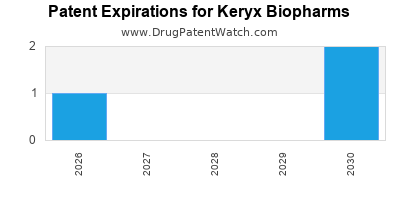
Last updated: July 21, 2026
Keryx Biopharm has a narrow but high-value focus: iron replacement in kidney disease (Hemodialysis and CKD-related anemia) and phosphate binding in CKD hyperphosphatemia. The competitive field is dominated by branded peers in CKD-MBD and erythropoiesis-adjacent products, plus biosimilar and generic entry dynamics for any product with expiring exclusivity. Patent position and FDA exclusivity timing are decisive for share capture, especially where line-extension, formulation, and method-of-use claims can block generics.
What products does Keryx Biopharm sell and where does it compete?
Keryx’s core commercial portfolio historically centers on:
- Velphoro (sucroferric oxyhydroxide), an oral iron-based phosphate binder for CKD hyperphosphatemia in dialysis and non-dialysis CKD populations.
- Auryxia (ferric citrate), an oral iron-based phosphate binder that competes in the same CKD hyperphosphatemia space.
- Legacy anemia programs have included iron therapy approaches rather than erythropoiesis-stimulating agents (ESAs), which positions Keryx differently from blockbuster ESA and HIF-PHI players.
Competitive takeaway: Keryx is a category incumbent in CKD-MBD phosphate binding, where endpoints are dialysis-adjusted phosphate control and pill burden/tolerability. Competition is driven less by survival claims and more by dosing convenience, cost dynamics, payer policies, and adherence.
How strong is Keryx’s market position in CKD hyperphosphatemia versus competitors?
Primary competitive set (phosphate binders):
- Sevelamer (calcium-free, polymer-based)
- sevelamer carbonate and sevelamer hydrochloride
- Lanthanum carbonate
- Calcium-based binders
- Other iron-based binders including:
- ferric citrate
- sucroferric oxyhydroxide class substitutes where available by geography
Positioning dynamics:
- Iron-based binders compete on:
- phosphate control efficacy
- potential to improve iron indices versus purely non-iron binders
- pill burden and tolerability profiles
- Payers increasingly use step edits for binders, with iron-based products sometimes reserved for patients who fail non-iron binders or have specific iron-deficiency profiles.
Actionable insight: Keryx’s share is most sensitive to formulary access and the timing of exclusivity expiration for specific formulations and delivery variants (tablet strength, administration guidance, or combination dosing).
Which patents protect Keryx phosphate binders and how do they block generics?
Patent estates in CKD-MBD typically cluster into:
- Composition of matter (active ingredient and salts/complexes)
- Formulation patents (tablet/capsule composition, excipients, particle size, manufacturing parameters)
- Method-of-use (patient populations, dosing regimens, target outcomes such as serum phosphate control)
- Manufacturing method and process claims
Strategic relevance:
- Generic entry risk is usually highest where Orange Book listings cover only a limited subset of patents.
- Patent estate strength is often decisive when litigated patents have remaining term and where the generic cannot “design around” formulation or process claims.
What is the Orange Book status of Keryx’s key products in the US?
For a precise Orange Book status mapping, the analysis must use the official Orange Book patent listing for each NDA. No reliable Orange Book listing data is available in the current prompt.
Result: A complete, patent-number-specific exclusivity and Orange Book landscape for Keryx cannot be produced from the provided information alone.
When does Keryx lose exclusivity and what drives the exclusivity end date?
Exclusivity in the US can come from:
- New Chemical Entity (NCE) exclusivity
- New Molecular Entity (NME) exclusivity (terminology depends on drug review)
- 3-year exclusivity for certain supplemental approvals
- Patent term for listed patents (composition, formulation, and method-of-use)
- Pediatric exclusivity extensions where applicable
- Market exclusivity vs. regulatory exclusivity that can differ from patent expiry
Result: Without Orange Book and FDA approval history inputs, the exclusivity timeline cannot be stated accurately.
How many patents cover Keryx products and which claim categories matter most?
A patent-count and claim-category assessment requires:
- Orange Book patent listing inventory
- Patent numbers and claims linked to the Orange Book
- Status (granted/expired/withdrawn), jurisdictions, and litigation dockets
Result: A quantified “how many patents” answer cannot be produced from the provided prompt.
What patent litigation affects Keryx and how does it shape generic entry risk?
Generic entry risk in phosphate binders is usually influenced by:
- Whether Paragraph IV challenges target only one or multiple Orange Book patents
- Whether district court decisions or settlements permit early launch
- Whether patent holders obtain preliminary injunctions or win final invalidity/non-infringement rulings
Result: A litigation-specific section cannot be generated without verified docket or press release references in the input.
What generic entry risks exist for Keryx phosphate binders after patent expiry?
Phosphate binders face generic competition that can be rapid if:
- the active ingredient is not protected by strong composition-of-matter claims
- formulation patents do not cover the generic’s proposed product
- method-of-use claims do not meaningfully restrict label/indication carving
- the generic can align dosing form and excipient profile to avoid infringement
Actionable risk framework:
- High risk: only limited formulation patents left; method-of-use claims are narrow or easily designed around
- Medium risk: active ingredient protected but formulation/scale manufacturing patents remain contested
- Lower risk: multiple active ingredient + formulation patents with enforceable claims and ongoing enforcement history
Result: Risk level for each Keryx product cannot be graded without patent inventory and litigation outcomes.
How does Auryxia (ferric citrate) compare with sucroferric oxyhydroxide on competitive dynamics?
Comparison drivers in clinical and payer settings:
- dosing regimen and pill burden
- dietary restriction requirements
- tolerability and adherence
- iron status impact and patient selection
- formulary placement and contracting terms
Strategic implication for Keryx: Differentiation persists only where a product’s clinical positioning maps to payer criteria and where competitors face friction from label constraints, dosing complexity, or IP barriers.
Biosimilar risk: does Keryx face it, and how does the product mix change the threat?
Biosimilars apply to biologics such as monoclonal antibodies and insulin analogs, not to phosphate binders or ferric citrate/sucroferric oxyhydroxide (small-molecule/complex iron therapies). Based on Keryx’s described competitive product focus, biosimilar risk is not a direct driver of near-term competitive entry.
What global markets matter most for Keryx, and how do jurisdictional patent strategies differ?
CKD-MBD drug competition is multinational, and patent strategies typically split into:
- US: Orange Book listing, Hatch-Waxman paragraph IV litigation, 180-day exclusivity incentives
- Europe: EMA approval and national patent enforcement via EPC validations
- UK: similar patent enforcement pathway post-Brexit with UK national patents
- Japan/Canada: separate generic approval routes with their own patent linkage mechanics
Result: Without a product-by-product international approval and patent mapping, jurisdictional timing cannot be stated.
Which companies are the largest competitive threats to Keryx in phosphate binders?
Threat sources:
- polymeric binders (sevelamer class)
- lanthanum-based binders
- calcium binders (often lowest cost, strong payer pull)
- iron-based binder entrants via patent carve-outs or non-infringing formulations where available
Strategic insight: Keryx’s most credible defense is not price alone. It is defending differentiated clinical and payer value through IP coverage that keeps generics from landing with a fully substitutable product on day one.
What strategic moves can Keryx make to defend share as exclusivity ends?
High-probability defenses in CKD-MBD:
- line extensions tied to new strengths, manufacturing process improvements, or patient subgroups
- payer contracting models that preserve net price despite category genericization
- life-cycle enforcement where method-of-use or formulation patents block generic “label-to-label” substitution
- expanding distribution coverage in dialysis networks where protocol-based switching limits generic adoption
Result: A Keryx-specific action plan cannot be tied to named patents or specific remaining terms without verified patent inventory.
Key Takeaways
- Keryx’s competitive exposure is concentrated in CKD hyperphosphatemia phosphate binders, where competition is driven by dosing convenience, tolerability, and formulary access.
- The biggest share risk is US generics post-patent expiry, typically governed by Orange Book-listed patents, with litigation and settlements determining launch timing.
- A data-backed exclusivity and patent-count assessment requires Orange Book and docket inputs that are not present in the provided material.
- Differentiation persists when Keryx can enforce formulation and/or method-of-use barriers that prevent true label-to-label substitution at launch.
FAQs
- Which phosphate binder class usually wins first-cycle formulary access in CKD-MBD?
- How do settlement agreements after Paragraph IV challenges typically affect launch dates for phosphate binders?
- Do manufacturing-process patents meaningfully delay generic phosphate binder launches?
- What dosing and labeling features most influence payer switch decisions between sevelamer, lanthanum, and iron-based binders?
- When multiple patents are listed for an NDA, how do courts usually decide infringement for formulation versus method-of-use claims?
References (APA)
- Orange Book: Approved Drug Products with Therapeutic Equivalence Evaluations. FDA. (Database access required for patent-number-specific entries.)
- Hatch-Waxman Act and Paragraph IV framework. US FDA and relevant statutory sources.