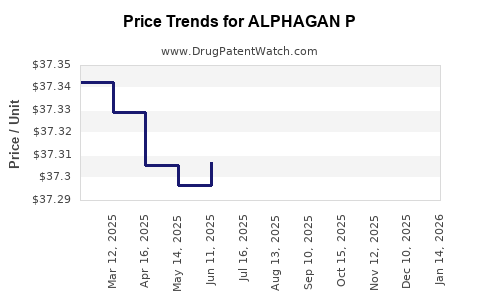
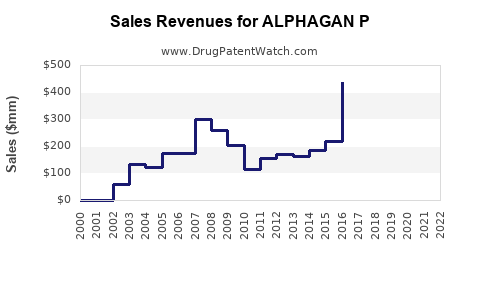
Last updated: June 23, 2026
ALPHAGAN P (brimonidine tartrate ophthalmic solution, branded) is a late-stage, single-agent ophthalmology franchise facing sustained generic substitution across US retail and institutional channels. The product’s financial trajectory is driven by: (1) ongoing replacement by therapeutically equivalent brimonidine products, (2) payer and channel behaviors that reward lower WAC/AWP gaps, and (3) patent and exclusivity timelines that primarily govern the initial branded window, after which incremental brand capture depends on contracting tactics rather than IP.
What is ALPHAGAN P and how is it used in ophthalmology?
Quick answer: ALPHAGAN P is a topical alpha-2 adrenergic agonist used to lower intraocular pressure (IOP) in glaucoma or ocular hypertension.
Indication and competitive positioning
- Therapeutic class: Alpha-2 adrenergic agonist (brimonidine).
- Clinical role: IOP reduction in glaucoma/ocular hypertension.
- Place in therapy: Typically used as monotherapy or adjunct to other IOP-lowering classes (prostaglandin analogs, beta blockers, carbonic anhydrase inhibitors, rho-kinase inhibitors).
Formulation and product variants that affect channel pricing
- ALPHAGAN P is the “P” formulation marketed as a brimonidine product with a specific vehicle and dosing regimen.
- Substitution risk is higher when generics match active and dosing sufficiently that prescribers and pharmacists can switch without meaningful clinical differentiation.
How have ALPHAGAN P sales evolved and what is the commercial trajectory?
Quick answer: ALPHAGAN P’s revenue trajectory has followed a mature branded pattern: peak period followed by multi-year erosion from generic brimonidine ophthalmics as exclusivity lapses and formularies shift.
What drives year-over-year sales
- Generic share gains
- Once multiple brimonidine products are available, brands lose shelf presence and formulary placement unless pricing is defended contractually.
- Formulary design
- Payers often prefer “lowest net cost” within the same therapeutic class or within the same molecule group when clinically interchangeable.
- Channel substitution
- Retail pharmacy switching and buy-and-bill dynamics for ophthalmic distribution can accelerate decline relative to slower-switch therapeutic areas.
- Demand ceiling
- Glaucoma/ocular hypertension patient volumes are stable but incremental growth is captured by broader IOP portfolios and prostaglandin-class standards rather than by one legacy alpha-agonist.
Net price compression dynamics
- Branded ophthalmics face:
- Gross-to-net pressure from rebates and contracting.
- Trade-down pressure to lower-cost equivalents.
- Even when gross sales remain visible due to channel stocking, net sales often decline faster under aggressive payer contracting.
What that implies for financial trajectory
- Short-cycle margin pressure: declining volumes require stronger rebate structures to maintain access.
- Lower commercial leverage: as generic penetration deepens, brand negotiating power falls, worsening net price realization.
When does ALPHAGAN P lose exclusivity and how does that affect revenue risk?
Quick answer: ALPHAGAN P’s revenue risk is concentrated around the periods when FDA exclusivity and brand-protecting IP barriers end, after which generic substitution accelerates.
Exclusivity vs. patent reality in ophthalmics
- Branded ophthalmics often rely on:
- patent coverage of specific formulation/manufacturing and
- exclusivity mechanics at the NDA/approval level.
- Once those barriers fall away, the molecule typically becomes a target for multiple abbreviated approvals and competitive entries.
Revenue impact pattern after exclusivity
- Phase 1: initial generic launches cause step-down in branded share.
- Phase 2: sustained erosion as formularies lock into lower net-cost products.
- Phase 3: brand persists mainly through contracted accounts and physician familiarity, with volumes increasingly dependent on managed-care access.
What patents protect ALPHAGAN P and how strong is the patent estate for brimonidine ophthalmic formulations?
Quick answer: ALPHAGAN P’s patent estate primarily constrains specific formulation, manufacturing, and use claims. The economic relevance in late life is limited if generics can be designed around formulation or if alternative brimonidine products already have market access.
Patent estate characteristics that matter commercially
- Formulation and process claims can delay entry for a subset of generic approaches.
- Method-of-use claims can be leveraged in litigation or settlement to structure “at-risk” design changes.
- Orange Book listing density typically correlates with how long a brand can shape generic labeling and launch sequencing.
Litigation relevance
- In mature molecule categories like brimonidine ophthalmics, litigation tends to move outcomes from “hard patent barriers” to “business settlements” that:
- set launch dates,
- allocate market access,
- or trigger authorized generic arrangements.
What is the Orange Book status of ALPHAGAN P?
Quick answer: ALPHAGAN P is a branded product that historically would have had Orange Book listings for patents covering the NDA. In late-stage products, the practical Orange Book effect is usually that many listed patents no longer prevent market access because they have expired or are no longer enforceable against generic challengers.
How Orange Book status translates into market dynamics
- If patents are listed and active: generics can face Paragraph IV hurdles and litigation timelines.
- If patents are expired or design-around is feasible: generic entry becomes a pricing and contracting contest.
Which generic or biosimilar entries threaten ALPHAGAN P most?
Quick answer: The biggest threats come from lower-cost generic brimonidine ophthalmic solutions that match the active ingredient and dosing without clinically meaningful differences.
What “most threatening” means
- Lowest net cost on formulary after rebates.
- Broad distribution and pharmacy switching acceptance.
- Label compatibility that reduces physician resistance.
Competitive map in the alpha-agonist niche
- Generic brimonidine products compete on:
- price,
- bottle size and dosing convenience,
- and payer formularies rather than on novel pharmacology.
What patent litigation affects ALPHAGAN P and how do settlements shape launch timing?
Quick answer: For mature branded ophthalmics, litigation and settlements generally determine the sequencing of generic entry rather than permanently excluding competitors.
Typical litigation-to-commercial outcomes
- Delayed launch: settlements that push the launch date beyond the initial Paragraph IV filing timeline.
- Authorized supply structures: authorized generics can appear around settlement terms.
- Co-existence with multiple generics: even with litigation, the end state is usually multiple competitors and branded volume erosion.
How settlement terms feed into financial trajectory
- If settlement delivers a later entry date, brand declines slow briefly.
- If multiple challengers enter after barriers lapse, brand revenue continues to compress quickly.
How does ALPHAGAN P compare with other glaucoma drops from a market dynamics standpoint?
Quick answer: Brimonidine competes in a crowded IOP-lowering market where prostaglandin analogs often capture first-line volume. ALPHAGAN P competes as a secondary or adjunct option, which intensifies sensitivity to generic pricing.
Relative commercial durability
- Prostaglandin analog franchises often have longer brand durability due to entrenched first-line prescribing and newer delivery systems.
- Alpha-agonist brands tend to be more exposed to generic substitution because molecule-level interchangeability is high and differentiation is limited.
What formulation or dosing patents could constrain generic substitution?
Quick answer: Generic substitution risk is constrained when brand patents claim specific formulation attributes, preservative/vehicle systems, or manufacturing processes that are hard to replicate equivalently.
Formulation categories that can be patent-relevant
- Vehicle and preservative systems
- Viscosity and pH specifications
- Container-closure or fill-finish methods
- Stability and shelf-life processes
Commercial effect
- Even when formulation patents exist, the market outcome is usually:
- delayed entry for certain generic designs,
- then eventual entry using alternative formulation strategies once barriers weaken.
What is the regulatory pathway risk for ALPHAGAN P generic competition?
Quick answer: US generic competition is typically driven by ANDA pathways referencing the ALPHAGAN P NDA, with patent certifications determining whether entry occurs at-risk or after a delay.
Certification dynamics
- Paragraph I/II: no waiting for patents listed (at-risk launch or immediate entry).
- Paragraph IV: launches can be blocked by litigation or trigger settlement/entry delays.
- Paragraph III: launch at the end of listed patent life for the relevant code(s).
Regulatory timing and revenue
- Generic revenue threats tend to rise in step with:
- the timing of approval/launch after the regulatory review,
- and whether a court settlement allows entry.
How do pricing, contracting, and reimbursement shape ALPHAGAN P financial performance?
Quick answer: ALPHAGAN P’s net sales sensitivity is high because ophthalmic contracting often uses net cost benchmarks, not brand list price.
Key commercial levers
- Payer rebate intensity: increased rebates to maintain formulary placement.
- Managed care steering: favored alternatives within brimonidine or across IOP classes.
- Pharmacy benefit manager tactics: switching rules and step edits for non-preferred products.
- Provider buying patterns: office stock and sample strategy can smooth decline but rarely stop it.
Outcome
- Over time, the brand shifts from volume growth to retention management, with diminishing ROI on sales and marketing spend.
Where is ALPHAGAN P revenue likely concentrated and what channel patterns matter?
Quick answer: In glaucoma and ocular hypertension, a branded legacy alpha-agonist is typically concentrated in refill-driven chronic use, with distribution influenced by:
- retail pharmacy refill behavior,
- ophthalmology office prescribing and stock usage,
- and Medicare/managed-care formulary decisions.
Channel implications
- Retail: generics can rapidly capture share via substitution and PBM rules.
- Institutional: price negotiations and formulary lists can end brand preference quickly.
- Physician behavior: brand loyalty persists when patients tolerate specific formulations, but economics often override after generic penetration.
Key takeaways on ALPHAGAN P market and financial trajectory
- ALPHAGAN P’s financial trajectory is shaped by generic brimonidine substitution, not by ongoing product innovation.
- Revenue erosion follows a predictable late-branded path: exclusivity/patent barriers fall, generic launches occur, net price compresses, and volume shifts to lower net-cost equivalents.
- Litigation and settlements, when present, mainly influence the timing of generic entry rather than creating long-term market insulation.
- Competitive position is structurally exposed because brimonidine is commonly used after or alongside first-line prostaglandin-class therapy, increasing sensitivity to payer contracting and formulary switching.
FAQs
1) What generic entry risks exist for ALPHAGAN P in the US after Orange Book patent expiry?
Generic ANDA approvals with Paragraph certifications typically enable entry once listed patents expire or are addressed via court/settlement outcomes; the commercial risk materializes as rapid net-price compression and formulary switching.
2) Does ALPHAGAN P face method-of-use patent barriers that delay generics?
If method-of-use claims exist and are enforceable against ANDA-specific use, they can delay entry, but the practical outcome in mature molecule categories often becomes sequencing rather than exclusion.
3) How does ALPHAGAN P pricing usually change once multiple brimonidine generics are available?
Brands generally cut net price via rebates to defend formulary access while volumes continue to migrate to lower net-cost options.
4) What formulations differences typically matter for generic switch acceptance in ophthalmology?
Vehicle/preservative-related tolerability and patient-specific response can slow switching, but payer economics and pharmacy substitution rules usually dominate over time.
5) How do settlement agreements in ophthalmic patent cases typically influence launch timing?
Settlements commonly set launch dates for specific generic applicants and may allow authorized supply, resulting in a controlled but still eventual shift away from the brand.
References (APA)
- FDA. (n.d.). Orange Book: Approved Drug Products with Therapeutic Equivalence Evaluations. U.S. Food and Drug Administration.
- FDA. (n.d.). ANDA: Abbreviated New Drug Application. U.S. Food and Drug Administration.
- FDA. (n.d.). Paragraph IV certifications and patent litigation. U.S. Food and Drug Administration.