Last updated: August 14, 2026
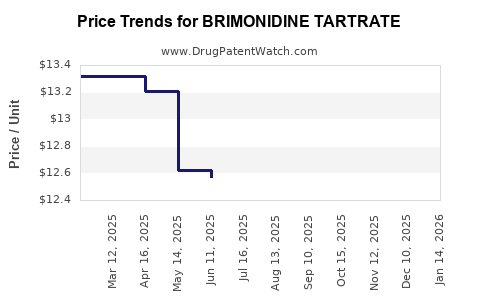
Brimonidine tartrate is a mature, multi-channel pharmaceutical ingredient with three principal U.S. markets: prescription glaucoma therapy, prescription rosacea treatment, and over-the-counter ocular redness relief. The original glaucoma franchise has lost primary exclusivity and faces extensive generic competition. Commercial value has shifted toward differentiated delivery systems, branded topical products, and consumer distribution.
The financial trajectory is therefore mixed. Prescription ophthalmic brimonidine is a high-volume, low-price generic market. Mirvaso retains branded value through its rosacea indication and gel formulation. Lumify has created the largest consumer-facing growth platform, although Bausch + Lomb does not separately disclose Lumify revenue.
What is brimonidine tartrate used for?
Brimonidine tartrate is an alpha-2 adrenergic receptor agonist that reduces aqueous humor production and increases uveoscleral outflow. Its commercial uses depend on concentration, dosage form, and route of administration.
| Product or product class |
Brimonidine concentration |
Indication |
Distribution |
| Alphagan and generic ophthalmic solution |
0.2% |
Open-angle glaucoma and ocular hypertension |
Prescription |
| Alphagan P and generic ophthalmic solution |
0.1% and 0.15% |
Open-angle glaucoma and ocular hypertension |
Prescription |
| Mirvaso topical gel |
0.33% |
Persistent facial erythema associated with rosacea |
Prescription |
| Lumify ophthalmic solution |
0.025% |
Temporary reduction of ocular redness |
OTC |
Alphagan P uses Purite, a stabilized oxychloro complex, as a preservative system. The product was developed to reduce ocular surface exposure relative to benzalkonium chloride-containing products. Mirvaso uses a topical gel designed for facial application, while Lumify uses a low-dose ophthalmic formulation intended for consumer use. These delivery differences limit direct substitution across product categories.
How large is the brimonidine tartrate market?
No major manufacturer reports global brimonidine tartrate revenue as a standalone line item. Market size is fragmented across generic prescription products, branded prescription products, OTC sales, and private-label distribution.
The prescription glaucoma segment is structurally mature. Brimonidine competes with low-cost generic timolol, dorzolamide, brinzolamide, prostaglandin analogs such as latanoprost and bimatoprost, and newer agents such as netarsudil. Brimonidine is often used as part of combination therapy rather than as a premium monotherapy.
The OTC segment has a different economic profile. Lumify is sold through retail, pharmacy, e-commerce, and optical channels, with consumer brand investment and shelf positioning playing a larger role than patent exclusivity. Bausch + Lomb identifies Lumify as part of its consumer portfolio, but does not provide separate product revenue in its public financial reporting (Bausch + Lomb, 2024).
The rosacea market is smaller than the overall glaucoma market but has higher branded pricing. Mirvaso competes with topical oxymetazoline, topical metronidazole, azelaic acid, ivermectin, and nonpharmaceutical laser or light-based procedures. The market is sensitive to treatment tolerability, rebound erythema concerns, payer coverage, and patient willingness to use a daily cosmetic-therapeutic product.
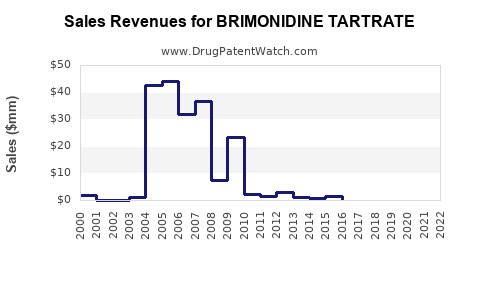
What is the financial trajectory for brimonidine tartrate?
Brimonidine revenue has moved through three distinct phases:
- The branded glaucoma phase, led by Alphagan and Alphagan P.
- The generic erosion phase, driven by multiple abbreviated new drug applications.
- The portfolio diversification phase, led by Mirvaso and Lumify.
Branded glaucoma revenue erosion
Alphagan entered the U.S. market in the 1990s. Once generic versions became available, price competition reduced the commercial value of brimonidine ophthalmic solution. Generic substitution is particularly strong in glaucoma because physicians and payers have extensive experience with the active ingredient and because several therapeutic alternatives are available.
The branded Alphagan franchise no longer has the economic characteristics of a protected specialty drug. Its remaining value is associated with prescribing familiarity, formulation preferences, distribution, and limited patient switching rather than broad market exclusivity.
Growth in consumer ocular redness relief
Lumify created a new commercial category for low-dose brimonidine. Its 0.025% concentration is materially lower than prescription glaucoma concentrations and is marketed for temporary redness reduction rather than intraocular pressure control.
Bausch + Lomb has invested in Lumify advertising, retail placement, and product extensions. Public filings report performance at the segment or brand-family level rather than disclosing exact Lumify net sales. The product’s economic model depends on repeat consumer purchases and over-the-counter availability, not physician prescribing.
Branded rosacea economics
Mirvaso has a more concentrated commercial base than Lumify. Its value depends on dermatology prescribing, insurance reimbursement, patient adherence, and the availability of competing topical agents. The product can command higher gross revenue per unit than generic ophthalmic brimonidine, but its market is exposed to formulary restrictions and clinical concerns about rebound redness in some patients.
Galderma, Mirvaso’s commercial owner, is privately held and does not provide the same level of product-level financial disclosure as a public pharmaceutical company. Mirvaso revenue therefore cannot be separated reliably from Galderma’s broader prescription dermatology portfolio using public filings.
When did brimonidine tartrate lose exclusivity?
The original glaucoma product has long since lost primary U.S. market exclusivity. Brimonidine ophthalmic solutions are available from multiple generic manufacturers, and generic substitution is established.
| Exclusivity category |
Current commercial position |
| Original active ingredient and glaucoma indication |
Expired or commercially overcome by generic competition |
| Alphagan ophthalmic solution |
Generic competition established |
| Alphagan P formulation and preservative differentiation |
Commercial differentiation remains, but broad generic pressure exists |
| Mirvaso 0.33% gel |
Branded formulation and indication protections may remain relevant depending on patent and regulatory status |
| Lumify 0.025% OTC product |
Brand, formulation, regulatory history, and consumer-market protections are more important than prescription exclusivity |
FDA approval does not mean that every patent covering a product has expired. Orange Book listings, regulatory exclusivity, formulation claims, and method-of-use claims must be evaluated product by product. The commercial conclusion is clear for standard prescription brimonidine ophthalmic solution: generic entry is established and the market is no longer dependent on one supplier.
What is the FDA regulatory status of brimonidine products?
The FDA has approved brimonidine tartrate in several dosage forms and regulatory pathways.
| Product |
FDA status |
Regulatory significance |
| Alphagan ophthalmic solution |
Approved prescription product |
Original glaucoma franchise |
| Alphagan P |
Approved prescription product |
Lower concentration and Purite preservative system |
| Generic brimonidine ophthalmic solutions |
Approved through ANDA pathways |
Multi-source generic market |
| Mirvaso topical gel |
Approved prescription product |
Rosacea-specific topical formulation |
| Lumify ophthalmic solution |
Approved OTC product |
Consumer ocular redness indication |
The OTC approval of Lumify expanded the addressable market beyond patients diagnosed with glaucoma or ocular hypertension. That change is commercially significant because it moved brimonidine into a high-frequency consumer category with direct-to-consumer marketing potential.
What patents protect brimonidine tartrate products?
Patent protection varies by product and claim type. The central distinction is between expired composition or early glaucoma patents and later formulation, concentration, delivery, and method-of-use claims.
Ophthalmic glaucoma products
The original Alphagan franchise relied on patents covering brimonidine-related pharmaceutical compositions and ophthalmic use. Those protections no longer prevent broad generic competition in standard ophthalmic solution.
Later patents and regulatory records may cover:
- Preservative systems
- Stabilized ophthalmic formulations
- Specific brimonidine concentrations
- Container or delivery systems
- Combination products
- Methods of treating ocular hypertension or glaucoma
A patent may remain listed or enforceable without preventing all generic competition. Generic applicants can avoid a listed claim, challenge it under Paragraph IV, or enter after a patent’s expiration.
Mirvaso topical gel
Mirvaso’s relevant intellectual-property position is more formulation-specific. Potential claim categories include:
- Brimonidine concentration and gel composition
- Topical treatment of facial erythema
- Dosing schedules
- Vehicle and penetration characteristics
- Stability and packaging
These claims are more commercially relevant than the original glaucoma composition patents because Mirvaso depends on a specific topical delivery system and a distinct dermatology indication.
Lumify OTC formulation
Lumify’s protection is based on a combination of regulatory positioning, brand recognition, low-dose formulation, consumer distribution, and possible formulation or method claims. The U.S. OTC pathway does not provide the same market structure as a new prescription chemical entity. Competitive entry may occur through an ANDA, an OTC monograph route where applicable, or a new drug application, depending on the product and regulatory strategy.
How many patents cover brimonidine tartrate?
There is no single meaningful patent count for brimonidine tartrate. A global search would include expired composition patents, active formulation patents, foreign counterparts, continuation applications, Orange Book-listed patents, and patents assigned to different owners over time.
A useful commercial count should separate:
| Patent category |
Commercial relevance |
| Expired composition patents |
Low barrier to standard generic entry |
| Active ophthalmic formulation patents |
May affect specific concentrations or preservative systems |
| Topical gel patents |
Potentially material for Mirvaso-type products |
| Method-of-use patents |
Relevant only where labeling and infringement theories align |
| Packaging and device patents |
May affect delivery but usually do not block all active-ingredient competition |
| Foreign patents |
Relevant to country-specific launch timing |
Patent strength is highest where claims cover a hard-to-design-around formulation or a regulatory indication that a competitor needs for labeling. It is weaker where the same clinical objective can be reached through a different concentration, vehicle, preservative, or label.
Are there Paragraph IV challenges to brimonidine products?
Paragraph IV litigation risk is concentrated in branded products with remaining listed patents, particularly formulation-specific prescription products. Standard generic brimonidine ophthalmic solution has already experienced extensive generic entry, so the principal risk is price erosion rather than a first generic launch event.
For a product such as Mirvaso, a Paragraph IV filing could challenge patents listed in the FDA Orange Book and trigger Hatch-Waxman litigation. The commercial outcome would depend on:
- The number and scope of listed patents
- Whether the generic seeks the same 0.33% gel formulation
- The applicant’s proposed label
- Patent-term expiration
- Litigation timing
- Possible 30-month stay
- Settlement terms and authorized-generic strategy
Public sources do not establish a single current litigation outcome that determines the entire brimonidine market. Litigation must be assessed separately for each branded product and patent family.
What biosimilar risk exists for brimonidine tartrate?
Biosimilar risk is not applicable. Brimonidine tartrate is a chemically synthesized small molecule, not a biologic. Competitive entry occurs through generic-drug pathways, primarily ANDAs in the United States, rather than through the biosimilar pathway under the Public Health Service Act.
This distinction reduces regulatory complexity for many competitors. The main barriers are formulation development, bioequivalence, device or container compatibility, manufacturing scale, and commercial economics.
Which companies compete in the brimonidine tartrate market?
The competitive field includes branded companies, generic manufacturers, and adjacent therapy providers.
| Company or group |
Relevant position |
| Bausch + Lomb |
Lumify OTC; historical Alphagan franchise |
| Galderma |
Mirvaso topical gel |
| Large generic manufacturers |
Brimonidine ophthalmic solutions |
| Specialty ophthalmic manufacturers |
Alternative glaucoma formulations and combinations |
| Dermatology companies |
Rosacea alternatives, including oxymetazoline, ivermectin, metronidazole, and azelaic acid |
| Consumer eye-care companies |
Redness-relief products and artificial tears |
Glaucoma competition is broader than the brimonidine category. Prostaglandin analogs often have strong first-line positioning because of dosing convenience and pressure-lowering efficacy. Brimonidine remains useful when additional pressure reduction is needed or when a clinician wants a non-prostaglandin mechanism.
What generic launch risks exist for brimonidine tartrate?
Generic launch risk differs by product.
Standard ophthalmic solution
The generic-launch risk is already realized. Multiple suppliers create a low-price market. Future entrants would face limited margins, established procurement relationships, and potential manufacturing economics that favor scale.
Mirvaso
A generic Mirvaso-equivalent product could produce meaningful price pressure if it obtains approval with the same concentration, dosage form, and indication. The risk depends on remaining patents, formulation complexity, and the ability to demonstrate therapeutic equivalence for a topical gel.
Lumify
An equivalent OTC product could face high brand and distribution barriers even if the active ingredient is technically available. Retail shelf space, consumer awareness, advertising, packaging, and retailer relationships are important competitive assets. The risk is more likely to emerge through brand extensions or competing low-dose redness-relief products than through a conventional prescription-style generic launch.
How strong is the brimonidine patent estate?
The estate is weak for the original glaucoma active ingredient and stronger, but more product-specific, for later dosage forms and consumer positioning.
| Segment |
Patent strength |
Main reason |
| Generic 0.2% ophthalmic solution |
Low |
Mature active ingredient and multi-source supply |
| Alphagan P-type formulation |
Moderate |
Preservative and concentration differentiation |
| Mirvaso-type topical gel |
Moderate to potentially strong |
Specific vehicle, concentration, and dermatology use |
| Lumify-type OTC product |
Moderate commercial protection |
Low-dose formulation, branding, consumer channel, and regulatory positioning |
Patent strength should not be confused with financial strength. A product can retain useful differentiation while generating limited revenue, particularly where payers or consumers can substitute lower-cost alternatives.
What manufacturing and intellectual-property barriers affect the market?
Manufacturing barriers are modest for standard brimonidine ophthalmic solutions but higher for branded formulations.
Key barriers include:
- Sterile ophthalmic manufacturing
- Preservative-system stability
- Container-closure integrity
- Dropper accuracy
- Topical gel uniformity
- Scale-up of low-dose formulations
- Shelf-life and photostability
- Regulatory comparability
- Retail packaging and supply-chain execution
For generic ophthalmic products, sterile manufacturing and quality compliance are the main operational hurdles. For Mirvaso-type products, the vehicle and topical performance add formulation complexity. For Lumify-type products, manufacturing is only one component of the competitive position. Consumer marketing and retail distribution can determine share even when technical entry is feasible.
What licensing deals affect brimonidine tartrate?
The commercial history of brimonidine includes company transfers, product acquisitions, and licensing arrangements associated with ophthalmic and dermatology portfolios. Public financial disclosures do not identify a current standalone royalty stream or transaction value for brimonidine tartrate across all products.
The most relevant commercial relationships are portfolio-based:
- Bausch + Lomb commercializes Lumify and has historical ties to the Alphagan franchise.
- Galderma commercializes Mirvaso in dermatology.
- Generic suppliers manufacture under their own ANDA approvals rather than through a single originator-controlled licensing structure.
Any valuation of a brimonidine transaction should separate rights to the active ingredient from rights to a formulation, indication, brand, territory, or OTC channel.
What is the geographic coverage of brimonidine tartrate?
Brimonidine is marketed internationally for ophthalmic and dermatology uses, but product names, concentrations, indications, patent positions, and regulatory status differ by country.
The United States has the most commercially differentiated structure because it includes:
- A mature generic glaucoma market
- A prescription rosacea product
- A branded OTC redness-relief product
- Orange Book and Hatch-Waxman mechanisms
European and other markets may have different generic launch dates, reimbursement structures, trade names, and prescription classifications. Geographic revenue estimates must therefore be built by product and country rather than extrapolated from U.S. prescription volume.
What patent litigation and settlement issues affect brimonidine?
Litigation risk is product-specific and tends to arise when a generic applicant seeks approval before expiration of listed formulation or method patents. The likely legal issues include claim construction, patent validity, written description, obviousness, and whether the proposed generic label induces infringement.
Settlement agreements may include:
- Agreed generic entry dates
- Authorized-generic rights
- Supply arrangements
- Royalty payments
- Narrowed labeling
- Covenants not to sue
No single settlement controls all brimonidine products. A settlement involving a topical gel would not necessarily affect generic ophthalmic solution or OTC low-dose products.
What is the investment outlook for brimonidine tartrate?
Brimonidine is best viewed as a portfolio asset rather than a single-drug growth story.
The generic glaucoma segment offers volume but limited pricing power. Mirvaso retains niche branded value but faces dermatology competition and payer pressure. Lumify has the strongest consumer-growth characteristics, supported by OTC access and brand-building, but its standalone financial contribution is not publicly disclosed.
The main upside drivers are:
- Expansion of OTC ocular redness products
- Consumer repeat purchase
- New packaging or product extensions
- Stable rosacea prescribing
- Supply-chain consolidation
- Premium positioning for preservative or formulation advantages
The main downside drivers are:
- Generic price erosion
- Retailer private-label competition
- Formulation-equivalent entry
- Adverse publicity regarding rebound redness or tolerability
- Reduced dermatology reimbursement
- Manufacturing or quality disruptions
Key Takeaways
- Brimonidine tartrate is a mature small-molecule market with separate prescription and OTC economics.
- Standard glaucoma products face established generic competition and low pricing power.
- Mirvaso retains branded value through its 0.33% topical gel and rosacea indication.
- Lumify is the principal consumer-growth platform, although product-level revenue is not publicly reported.
- Biosimilar risk does not apply; competitive entry occurs through generic pathways.
- Patent strength is low for the original glaucoma active ingredient and higher for specific formulations, concentrations, delivery systems, and methods of use.
- The most material future financial risk is formulation-specific generic entry and consumer-channel competition.
- Brimonidine’s investment value depends more on brand, formulation, and distribution rights than on the underlying molecule.
FAQs
Is brimonidine tartrate still commercially protected?
Standard ophthalmic brimonidine is no longer protected from broad generic competition. Product-specific formulation, indication, brand, and OTC protections may remain relevant for Mirvaso and Lumify.
Is Lumify the same as prescription brimonidine?
Lumify contains the same active ingredient, brimonidine tartrate, at a substantially lower concentration of 0.025%. It is approved for temporary ocular redness relief, not glaucoma treatment.
Can a generic manufacturer launch a Mirvaso equivalent?
Potentially, but approval would depend on formulation development, regulatory requirements, patent status, and the ability to establish equivalence for the 0.33% topical gel and proposed indication.
Does brimonidine tartrate have biosimilars?
No. Brimonidine tartrate is a small-molecule drug, so competitors use generic-drug approval pathways rather than biosimilar pathways.
Which brimonidine segment has the best growth prospects?
The OTC ocular redness segment has the strongest growth profile because it reaches consumers outside specialty ophthalmology. The standard glaucoma segment has the weakest growth profile because it is mature and heavily genericized.
References
- Bausch + Lomb Corporation. (2024). 2023 annual report.
- Galderma S.A. (2024). Annual report and financial information.
- U.S. Food and Drug Administration. (2013). Mirvaso (brimonidine tartrate) topical gel, 0.33%: Prescribing information.
- U.S. Food and Drug Administration. (2017). Lumify (brimonidine tartrate ophthalmic solution) 0.025%: Labeling and approval information.
- U.S. Food and Drug Administration. (2024). Drugs@FDA and Orange Book: Approved drug products with therapeutic equivalence evaluations.
- U.S. Food and Drug Administration. (2024). Alphagan P (brimonidine tartrate ophthalmic solution) prescribing information.
- U.S. Food and Drug Administration. (2024). Approved drug products and abbreviated new drug application database.