Last updated: July 29, 2026
Alendronate sodium is an established, off-patent bisphosphonate with broad generic penetration in the US and multiple ex-US markets. Financial trajectory is driven by ongoing volume substitution from branded to generic, periodic pricing resets, and the mix shift between oral daily vs weekly regimens and dosing strengths. The near-term commercial outlook is dominated by generic brand competition rather than exclusivity events, with revenue largely sustained by continued new-patient incidence for osteoporosis/osteopenia and by adherence differences between dosing schedules.
What drives alendronate sodium market dynamics in the US generic market?
Featured snippet answer: Demand is sustained by osteoporosis treatment and persistence needs, while pricing is compressed by multi-source generic competition across tablet strengths (5 mg, 10 mg, 35 mg, 40 mg, 70 mg) and dosing regimens (daily and weekly). Revenue growth depends more on volume and adherence/mix than on IP exclusivity.
How does generic competition affect pricing and gross margin?
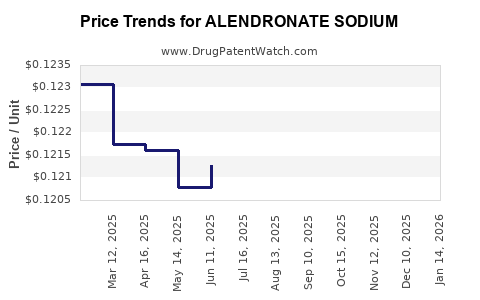
Alendronate sodium has the typical off-patent pricing profile: wholesale price erosion after generic entry, followed by stabilization at low single-digit-to-mid-single-digit gross margin ranges for distributors/pharmacies depending on contract dynamics. Key dynamics:
- Multi-source shelf access: multiple approved ANDA products reduce effective pricing power.
- Formulary tiering: many plans place generics on low tiers, pressuring net price.
- Contract pharmacy and PBM rebates: generic competition intensifies bid pressure and rebate competition.
Which dosing schedules shift demand and adherence?
Oral bisphosphonates show adherence sensitivity to dosing frequency and tolerability (GI effects). Alendronate’s mix tends to rotate between:
- Weekly 70 mg (most prominent in osteoporosis) versus
- Daily 10 mg or 5 mg (depending on indication and regimen)
Mix shift typically follows guideline patterns, prescriber preference, and patient convenience, with weekly regimens often supporting better persistence than daily dosing.
What substitution patterns are common at the pharmacy counter?
- Therapeutic interchange inside bisphosphonates: when plans restrict cost, alendronate is often substituted within the oral bisphosphonate class unless a patient has prior intolerance.
- Strength and regimen interchange: switching from one strength/frequency to another is common if the patient’s regimen is clinically interchangeable and the pharmacy carries the preferred NDC under the plan.
When does alendronate sodium lose exclusivity, and what exclusivity levers remain?
Featured snippet answer: As a legacy molecule, alendronate sodium is already off-patent and not meaningfully protected by ongoing composition-of-matter or use exclusivity for broad US market revenue. Commercial “exclusivity” today is largely limited to data exclusivity for specific line extensions, but for the core molecule the dominant driver is generic availability.
What exclusivity exists in practice today?
For the overall molecule, the remaining exclusivity levers are generally not decisive for market-wide revenue because:
- Patent protection has largely expired for earlier branded formulations.
- ANDAs have already captured most market segments.
- Any remaining protections tend to be product-specific (a particular strength, formulation, or NDA/Biologics-like exclusivity mechanism), and they do not prevent generic erosion across the class.
How does regulatory data exclusivity compare with patent exclusivity here?
- For widely generic molecules, data exclusivity does not block follow-on generics at scale once ANDAs exist.
- Patent estates (if any remain for narrow formulation/device combinations) only matter for the specific protected product line, not the category.
What is the Orange Book status of alendronate sodium products, and how many ANDAs compete?
Featured snippet answer: Alendronate sodium is listed across many generic ANDA products covering multiple strengths and dosing schedules, producing dense Orange Book coverage that limits pricing power.
What to expect from Orange Book listings for this molecule
In practice, the Orange Book pattern for established oral generics like alendronate sodium is:
- Many listed application holders and marketing companies.
- Multiple dosage strengths with separate product identifiers (NDC-level).
- Dispersed expiration and “patent-protected product” footprints that have minimal impact on total category revenue.
How does dense listing affect launch timing and market share?
- No single entrant can delay competition long enough to capture sustained premium pricing.
- Post-launch market share becomes a function of contracting and distribution, not IP leverage.
What patent estate and formulation protections exist for alendronate sodium?
Featured snippet answer: The commercially meaningful patent estate has mostly already been exhausted; current market structure reflects off-patent composition and formulation, with competition driven by manufacturing cost and contracting.
Are there still formulation or method-of-use patents relevant to commercial differentiation?
Generally, for mature bisphosphonates:
- Formulation patents, if present, tend to be narrow and are less likely to protect broad oral tablet categories across all strengths.
- Method-of-use protections (indications and dosing instructions) can matter in litigation contexts, but they rarely prevent generic tablet entry if the ANDA can carve out protected indications or rely on non-protected use.
Do patents on specific indications change commercialization strategy?
For category-level mature drugs, protected niche indications do not stop category erosion. The commercial impact is typically:
- Restricted substitution for that niche (in theory) but
- Limited ability to sustain branded economics due to multi-source generic availability.
Which companies dominate alendronate sodium supply in the US?
Featured snippet answer: Dominant players are generic manufacturers with multiple ANDA products across alendronate strengths, typically including large US generic groups and contract manufacturers supplying multiple labels.
How dominance is measured in this market
- Number of stocked NDCs
- Contract positioning (PBMs and GPOs)
- Stability of supply and manufacturing yield
- Pricing under dynamic rebate frameworks
What matters for licensing and procurement
For buyers, market power sits with:
- Firms that can supply multiple strengths reliably
- Manufacturers with favorable manufacturing cost structure
- Labels that can secure favorable formulary positioning
How does alendronate sodium compare with other bisphosphonates on cost and market position?
Featured snippet answer: Alendronate sodium typically competes as the lower-cost oral bisphosphonate anchor versus branded competitors and often competes against other generics depending on pricing cycles.
Key competitive axes
- Oral dosing frequency and adherence
- GI tolerability
- Formulary placement vs alternative bisphosphonates (oral and parenteral)
- Patient preference and physician switching behavior
What is the competitive implication for revenue?
- Category competition compresses net pricing.
- Revenue growth is usually limited unless adherence improves or supply expands into new plan formularies.
What generic entry risks exist for alendronate sodium?
Featured snippet answer: Generic entry risk is structurally low because alendronate sodium is already widely generified across strengths. The main “risk” is price erosion rather than entry blocking.
How market share shifts typically occur
- New entrants win share through price competitiveness and rebate packages.
- Existing suppliers defend via supply continuity and contracted pricing terms.
- Legal risk is less central now than commercial contracting and manufacturing execution.
How does biosimilar risk apply to alendronate sodium?
Featured snippet answer: Biosimilar risk does not apply to alendronate sodium because it is a small-molecule drug, not a biologic.
What FDA regulatory status applies to alendronate sodium and its generics?
Featured snippet answer: Alendronate sodium generics are regulated as ANDA products under the Hatch-Waxman framework, with approved generics spanning multiple strengths and dosing regimens.
What regulatory milestones typically shape market availability
- ANDA approvals for each strength
- Manufacturing site changes and label updates
- Periodic discontinuations and relaunches that can create temporary supply distortions
What tends to disrupt supply and pricing
- Manufacturing outages or quality events at suppliers
- Temporary shortages that increase wholesale prices
- Plan formulary adjustments that reweight demand
These events can drive short spikes in net price and revenue but do not change the underlying off-patent equilibrium.
How has alendronate sodium’s financial trajectory evolved from launch-era to today?
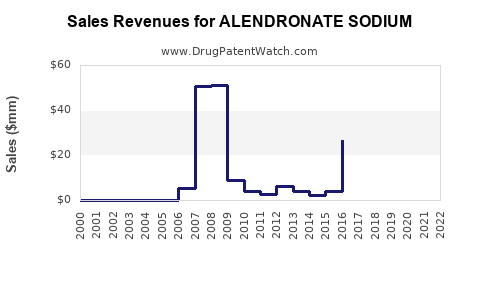
Featured snippet answer: Financial trajectory has followed the classic pattern for mature oral small-molecule brands: high initial branded revenue, followed by steep erosion upon generic entry, then long-run low-margin stability with periodic contract-driven price swings.
What revenue drivers remain after genericization
- Epidemiology and persistence: osteoporosis incidence and long-term adherence.
- Mix shift: weekly regimens vs daily regimens, strength mix (35/70 mg vs 5/10 mg).
- Formulary stability: sustained inclusion in major formularies supports volume.
- Switching behavior: switching from other bisphosphonates for cost reasons.
- Supply reliability: out-of-stock events can transiently increase prices.
What revenue headwinds remain structurally
- Continued rebate pressure
- Commodity-like manufacturing economics
- Generic pricing compression across multiple labels
How settlement and litigation dynamics typically play out
For a fully mature molecule, the dominant litigation patterns tend to occur earlier, affecting timing of initial generic launches. In the current stage, litigation typically does not change the category’s long-run economics materially.
What is the likely market size and revenue exposure by product format (tablet vs others)?
Featured snippet answer: Revenue exposure is primarily tablet formulations across multiple strengths (oral daily and weekly). Non-tablet formats are generally not the commercial core for this molecule in mainstream US prescribing.
Product format exposure
- Tablet oral is the bulk of commercial volume.
- Distribution is strength-dependent (weekly 70 mg tends to concentrate prescription volume).
- Any minor share from alternative packaging or strength-specific formulations still competes in a multi-NDC generics ecosystem.
What key takeaways matter for investors, licensors, and formulary stakeholders?
- Alendronate sodium is an off-patent, highly genericized small molecule; pricing power is structurally limited.
- Financial trajectory is dominated by volume and mix (daily vs weekly, strength mix) plus contracting dynamics, not exclusivity.
- Market dynamics are commodity-like: winners are those with supply reliability, broad NDC coverage, and strong PBM/GPO contracting.
- “Exclusivity” today is not a category-level revenue driver; it is at most narrow and product-specific.
- Competitive risk is mainly pricing erosion and supply disruption rather than blocked generic competition.
FAQs
1) Why is alendronate sodium usually cheaper than other osteoporosis treatments?
Because it is widely available as multi-source generics after prior brand exclusivity periods ended, driving net price down through contracting and rebate competition.
2) Does alendronate sodium have fewer regulatory barriers than newer osteoporosis drugs?
Yes. Generic alendronate sodium is already established through ANDAs for multiple strengths, so market access barriers are primarily commercial rather than initial regulatory.
3) What dosage strength is most associated with revenue in US osteoporosis prescriptions?
Weekly 70 mg is typically the most visible strength in osteoporosis care due to dosing convenience and prescribing patterns.
4) Can shortages of alendronate sodium temporarily raise prices?
Yes. Manufacturing outages or quality-related supply interruptions can cause short-term wholesale and net price movements even in an off-patent category.
5) Is there biosimilar competition risk for alendronate sodium?
No. It is a small molecule, not a biologic, so biosimilar pathways do not apply.
References
- FDA. Orange Book: Approved Drug Products with Therapeutic Equivalence Evaluations. US FDA (accessed 2026).
- FDA. ANDA Drug Approval Reports. US FDA (accessed 2026).
- FDA. Drug Shortages. US FDA (accessed 2026).