Share This Page
Drug Sales Trends for ALENDRONATE SODIUM
✉ Email this page to a colleague
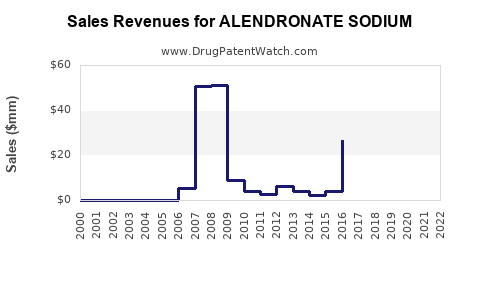
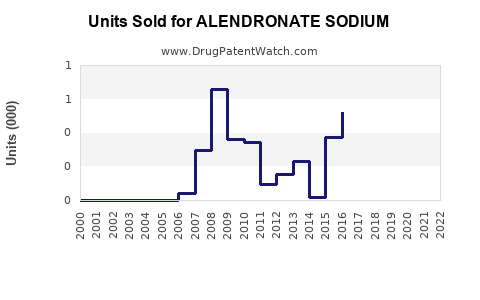
Annual Sales Revenues and Units Sold for ALENDRONATE SODIUM
| Drug Name | Revenues (USD) | Units | Year |
|---|---|---|---|
| ALENDRONATE SODIUM | ⤷ Start Trial | ⤷ Start Trial | 2022 |
| ALENDRONATE SODIUM | ⤷ Start Trial | ⤷ Start Trial | 2021 |
| ALENDRONATE SODIUM | ⤷ Start Trial | ⤷ Start Trial | 2020 |
| ALENDRONATE SODIUM | ⤷ Start Trial | ⤷ Start Trial | 2019 |
| ALENDRONATE SODIUM | ⤷ Start Trial | ⤷ Start Trial | 2018 |
| ALENDRONATE SODIUM | ⤷ Start Trial | ⤷ Start Trial | 2017 |
| ALENDRONATE SODIUM | ⤷ Start Trial | ⤷ Start Trial | 2016 |
| >Drug Name | >Revenues (USD) | >Units | >Year |
Alendronate Sodium Market Analysis, Sales Forecast, Patent Status, and Generic Competition
Alendronate sodium is a mature, low-cost generic bisphosphonate used primarily for osteoporosis. Its commercial market is declining gradually in value because branded Fosamax exclusivity has expired, prices are compressed, and generic substitution is high. Volume should remain comparatively stable through 2030 because alendronate remains a guideline-supported first-line treatment and is widely available in once-weekly 70 mg tablets.
The global finished-dose market is estimated at approximately $280 million to $360 million in 2024. Under a base-case model, revenue declines at roughly 2% to 3% annually to $260 million to $290 million by 2030. The principal commercial opportunity is low-cost, high-volume supply rather than premium pricing or new intellectual property.
What is the current market size for alendronate sodium?
Alendronate sodium is a mature generic market with limited reliable public reporting at the individual molecule level. Most manufacturers do not disclose product-specific revenue. The following estimate covers global finished-dose sales for alendronate sodium tablets and oral solution, excluding calcium and vitamin D products sold as separate products.
| Metric | 2024 estimate |
|---|---|
| Global finished-dose market | $280 million-$360 million |
| U.S. market | $90 million-$130 million |
| U.S. prescription volume | Approximately 8 million-12 million prescriptions |
| Dominant dosage form | 70 mg once-weekly tablet |
| Generic share of U.S. volume | More than 95% |
| Branded share | Minimal |
| Market stage | Mature generic |
| Primary demand driver | Osteoporosis treatment and fracture prevention |
The estimate is based on the molecule’s generic status, U.S. prescription availability, long-term use in osteoporosis, low unit prices, and the absence of meaningful branded pricing power. Public revenue data should not be interpreted as a company-reported market total.
Alendronate competes with generic risedronate, ibandronate, zoledronic acid, denosumab, anabolic osteoporosis agents, and oral calcium/vitamin D regimens. It remains attractive to payers because the acquisition cost is low and clinical experience is extensive.
What are the sales projections for alendronate sodium through 2030?
The base case assumes continued generic price erosion, stable or modestly declining prescription volume, and no major safety-related regulatory action. Revenue is measured in global finished-dose sales.
| Year | Base-case revenue | Low case | High case |
|---|---|---|---|
| 2024 | $320 million | $280 million | $360 million |
| 2025 | $312 million | $268 million | $355 million |
| 2026 | $304 million | $257 million | $350 million |
| 2027 | $296 million | $247 million | $345 million |
| 2028 | $289 million | $238 million | $340 million |
| 2029 | $282 million | $229 million | $335 million |
| 2030 | $275 million | $220 million | $330 million |
Base-case assumptions
The base case implies a compound annual growth rate of approximately negative 2.5% from 2024 to 2030. The decline is driven by:
- lower generic prices;
- continued substitution among multiple approved suppliers;
- treatment switching to denosumab or intravenous bisphosphonates in higher-risk patients;
- greater use of drug holidays after extended bisphosphonate therapy;
- limited ability to create premium differentiation.
Volume should decline more slowly than revenue. In some markets, prescription volume may remain flat while price per prescription falls. Alendronate’s once-weekly 70 mg formulation supports adherence and reduces the risk of rapid volume loss.
Which factors will drive alendronate sodium demand?
The main demand supports are clinical familiarity, low cost, and guideline positioning.
Osteoporosis prevalence
The aging population increases the number of patients eligible for antiresorptive therapy. The International Osteoporosis Foundation estimates that osteoporosis affects hundreds of millions of people worldwide, with the highest treatment need among postmenopausal women and older men.[1]
Alendronate is commonly used for:
- postmenopausal osteoporosis;
- osteoporosis in men;
- glucocorticoid-induced osteoporosis;
- fracture-risk reduction in patients with low bone mineral density;
- selected Paget’s disease indications.
Guideline support
The Endocrine Society and other clinical organizations continue to identify oral bisphosphonates as standard initial therapy for many patients at high fracture risk.[2] Generic alendronate often has preferred formulary status because it is substantially less expensive than branded or injectable alternatives.
Low acquisition cost
Wholesale prices are compressed, but low cost supports formulary inclusion. The product can remain commercially relevant even when per-unit margins are narrow because manufacturing technology is established and demand is recurring.
Adherence limitations
Alendronate has administration requirements that restrict growth. Patients must take it with plain water, remain upright after dosing, and avoid food or other medicines for a defined period. Gastrointestinal intolerance and adherence failures can cause switching to risedronate, zoledronic acid, or denosumab.[3]
How does alendronate sodium compare with competing osteoporosis drugs?
| Product | Administration | Generic status | Main commercial position |
|---|---|---|---|
| Alendronate sodium | Daily or weekly oral tablet; oral solution | Generic | Lowest-cost first-line option |
| Risedronate sodium | Daily, weekly, or monthly oral dosing | Generic | Alternative oral bisphosphonate |
| Ibandronate sodium | Monthly oral or quarterly IV dosing | Generic | Less comprehensive fracture indication profile |
| Zoledronic acid | Annual IV infusion | Generic | Adherence advantage; administration cost |
| Denosumab | Six-month subcutaneous injection | Branded/generic competition emerging in some markets | Higher-cost alternative for selected patients |
| Teriparatide | Daily injection | Generic and biosimilar competition in some markets | Anabolic therapy for high-risk patients |
| Romosozumab | Monthly injection | Branded | High-risk fracture treatment |
Alendronate’s primary competitive advantage is price. Its main disadvantages are gastrointestinal administration requirements, poor adherence in some patients, and lower convenience than annual intravenous or six-month injectable therapies.
What formulations are protected by alendronate sodium patents?
The principal marketed formulations are:
| Formulation | Common strengths | Commercial status |
|---|---|---|
| Immediate-release tablets | 5 mg, 10 mg, 35 mg, 40 mg, 70 mg | Generic |
| Oral solution | Commonly 70 mg per 75 mL | Generic in selected markets |
| Combination products | Alendronate with cholecalciferol or calcium-related products | Market-specific |
The 70 mg once-weekly tablet is the commercially important formulation. Daily 5 mg and 10 mg strengths are used less often but remain available for selected treatment and prevention regimens. The 35 mg weekly strength has a role in prevention.
Formulation patents associated with branded Fosamax have expired or no longer provide a meaningful barrier to ordinary generic tablet competition. Future patent value is more likely to arise from differentiated delivery systems, improved tolerability, combination products, or specialized packaging than from the basic active ingredient.
When does alendronate sodium lose exclusivity?
Alendronate sodium lost meaningful U.S. market exclusivity years ago. Merck’s Fosamax became subject to generic competition after expiration of the relevant compound and regulatory exclusivity protections, with generic versions entering the U.S. market in the mid-2000s.
| Exclusivity category | Current position |
|---|---|
| Active ingredient exclusivity | Expired |
| Branded product exclusivity | Expired |
| U.S. regulatory exclusivity | Expired |
| Core composition patent protection | Expired |
| Generic ANDA competition | Established |
| Biosimilar exclusivity | Not applicable |
Alendronate is a small molecule, not a biologic. Biosimilar risk therefore does not apply. The relevant competitive threat is conventional ANDA-approved generic competition.
What is the Orange Book status of alendronate sodium?
The FDA Orange Book identifies approved reference-listed drugs and associated patent or exclusivity information.[4] For alendronate sodium, the relevant reference product is Fosamax or an applicable FDA reference-listed product, depending on dosage form and indication.
The commercial significance of Orange Book status is limited because:
- the key branded exclusivity periods have expired;
- multiple generic suppliers have entered;
- generic pricing is already established;
- no active branded patent estate appears to block ordinary tablet competition.
Individual ANDA applicants may still face product-specific patent certifications, formulation issues, or regulatory review questions. Those matters do not change the overall conclusion that alendronate is an open generic market.
Which companies compete in the alendronate sodium market?
Competition varies by country and dosage strength. Companies that have marketed or supplied generic alendronate products in the United States and international markets include Teva Pharmaceutical Industries, Viatris and legacy Mylan businesses, Sandoz, Apotex, Dr. Reddy’s Laboratories, Sun Pharmaceutical Industries, Zydus Lifesciences, Amneal Pharmaceuticals, and smaller regional manufacturers.
The market is fragmented. No single supplier is likely to control the global market because:
- the product is off-patent;
- tablet manufacturing is established;
- pharmacy substitution is common;
- payer contracts favor low prices;
- supply can shift among approved manufacturers.
The strongest suppliers are those with reliable API sourcing, FDA-compliant manufacturing, competitive ANDA portfolios, and the ability to maintain supply during shortages or plant interruptions.
What generic entry risks exist for alendronate sodium?
Generic entry risk is already realized rather than prospective. The key commercial risks are now price and supply risks.
Price erosion
Additional suppliers can reduce average selling prices, particularly for the 70 mg weekly tablet. The market has limited differentiation, so contracts often turn on price, service levels, and continuity of supply.
Manufacturing concentration
Alendronate sodium API and finished-dose manufacturing may be concentrated among a limited number of qualified suppliers in some regions. A manufacturing suspension, inspection finding, or API shortage could temporarily increase prices or shift market share.
Product quality and bioequivalence
Although alendronate is an established oral product, manufacturers must maintain content uniformity, dissolution performance, stability, and bioequivalence. Regulatory action against a major supplier could create short-term supply opportunities for competitors.
Clinical switching
Patients with adherence problems, gastrointestinal symptoms, renal limitations, or high fracture risk may switch to injectable therapies. This limits long-term volume expansion even when osteoporosis prevalence rises.
What is the patent strength of the alendronate sodium estate?
The patent estate is weak for the basic active ingredient and standard oral tablets.
| Patent category | Strength in 2024 |
|---|---|
| Core molecule | Very weak; expired |
| Standard tablet composition | Weak; generic competition established |
| Weekly dosing concept | Weak; commercially established |
| Oral solution | Limited protection value |
| Combination products | Potentially moderate if independently claimed |
| Manufacturing process | Potentially relevant but generally non-blocking |
| New delivery system | Potentially strong if clinically differentiated |
A new entrant should not rely on basic composition patents to support premium pricing. The defensible areas are product quality, supply reliability, formulation tolerability, packaging, combination therapy, and regulatory execution.
Are there Paragraph IV challenges or alendronate patent lawsuits?
Paragraph IV litigation is most commercially relevant when an ANDA applicant challenges an unexpired Orange Book patent. For ordinary alendronate sodium tablets, the principal patent barriers have expired, so the market does not present the same litigation profile as a recently launched branded drug.
No active patent dispute is central to the current commercial outlook for standard generic alendronate sodium. Any litigation risk would more likely concern:
- a new combination formulation;
- a modified-release product;
- a branded reformulation;
- a manufacturing process;
- a dosage regimen with separate patent claims.
Settlement agreements are not a material factor in the mature generic market. The value of a Paragraph IV strategy is low unless a supplier identifies a surviving, commercially relevant claim covering a differentiated formulation.
What licensing deals affect alendronate sodium?
Large, publicly reported licensing transactions are not central to the standard alendronate sodium market. Most supply arrangements are expected to involve:
- API purchase agreements;
- contract manufacturing;
- regional distribution;
- private-label supply;
- licensing of combination products.
The commercial value of a licensing deal is likely to depend on regulatory approvals, manufacturing capacity, geographic rights, and supply guarantees rather than exclusivity over alendronate itself.
What is the FDA regulatory status of alendronate sodium?
Alendronate sodium is FDA-approved as an oral bisphosphonate for osteoporosis-related indications and Paget’s disease under applicable product labeling.[5] Generic products are approved through the ANDA pathway by demonstrating pharmaceutical equivalence and bioequivalence to the reference product.
Important regulatory considerations include:
- renal function limitations;
- contraindications involving esophageal abnormalities;
- hypocalcemia;
- administration with water and posture restrictions;
- osteonecrosis of the jaw warnings;
- atypical femoral fracture warnings;
- duration-of-therapy and drug-holiday considerations.
These warnings affect prescribing and adherence but have not removed alendronate from first-line treatment algorithms.
What is the commercial outlook for alendronate sodium?
Alendronate sodium is a stable but declining generic market. The best commercial opportunities are operational:
- securing low-cost API;
- maintaining FDA-compliant manufacturing;
- supplying the 70 mg weekly tablet;
- obtaining preferred formulary or wholesaler access;
- reducing back-order risk;
- expanding in price-sensitive international markets.
A new entrant faces low regulatory novelty but strong price competition. A supplier with excess tablet capacity can achieve acceptable returns through scale and dependable supply. A premium launch without formulation or adherence differentiation is unlikely to succeed.
Key Takeaways
- Alendronate sodium is an established generic osteoporosis medicine with expired core exclusivity.
- Global finished-dose revenue is estimated at $280 million to $360 million in 2024.
- Base-case revenue is projected to decline to approximately $275 million by 2030.
- The 70 mg once-weekly tablet is the principal commercial formulation.
- U.S. generic penetration is above 95% by volume.
- Biosimilar risk does not apply because alendronate is a small molecule.
- The Orange Book does not present a meaningful blocking patent barrier for standard tablets.
- The main risks are price erosion, manufacturing interruptions, adherence limitations, and switching to injectable osteoporosis therapies.
- Patent value is limited for the basic molecule but may exist in differentiated formulations, combination products, and manufacturing processes.
- Commercial success depends on scale, supply reliability, and low cost rather than exclusivity.
FAQs
Is alendronate sodium still a profitable generic drug?
Yes, but profitability depends on manufacturing scale, API cost, supply reliability, and contract access. The product is unlikely to support high margins because several generic suppliers compete on price.
Which alendronate sodium strength has the highest demand?
The 70 mg once-weekly tablet is generally the leading formulation because it reduces dosing frequency and is widely used for osteoporosis treatment.
Can a company obtain new patents on alendronate sodium?
New patents may be available for a genuinely differentiated formulation, combination product, delivery system, or manufacturing process. A new patent on the basic active ingredient is not commercially viable because core protection has expired.
Is alendronate sodium safer than denosumab?
The products have different risk profiles and patient-selection criteria. Alendronate has gastrointestinal administration limitations and rare long-term skeletal risks, while denosumab has injection-related considerations and rebound fracture risk after discontinuation. Treatment choice depends on renal function, fracture risk, adherence, and clinical history.
Will alendronate sodium sales increase with an aging population?
Patient need may increase, but revenue is unlikely to rise proportionally. Generic price erosion, treatment switching, drug holidays, and competition from injectable products are expected to offset much of the demographic demand growth.
References
- International Osteoporosis Foundation. (2023). Epidemiology of osteoporosis and fragility fractures. https://www.osteoporosis.foundation
- Eastell, R., Rosen, C. J., Black, D. M., Cheung, A. M., Murad, M. H., & Shoback, D. (2019). Pharmacological management of osteoporosis in postmenopausal women: An Endocrine Society guideline update. Journal of Clinical Endocrinology & Metabolism, 104(5), 1595-1622.
- U.S. Food and Drug Administration. (2024). Fosamax and alendronate sodium prescribing information. https://www.accessdata.fda.gov
- U.S. Food and Drug Administration. (2024). Approved drug products with therapeutic equivalence evaluations: Orange Book. https://www.fda.gov/drugsatfda
- U.S. National Library of Medicine. (2024). Alendronate sodium drug labels. DailyMed. https://dailymed.nlm.nih.gov
More… ↓
