Last updated: July 21, 2026
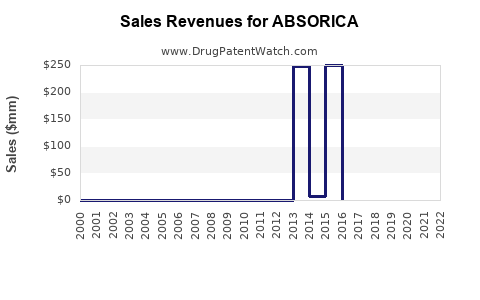
ABSORICA market dynamics and financial trajectory: revenue trends, channel drivers, exclusivity headwinds, and generic/biosimilar risk
ABSORICA (isotretinoin) is a long-established systemic acne drug marketed under a risk management program and competing against multiple isotretinoin equivalents. Near-term market dynamics are dominated by: (1) share pressure from other isotretinoin branded products and generics, (2) iPLEDGE-driven prescribing and patient-access friction, and (3) the practical economics of switching within therapeutically equivalent isotretinoin products.
Because ABSORICA is not a novel drug class and isotretinoin has multiple marketed alternatives, the financial trajectory typically tracks broader acne-severity incidence, prescriber adherence to isotretinoin, payer management, and the level of generic penetration in the isotretinoin market. The brand’s revenue is therefore sensitive to formulary status and to the pricing spread between ABSORICA and AB-rated isotretinoin products.
What is ABSORICA’s commercial position versus other isotretinoin brands and generics?
Short answer: ABSORICA competes in a crowded isotretinoin market where branded share generally depends on formulary placement and pricing relative to AB-generic isotretinoin.
Who are the main competitive comparators?
ABSORICA’s competitive set is isotretinoin products across:
- Branded systemic isotretinoin (marketed in the same therapeutic niche of severe recalcitrant nodular acne).
- Generic isotretinoin products (AB-rated equivalents).
- Interchange within isotretinoin dosing (switching behavior driven by payers and pharmacy benefit managers).
What drives prescribing and switching economics?
- Acne severity stratification: Prescribers target isotretinoin for severe recalcitrant nodular acne and similar indications managed under dermatology pathways.
- Access friction: Patient enrollment and monthly requirements under iPLEDGE affect patient throughput and continuation rates.
- Cost-control levers: Formularies often favor lower net-cost isotretinoin products, pushing switching away from a single brand unless that brand has favorable rebates or exclusive access in a plan.
How do pharmacy benefits typically shape brand retention?
For older systemic specialty products with mature generic competition, brand retention usually correlates with:
- rebate intensity and contract coverage,
- step edits for higher-cost brands,
- and pharmacy substitution rules.
How does iPLEDGE influence ABSORICA demand and revenue stability?
Short answer: iPLEDGE reduces frictionless prescribing and can dampen demand volatility, but it does not eliminate switching toward cheaper isotretinoin options when formulary pressure intensifies.
Demand-impact channels
- New starts volume: iPLEDGE workflow can slow new patient onboarding, especially where infrastructure and staff training vary by clinic.
- Treatment continuity: monthly verification can reduce continuation in real-world settings, affecting per-patient total prescriptions and reorder patterns.
- Regional and provider variability: dermatology centers with established workflows tend to initiate and manage isotretinoin more consistently.
Revenue stability implication
Even when clinical demand exists, the administrative burden creates an operational floor on throughput. That typically makes short-term demand less elastic than pure price changes, but it does not protect a brand when net price moves unfavorably versus generics.
When does ABSORICA lose exclusivity, and how does that affect financial trajectory?
Short answer: ABSORICA’s commercial phase is primarily shaped by generic availability timelines in isotretinoin rather than by a single brand “entry cliff.”
Exclusivity and patent estate effects (commercial lens)
For established isotretinoin brands, the financial inflection typically occurs when:
- key composition-of-matter and formulation protections expire, enabling AB generic entry, and
- subsequent paragraph IV litigation and settlements conclude, clearing additional generic launches.
Practical effect on revenue
- Post-launch generic penetration: drives rapid gross-to-net compression as brands lose pharmacy and payer preferences.
- Share erosion: generally steep in the first 6 to 18 months after major generic entries, then moderates as remaining share concentrates in higher-rebate contracting and prescriber preference pockets.
- Net revenue dependence: shifts from volume growth to retention via contracts.
What patent or formulation protections affect ABSORICA market access?
Short answer: ABSORICA’s market access risk is primarily tied to whether any remaining patents protect a specific formulation, dosing, or use beyond AB-equivalent isotretinoin.
Where companies tend to find “durable” commercial protection in isotretinoin
- Formulation patents (if any protect particle, release, or other product characteristics distinct from AB generics).
- Method-of-use patents tied to specific regimens or patient-selection criteria.
- Manufacturing/process patents that can delay entry but are less likely to block AB substitution long term once generic parity is demonstrated.
Commercial meaning for ABSORICA
If any protectable differentiation remains, the impact is usually modest compared with the core economic pull toward AB generics unless the brand has meaningful contract coverage.
What FDA regulatory status does ABSORICA have, and how does it translate to competition?
Short answer: ABSORICA is an FDA-approved isotretinoin product competing in a regulatory environment where AB-rated generics can enter once listed exclusivities and relevant patents are cleared.
Orange Book dynamics that matter for ABSORICA (business view)
- If listed patents remain in force: branded product can deter initial AB filings or force litigation.
- Once cleared/expired: generic entry becomes mostly a commercial decision and pricing strategy issue for developers.
FDA pathway implications for competitors
- ANDA with Paragraph IV filings can accelerate entry post-settlement.
- Label and bioequivalence: AB substitution generally supports quick uptake at the pharmacy counter.
What generic entry risks exist for ABSORICA, including Paragraph IV pathways?
Short answer: Generic risk is structurally high because isotretinoin is an established active ingredient with multiple market entrants historically.
How Paragraph IV changes the timeline
Paragraph IV challenges can:
- compress exclusivity windows through settlements,
- accelerate launch through generic court outcomes,
- or keep the brand’s effective protection longer if litigation delays entry.
Commercial risk ranking
- Highest risk: scenarios where multiple ANDA approvals clear around the same period.
- Medium risk: single entrant or narrow patent obstacles resolved.
- Lower risk: if litigation extends beyond expected windows and reduces generic launch cadence.
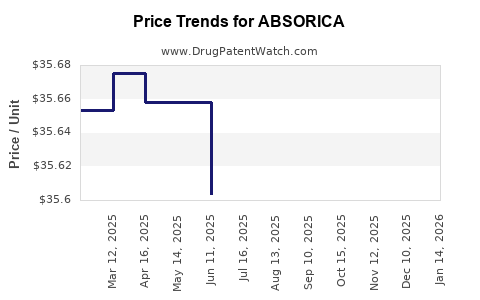
What ABSORICA pricing and gross-to-net trends typically look like during generic penetration?
Short answer: As generic penetration rises, brand gross-to-net usually compresses due to lost market share, rebate adjustments, and contract renegotiations.
Common financial mechanics
- Rebate re-optimization: brand reduces net price to maintain coverage, harming gross margins.
- Volume shift to AB products: reduces sell-in volume and forces marketing spend and contracting spend higher as a percentage of revenue.
- Mix effects: if patients shift to different isotretinoin products, the brand’s remaining volumes may become lower-margin.
How does ABSORICA compare with other acne therapeutics in market dynamics?
Short answer: ABSORICA faces not only generic isotretinoin competition but also therapeutic competition from topical and systemic acne regimens that can reduce isotretinoin “necessity” for some patients.
Competitive substitution outside isotretinoin
- Topical retinoids, benzoyl peroxide, topical antibiotics
- Oral antibiotics (often limited by resistance management)
- Hormonal therapies for acne (in appropriate populations)
- Oral alternatives in some clinical pathways
Why isotretinoin still anchors severe disease
Even with alternatives, severe recalcitrant nodular acne continues to drive isotretinoin demand. The brand’s revenue trajectory depends on what share of patients progress to isotretinoin after trial of other options.
What litigation or settlement agreements could affect ABSORICA revenue timelines?
Short answer: Settlement outcomes can accelerate generic entry and create revenue step-downs that are sharper than routine patent expiration.
What settlement timing typically changes
- entry start date for specific ANDA filers,
- carve-outs on the label or product form,
- and at times co-promotion or licensing arrangements.
Litigation’s business effect
- Before settlement: the market expects delays or partial entry, supporting higher brand confidence in contracts.
- After settlement: competitors schedule manufacturing and distribution, triggering rapid formulary switching.
What manufacturing and supply-chain constraints affect ABSORICA availability and sales?
Short answer: Shortages are revenue-negative because iPLEDGE-based treatment cycles can’t easily pause, but supply constraints are not a primary structural driver compared with generic competition.
Real-world drivers
- capacity and procurement for isotretinoin API,
- stability and packaging lead times,
- compliance and inspection outcomes,
- and distribution disruptions.
Financial impact pattern
In shortage periods, brands may capture demand that would otherwise flow to competitors, temporarily supporting revenue. Over longer horizons, generic price advantages typically dominate once supply normalizes.
Key financial trajectory framework for ABSORICA: what to track quarter to quarter
Short answer: ABSORICA’s financial trajectory is best understood through three metrics: unit volume changes versus isotretinoin AB equivalents, net price and rebate pressure, and formulary status changes.
High-signal KPI set
- Total prescriptions and units (brand vs AB isotretinoin)
- Average realized price and gross-to-net trend
- Channel inventory at wholesalers
- Formulary coverage counts by payer segment
- Dispensing share in key PBM books of business
- Contracting events (new rebate agreements, formulary exclusions)
Scenario map
- Generic acceleration + rebate tightening: rapid revenue decline.
- Stable coverage + modest price cuts: slower decline, often with margin compression.
- Formulary wins against generics: rare but can flatten the slope temporarily.
ABSORICA revenue exposure: concentration in dermatology and insurer formularies
Short answer: The brand’s revenue exposure is concentrated in dermatology prescribing patterns and payer formularies where iPLEDGE-managed isotretinoin is treated as a specialty pharmacy or limited formulary product.
What payer segments matter most
- Commercial plans with active PBM management
- Medicaid populations with different formulary and administrative friction patterns
- Cash-pay dynamics (usually small relative to insured specialty use)
How utilization management shows up in financials
- prior authorization in some plans,
- step therapy behavior where appropriate,
- and brand exclusion unless net price is competitive.
Key Takeaways
- ABSORICA operates in a mature isotretinoin market where demand is moderated by iPLEDGE workflow and heavily pressured by AB generic alternatives.
- The brand’s financial trajectory is typically driven more by formulary access, rebate pressure, and generic penetration pace than by therapeutic innovation.
- Generic entry timelines tied to Orange Book-listed patents and any Paragraph IV litigation outcomes are the main accelerants of revenue decline.
- Near-term revenue depends on whether ABSORICA maintains favorable net pricing and coverage versus AB isotretinoin products.
FAQs
1) What happens to ABSORICA sales when isotretinoin generics expand across major PBMs?
Brand share typically declines quickly due to formulary preference shifts, leading to net price and margin compression. Revenue often follows a steep post-entry slope before stabilizing at a smaller covered niche.
2) Does iPLEDGE make ABSORICA demand less sensitive to price?
It can reduce elasticity for new starts and continuity, but it does not offset payer-driven switching once net price for generics undercuts the brand.
3) How do contract and rebate changes translate into ABSORICA quarterly performance?
Rebate increases and stronger coverage can slow volume erosion, but realized net revenue usually compresses as the brand competes for formulary placement.
4) What is the biggest financial risk for ABSORICA versus other acne drugs?
The biggest structural risk is accelerated substitution by AB isotretinoin generics, not therapeutic competition from non-isotretinoin acne regimens.
5) Are formulation or method-of-use patents likely to protect ABSORICA longer than composition-of-matter?
Protection can be narrower and less effective commercially once AB-equivalent isotretinoin is available. Formulation/method claims may delay specific entries but rarely stop broader generic substitution over time.
References
- FDA. Drug Approval Package for ABSORICA (isotretinoin). U.S. Food and Drug Administration.
- FDA. iPLEDGE Program. U.S. Food and Drug Administration.
- FDA. Orange Book: Approved Drug Products with Therapeutic Equivalence Evaluations. U.S. Food and Drug Administration.