Last updated: September 7, 2026
Isotretinoin is a mature generic dermatology market with low compound-level patent risk, limited pricing power, and demand supported by severe acne treatment. The original Accutane franchise has lost exclusivity, while branded formulations such as Absorica and Absorica LD compete through absorption characteristics, prescribing convenience, and product differentiation rather than core molecule protection. Financial value has shifted from originator economics to high-volume generic supply and niche branded formulations.
The principal market constraints are pregnancy-prevention controls, adverse-effect monitoring, supply reliability, and reimbursement. Isotretinoin is not a biosimilar market. It is an orally administered small molecule with multiple approved generic products.
What is the current market position of isotretinoin?
Isotretinoin is used primarily for severe recalcitrant nodular acne and selected cases of treatment-resistant acne. In the United States, FDA-approved products include generic isotretinoin capsules and branded formulations including Absorica and Absorica LD. Accutane, Roche’s original U.S. brand, is no longer marketed in the United States.
The market has four commercial layers:
| Market layer |
Principal products |
Commercial position |
| Originator brand |
Accutane |
Historical franchise; no current U.S. commercial role |
| Branded formulations |
Absorica, Absorica LD |
Premium products differentiated by food requirements and formulation |
| Authorized or conventional generics |
Isotretinoin capsules, including Claravis, Amnesteem and generic equivalents |
Largest competitive segment |
| International brands and generics |
Roaccutane and country-specific products |
Fragmented by jurisdiction and regulatory status |
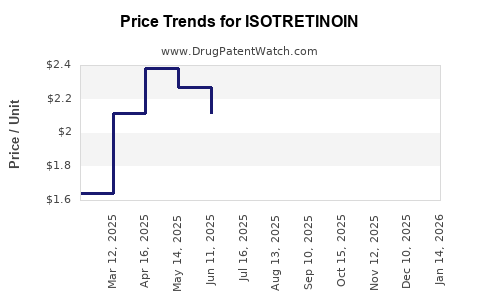
Generic isotretinoin has reduced the average selling price over time. Branded products retain value where prescribers or patients prioritize formulation attributes, insurance coverage, pharmacy access, or reduced dependence on dietary fat for absorption.
FDA labeling identifies isotretinoin as a treatment for severe recalcitrant nodular acne and requires strict pregnancy-prevention controls because of the drug’s high teratogenic risk.[1]
How large is the isotretinoin market and what is its financial trajectory?
Public companies generally do not report isotretinoin revenue as a separate line item. Financial analysis therefore depends on prescription volume, product mix, market research, and company disclosures rather than audited drug-level sales.
The financial trajectory has followed four stages:
- Originator expansion. Accutane generated substantial revenue for Roche before generic competition and product-liability costs altered the franchise.
- Generic erosion. Multiple manufacturers entered after loss of compound exclusivity, compressing prices and distributing volume across suppliers.
- Branded reformulation. Absorica and Absorica LD created premium segments based on formulation and absorption claims.
- Mature-market stabilization. Current value is concentrated in recurring prescription demand, generic manufacturing efficiency, and limited branded differentiation.
| Economic driver |
Effect on market value |
| High prescription volume in dermatology |
Supports stable unit demand |
| Multiple generic suppliers |
Compresses price and margins |
| Teratogenicity and iPLEDGE controls |
Increase dispensing friction and operating cost |
| Absorica formulation differentiation |
Supports premium pricing in selected channels |
| Limited treatment duration |
Restricts lifetime revenue per patient |
| No meaningful compound exclusivity |
Prevents originator-level pricing |
The market is commercially durable but not a high-growth pharmaceutical franchise. Revenue growth is more likely to come from prescription expansion, channel gains, or premium formulation conversion than from price increases.
Which companies have the greatest exposure?
Sun Pharmaceutical Industries has the clearest branded exposure through Absorica and Absorica LD. Generic exposure is distributed among manufacturers and marketers that have received FDA approval for isotretinoin capsules. Teva, Amneal, Viatris-related businesses, Dr. Reddy’s Laboratories, and other generic suppliers have participated in the broader U.S. dermatology market at different times, although product availability can change by manufacturer and wholesaler.
No single company’s public financial reporting reliably isolates isotretinoin revenue. The commercial risk is therefore more relevant at the product and portfolio level than at the consolidated-company level.
When did isotretinoin lose exclusivity?
The active pharmaceutical ingredient is old and no longer protected by an enforceable composition-of-matter patent in the United States. Accutane’s principal commercial exclusivity ended before the modern market of generic isotretinoin capsules was established.
The FDA approved the first generic isotretinoin products through the Abbreviated New Drug Application pathway after the relevant listed exclusivities and patent barriers no longer prevented approval. The Orange Book records approved products, reference drugs, listed patents, and regulatory exclusivity information.[2]
The practical exclusivity position is:
| Protection type |
Current position |
| Compound patent |
Expired |
| Original Accutane brand exclusivity |
Expired |
| New chemical entity exclusivity |
Expired |
| Core indication protection |
No meaningful market-blocking protection |
| Formulation patents |
Potentially relevant to specific branded products |
| Method-of-use patents |
Limited commercial significance compared with generic access |
| REMS-related controls |
Regulatory burden, not market exclusivity |
Isotretinoin’s market is therefore governed principally by FDA approval, manufacturing economics, formulation claims, and distribution controls.
What is the Orange Book status of isotretinoin?
The FDA Orange Book lists approved isotretinoin products and identifies reference-listed drugs and any associated patents or exclusivities.[2] The original Accutane product is not the source of current U.S. market power. Generic isotretinoin capsules can compete on the basis of therapeutic equivalence where FDA ratings and labeling support substitution.
A product may remain commercially differentiated even without strong patent protection if it has:
- A recognized brand;
- A formulation that changes food-dependent absorption;
- Established prescriber familiarity;
- Favorable payer placement;
- Reliable availability through certified pharmacies;
- A manufacturer with strong dermatology distribution.
Absorica was developed to provide more predictable absorption without the same high-fat meal requirement associated with certain conventional isotretinoin products. Absorica LD uses a lower-dose formulation intended to provide alternative dosing flexibility.[3,4]
What patents protect Absorica and Absorica LD?
The principal intellectual-property distinction is between isotretinoin as a molecule and formulation-specific protection.
The original molecule has no commercially meaningful active patent protection. Branded products may rely on patents covering composition, particle characteristics, absorption behavior, dosage form, or manufacturing processes. Those rights do not automatically block all generic isotretinoin products. Their commercial scope depends on claim language, Orange Book listing, litigation outcomes, and whether an ANDA applicant makes a valid Paragraph IV challenge.
The relevant patent questions are product-specific:
- Does the patent claim the active ingredient or only a formulation?
- Is the patent listed in the Orange Book?
- Does the generic product practice the claimed feature?
- Is the patent still unexpired after patent-term adjustment or extension?
- Has a court upheld, narrowed, or invalidated the patent?
- Does the generic applicant use a Paragraph IV certification?
FDA labeling confirms the differentiated administration requirements for Absorica and Absorica LD.[3,4] Patent protection for these products should be assessed against the current Orange Book listings and USPTO records rather than inferred from the brand name alone.
Are there Paragraph IV challenges to isotretinoin products?
Paragraph IV litigation is most relevant to branded formulation products, not to the expired isotretinoin molecule. An ANDA applicant may certify that a listed patent is invalid, unenforceable, or not infringed. The filing can trigger litigation and a potential 30-month stay under the Hatch-Waxman framework.[5]
For isotretinoin, a Paragraph IV dispute would usually involve:
- Absorption technology;
- Food-effect claims;
- Particle-size or formulation claims;
- Capsule composition;
- Dose-specific delivery characteristics.
A Paragraph IV challenge to a branded formulation would not necessarily eliminate conventional generic isotretinoin competition. It would affect only the challenged product’s formulation-specific barrier.
Publicly available regulatory records through mid-2024 do not establish a current patent dispute that has materially changed the overall U.S. isotretinoin market. The market remains generic-led, with formulation patents acting as selective barriers around premium products.
What litigation affects isotretinoin?
Isotretinoin has generated extensive product-liability litigation, particularly involving inflammatory bowel disease claims, psychiatric effects, and other alleged adverse outcomes. Those cases differ from patent litigation and have affected the commercial history of Accutane.
The U.S. Supreme Court addressed Accutane-related product-liability issues in Roche Laboratories, Inc. v. Meditz and related federal litigation involving warning adequacy and causation. Product-liability exposure contributed to the commercial decline of the original brand, although it did not restore market exclusivity.
The regulatory record continues to emphasize serious risks, including birth defects, depression-related concerns, lipid abnormalities, liver enzyme changes, and other adverse reactions.[1] Litigation risk remains more relevant to pharmacovigilance, labeling, insurance, and manufacturer compliance than to generic entry.
What is the FDA regulatory status of isotretinoin?
Isotretinoin is FDA-approved, but access is controlled through the iPLEDGE Risk Evaluation and Mitigation Strategy. The program applies to prescribers, pharmacies, wholesalers, and patients and is designed to prevent fetal exposure.[6]
The regulatory model affects commercial operations in several ways:
- Dispensing requires compliance with program procedures.
- Prescription timing and authorization rules can create missed fills.
- Pharmacies require trained personnel and system controls.
- Manufacturers face ongoing labeling and safety-monitoring obligations.
- Patient restrictions reduce convenience relative to ordinary acne medicines.
In December 2021, FDA revised iPLEDGE requirements after system and access concerns. The changes reduced some administrative barriers but retained the central pregnancy-prevention framework.[6]
Is there biosimilar risk for isotretinoin?
There is no biosimilar risk. Isotretinoin is a chemically synthesized small molecule regulated through generic-drug pathways, not the biologics licensing pathway.
Competitive risk instead comes from:
- Additional ANDA approvals;
- Generic price competition;
- Formulation substitution;
- Private-label supply;
- Manufacturing disruptions;
- Imported or internationally sourced products;
- Pharmacy and wholesaler contracting.
The technical manufacturing barrier is moderate. Isotretinoin requires controlled synthesis, impurity management, light and oxygen protection, capsule production, stability testing, and compliance with current good manufacturing practices. The higher barrier is regulatory and operational: manufacturers must maintain consistent quality while supporting a drug with strict safety controls.
How does isotretinoin compare with competing acne drugs?
| Drug category |
Typical role |
Patent and pricing position |
| Isotretinoin |
Severe recalcitrant acne |
Mature generic market; strongest efficacy for selected patients |
| Oral antibiotics |
Moderate to severe inflammatory acne |
Generic, but limited by antimicrobial stewardship and treatment duration |
| Topical retinoids |
Maintenance and mild-to-moderate acne |
Generic and branded competition |
| Spironolactone |
Hormonal acne in selected patients |
Generic, off-label use in many cases |
| Clascoterone |
Topical androgen-receptor inhibitor |
Newer branded product with greater formulation and patent exposure |
| Sarecycline |
Oral tetracycline antibiotic |
Branded, differentiated by narrow-spectrum positioning |
| Topical fixed combinations |
Broad acne treatment |
Mixed generic and branded economics |
Isotretinoin has a stronger clinical position in severe disease but a more burdensome regulatory profile. Its short-course treatment model limits recurring revenue per patient, while maintenance therapies can generate longer prescription duration.
What generic launch scenarios exist?
The most likely U.S. launch scenario is continued generic competition with selective branded persistence.
Base case
Generic suppliers retain most unit volume. Absorica and Absorica LD remain available for patients whose physicians value formulation-specific administration or who have coverage that supports the branded product.
Downside case for branded products
Additional formulation challenges, payer restrictions, or generic substitution reduce branded share. Pricing becomes increasingly dependent on rebates and specialty-pharmacy access.
Supply-driven upside case
Manufacturing disruption at one or more generic suppliers temporarily increases utilization or pricing for manufacturers with reliable inventory. This would likely be episodic rather than structural.
Regulatory downside case
Changes to pregnancy-prevention controls, safety labeling, or pharmacy compliance increase administrative costs and reduce prescription completion rates.
What is the geographic coverage of isotretinoin?
The molecule is marketed internationally under Accutane, Roaccutane, and numerous generic names. Regulatory treatment differs by country:
- The United States uses iPLEDGE and FDA-approved capsule products.
- European markets apply national and European Union pregnancy-prevention requirements.
- Canada and Australia use their own risk-management and prescribing frameworks.
- Emerging markets may have wider brand and generic availability but uneven monitoring controls.
International revenue is fragmented because pricing, reimbursement, brand recognition, prescription restrictions, and local manufacturing requirements differ substantially. U.S. formulation patents and Orange Book listings do not automatically determine protection in Europe, Canada, Japan, or emerging markets.
Key Takeaways
- Isotretinoin is a mature, generic-led market with stable clinical demand and limited molecule-level patent risk.
- Accutane’s original U.S. exclusivity has ended; the brand is no longer the central commercial product.
- Absorica and Absorica LD rely on formulation differentiation, regulatory approvals, brand recognition, and possible formulation patents.
- Generic price pressure limits industry-wide revenue growth.
- No biosimilar threat exists because isotretinoin is a small-molecule drug.
- iPLEDGE remains the principal regulatory and operational barrier.
- Public company filings generally do not disclose standalone isotretinoin revenue.
- Future commercial value is concentrated in supply reliability, branded formulation conversion, and manufacturing efficiency.
FAQs About Isotretinoin Market Economics and Patent Risk
Is isotretinoin still profitable for pharmaceutical companies?
Yes, but profitability is concentrated in efficient generic manufacturing and selected branded formulations. The molecule itself does not support originator-level pricing.
Is Absorica protected from generic competition?
Absorica may have formulation-specific patent and regulatory protections, but those protections do not block conventional generic isotretinoin capsules. The applicable Orange Book listings and patent claims determine the scope of any barrier.
Can a generic manufacturer launch isotretinoin without copying Accutane?
Yes. An ANDA applicant can rely on FDA’s reference-listed drug and demonstrate bioequivalence under the applicable generic pathway. The applicant must satisfy labeling, manufacturing, quality, and risk-management requirements.
Does iPLEDGE give isotretinoin market exclusivity?
No. iPLEDGE is a safety-control program, not a patent or statutory exclusivity right. It raises compliance costs for all participating manufacturers and pharmacies.
What is the biggest commercial risk for isotretinoin manufacturers?
The largest risks are generic price erosion, product availability failures, formulation patent disputes, safety-related regulatory action, and manufacturing noncompliance.
References
- U.S. Food and Drug Administration. (2023). Isotretinoin prescribing information. FDA.
- U.S. Food and Drug Administration. (2024). Approved drug products with therapeutic equivalence evaluations: Orange Book. FDA.
- Sun Pharmaceutical Industries, Inc. (2023). Absorica isotretinoin capsules prescribing information. FDA/DailyMed.
- Sun Pharmaceutical Industries, Inc. (2023). Absorica LD isotretinoin capsules prescribing information. FDA/DailyMed.
- U.S. Food and Drug Administration. (2024). ANDA submissions: Patent certifications and 30-month stays under the Hatch-Waxman Amendments. FDA.
- U.S. Food and Drug Administration. (2021). iPLEDGE REMS modifications and risk-management requirements for isotretinoin. FDA.