Share This Page
Drug Price Trends for ABSORICA
✉ Email this page to a colleague
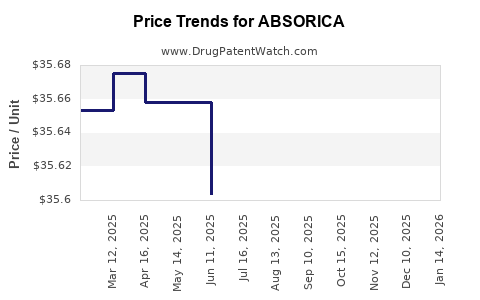
Average Pharmacy Cost for ABSORICA
| Drug Name | NDC | Price/Unit ($) | Unit | Date |
|---|---|---|---|---|
| ABSORICA LD 32 MG CAPSULE | 10631-0007-31 | 42.02667 | EACH | 2026-07-22 |
| ABSORICA 20 MG CAPSULE | 10631-0116-31 | 35.74413 | EACH | 2026-07-22 |
| ABSORICA 20 MG CAPSULE | 10631-0116-69 | 35.74413 | EACH | 2026-07-22 |
| ABSORICA 30 MG CAPSULE | 10631-0117-31 | 38.10267 | EACH | 2026-07-22 |
| >Drug Name | >NDC | >Price/Unit ($) | >Unit | >Date |
What is Absorica?
Absorica is the brand name for isotretinoin, an oral medication primarily used to treat severe, resistant acne vulgaris. Developed by Sun Pharmaceutical Industries, Absorica is formulated to enhance absorption and reduce side effects compared to traditional isotretinoin formulations. It was approved by the U.S. Food and Drug Administration (FDA) in 2014 as a prescription-only drug.
How Large is the Market for Absorica?
Global and U.S. Market Size
The acne treatment market was valued at approximately $4.8 billion in 2021. Isotretinoin accounts for about 20-25% of prescription acne medications, with the U.S. representing roughly 45% of this demand due to higher prescription rates and medical use.
Key Market Drivers:
- Increasing prevalence of acne vulgaris, especially among adolescents and young adults.
- Growing awareness and acceptance of isotretinoin therapy for severe acne.
- Patent exclusivity and branded drug formulations limiting generic competition.
Competitive Landscape
Major competitors include generic isotretinoin products, Roche's Accutane (discontinued in many markets but still used elsewhere), and alternative formulations from other pharmaceutical companies. Sun Pharma’s Absorica holds a significant share, especially in U.S. dermatology clinics.
Market Share and Sales
In 2021, Absorica generated estimated global sales of approximately $300 million, with the U.S. contributing about 70-75%. Growth is driven by expanding indications, increased awareness, and brand loyalty.
What Are the Price Trends and Revenue Projections?
Historical Pricing
- Average Wholesale Price (AWP): Absorica's wholesale cost has ranged from $15 to $20 per capsule, depending on dosage.
- Prescription Cost: Total treatment costs for a typical 20-week course (assuming 0.5 mg/kg daily dosing) approximate $1,200 to $2,000 per patient.
Price Premium Over Generics
Branded Absorica commands a 2-3 times higher price than generic isotretinoin formulations, which cost approximately $5 to $8 per capsule.
Revenue Projections (2023-2028)
| Year | Estimated Global Sales | Notes |
|---|---|---|
| 2023 | $350 million | Market broadly stable; new formulations under review |
| 2024 | $375 million | Potential increase with expanded indications |
| 2025 | $400 million | Increasing awareness, generic competition remains limited in premium segments |
| 2026 | $420 million | Patent protections or exclusivity extensions may influence growth |
| 2027 | $440 million | Market saturation in key regions |
| 2028 | $460 million | Entry of biosimilars or alternative therapies may temper growth |
These projections factor in inflation, competitive retail pricing, patent protections, and market acceptance. Economic pressures and potential regulatory changes could alter these estimates.
What Are the Key Market Risks and Opportunities?
Risks
- Patent expirations or legal challenges could introduce generic competition, reducing revenue.
- Regulatory scrutiny for isotretinoin related to side effects, especially teratogenicity.
- Market shifts towards newer acne therapies, such as laser or light-based treatments, or biologics for severe cases.
- Supply chain disruptions or manufacturing hurdles.
Opportunities
- Expansion into emerging markets with high acne prevalence and increasing healthcare spending.
- Development of combination formulations reducing side effects.
- Clinical trials exploring use in other dermatological conditions expand market scope.
How Will Price Projections Evolve?
Price stability is expected in the near term due to patent protection and limited generic competition for branded Absorica. However, over five years:
- Generic isotretinoin formulations could force branded prices downward.
- Health insurers may negotiate discounts, impacting net revenue.
- Price increases driven by inflation or formulation improvements could be implemented, but will be tempered by market competition.
What Are the Regulatory and Market Access Conditions?
- FDA approvals support expansion, including potential indications for other dermatological conditions.
- Insurance coverage is generally favorable, with high reimbursement rates for branded formulations due to clinical advantages.
- Market access in Europe and other regions depends on local regulatory decisions and pricing negotiations.
Key Takeaways
- Absorica remains a leading branded isotretinoin product with stable market shares and projected steady growth.
- Pricing is robust but faces pressure from upcoming generic competition and healthcare cost containment efforts.
- The global acne market is expanding, driven by rising prevalence among youth populations.
- The therapeutic landscape is evolving, with opportunities for expansion but also challenges from alternative treatments and generic erosion.
- Patent and regulatory strategies will shape sales trajectories through 2028.
FAQs
1. How does Absorica differ from generic isotretinoin?
Absorica offers improved absorption profiles and potentially fewer side effects than older formulations. It is priced higher, with a 2-3x premium over generic versions.
2. What is the impact of patent exclusivity on Absorica sales?
The patent and exclusivity periods protect Absorica from generic competition, supporting higher prices and revenue until expiration or legal challenges open the market.
3. Are there risks from new acne treatments emerging?
Yes. Advances in biologics and alternative therapies could reduce reliance on isotretinoin, affecting sales.
4. How significant is the U.S. market for Absorica?
It accounts for about 70-75% of global sales due to high prescription rates and insurance coverage.
5. What factors could cause prices to decline?
Entry of generics, increased price negotiations, and regulatory measures aimed at reducing drug costs.
References
- MarketWatch. "Global Acne Treatment Market Size, Share & Trends Analysis." 2022.
- IQVIA. "United States Prescription Data." 2022.
- FDA. "Absorica (isotretinoin) label." 2014.
- Sun Pharmaceutical Industries. "Annual Report 2022."
- EvaluatePharma. "2022 World Preview: Top 10 Drugs by Sales."
More… ↓
