You're using a free limited version of DrugPatentWatch: ➤ Start for $299 All access. No Commitment.

Last Updated: December 11, 2025

Desloratadine - Generic Drug Details


✉ Email this page to a colleague

« Back to Dashboard


What are the generic drug sources for desloratadine and what is the scope of freedom to operate?

Desloratadine is the generic ingredient in five branded drugs marketed by Merck Sharp Dohme, Taro, Organon, Reddys, Ajenat Pharms, Chartwell Rx, Dash Pharms, Dr Reddys Labs Ltd, Lupin Pharms, Orbion Pharms, Perrigo, Sun Pharm Inds, and Organon Llc, and is included in seventeen NDAs. Additional information is available in the individual branded drug profile pages.

There are sixteen drug master file entries for desloratadine. Eight suppliers are listed for this compound. There are two tentative approvals for this compound.

Summary for desloratadine
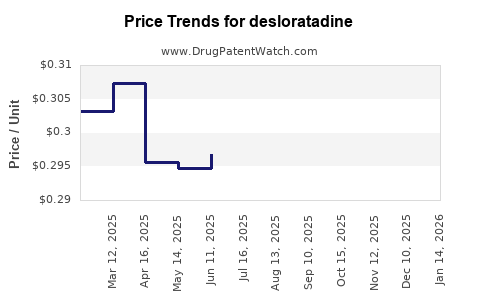
Drug Prices for desloratadine

See drug prices for desloratadine

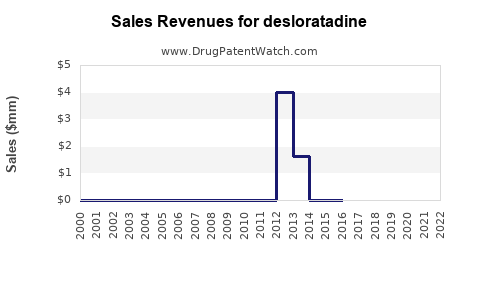
Drug Sales Revenue Trends for desloratadine

See drug sales revenues for desloratadine

Recent Clinical Trials for desloratadine

Identify potential brand extensions & 505(b)(2) entrants

SponsorPhase
Montefiore Medical CenterPHASE2
Laboratorios Silanes S.A. de C.V.PHASE3
Medical University of SilesiaNA

See all desloratadine clinical trials

Generic filers with tentative approvals for DESLORATADINE
Applicant Application No. Strength Dosage Form
⤷  Get Started Free⤷  Get Started Free5MGTABLET; ORAL

The 'tentative' approval signifies that the product meets all FDA standards for marketing, and, but for the patents / regulatory protections, it would approved.

Pharmacology for desloratadine
Paragraph IV (Patent) Challenges for DESLORATADINE
Tradename Dosage Ingredient Strength NDA ANDAs Submitted Submissiondate
CLARINEX Oral Solution desloratadine 0.5 mg/mL 021300 1 2008-05-08
CLARINEX Orally Disintegrating Tablets desloratadine 2.5 mg and 5 mg 021165 3 2006-06-21

US Patents and Regulatory Information for desloratadine

Applicant Tradename Generic Name Dosage NDA Approval Date TE Type RLD RS Patent No. Patent Expiration Product Substance Delist Req. Exclusivity Expiration
Organon CLARINEX D 24 HOUR desloratadine; pseudoephedrine sulfate TABLET, EXTENDED RELEASE;ORAL 021605-001 Mar 3, 2005 DISCN Yes No ⤷  Get Started Free ⤷  Get Started Free ⤷  Get Started Free
Merck Sharp Dohme CLARINEX desloratadine SOLUTION;ORAL 021300-001 Sep 1, 2004 DISCN Yes No ⤷  Get Started Free ⤷  Get Started Free ⤷  Get Started Free
Chartwell Rx DESLORATADINE desloratadine TABLET;ORAL 078364-001 Dec 3, 2010 DISCN No No ⤷  Get Started Free ⤷  Get Started Free ⤷  Get Started Free
Organon Llc CLARINEX-D 12 HOUR desloratadine; pseudoephedrine sulfate TABLET, EXTENDED RELEASE;ORAL 021313-001 Feb 1, 2006 RX Yes Yes ⤷  Get Started Free ⤷  Get Started Free ⤷  Get Started Free
Lupin Pharms DESLORATADINE desloratadine TABLET;ORAL 078352-001 Oct 25, 2010 AB RX No No ⤷  Get Started Free ⤷  Get Started Free ⤷  Get Started Free
Perrigo DESLORATADINE desloratadine TABLET;ORAL 078361-001 Dec 22, 2011 DISCN No No ⤷  Get Started Free ⤷  Get Started Free ⤷  Get Started Free
>Applicant >Tradename >Generic Name >Dosage >NDA >Approval Date >TE >Type >RLD >RS >Patent No. >Patent Expiration >Product >Substance >Delist Req. >Exclusivity Expiration

Expired US Patents for desloratadine

Applicant Tradename Generic Name Dosage NDA Approval Date Patent No. Patent Expiration
Organon CLARINEX desloratadine TABLET, ORALLY DISINTEGRATING;ORAL 021312-001 Jun 26, 2002 5,607,697*PED ⤷  Get Started Free
Organon CLARINEX desloratadine TABLET, ORALLY DISINTEGRATING;ORAL 021312-001 Jun 26, 2002 5,178,878*PED ⤷  Get Started Free
Organon CLARINEX desloratadine TABLET, ORALLY DISINTEGRATING;ORAL 021312-002 Jul 14, 2005 5,178,878*PED ⤷  Get Started Free
Organon CLARINEX desloratadine TABLET, ORALLY DISINTEGRATING;ORAL 021312-001 Jun 26, 2002 7,211,582*PED ⤷  Get Started Free
Organon CLARINEX desloratadine TABLET, ORALLY DISINTEGRATING;ORAL 021312-001 Jun 26, 2002 4,804,666*PED ⤷  Get Started Free
Organon CLARINEX desloratadine TABLET;ORAL 021165-001 Dec 21, 2001 7,405,223*PED ⤷  Get Started Free
>Applicant >Tradename >Generic Name >Dosage >NDA >Approval Date >Patent No. >Patent Expiration

EU/EMA Drug Approvals for desloratadine

Company Drugname Inn Product Number / Indication Status Generic Biosimilar Orphan Marketing Authorisation Marketing Refusal
Actavis Group PTC ehf Desloratadine Actavis desloratadine EMEA/H/C/002435Treatment of allergic rhinitis and urticaria. Authorised yes no no 2012-01-13
N.V. Organon Azomyr desloratadine EMEA/H/C/000310Azomyr is indicated for the relief of symptoms associated with:allergic rhinitis (see section 5.1)urticaria (see section 5.1) Authorised no no no 2001-01-15
Ratiopharm GmbH Desloratadine ratiopharm desloratadine EMEA/H/C/002404Desloratadine ratiopharm is indicated in adults for the relief of symptoms associated with:allergic rhinitischronic idiopathic urticaria as initially diagnosed by a physician Authorised yes no no 2012-01-13
N.V. Organon Aerius desloratadine EMEA/H/C/000313Aerius is indicated for the relief of symptoms associated with:allergic rhinitis;urticaria. Authorised no no no 2001-01-15
N.V. Organon Neoclarityn desloratadine EMEA/H/C/000314Neoclarityn is indicated for the relief of symptoms associated with:allergic rhinitisurticaria Authorised no no no 2001-01-15
Teva B.V Desloratadine Teva desloratadine EMEA/H/C/002419Desloratadine Teva is indicated for the relief of symptoms associated with:allergic rhinitis;urticaria. Authorised yes no no 2011-11-24
>Company >Drugname >Inn >Product Number / Indication >Status >Generic >Biosimilar >Orphan >Marketing Authorisation >Marketing Refusal

Market Dynamics and Financial Trajectory for Desloratadine

Last updated: July 28, 2025


Introduction

Desloratadine, a selective peripheral inverse agonist of peripheral H₁ receptors, is a second-generation antihistamine predominantly prescribed for allergic rhinitis and chronic idiopathic urticaria. Since its initial approval in the early 2000s, desloratadine has established itself as a leading antihistaminic agent globally, owing to its favorable safety profile and minimal sedative effects. This article examines the evolving market dynamics and financial outlook for desloratadine, analyzing key drivers, challenges, and emerging opportunities influencing its trajectory.


Global Market Overview

The global antihistamine market, valued at approximately USD 3.4 billion in 2022, is projected to grow at a compound annual growth rate (CAGR) of 4.2% through 2030, driven primarily by increasing prevalence of allergic disorders and expanding healthcare access in emerging markets [1]. Desloratadine's dominant position within the second-generation antihistamines has contributed significantly to this growth.

Regional markets display divergent dynamics. North America, with its high awareness and access to healthcare, accounts for roughly 45% of the global desloratadine market. Europe follows, supported by an aging population and rising allergy incidence. Asia-Pacific has shown accelerated growth—at a CAGR of approximately 5.8%—due to increased urbanization, pollution-related allergies, and expanding healthcare infrastructure [2].


Key Market Drivers

1. Rising Prevalence of Allergic Disorders

The global allergy burden continues to expand, with reports indicating that approximately 20-30% of the population suffers from allergic rhinitis and urticaria [3]. Increased diagnosis rates and broader awareness bolster demand for effective antihistamines like desloratadine.

2. Efficacy and Safety Profile

Desloratadine’s minimal sedative effects, once-daily dosing, and safety in pediatric and elderly populations underpin its sustained popularity. Its over-the-counter (OTC) availability in several markets further amplifies consumer access.

3. Patent Expiry and Market Entry

Generic pharmaceutical companies have introduced cost-effective desloratadine formulations, boosting accessibility and volume sales. The expiration of patents in key markets (e.g., the US in 2019) facilitated proliferation of generics, intensifying competitive dynamics.

4. Strategic Alliances and Market Expansion

Pharmaceutical firms pursue licensing agreements and regional expansion to capitalize on emerging markets. For instance, local formulations tailored to regional preferences have contributed to increased sales volumes.


Challengers and Market Constraints

1. Pricing Pressures

Generic proliferation exerts downward pressure on prices, impacting profit margins. The commoditization of desloratadine constrains revenue growth unless offset by volume increases.

2. Regulatory and Patent Challenges

While patent expiries foster generic competition, ongoing patent disputes and regulatory hurdles can delay new product introductions, affecting revenue timelines.

3. Market Saturation in Developed Regions

High penetration rates in North America and Europe create limited room for growth, prompting companies to target emerging markets or diversify product portfolios.

4. Emerging Competitors

Newer antihistamines or combination therapies, with improved efficacy or expanded indications, threaten to displace desloratadine in certain patient segments.


Financial Trajectory and Future Outlook

The financial prospects of desloratadine hinge on multiple factors:

  • Market Penetration and Growth:
    In developed markets, desloratadine’s sales are stabilizing due to saturation. However, robust growth persists in Asia-Pacific and Latin America, where healthcare penetration is still increasing and allergy prevalence is rising [4].

  • Margins and Pricing Strategy:
    The commoditization driven by generics has compressed profit margins. Yet, economies of scale, optimized supply chains, and regional tailored formulations can sustain favorable margins.

  • Research and Development:
    Incremental innovations, such as combination drugs or new delivery routes, may create ancillary revenue streams. However, significant R&D investment risk limits the likelihood of label extensions unless new indications are discovered.

  • Market Entry and Expansion Strategies:
    Companies adopting aggressive regional expansion and engaging in strategic licensing are poised for increased revenue, particularly in underserved markets with rising allergy incidence.

  • Impact of COVID-19:
    The pandemic influenced allergy and respiratory condition management, temporarily increasing demand for antihistamines like desloratadine. Post-pandemic recovery appears to reinforce sales momentum as healthcare systems normalize.

Projected Revenue Outlook

Analysts project the global desloratadine market to grow at a moderate CAGR of approximately 3.5-4.0% over the next five years, driven by emerging markets and increased OTC sales. The market value may approach USD 4.2 billion by 2028, with North America and Europe contributing over 60% of revenues, albeit with marginal growth rates. Notably, the Asia-Pacific segment is expected to register the fastest CAGR, buoyed by demographic and infrastructural factors.


Competitive Landscape

Key players include Sanofi, Teva Pharmaceuticals, Mylan (now part of Viatris), and Amneal Pharmaceuticals—each leveraging patent expirations to expand generic offerings. Sanofi’s initial development and commercialization of desloratadine as a branded product established early dominance. Currently, the generic segment comprises over 85% of sales volume due to price sensitivity and widespread availability.

Emerging Opportunities

  • Digital Health and Telepharmacy:
    Integration into online healthcare platforms facilitates patient access and adherence, especially in remote regions.

  • Combination Therapies:
    Developing multi-active formulations combining desloratadine with decongestants or corticosteroids can address broader clinical needs and open new revenue streams.

  • Personalized Medicine:
    Genetic profiling to identify responsive subpopulations may refine prescribing practices and improve market segmentation.

  • Regulatory Advances:
    Streamlining approval processes for biosimilars or novel formulations could accelerate market penetration.


Conclusion

Desloratadine’s market remains resilient, supported by its efficacy, safety, and widespread adoption. However, increasing generic competition, pricing pressures, and market saturation in developed regions temper growth prospects. The most promising opportunities lie in emerging markets, innovative formulations, and digital health integration. To capitalize on these dynamics, pharmaceutical companies must adopt region-specific strategies, invest in incremental innovation, and monitor regulatory shifts closely.


Key Takeaways

  • The global desloratadine market is expected to grow steadily, primarily driven by emerging markets and OTC sales.
  • Patent expiries have catalyzed intense generic competition, constraining margins but expanding accessibility.
  • Market saturation in developed regions requires strategic diversification and innovation to sustain growth.
  • Emerging opportunities include combination therapies, digital health integration, and regional expansion.
  • Long-term success will depend on balancing cost optimization with innovative approaches to address evolving consumer and regulatory landscapes.

FAQs

1. What factors most significantly influence desloratadine's market growth?
Prevalence of allergic disorders, patent expirations, generic competition, regulatory policies, and emerging market expansions are primary drivers.

2. How do patent expirations affect desloratadine’s market dynamics?
Patent expiries enable generic manufacturers to introduce cost-effective alternatives, increasing market competition, reducing prices, and impacting brand revenues.

3. Are there opportunities for desloratadine in treating new indications?
Currently, desloratadine’s approvals focus on allergic rhinitis and urticaria. Research into new indications is limited; most growth strategies focus on expanding existing markets rather than novel uses.

4. How has COVID-19 influenced the desloratadine market?
The pandemic temporarily increased demand due to respiratory and allergy-related symptoms, with post-pandemic recovery expected to stabilize and potentially boost sales further.

5. What strategies can pharmaceutical companies adopt to sustain desloratadine revenues?
Strategies include geographic expansion, developing combination therapies, cost optimization of manufacturing, digital health integration, and pursuing incremental innovation.


References

[1] MarketWatch. Antihistamine Drugs Market Size, Share & Industry Analysis, 2023-2030.
[2] Research and Markets. Geographic Insights into the Antihistamines Market.
[3] World Allergy Organization. Global Allergy Report 2022.
[4] IMS Health. Emerging Markets in Pharmaceutical Sales, 2022.


More… ↓

⤷  Get Started Free

Make Better Decisions: Try a trial or see plans & pricing

Drugs may be covered by multiple patents or regulatory protections. All trademarks and applicant names are the property of their respective owners or licensors. Although great care is taken in the proper and correct provision of this service, thinkBiotech LLC does not accept any responsibility for possible consequences of errors or omissions in the provided data. The data presented herein is for information purposes only. There is no warranty that the data contained herein is error free. We do not provide individual investment advice. This service is not registered with any financial regulatory agency. The information we publish is educational only and based on our opinions plus our models. By using DrugPatentWatch you acknowledge that we do not provide personalized recommendations or advice. thinkBiotech performs no independent verification of facts as provided by public sources nor are attempts made to provide legal or investing advice. Any reliance on data provided herein is done solely at the discretion of the user. Users of this service are advised to seek professional advice and independent confirmation before considering acting on any of the provided information. thinkBiotech LLC reserves the right to amend, extend or withdraw any part or all of the offered service without notice.