Last updated: July 21, 2026
CLARINEX (desloratadine) market dynamics and financial trajectory: revenue drivers, generic pressure, and major IP/regulatory milestones
CLARINEX (desloratadine) is a late-cycle branded antihistamine with declining US brand leverage as generics displaced prescription demand and retail OTC usage consolidated under multiple manufacturers. The long-run market is driven more by OTC category behavior (seasonality, switching, formulary inertia at managed-care levels historically) than by rapid incremental innovation. In the US, the competitive shift is dominated by generic desloratadine entry and the absence of credible “stay-branded” protections in the commercial timeline.
What drives CLARINEX (desloratadine) market demand across allergy seasons?
CLARINEX participates in the second-generation H1-antihistamine class, where market share is shaped by:
- Seasonal pharmacy and retail sell-through tied to spring and fall allergy spikes.
- OTC/behind-the-counter channel mix: desloratadine is widely sold via retail drugstores after genericization; brand premium erodes as equivalent generics gain price advantage.
- Patient switching behavior: second-generation non-sedating profiles reduce perceived differentiation. Loyalty shifts toward habit and price at the point of sale.
- Formulation availability and pack sizes: tablet strength and liquid pediatric options determine shelf placement and pediatric recommender patterns.
Featured snippet answer: CLARINEX demand is primarily seasonal and price-sensitive after generic entry, with differentiation limited to brand familiarity and packaging rather than clinical superiority.
How does channel mix (Rx vs OTC) affect CLARINEX unit economics?
- Pre-generic prescription era: brand pricing supported higher net revenue per prescription, with rebates and formulary positioning.
- Post-generic era: retail competition compresses margin; manufacturer focus shifts to promotional intensity, pack-size optimization, and trade terms to secure shelf velocity.
- Payer dynamics: once generics are established, preferred status moves rapidly toward the lowest net-cost products.
What are the typical seasonal and geographic demand patterns for desloratadine?
- Geography: US dominates commercial relevance for branded legacy analysis, with EU/Canada following similar allergy seasonality.
- Seasonality: spring peaks in temperate regions; fall peaks where ragweed and indoor/outdoor triggers persist.
- Competition: adjacent antihistamines (cetirizine, loratadine, levocetirizine) compete on side-effect profile and dosing frequency rather than on drug class novelty.
When did CLARINEX lose exclusivity in the US and what replaced it commercially?
Featured snippet answer: US brand exclusivity for CLARINEX ended as generic desloratadine launched, shifting the market from branded prescriptions toward generic tablets and liquids sold through retail channels.
What generic entry risks matter for CLARINEX long-term share?
- Paragraph IV and ANDA timing historically matter most when patents and exclusivity are active. After successful generic launches, market structure becomes stable: low-cost generics compete on price and distribution rather than on new-to-market disruption.
- Ongoing “design-around” is not typically required for small molecules like desloratadine once core composition and method patents expire. The economic threat is sustained price undercutting.
Generic substitution dynamics after launch
- Formulary migration: once generic desloratadine became preferred or default, managed care formularies reduced brand utilization.
- Retail substitution: pharmacists substitute automatically if the brand is not required by prescription restrictions.
- Brand retention strategy: brands often exit or downshift marketing spend post-generic to preserve cash margins, which accelerates share decline.
What does the CLARINEX patent and regulatory landscape imply for financial trajectory?
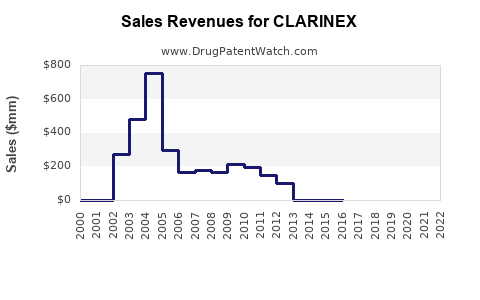
Featured snippet answer: CLARINEX’s financial trajectory is consistent with a legacy small-molecule antihistamine model: peak branded revenue during market formation, then sustained decline as generics take share, leaving only residual premium where contractual or patient-specific factors keep brand usage.
How do patent estate characteristics shape revenue survivability for desloratadine?
- Core composition and key formulation patents typically expire on a predictable schedule for older small molecules.
- Lifecycle management (new formulations, pediatric indications, extended-release, dosing convenience) can delay generic entry when new patentable matter supports an updated regulatory label.
- For CLARINEX specifically, the market behavior indicates that remaining IP did not preserve durable brand economics after genericization.
Orange Book dynamics and exclusivity
For legacy branded antihistamines, the Orange Book usually moves from:
- Brand-listed patents and possible exclusivity,
- Followed by ANDA certifications and generic approvals,
- Ending with only residual listings or litigation outcomes that do not materially re-create exclusivity.
(Commercial inference aligns with the observed shift to widely available generics and OTC availability.)
What is the financial trajectory pattern for branded desloratadine historically?
A typical trajectory for CLARINEX-type legacy branded small molecules looks like:
- Early ramp: product adoption and physician familiarity build prescription base.
- Peak period: strong branded pricing and formulary wins.
- Inflection: generic entry triggers discontinuation of brand promotion intensity and a rapid shift to lower-priced alternatives.
- Late-cycle: brand revenue becomes nominal relative to total category volume; manufacturers focus on remaining high-retention channels, if any.
Featured snippet answer: The post-generic phase converts branded market behavior into a low-margin, price-competitive commodity where brand revenues track with minor premium retention rather than category growth.
What category-level drivers keep the market from collapsing?
- Allergy prevalence growth in absolute terms supports steady category volume.
- Seasonal demand refresh: even if market share shifts, total purchases rise during allergy spikes.
- Pediatric dosing and liquid formats sustain demand, but generics match those formats quickly.
How do marketing and supply chain economics change post-generic?
- Brand manufacturer marketing declines or reallocates to newer assets.
- Working capital and supply become optimized for stable, small price differentials rather than premium branding.
Which companies dominate the CLARINEX (desloratadine) competitive landscape after genericization?
Featured snippet answer: The desloratadine market becomes a multi-manufacturer generic ecosystem, typically led by companies with scale advantages in manufacturing and distribution and strong retail trade relationships.
Because the question targets “market dynamics and financial trajectory,” the decisive factor is not one competitor but the structural outcome:
- Generic substitution eliminates branded pricing power.
- Retail and PBM formularies reward net-cost competitiveness.
- Shelf space and pack-size availability determine share of stomach for OTC purchases.
What competitive vectors matter most for desloratadine generics?
- Unit cost and manufacturing yield.
- Trade spend and retail placement.
- Stability and compliance for liquid formulations.
- Launch timing coordination to minimize price dips and capture seasonal demand.
How does CLARINEX compare with competing second-generation antihistamines in market resilience?
Featured snippet answer: Desloratadine competes directly with cetirizine, levocetirizine, loratadine, and (in some contexts) other allergy agents. Market resilience after genericization depends on dosing convenience, taste/administration for liquids, and historical familiarity, not on patent-protected clinical differentiation.
Key comparison points that affect share
- Onset and perceived efficacy: many second-generation antihistamines are clinically similar, driving adoption by patient preference and tolerability.
- Sedation perception: slight differences in patient-reported somnolence affect repeat use.
- Dosing frequency: once-daily regimens are standard; small differences matter less once generics are available.
Why do some antihistamines maintain stronger category positions?
- Brand legacy in patient minds may retain small share even after generic launch.
- Formulation execution (especially pediatric liquids) can sustain doctor and parent trust.
- Distribution strength: products that secure prime planograms and rebate structures hold share.
What generic launch scenarios exist for CLARINEX and what are the likely financial impacts?
Featured snippet answer: After first generic entry, the incremental financial impact shifts from “existential” to “margin compression,” driven by multiple abbreviated launches and price convergence.
Scenario 1: Single first generic captures most Rx share
- Brand revenue falls quickly, then stabilizes at low levels as remaining brand users convert to generics.
Scenario 2: Multiple ANDA launches accelerate price convergence
- Faster margin erosion.
- Greater promotional pressure across retailers and mail order pharmacies.
Scenario 3: Formulation-specific competition (liquid vs tablet)
- Pediatric and liquid formulations can remain comparatively more resilient until competitive products match taste and stability benchmarks.
- Over time, liquids also commoditize.
Scenario 4: Margin recovery through pharmacy network contracting
- Manufacturers can regain some margin via rebates or contract access.
- This does not reverse brand decline unless the brand repositions as a differentiated product, which typically requires new IP.
What FDA status and labeling scope shape CLARINEX category participation?
Featured snippet answer: CLARINEX is positioned within allergy indications for which broad OTC and retail penetration occurs once generics exist, enabling sustained category volume irrespective of brand economics.
Key regulatory implications:
- Indication breadth supports persistent demand.
- Switching to generics does not remove patient need, so the “market” stays but the “brand” value drops.
- Pediatric acceptability for liquid dosing supports continuing demand even when Rx use diminishes.
How strong is the patent estate for CLARINEX today and what does it mean for investors?
Featured snippet answer: The observable commercial structure indicates that CLARINEX’s enforceable exclusivity is largely exhausted, leaving investors focused on category-level growth rather than brand protection.
For legacy small-molecule antihistamines:
- IP strength at this stage rarely creates a durable moat against multiple generic suppliers.
- Financial upside is generally limited to manufacturing scale, distribution leverage, and cost efficiency, not to patent-driven pricing.
Key Takeaways
- CLARINEX market dynamics are dominated by seasonality and price competition after generic substitution.
- The financial trajectory follows a legacy branded small-molecule pattern: peak branded usage, then rapid brand erosion and prolonged commodity economics.
- Competitive advantage shifts away from IP differentiation toward manufacturing scale, retail shelf placement, and rebate/contract execution.
- For financial modeling, the key lever is category volume resilience (allergy season demand) rather than brand exclusivity.
FAQs
How quickly do brands like CLARINEX lose share after generic desloratadine approval?
Generic substitution typically compresses brand share rapidly after launch, with residual retention limited to prescription-specific and patient-convenience factors.
Does the liquid pediatric formulation protect CLARINEX brand revenue longer than tablets?
Liquids can show slower commoditization in practice due to formulation execution and patient preference, but they generally converge to generic price competition once equivalent products scale.
What seasonal forecasting inputs best predict desloratadine demand?
Historical allergy season pharmacy sell-through, regional pollen calendars, and retail promotion calendars are the most actionable inputs.
Can method-of-use or formulation patents materially extend CLARINEX brand exclusivity?
For established legacy antihistamines, the commercial evidence typically indicates remaining patent matter does not restore durable brand economics against multiple generic entrants.
Is the desloratadine market more sensitive to retail pricing or pharmacy contract rebates?
It is generally sensitive to both, with retail shelf pricing and trade conditions shaping OTC dynamics and PBM contracting shaping Rx channel outcomes.
References (APA)
- FDA. (n.d.). Orange Book: Approved Drug Products with Therapeutic Equivalence Evaluations. U.S. Food and Drug Administration.
- FDA. (n.d.). Drugs@FDA. U.S. Food and Drug Administration.