Last updated: September 8, 2026
Desloratadine is a mature, largely commoditized second-generation antihistamine. Merck’s Clarinex brand lost its commercial position after generic entry, while desloratadine remains available through multiple generic manufacturers in tablets, orally disintegrating tablets and oral solution. Current value is concentrated in high-volume, low-price prescription and over-the-counter markets rather than in branded innovation.
What is the current market position of desloratadine?
Desloratadine is the active metabolite of loratadine and selectively blocks peripheral histamine H1 receptors. It is marketed for allergic rhinitis and chronic idiopathic urticaria.
The original branded product was Clarinex, developed by Schering-Plough and later controlled by Merck after the 2009 Schering-Plough merger. International brand names include Aerius and Neoclarityn. The product competes with loratadine, cetirizine, levocetirizine, fexofenadine and bilastine.
| Product |
Active ingredient |
Commercial position |
Principal competitors |
| Clarinex |
Desloratadine |
Legacy brand; largely displaced by generics |
Loratadine, cetirizine, fexofenadine |
| Aerius |
Desloratadine |
International branded product in selected markets |
Generic desloratadine and other antihistamines |
| Generic desloratadine |
Desloratadine |
Main U.S. volume source |
Generic loratadine, cetirizine and fexofenadine |
| Claritin |
Loratadine |
Separate product and brand franchise |
Clarinex/Aerius, Zyrtec, Allegra |
Desloratadine has limited differentiation from other non-sedating antihistamines. Its once-daily dosing and low central nervous system penetration support continued use, but these attributes are common across the class.
How did desloratadine sales develop over time?
Desloratadine followed the standard lifecycle of a branded small-molecule antihistamine:
- FDA approval and branded launch.
- Growth through prescription substitution for older antihistamines.
- Expansion into pediatric and orally disintegrating formulations.
- Loss of exclusivity and generic price erosion.
- Continued unit demand with declining branded revenue.
The FDA approved Clarinex tablets in January 2001. Oral solution and orally disintegrating tablet formulations followed, expanding use in pediatric patients and patients with difficulty swallowing [1].
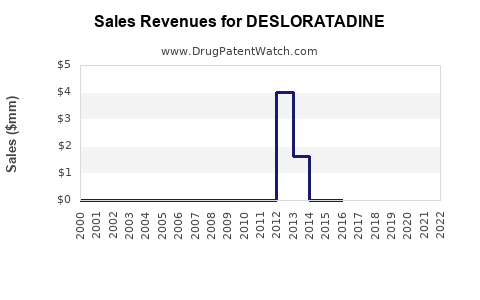
Clarinex revenue was commercially meaningful during the early 2000s, but the product remained smaller than the broader Claritin franchise. Claritin generated multibillion-dollar sales before loratadine moved into over-the-counter distribution, while Clarinex generated a much smaller branded revenue stream. Merck subsequently stopped reporting Clarinex as a significant standalone growth product after generic competition and portfolio reprioritization.
Why did branded revenue decline?
The principal causes were:
- Loss of primary compound and formulation exclusivity.
- Generic substitution in the U.S.
- Heavy competition from cetirizine and fexofenadine.
- Expansion of OTC antihistamine access.
- Low switching costs for physicians, pharmacists and patients.
- Limited clinical differentiation among once-daily second-generation antihistamines.
Branded revenue declines did not eliminate demand for the molecule. They shifted value from the originator to generic manufacturers, distributors and retail pharmacies.
When did desloratadine lose market exclusivity?
Desloratadine’s principal U.S. compound patent protection expired before the current generic market developed. Later protection for formulations and pediatric presentations extended commercial barriers for selected products but did not create durable exclusivity for the active ingredient.
Key U.S. regulatory milestones
| Milestone |
Approximate timing |
Commercial effect |
| Clarinex tablets approved |
2001 |
Originator launch |
| Pediatric and liquid formulations approved |
2000s |
Broader dosing and administration options |
| First generic approvals |
2010s |
Erosion of branded prescription share |
| OTC transition for desloratadine products |
2020s in the U.S. |
Wider consumer access and lower price points |
| Current market |
2020s |
Generic and retail-driven |
The timing of individual generic launches differed by dosage form, manufacturer and patent challenge. A precise launch date cannot be inferred solely from the original product approval date because later patents and regulatory exclusivities applied to particular presentations.
What patents protect desloratadine?
The original desloratadine patent estate covered the compound and related pharmaceutical uses. The most commercially relevant rights were associated with Schering-Plough and its successors.
| Patent category |
Scope |
Current commercial effect |
| Active compound patents |
Desloratadine and related chemical structures |
Expired or no longer capable of blocking routine generic tablets |
| Composition patents |
Pharmaceutical compositions containing desloratadine |
Historical protection; generally expired |
| Orally disintegrating formulations |
Rapid-dissolving dosage forms and excipient systems |
May have delayed specific product entry but does not protect all desloratadine products |
| Oral solution formulations |
Liquid formulations and dosing systems |
Presentation-specific protection |
| Method-of-use patents |
Allergic rhinitis, urticaria and related indications |
Limited practical impact after broad generic approval |
| Pediatric exclusivity |
Pediatric labeling and clinical data |
Temporary regulatory extension, not a long-term patent barrier |
Relevant early U.S. patent records include patents associated with desloratadine composition and formulation technology, including U.S. Patent No. 5,607,951 and later formulation patents assigned to Schering-Plough or related entities. Patent scope and expiration must be assessed by claim, terminal disclaimer, pediatric extension and listed dosage form rather than by the brand name alone [2].
What is the Orange Book status of Clarinex?
Clarinex has historically appeared in the FDA Orange Book with multiple dosage forms and strengths. Orange Book listings identify approved drug products and patent or exclusivity information relevant to abbreviated new drug applications.
The practical Orange Book position is now limited:
- The active ingredient is no longer protected by a live, broad compound monopoly.
- Generic desloratadine products are approved through the ANDA pathway.
- Formulation-specific patents may have affected individual products or launch timing.
- Clarinex’s commercial importance is materially lower than during its branded lifecycle.
- FDA approval of generic products does not guarantee market access if a listed patent or settlement restricts launch timing.
FDA discontinued-product records and Orange Book updates should be reviewed together because a branded product may remain historically listed even after commercial discontinuation [3].
Which companies manufacture or sell desloratadine?
The generic market is fragmented. Manufacturers have included major U.S. generic companies and international pharmaceutical suppliers, with availability varying by dosage form and country.
Typical participants include:
- Teva Pharmaceuticals
- Sandoz
- Dr. Reddy’s Laboratories
- Cipla
- Lupin
- Amneal Pharmaceuticals
- Zydus Pharmaceuticals
- Torrent Pharmaceuticals
- Hikma and regional suppliers
- Private-label and contract-manufacturing companies
Market share is difficult to assess from public disclosures because manufacturers generally report desloratadine within broader generic portfolios. Retail and prescription claims data are more useful than company annual reports for measuring unit share.
How does desloratadine compare with loratadine, cetirizine and fexofenadine?
| Attribute |
Desloratadine |
Loratadine |
Cetirizine |
Fexofenadine |
| Generation |
Second |
Second |
Second |
Second |
| Typical dosing |
Once daily |
Once daily |
Once daily |
Once or twice daily, depending on strength |
| Sedation profile |
Generally low |
Generally low |
More sedation risk in some patients |
Generally low |
| Generic availability |
Broad |
Broad |
Broad |
Broad |
| Brand legacy |
Clarinex, Aerius |
Claritin |
Zyrtec |
Allegra |
| Differentiation |
Limited |
Broad OTC familiarity |
Perceived potency and rapid relief |
Low sedation and OTC recognition |
| Pricing |
Low generic pricing |
Low generic pricing |
Low generic pricing |
Low generic pricing |
Desloratadine has a pharmacological relationship with loratadine but is marketed as a distinct active ingredient. The commercial distinction is stronger in regulatory labeling and branding than in retail purchasing behavior.
Cetirizine has often maintained stronger consumer recognition in allergy treatment, while fexofenadine retains a position among consumers seeking a low-sedation option. Desloratadine competes mainly on availability, tolerability and physician familiarity.
What generic entry risks exist for desloratadine?
Generic entry risk is high because the market has the characteristics of a mature small molecule:
- Multiple approved manufacturers.
- No meaningful compound patent barrier.
- Simple tablet and liquid dosage forms.
- Low technical complexity.
- Limited clinical differentiation.
- Established active pharmaceutical ingredient supply.
- Substitution by pharmacists and payers.
- Retail availability through private-label channels.
The main remaining barriers are manufacturing quality, regulatory compliance, supply reliability and distribution scale. These barriers can affect individual suppliers but do not protect the originator’s franchise.
What could delay a generic launch?
Potential delays include:
- Patent litigation involving a specific dosage form.
- Paragraph IV litigation and a 30-month stay.
- FDA deficiencies in an ANDA.
- Bioequivalence problems.
- Drug-shortage or manufacturing controls.
- Commercial decisions to delay launch because of low expected margins.
- Settlement provisions between the originator and an ANDA filer.
These risks are product-specific. They do not restore exclusivity for all desloratadine products.
Were there Paragraph IV challenges or settlements?
Generic applicants commonly use Paragraph IV certifications when they contend that listed patents are invalid, unenforceable or not infringed. Desloratadine’s historical patent challenges were principally relevant to branded formulation and presentation patents rather than to a durable, unexpired compound patent.
A Paragraph IV filing can trigger patent litigation and a statutory 30-month stay of FDA approval under the Hatch-Waxman Act. The economic importance of such litigation declines sharply after multiple generic products reach the market.
Public litigation databases should be used to confirm case numbers, defendants, asserted patent claims and settlement terms. A historic Paragraph IV case does not necessarily indicate a current barrier to commercial entry.
What is the FDA regulatory status of desloratadine?
Desloratadine is an FDA-approved prescription and OTC antihistamine active ingredient. U.S. products include tablets, orally disintegrating tablets and oral solution. The regulatory pathway for generic tablets and solutions is generally an ANDA demonstrating pharmaceutical equivalence and bioequivalence to an approved reference listed drug [1,4].
The regulatory environment supports continued supply because:
- The active ingredient has an established safety record.
- The dosage forms are conventional.
- Generic approval standards are well established.
- Pediatric dosing information exists for liquid and age-specific products.
- No biologic or biosimilar pathway is involved.
Biosimilar risk is therefore irrelevant. Desloratadine is a chemically synthesized small molecule, not a biologic.
What manufacturing and intellectual-property barriers remain?
Manufacturing barriers are moderate at the supplier level and low at the market level.
Manufacturing considerations
Suppliers must control:
- Active pharmaceutical ingredient purity.
- Impurity profiles and degradation products.
- Content uniformity.
- Dissolution performance.
- Stability in liquid formulations.
- Excipient compatibility.
- Child-resistant and consumer packaging.
- FDA and international good manufacturing practice compliance.
Liquid and orally disintegrating formulations can require more process control than standard tablets. These products may retain slightly better margins than conventional tablets, but they remain exposed to generic competition.
Intellectual-property considerations
The strongest remaining IP positions are likely to be narrow:
- Specific excipient combinations.
- Orally disintegrating systems.
- Packaging or delivery configurations.
- New combinations with other active ingredients.
- Jurisdiction-specific formulation claims.
Those rights may support a niche product but are unlikely to recreate the economics of the original Clarinex franchise.
How strong is the desloratadine patent estate?
The current estate is weak against ordinary generic tablets and moderate only for selected formulations or jurisdictions.
| Estate component |
Current strength |
| Broad compound protection |
Low to none |
| Standard tablet protection |
Low |
| Oral solution protection |
Low to moderate, depending on claim status |
| Orally disintegrating tablet protection |
Moderate for narrow claims |
| Method-of-use protection |
Low practical blocking power |
| International protection |
Uneven by country |
| Manufacturing know-how |
Moderate operational value, limited exclusivity |
Patent strength should be measured against the proposed generic product. A narrow orally disintegrating formulation patent may matter to one ANDA but not to a conventional tablet supplier.
What is the financial trajectory for desloratadine?
The financial trajectory has three phases:
| Phase |
Revenue pattern |
Margin profile |
Main value holder |
| Branded growth |
Rising prescription sales |
High |
Originator |
| Post-launch competition |
Falling branded sales |
Declining |
Originator and early generic entrants |
| Mature generic market |
High unit volume, low price |
Low to moderate |
Scaled manufacturers and distributors |
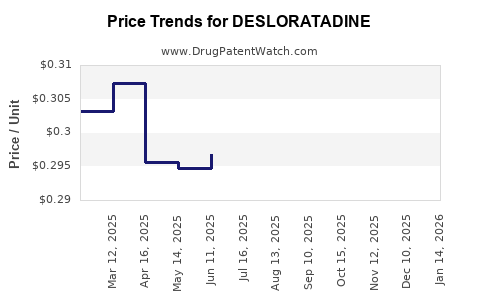
Desloratadine’s current financial profile is volume-driven. Revenue per prescription is low, and branded price premiums are difficult to sustain. Manufacturers can still generate acceptable returns through scale, efficient sourcing and portfolio distribution, but the product is unlikely to be a major growth driver for a large pharmaceutical company.
Revenue exposure for originators
Merck’s current financial exposure to desloratadine is limited. The company’s reporting is not structured around Clarinex as a major standalone revenue line, and the brand no longer represents a material growth asset relative to Merck’s oncology, vaccines, hospital and immunology businesses [5].
For generic manufacturers, exposure is more operational than strategic. A supplier can benefit from:
- Large prescription volume.
- Stable allergy demand.
- Low clinical development costs.
- Multiple dosage forms.
- Retail and institutional distribution.
The principal risks are price compression, customer concentration, supply interruptions and competitive oversupply.
What generic launch scenarios are most likely?
Base case: continued commoditization
Multiple generic manufacturers remain active, prices stay low and demand grows slowly with seasonal allergy prevalence. The originator retains little share outside selected international markets.
Upside case for generic suppliers: supply consolidation
If manufacturers exit because of low margins or regulatory problems, remaining suppliers may obtain temporary pricing power. This would be a supply-driven effect, not evidence of renewed patent protection.
Downside case: further price erosion
Additional ANDA approvals, private-label expansion and retailer purchasing pressure reduce net prices. Conventional tablets are most exposed. Liquid and orally disintegrating products may experience slower erosion.
Branded recovery scenario
A broad branded recovery is unlikely without a new delivery system, combination product, consumer repositioning or regulatory switch strategy. The existing molecule has insufficient differentiation to support a major premium in a mature antihistamine class.
How does desloratadine compare with newer allergy therapies?
Desloratadine faces competition from established antihistamines rather than from high-cost specialty therapies. Intranasal corticosteroids, antihistamine nasal sprays, leukotriene modifiers and immunotherapy address overlapping allergy symptoms but have different administration and efficacy profiles.
Its advantages are simplicity, oral dosing and low cost. Its weaknesses are limited differentiation, generic substitution and the absence of a defensible premium brand.
Key Takeaways
- Desloratadine is a mature second-generation antihistamine with broad generic availability.
- Clarinex and Aerius lost most of their commercial value after compound and formulation exclusivity expired.
- Current competition is strongest from loratadine, cetirizine and fexofenadine.
- Standard desloratadine tablets face high generic entry risk and low pricing power.
- Formulation patents may matter for orally disintegrating tablets and liquid products, but they do not protect the molecule broadly.
- The FDA pathway is established, and biosimilar risk is not relevant.
- Current financial value is concentrated in generic volume, manufacturing efficiency and supply reliability.
- A branded revenue rebound is unlikely without meaningful formulation or product differentiation.
FAQs
Is desloratadine the same drug as loratadine?
No. Desloratadine is the active metabolite of loratadine, but the two are separately approved active ingredients with separate labeling and product records.
Is Clarinex still a commercially important brand?
No. Clarinex is historically important but has limited current commercial significance in the U.S. because generic desloratadine is widely available.
Can a generic manufacturer launch desloratadine without challenging every patent?
Yes. A manufacturer may certify that relevant patents do not apply to its product, have expired, are not infringed or are invalid. The required certification depends on the patents listed for the reference product and the proposed dosage form.
Which desloratadine dosage form has the greatest pricing potential?
Orally disintegrating tablets and oral solutions can have higher unit economics than standard tablets, but their pricing potential is constrained by formulation competition, payer substitution and private-label products.
Does desloratadine have biosimilar competition?
No. Desloratadine is a small-molecule drug. Competition proceeds through generic drug applications, not biosimilar applications.
References
- U.S. Food and Drug Administration. (2001). Clarinex (desloratadine) prescribing information.
- U.S. Patent and Trademark Office. (1997). U.S. Patent No. 5,607,951.
- U.S. Food and Drug Administration. (2024). Approved drug products with therapeutic equivalence evaluations.
- U.S. Food and Drug Administration. (2024). Orange Book: Approved drug products with therapeutic equivalence evaluations.
- Merck & Co., Inc. (2009-2024). Annual reports and securities filings.