Share This Page
Chlorpromazine - Generic Drug Details
✉ Email this page to a colleague
What are the generic sources for chlorpromazine and what is the scope of freedom to operate?
Chlorpromazine
is the generic ingredient in five branded drugs marketed by Glaxosmithkline, Actavis Mid Atlantic, Genus, Pharm Assoc, Rubicon Research, Wockhardt, Hikma, Saptalis Pharms, Abraxis Pharm, Aspiro, Deva Hlding, Dr Reddys, Eugia Pharma, Gland, Marsam Pharms Llc, MSN, Thinq Pharm-cro Pvt, Watson Labs, Wyeth Ayerst, Zydus Pharms, Alpharma Us Pharms, Chartwell Rx, Abbott, Alembic, Amneal Pharms Co, Aurobindo Pharma Ltd, Cycle, Glenmark Pharms Ltd, Ivax Sub Teva Pharms, Kv Pharm, Lannett Co Inc, Lederle, Lupin, Purepac Pharm, Pvt Form, Somerset Theraps Llc, Sun Pharm, Teva Pharms, Upsher Smith Labs, Vangard, West Ward, Zameer Pharms, Zydus Lifesciences, and Parke Davis, and is included in eighty-four NDAs. Additional information is available in the individual branded drug profile pages.Summary for chlorpromazine
| US Patents: | 0 |
| Tradenames: | 5 |
| Applicants: | 44 |
| NDAs: | 84 |
| Raw Ingredient (Bulk) Api Vendors: | 74 |
| Clinical Trials: | 40 |
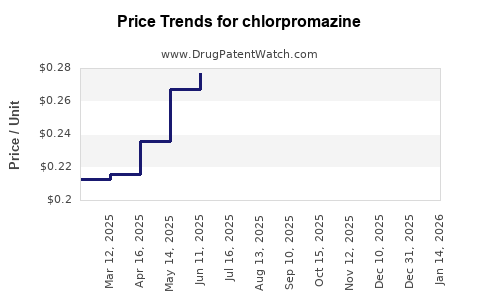
| Drug Prices: | Drug price trends for chlorpromazine |
| What excipients (inactive ingredients) are in chlorpromazine? | chlorpromazine excipients list |
| DailyMed Link: | chlorpromazine at DailyMed |
Recent Clinical Trials for chlorpromazine
Identify potential brand extensions & 505(b)(2) entrants
| Sponsor | Phase |
|---|---|
| Ji Xunming,MD,PhD | NA |
| University Hospital, Strasbourg, France | PHASE2 |
| Capital Medical University | PHASE1 |
Medical Subject Heading (MeSH) Categories for chlorpromazine
Anatomical Therapeutic Chemical (ATC) Classes for chlorpromazine
US Patents and Regulatory Information for chlorpromazine
Chlorpromazine Market Dynamics, Financial Trajectory, Patents, and Generic Competition
Chlorpromazine is a mature, off-patent phenothiazine antipsychotic with limited commercial growth prospects. Its market has shifted from branded psychiatric therapy to low-cost generic supply for schizophrenia, acute behavioral symptoms, nausea and vomiting, intractable hiccups, and selected hospital uses. Public financial reporting does not isolate chlorpromazine revenue, but the product’s economics are clear: low prices, multiple suppliers, limited differentiation, periodic supply constraints, and declining use in high-income markets.
What is chlorpromazine and how is it used?
Chlorpromazine is a first-generation antipsychotic in the phenothiazine class. It acts primarily through dopamine D2 receptor antagonism and also has anticholinergic, antihistaminic, and alpha-adrenergic effects.
The U.S. FDA-approved uses include:
- Schizophrenia and other psychotic disorders
- Manic symptoms associated with bipolar disorder
- Severe behavioral problems in children
- Nausea and vomiting
- Intractable hiccups
- Acute intermittent porphyria
- Preoperative apprehension
- Tetanus-related symptoms in selected settings
The drug is available in oral tablets, oral concentrate, and injectable formulations. The injectable product is used primarily in institutional and hospital settings, while oral products are dispensed through retail, specialty, and institutional pharmacies. FDA labeling includes a boxed warning regarding increased mortality in elderly patients with dementia-related psychosis.[1]
Chlorpromazine is also listed in international essential-medicines frameworks because of its low cost and continuing clinical utility in psychotic disorders.[2]
How large is the chlorpromazine market?
No major public company reports chlorpromazine revenue as a standalone product. The drug is generally included within broader generic antipsychotic or hospital injectable portfolios. Market-research estimates that assign a single global revenue figure to chlorpromazine should be treated cautiously because they often rely on modeled sales, channel estimates, or retail data that exclude institutional procurement.
The commercial market has four defining characteristics:
| Market factor | Chlorpromazine impact |
|---|---|
| Product age | Original branded and composition-of-matter protection expired decades ago |
| Supplier base | Multiple generic manufacturers and regional suppliers |
| Pricing | Low unit prices and limited pricing power |
| Demand | Stable clinical floor but declining use in many developed markets |
| Differentiation | Limited, except for injectable availability, liquid dosage forms, and supply reliability |
| Revenue profile | Small, fragmented, and generally immaterial to diversified manufacturers |
The United States market is no longer driven by brand promotion. Demand comes from legacy prescribing, hospital protocols, public-sector purchasing, correctional and psychiatric institutions, and price-sensitive health systems.
In emerging markets, chlorpromazine retains greater relevance because newer antipsychotics can be substantially more expensive. In those markets, procurement tenders and government formularies often determine volume. Revenue growth is therefore more likely to come from geographic expansion, tender wins, and supply continuity than from increased prescribing in developed markets.
What is the financial trajectory for chlorpromazine?
Chlorpromazine’s long-term financial trajectory is flat to declining in high-income markets and more stable in lower-income markets.
Historical trajectory
Chlorpromazine was introduced in the 1950s and became one of the first widely used modern antipsychotics. Thorazine, the original U.S. brand, generated substantial clinical and commercial value during the early expansion of institutional psychiatry. That economic position eroded after generic entry and the development of newer antipsychotic classes.
The market then passed through three stages:
- Branded innovation and rapid adoption in the 1950s and 1960s.
- Generic substitution and price erosion after patent expiry.
- Mature, low-margin demand alongside newer first-generation and atypical antipsychotics.
Second-generation antipsychotics, including risperidone, olanzapine, quetiapine, and aripiprazole, displaced chlorpromazine in many outpatient settings because of more favorable tolerability and broader commercial support. Chlorpromazine remains clinically useful but is usually not the first choice for routine long-term treatment in markets with broad access to newer agents.
Current financial profile
The product has limited ability to increase price or expand market share. Financial performance depends on:
- Manufacturing cost control
- Contract and government tenders
- Reliable injectable supply
- Maintenance of approved dosage forms
- Avoidance of product discontinuation
- Efficient regulatory compliance
- Access to hospital and institutional purchasing channels
Retail tablet sales generally generate low revenue per prescription. Injectable products can have greater strategic value because hospital shortages can shift demand quickly, but injectable supply also carries higher manufacturing, sterility, and quality-control requirements.
A generic manufacturer may retain chlorpromazine in its portfolio because the product uses existing manufacturing infrastructure, fills a psychiatric-hospital procurement need, or supports a broader contract with public-sector buyers. The product is less attractive as a standalone growth asset.
When does chlorpromazine lose exclusivity?
Chlorpromazine lost meaningful U.S. patent exclusivity many decades ago. The original compound and branded product are not protected by a current composition-of-matter patent that would prevent generic manufacture.
The original commercial product was developed and marketed by Rhône-Poulenc, with the U.S. brand Thorazine associated with SmithKline and later corporate successors. Any original patent rights expired long before the modern generic-drug market.
| Exclusivity category | Current status |
|---|---|
| Original compound patent | Expired |
| Original branded product protection | Expired |
| Data exclusivity | Expired |
| Pediatric exclusivity | Not commercially relevant |
| Orphan exclusivity | Not applicable to the core product |
| Current Orange Book patent barrier | No material barrier associated with ordinary chlorpromazine products |
| Generic substitution | Established for decades |
Later patents could theoretically cover a particular formulation, manufacturing process, or delivery system. Those rights would not restore broad exclusivity for chlorpromazine as an active ingredient. A product-specific patent would need to claim a commercially meaningful formulation or use and remain enforceable against the relevant generic product.
What is the Orange Book status of chlorpromazine?
Chlorpromazine products have been marketed through multiple approved generic applications and dosage forms. The regulatory position is that of a mature generic medicine rather than a protected reference-brand franchise.
The FDA Orange Book evaluates approved drug applications, therapeutic equivalence, and listed patents or exclusivities. For chlorpromazine, the commercially relevant regulatory issues are:
- Whether a manufacturer has an active approved abbreviated new drug application
- Whether the specific dosage form has a current therapeutic-equivalence rating
- Whether the product is actively marketed
- Whether the manufacturer has discontinued a presentation
- Whether the product has a current shortage or supply notification
The absence of a meaningful active patent estate means that the principal barriers are operational and regulatory rather than intellectual-property based. These barriers include facility compliance, sterile manufacturing capability for injection, product-specific bioequivalence, and the economics of maintaining low-volume applications.
The FDA-approved product labeling identifies warnings relating to tardive dyskinesia, neuroleptic malignant syndrome, hypotension, seizures, blood dyscrasias, liver injury, anticholinergic effects, and cardiac risk.[1] These safety requirements increase postmarket-compliance obligations but do not create market exclusivity.
How many patents cover chlorpromazine?
No broad, commercially material patent estate protects chlorpromazine as a molecule in the United States.
The relevant patent categories are narrower:
| Patent category | Commercial significance |
|---|---|
| Original chemical compound patents | Expired |
| Salt or crystalline-form patents | Generally unlikely to create current broad exclusivity for conventional products |
| Oral formulation patents | Potentially relevant only to a specific differentiated formulation |
| Injectable formulation patents | May cover a process or presentation, but do not block standard products absent enforceable claims |
| Method-of-use patents | Limited value where the labeled uses are longstanding and generic products have broad indications |
| Manufacturing patents | May affect a supplier’s process but usually do not block alternative manufacturing routes |
| Device or delivery-system patents | Relevant only to a proprietary delivery platform |
Patent risk is therefore low for conventional chlorpromazine tablets, oral concentrate, and standard injection. A company considering acquisition or licensing should focus less on patent duration and more on application status, manufacturing reliability, product liability, and supply-chain concentration.
Are there Paragraph IV challenges involving chlorpromazine?
Paragraph IV litigation is not a material current market issue for conventional chlorpromazine products.
A Paragraph IV certification alleges that a listed patent is invalid, unenforceable, or not infringed. Such challenges are most commercially significant when a branded product has valuable remaining sales and a generic applicant can obtain 180-day exclusivity or trigger litigation-linked launch uncertainty.
Chlorpromazine does not present that profile. Its original patents expired long ago, branded sales are not the primary market driver, and generic supply has existed for decades. A new entrant would more likely face ordinary ANDA approval and manufacturing hurdles than an originator patent suit.
Potential disputes could still arise over:
- A novel extended-release formulation
- A proprietary liquid dosage form
- A combination product
- A new delivery device
- A process patent
- A specific method-of-use claim
Those disputes would concern the incremental product, not the established chlorpromazine market.
What formulations are protected by chlorpromazine patents?
Conventional chlorpromazine dosage forms have little meaningful exclusivity. Commercially relevant formulations include:
- Immediate-release tablets
- Oral concentrate or solution
- Intramuscular injection
- Hospital-use injectable presentations
Formulation economics differ by dosage form.
Tablets
Tablets are the most commoditized presentation. Multiple suppliers can manufacture them, and substitution is generally straightforward where the product is therapeutically equivalent. Pricing is low, and a manufacturer needs scale or procurement access to achieve attractive returns.
Oral liquid
Liquid products can face less direct competition than tablets because they require additional stability, packaging, dosing, and quality-control work. The presentation may be useful for patients who cannot swallow tablets and for institutional care. That operational complexity can support modestly better economics, but it does not create durable monopoly pricing.
Injection
Injectable chlorpromazine has greater supply-chain importance because sterile manufacturing capacity is more limited. Hospitals may continue purchasing from a supplier even when tablet competition is intense, provided the manufacturer maintains quality and reliable delivery. Manufacturing risk includes aseptic processing, container closure integrity, sterility testing, and facility compliance.
Which companies are challenging chlorpromazine?
No single company is conducting a high-profile branded challenge to chlorpromazine. The competitive environment consists of generic manufacturers, contract manufacturers, hospital suppliers, and regional pharmaceutical companies.
Competition occurs through:
- ANDA approvals
- Government tenders
- Hospital contracts
- Wholesale distribution
- Private-label arrangements
- Regional registration and supply agreements
The leading competitive substitutes are not limited to other chlorpromazine manufacturers. They include:
| Competitor | Competitive position |
|---|---|
| Haloperidol | Strong hospital and acute-behavioral competitor |
| Fluphenazine | Long-acting and oral first-generation alternative |
| Perphenazine | Lower-cost phenothiazine alternative |
| Risperidone | Widely used generic atypical antipsychotic |
| Olanzapine | Broad outpatient use and generic availability |
| Quetiapine | Large generic market across psychiatric indications |
| Aripiprazole | Lower extrapyramidal liability and broad outpatient use |
| Prochlorperazine | Competes in nausea and vomiting, but has a different primary market |
Chlorpromazine’s main vulnerability is therapeutic substitution, not direct patent competition.
What regulatory risks affect chlorpromazine sales?
The FDA regulatory status is stable, but safety and quality issues can influence demand.
Key risks include:
- Sedation and cognitive impairment
- Orthostatic hypotension
- Extrapyramidal symptoms
- Tardive dyskinesia
- Neuroleptic malignant syndrome
- Seizure-threshold reduction
- Anticholinergic effects
- Hepatic injury
- Blood dyscrasias
- Cardiac conduction and arrhythmia risk
- Increased mortality in elderly patients with dementia-related psychosis
These risks have contributed to the shift toward newer agents in many treatment settings. They also limit use in elderly patients and patients with cardiovascular, seizure, or autonomic conditions.
Manufacturing quality is a separate commercial risk. A shortage at one supplier can create temporary market share gains for competitors, but those gains may reverse when supply normalizes. For sterile products, an FDA warning letter, import alert, manufacturing suspension, or remediation program can have an immediate effect on availability.
What generic entry risks exist for chlorpromazine?
Generic-entry risk is already fully realized for the core product. A new entrant would not be entering a protected market; it would be entering a mature, price-sensitive market.
The primary risks are:
- Low gross margins caused by multiple approved suppliers.
- Limited prescription growth.
- Wholesale and hospital buyer concentration.
- Price erosion after tender awards.
- High fixed costs for injectable manufacturing.
- Difficulty securing consistent active pharmaceutical ingredient supply.
- Low commercial return on regulatory maintenance.
- Product discontinuation by competitors that can create unstable demand.
The opportunity is strongest where a manufacturer has excess tablet capacity, an established sterile facility, or a distribution network serving psychiatric institutions and public hospitals.
How does chlorpromazine compare with newer antipsychotics?
Chlorpromazine has a lower acquisition cost but generally carries a less favorable tolerability profile than many newer alternatives. That tradeoff drives its market position.
| Attribute | Chlorpromazine | Newer atypical antipsychotics |
|---|---|---|
| Acquisition cost | Very low | Low to moderate after generic entry |
| Clinical history | Extensive | Extensive for leading products |
| Extrapyramidal risk | Material | Varies, often lower at standard doses |
| Sedation | Common | Varies by product |
| Metabolic risk | Lower than some atypicals | Can be substantial |
| Outpatient preference | Limited | Generally stronger |
| Hospital and low-resource use | Persistent | Increasing but budget-sensitive |
| Patent exposure | None of commercial significance | Mostly expired for major molecules, with some formulation variation |
| Growth potential | Low | Higher in selected therapeutic segments |
The product remains relevant where affordability, existing clinical familiarity, or formulary status outweighs tolerability concerns.
What licensing deals and commercial partnerships affect chlorpromazine?
Chlorpromazine is unlikely to generate material licensing activity as an active ingredient. The original branded rights are historical, and generic manufacturers typically compete through supply contracts rather than high-value intellectual-property licenses.
Commercial arrangements may include:
- Contract manufacturing
- Regional distribution rights
- Government procurement agreements
- Private-label supply
- Hospital-system contracts
- API sourcing agreements
These arrangements are usually not publicly disclosed unless they involve a publicly traded company and meet materiality thresholds. A licensing transaction focused solely on conventional chlorpromazine would likely have limited strategic value. The more plausible transaction is a portfolio acquisition containing chlorpromazine alongside other mature hospital or psychiatric products.
What is the generic launch outlook for chlorpromazine?
The generic launch outlook is open but commercially modest.
A new tablet entrant could obtain regulatory approval without facing an originator patent barrier, but approval would not guarantee meaningful sales. Market access would depend on:
- Therapeutic equivalence
- Wholesaler listing
- Reimbursement status
- Stable manufacturing
- Competitive pricing
- Availability of all commercially relevant strengths
- Ability to supply shortages
An injectable entrant may have a stronger commercial rationale because sterile competitors are fewer and hospitals value continuity of supply. The costs and regulatory burden are also higher.
The most attractive strategy is not a broad, high-cost launch. It is targeted participation in selected institutional, hospital, or international tenders with a dependable supply position.
What is the geographic coverage of chlorpromazine demand?
Chlorpromazine has the broadest practical demand in regions where health systems require low-cost antipsychotics.
United States and Western Europe
Use is concentrated in legacy prescribing, inpatient psychiatry, selected nausea and hiccup indications, and situations where clinicians use a low-cost conventional antipsychotic. Generic competition and therapeutic substitution keep revenue limited.
Asia-Pacific
Demand is more heterogeneous. Large populations, public-sector procurement, and uneven access to newer antipsychotics support continued use. Local registration and tender participation are more important than brand recognition.
Latin America
Chlorpromazine remains relevant in public hospitals and psychiatric institutions. Pricing, local manufacturing, and government purchasing influence market access.
Middle East and Africa
Affordability and essential-medicine procurement support demand. Supply reliability can matter more than product differentiation.
Geographic expansion can increase unit volume, but it does not necessarily produce strong revenue growth because many markets are heavily tender-driven.
How strong is the chlorpromazine patent estate?
The patent estate is weak as a commercial defense and irrelevant as a barrier to ordinary generic competition.
Its remaining strength lies only in the possibility that a company may develop a differentiated product with a new formulation, delivery system, or validated use. Even then, the addressable market would need to justify clinical development, regulatory expenditure, and commercial launch costs.
For conventional chlorpromazine, the strongest assets are operational:
- Approved product applications
- Qualified manufacturing sites
- Reliable API supply
- Sterile production capability
- Hospital contracts
- Regulatory registrations in multiple countries
- Demonstrated shortage-response capacity
Those assets can support recurring sales but do not create monopoly pricing.
Key Takeaways
- Chlorpromazine is a mature, off-patent generic antipsychotic with no material current composition-of-matter exclusivity.
- Public companies generally do not report chlorpromazine revenue separately.
- Revenue is likely stable to declining in developed markets and more resilient in low-cost and public-sector markets.
- The principal competition comes from therapeutic substitutes such as haloperidol, risperidone, olanzapine, quetiapine, and aripiprazole.
- Conventional tablets are highly commoditized.
- Oral liquid and injectable products can have greater supply value, but they do not provide broad patent protection.
- Paragraph IV litigation is not a material feature of the current chlorpromazine market.
- Manufacturing reliability, sterile capacity, tender access, and regulatory compliance are more important than patent ownership.
- The strongest commercial opportunity is a low-cost, reliable supply strategy focused on hospitals, institutions, government procurement, and selected international markets.
- Chlorpromazine is more strategically valuable as part of a mature generic portfolio than as a standalone growth asset.
FAQs
Is chlorpromazine still commercially available?
Yes. Availability varies by country, dosage form, manufacturer, and supply conditions. Tablets and injectable products may not be continuously available from every supplier.
Is Thorazine still a profitable brand?
Thorazine no longer has the commercial profile of an active branded growth product. The market is predominantly generic, with limited brand-based pricing power.
Can a company patent a new chlorpromazine product?
A company may be able to patent a genuinely novel formulation, delivery system, combination, or manufacturing process. Such protection would not restore exclusivity for standard chlorpromazine tablets or injection.
Is chlorpromazine included in hospital shortage markets?
It can be affected by shortages, particularly in injectable presentations. Sterile manufacturing constraints and supplier concentration can cause temporary availability problems.
Does chlorpromazine have biosimilar competition?
No. Chlorpromazine is a chemically synthesized small molecule, not a biologic. The relevant competitors are generic drugs, not biosimilars.
References
-
U.S. Food and Drug Administration. (2023). Chlorpromazine hydrochloride injection prescribing information. FDA.
-
World Health Organization. (2023). WHO model list of essential medicines, 23rd list. World Health Organization.
-
U.S. Food and Drug Administration. (2024). Approved drug products with therapeutic equivalence evaluations. FDA.
-
National Library of Medicine. (2024). Chlorpromazine hydrochloride drug labels. DailyMed.
-
National Institute of Mental Health. (2024). Mental health medications and treatment information. U.S. Department of Health and Human Services.
More… ↓
