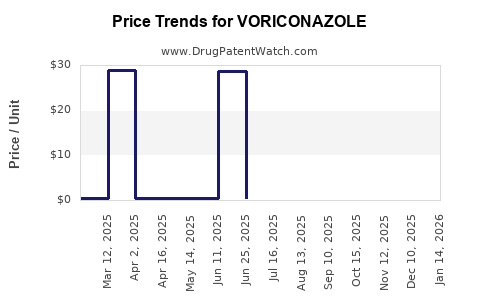
Last updated: September 7, 2026
Voriconazole is a mature, genericized triazole antifungal with declining branded revenue, broad clinical adoption, and persistent demand in invasive fungal infections. Pfizer’s Vfend franchise lost meaningful exclusivity after U.S. patent expiry and generic entry. The commercial market is now driven by hospital procurement, generic pricing, supply reliability, therapeutic monitoring, and use in high-risk immunocompromised patients rather than by brand promotion.
What is the current market position of voriconazole?
Voriconazole is a second-generation triazole antifungal marketed originally by Pfizer as Vfend. It is available in oral tablets, oral suspension, and intravenous formulations. The FDA approved Vfend in 2002 for serious fungal infections, including invasive aspergillosis, candidemia in non-neutropenic patients, esophageal candidiasis, and serious infections caused by Scedosporium apiospermum and Fusarium species [1].
The product remains clinically important because it has:
- Activity against Aspergillus species and several difficult-to-treat molds.
- Oral and intravenous dosage forms.
- Established use in hematopoietic stem-cell transplant and other immunocompromised populations.
- Generic availability in the United States and other major markets.
- A large clinical evidence base and inclusion in infectious-disease treatment guidelines.
The market has shifted from a branded specialty pharmaceutical model to a generic hospital and infectious-disease product. Pfizer remains associated with the originator brand, but generic manufacturers control much of the volume in price-sensitive markets.
How has voriconazole revenue changed over time?
Voriconazole revenue followed the standard lifecycle of a specialty anti-infective: rapid uptake after launch, expansion through additional indications, peak commercial contribution during the patent-protected period, and steep erosion after generic competition.
| Period |
Commercial stage |
Financial effect |
| 2002-2005 |
U.S. launch and indication expansion |
Rapid branded adoption in invasive fungal disease |
| 2006-2010 |
Mature branded period |
Stable demand from transplant and hospital markets |
| 2011-2015 |
Paragraph IV and generic-entry period |
Price and volume pressure began to increase |
| 2016 onward |
Loss of core patent protection |
Significant branded erosion and generic substitution |
| Current market |
Mature generic category |
Low branded visibility; revenue concentrated across multiple suppliers |
Pfizer’s public financial reporting does not consistently disclose a current standalone global revenue line for Vfend. As a result, recent brand-specific revenue cannot be derived reliably from Pfizer’s consolidated annual reports. The financial trajectory is clear even without a current standalone figure: Vfend has moved from a material branded product to a low-growth or declining legacy product, while generic voriconazole retains recurring institutional demand.
The main commercial value now lies in aggregate market volume rather than originator-brand pricing. Demand is supported by invasive aspergillosis treatment, prophylaxis in selected high-risk patients, and infections caused by uncommon molds. Generic prices are lower than historical Vfend prices, but supply interruptions or limited competition can produce temporary price volatility.
When did voriconazole lose exclusivity?
Voriconazole lost effective U.S. market exclusivity in stages rather than on a single date.
The principal U.S. compound patent associated with voriconazole was U.S. Patent No. 5,886,213, assigned to Pfizer-related entities. The patent covered the compound and was listed with an expiration date in 2016 after applicable patent-term adjustments and pediatric-extension considerations. The core loss of exclusivity occurred in the middle of the 2010s.
The commercial timeline was affected by:
- Patent challenges filed by generic-drug companies.
- FDA approval of generic oral and injectable products.
- Pediatric exclusivity and other regulatory adjustments.
- Separate protection for dosage forms, formulations, or listed uses.
- Country-specific patent and regulatory rules.
| Protection category |
Commercial relevance |
| Compound patent |
Primary barrier to generic entry |
| Tablet and suspension patents |
Potentially relevant to specific formulations |
| Intravenous formulation protection |
Could affect injectable entry separately |
| Method-of-use patents |
May restrict labeled indications, but usually do not prevent all generic sales |
| Regulatory exclusivity |
Limited compared with the duration of compound-patent protection |
Generic manufacturers could also pursue approval through abbreviated new drug applications while using patent certifications under the Hatch-Waxman framework. The practical result was a transition from branded exclusivity to multi-source competition.
What is the Orange Book status of voriconazole?
The FDA Orange Book historically listed Vfend dosage forms and related patent information. The relevant product categories include:
- Voriconazole tablets.
- Voriconazole for oral suspension.
- Voriconazole for injection.
The central compound-patent barrier has expired. Any remaining Orange Book-listed patents, if applicable to a particular presentation or use, do not recreate the original market exclusivity associated with the compound patent. For generic applicants, the commercial assessment depends on the exact dosage form, patent certification, and whether the applicant seeks approval for all or only certain labeled uses.
The FDA-approved generic pathway is important because voriconazole is a small-molecule drug. Generic applicants do not need to demonstrate biosimilarity. They must demonstrate pharmaceutical equivalence, bioequivalence, and compliance with applicable manufacturing requirements through an ANDA or another approved pathway [2].
Which companies are challenging or competing with Vfend?
The competitive landscape is fragmented. Generic voriconazole has been marketed by multiple companies over time, including major generic suppliers and regional manufacturers. The list of active suppliers varies by country, dosage form, manufacturing site, and regulatory status.
Competition includes:
- Large multinational generic manufacturers.
- U.S. specialty and hospital suppliers.
- Contract manufacturers supplying regional distributors.
- Government and hospital tender suppliers.
- Compounded or extemporaneous suppliers for selected oral-suspension needs.
The principal competitive factors are price, availability, injectable manufacturing capacity, product quality, and distribution access. A supplier with an approved product may still have limited commercial presence if it cannot maintain reliable inventory or participate in hospital tenders.
What formulations are protected by voriconazole patents?
Voriconazole is commercially differentiated by delivery form rather than by a modern reformulation franchise.
| Formulation |
Clinical and commercial role |
Competitive exposure |
| Oral tablets |
Routine outpatient and step-down therapy |
High generic substitution |
| Oral suspension |
Pediatric and swallowing-impaired patients |
Generic competition, with more operational complexity |
| Intravenous injection |
Initial treatment in severe or non-oral cases |
Manufacturing and hospital-contract barriers |
| Extemporaneous liquid formulations |
Limited-use alternative |
Quality and stability considerations |
The intravenous product has greater manufacturing complexity than tablets because it involves sterile production, reconstitution, and hospital handling. This can reduce the number of reliable suppliers even after patent expiry. The barrier is operational and regulatory rather than a durable molecule patent.
Voriconazole also has clinically important pharmacokinetic characteristics. It is metabolized largely through CYP2C19, CYP2C9, and CYP3A4, and exposure can vary substantially between patients. Therapeutic drug monitoring is commonly used in high-risk patients. These characteristics support continued specialist oversight but do not create meaningful branded exclusivity.
How strong is the voriconazole patent estate?
The patent estate is commercially weak as a source of current exclusivity because the principal compound protection has expired. Its historical strength was substantial because the compound patent covered the active pharmaceutical ingredient and delayed broad generic substitution.
Current patent strength can be summarized as follows:
| Patent issue |
Current assessment |
| Core molecule |
Expired in the U.S. after the primary protection period |
| Broad commercial exclusivity |
No longer available to the originator |
| Dosage-form protection |
Limited value after core compound expiry |
| Method-of-use protection |
Narrower and potentially subject to label carve-outs |
| Manufacturing know-how |
Relevant to quality and supply, not broad market exclusivity |
| International protection |
Varies by country; mature markets generally face generic competition |
The remaining intellectual-property value is more relevant to specific formulations, manufacturing processes, or jurisdictional differences than to global protection of the active ingredient.
What generic-entry risks exist for voriconazole?
Generic-entry risk is high in tablets and oral suspension because the active ingredient is established, the clinical reference product is well characterized, and multiple generic suppliers can compete.
The main generic-entry risks to the originator include:
- Rapid substitution in hospital formularies.
- Tender-driven price reductions.
- Loss of physician preference for the brand.
- Distributor preference for lower-cost alternatives.
- Reduced reimbursement for branded products.
- Commercial substitution after product shortages are resolved.
The main risks to generic suppliers are different. They include:
- Manufacturing interruptions.
- Sterile injectable quality failures.
- Limited active-pharmaceutical-ingredient sources.
- Low margins after tender competition.
- Regulatory observations at manufacturing facilities.
- Pharmacovigilance and product-quality obligations.
Generic competition does not eliminate all commercial opportunity. A supplier can gain share if it offers reliable injectable supply, competitive contracting, or consistent delivery to transplant centers and hospital systems.
What patent litigation and settlement issues affected voriconazole?
Voriconazole entered the U.S. generic market through the standard patent-challenge environment for a small-molecule product. Generic applicants could file Paragraph IV certifications asserting that listed patents were invalid, unenforceable, or not infringed. Such filings can trigger patent litigation and a statutory stay of FDA approval under the Hatch-Waxman Act.
The key business effect was timing. A successful patent challenge or settlement can bring generic supply to market before the nominal expiration of every listed patent. A later generic launch can also occur after the core patent expires even if disputes remain over individual formulations or uses.
No current litigation materially restores Vfend’s original market position. Any historical settlement terms between Pfizer and generic applicants must be evaluated by product, applicant, and jurisdiction. Settlement dates do not by themselves establish current market exclusivity.
What is the FDA regulatory status of voriconazole?
Voriconazole remains an FDA-approved prescription antifungal. Vfend is approved in multiple dosage forms, and generic versions have been approved through the FDA’s abbreviated pathway.
The FDA label identifies several clinically relevant warnings:
- Visual disturbances.
- Hepatic toxicity.
- QT prolongation.
- Serious dermatologic reactions.
- Photosensitivity and potential skin-cancer risk with prolonged exposure.
- Important drug-drug interactions.
- Variable exposure requiring clinical monitoring in selected patients.
The FDA also identifies limitations in pediatric and adult dosing because voriconazole pharmacokinetics differ across age groups and patient populations [1]. These factors create clinical-management requirements but do not materially limit generic substitution where the generic product is therapeutically equivalent.
Does voriconazole face biosimilar competition?
No. Voriconazole is a chemically synthesized small molecule, not a biologic. It faces generic-drug competition, not biosimilar competition.
The relevant regulatory pathway is an ANDA or another small-molecule approval route. Biosimilar concepts such as reference-product interchangeability, biologic exclusivity, and comparative immunogenicity do not apply to voriconazole.
How does voriconazole compare with competing antifungals?
Voriconazole competes with both alternative triazoles and newer antifungal classes.
| Drug |
Class |
Competitive position |
| Voriconazole |
Triazole |
Established Aspergillus therapy; oral and IV forms |
| Isavuconazole |
Triazole |
Newer branded alternative with different safety and interaction profile |
| Posaconazole |
Triazole |
Strong role in prophylaxis and selected treatment settings |
| Liposomal amphotericin B |
Polyene |
Important alternative for severe invasive fungal disease |
| Isavuconazonium |
Prodrug of isavuconazole |
Branded hospital competitor |
| Echinocandins |
Distinct antifungal class |
Important for candidiasis, with limited mold coverage |
Voriconazole’s generic price advantage is its main commercial strength. Newer branded products may compete through dosing convenience, safety profile, reduced interaction burden, or specific guideline positioning. Voriconazole remains vulnerable where clinicians prioritize predictable exposure, lower interaction risk, or simpler therapeutic monitoring.
What financial trajectory should investors expect?
The financial outlook is mature and volume-based.
Revenue exposure
Pfizer’s direct revenue exposure is limited by generic substitution and the lack of a separately reported, high-growth Vfend franchise. Current market value is distributed among generic manufacturers, hospital suppliers, and contract manufacturers.
Margin profile
Branded margins declined after generic entry. Generic margins depend on:
- Number of active suppliers.
- Hospital tender intensity.
- API costs.
- Sterile-manufacturing capacity.
- Product shortages.
- Reimbursement and procurement rules.
Tablets tend to have lower manufacturing barriers and heavier price competition. Injectable voriconazole can maintain better pricing when few suppliers have dependable sterile capacity.
Growth drivers
Potential volume growth comes from:
- Expansion of transplant and oncology care.
- Greater recognition of invasive fungal disease.
- Continued use in immunocompromised populations.
- Hospital demand for oral-to-intravenous treatment pathways.
- Increased access in emerging markets.
Downside drivers
The main downside risks are:
- Further generic price erosion.
- Substitution by isavuconazole or posaconazole.
- Improved antifungal stewardship.
- Reduced duration of therapy.
- Hospital budget pressure.
- Supply-chain concentration.
- Safety concerns or changing treatment guidelines.
The likely market profile is stable-to-declining branded revenue with recurring generic demand. A rapid return to premium pricing is unlikely without a new protected formulation, delivery technology, or substantially differentiated clinical use.
What geographic markets remain commercially attractive?
The United States, Western Europe, Japan, and other developed markets are mature and highly genericized. Commercial opportunity in these markets depends on supply reliability, contracting, and formulation availability.
Emerging markets may offer greater unit growth because of expanding transplant services, oncology treatment, intensive care capacity, and diagnostic access. Pricing is generally lower, and local registration, procurement rules, and manufacturing requirements can restrict entry.
Geographic patent protection is no longer uniform in commercial importance. In many major markets, regulatory and supply execution matter more than compound-patent rights. Country-level analysis remains necessary because patent expiry, generic approval, data exclusivity, and tender rules differ.
Key Takeaways
- Voriconazole is a mature generic antifungal with sustained clinical demand.
- Pfizer’s Vfend franchise lost its primary U.S. exclusivity position after compound-patent expiry in the mid-2010s.
- Generic competition is strongest for tablets and oral suspension.
- Intravenous supply remains more exposed to sterile-manufacturing constraints and shortages.
- Voriconazole faces generic competition, not biosimilar competition.
- Pfizer does not provide a consistently reported current standalone Vfend revenue figure.
- Financial value has shifted from branded pricing to aggregate generic volume and supply reliability.
- Newer antifungals compete through safety, dosing, interaction, and prophylaxis advantages.
- The remaining patent estate has limited ability to restore broad market exclusivity.
- The most attractive commercial positions are likely to involve reliable hospital supply, injectable manufacturing, and geographic markets with limited competition.
FAQs
Is voriconazole still patented?
The principal U.S. compound patent protection has expired. Any remaining patent issues are narrower and may relate to particular formulations, uses, or jurisdictions.
Is Vfend still sold in the United States?
Vfend is an FDA-approved brand, but generic voriconazole is widely available and has reduced the brand’s commercial importance.
Can generic voriconazole be substituted for Vfend?
FDA-approved generic products are therapeutically equivalent to the applicable reference product when listed as substitutable under FDA standards. Formulation, dosage, and prescribing requirements still apply.
Why is intravenous voriconazole commercially more defensible than tablets?
Intravenous voriconazole requires sterile manufacturing, quality control, hospital distribution, and reliable inventory. These operational barriers can limit the number of dependable suppliers even after patent expiry.
What is the main clinical risk affecting voriconazole demand?
The principal risks are drug interactions, variable exposure, hepatic toxicity, visual effects, QT prolongation, and photosensitivity. These factors can shift use toward alternative antifungals in selected patients.
References
-
U.S. Food and Drug Administration. (2024). Vfend (voriconazole) prescribing information. FDA.
-
U.S. Food and Drug Administration. (2024). Approved drug products with therapeutic equivalence evaluations. FDA.
-
Pfizer Inc. (2002-2024). Annual reports and Form 10-K filings. Pfizer.
-
U.S. Patent and Trademark Office. (1999). U.S. Patent No. 5,886,213, triazole antifungal compounds. USPTO.
-
U.S. Food and Drug Administration. (1984). Drug Price Competition and Patent Term Restoration Act of 1984. FDA.