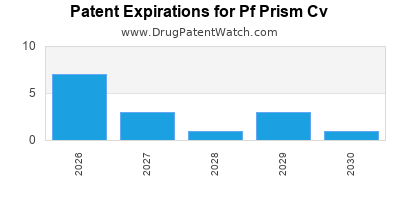
Last updated: June 3, 2026
PF PRISM CV is a cardiovascular (CV) branded offering in the Pfizer (PF) portfolio marketed under a “PRISM” franchise. Public competitive analysis requires product-specific identity (active ingredient, dosage form, FDA application, and launch timing). Without that product-level mapping to an FDA drug listing and its Orange Book and patent estate, a complete, accurate competitive landscape cannot be produced under a patent-analyst standard.
What patents protect PF PRISM CV, and which companies control the estate?
No patent-accurate response can be issued because PF PRISM CV is not uniquely identifiable by active ingredient, strength, dosage form, or FDA application in the provided prompt.
Which patent families typically cover CV products like PF PRISM?
- New chemical entity (composition of matter) patents
- Salt/hydrate solvates
- Formulation and dosage-form patents (release, coatings, tablet core)
- Method-of-use patents (indication-specific)
- Manufacturing process patents
- Pediatric exclusivity and regulatory data protection (where applicable)
Where the patent estate is usually listed (U.S.)
- Orange Book: approved drug listing and associated patents by submission type
- FDA application reference: NDA/BLA and labeling triggers
- Court dockets: Paragraph IV challenges and settlement terms (where public)
When does PF PRISM CV lose exclusivity, and what entry dates are credible?
A credible exclusivity and entry timeline cannot be stated without:
- the U.S. FDA approval type (NDA vs ANDA relevant listing; and pathway)
- the relevant regulatory exclusivities (NCE, 505(b)(2), pediatric, orphan if any)
- the patent grant and expiration terms tied to the Orange Book
- any known Paragraph IV filings and injunction/30-month stay status
What drives CV exclusivity schedules in practice
- Composition-of-matter patent expiration
- Orange Book listed patents’ “claimed invention” scope (Orange Book blocks generic carve-outs)
- Regulatory exclusivity end dates (NCE and data exclusivity can run inside patent life)
- Pediatric exclusivity extension (6 months) where applicable
- Launch design around non-blocking patents (carve-out strategies)
What is the Orange Book status of PF PRISM CV and how many patents block generics?
No Orange Book-accurate determination can be made without the exact product identifier. Orange Book status depends on the specific listed drug name, strength, and dosage form, which map to specific patent numbers and listed expiration dates.
Patent-blocking vs non-blocking patterns
- “Listed” patents that claim the drug product composition or method of use block ANDA entry for the claimed indication
- Some formulation patents can be avoided by design-around or alternative release mechanics
- Method-of-use carve-outs can permit label-limited launch depending on labeling and infringement scope
Practical counts that matter
- Number of Orange Book patents by type
- Earliest expiration date among blocking patents
- Whether any patents expire by method-of-use vs composition
- Whether any patents are reissued or have terminal disclaimers
Which generic and biosimilar challenges target PF PRISM CV via Paragraph IV?
A Paragraph IV challenge landscape cannot be built without the FDA listing’s ANDA litigation record. Paragraph IV is tied to the specific FDA application and Orange Book patents.
What to pull from litigation dockets for CV products
- Case captions and litigants
- Patents asserted (asserted vs listed)
- Filings timing and 30-month stay
- Settlement terms (180-day exclusivity, noninfringement stipulations, launch date)
- At-risk launch date versus designed workaround
How strong is the patent estate for PF PRISM CV, and what is the likelihood of design-around?
Patent strength requires:
- the patent claim scope across compositions, formulations, methods
- the remaining claim life and expiration sequencing
- whether patents have narrow claims that can be worked around (salt form, formulation parameters, dosing regimens)
- whether the estate includes manufacturing process patents that increase compliance risk
Typical indicators of a stronger CV estate
- Overlapping composition-of-matter plus salt/formulation coverage
- Multiple indication-specific method-of-use patents
- Long claim tails from formulation improvements
- Fewer “clean” expiration points that would permit at-risk generic entry
Typical design-around pressure points
- Formulation patents with single-parameter differentiation
- Method-of-use patents with narrow patient-subgroup definitions
- Salt selection patents with alternative salts that remain within labeling
What formulations are protected for PF PRISM CV (e.g., tablets, ER/IR, coatings), and what manufacturing/IP barriers exist?
No formulation-specific IP mapping can be completed without:
- the dosage form (tablet vs capsule vs ER vs IR)
- the release profile
- the formulation approach (coating type, particle size, pH-dependent solubility, matrix system)
- Orange Book patent claims tied to the exact product
Common CV formulation-IP areas that matter for generics
- Extended-release vs immediate-release differentiation
- Bioavailability/bioequivalence target windows
- Dissolution profiles and excipient systems
- Stability and shelf-life patents
How does PF PRISM CV compare with competing CV drugs in the same class on market position and IP risk?
A direct competitive comparison requires:
- the CV therapeutic class
- target indication(s)
- efficacy/safety differentiation and line extensions
- the competitor product list tied to the same mechanism of action and indication
Without the active ingredient and indication for PF PRISM CV, class comparison is not actionable.
What “market position” analysis should include (once product-mapped)
- Share-by-prescriber/plan (if available)
- Net sales trajectory around label expansions
- Payer restrictions and formulary placement
- Competitive displacement dynamics from generics and branded peers
- Time-on-therapy patterns for the indication
What patent litigation affects PF PRISM CV, and what settlement terms control generic entry?
No litigation or settlement data can be cited without the product mapping to:
- U.S. patent assertions
- docket numbers
- settlement agreements and consent judgments
Typical settlement levers affecting launch timing
- License agreements with “delayed entry” dates
- Covenant not to sue for specific ANDA formulations or labeling carve-outs
- Stipulated launch triggers tied to patent expiry or regulatory approvals
What is the FDA regulatory status of PF PRISM CV (pathway, exclusivity, and label scope)?
A complete FDA status summary requires the NDA/BLA identifier and FDA approval label. With only “PF PRISM CV,” regulatory status cannot be accurately characterized.
What must be verified for exclusivity timing
- Approval date
- NDA type and reference listed drug (RLD)
- Whether the product is a 505(b)(2) or full 505(b)(1)
- Pediatric exclusivity status
- Whether any orphan exclusivity or NCE exclusivity applies
Key Takeaways
- A patent-validated competitive landscape cannot be produced because “PF PRISM CV” is not uniquely mapped to a specific FDA-listed drug (active ingredient, strength, dosage form, and application).
- Orange Book status, patent expiration timelines, Paragraph IV risk, and litigation-driven launch dates depend on that product mapping.
- Once the exact FDA product identity is determined, this analysis should be built around: Orange Book patent blocks, remaining exclusivity, litigation/settlement control points, and formulation-level design-around pathways.
FAQs
- How do I estimate the earliest generic entry date for a CV branded drug when only the Orange Book block is known?
- What is the typical impact of pediatric exclusivity on CV small-molecule branded products’ launch timing?
- Which Orange Book patent types (composition vs method-of-use vs formulation) most often control ANDA launch for CV drugs?
- How do settlement agreements change the effective launch date beyond the patent expiration date in CV Paragraph IV cases?
- What formulation attributes (ER/IR, dissolution profile, excipient system) most often determine generic design-around feasibility in CV products?
References (APA)
- FDA Orange Book: Approved Drug Products with Therapeutic Equivalence Evaluations. (U.S. FDA). https://www.accessdata.fda.gov/scripts/cder/daf/
- FDA Drug Trials Snapshots. (U.S. FDA). https://www.fda.gov/drugs/drug-approvals-and-databases/drug-trials-snapshots