Last Updated: June 24, 2026

TICAGRELOR - Generic Drug Details


✉ Email this page to a colleague

« Back to Dashboard


What are the generic drug sources for ticagrelor and what is the scope of patent protection?

Ticagrelor is the generic ingredient in two branded drugs marketed by Astrazeneca, Alembic, Alkem Labs Ltd, Amneal, Apotex, Changzhou Pharm, Dr Reddys, Hisun Pharm Hangzhou, Invagen Pharms, Macleods Pharms Ltd, Mankind Pharma, Micro Labs, MSN, Mylan, Prinston Inc, Sciegen Pharms, Sunshine, Taro, Watson Labs Inc, and Zhejiang Jingxin, and is included in twenty-one NDAs. There are two patents protecting this compound and two Paragraph IV challenges. Additional information is available in the individual branded drug profile pages.

Ticagrelor has sixty-two patent family members in thirty-five countries.

There are twenty-one drug master file entries for ticagrelor. Twenty-seven suppliers are listed for this compound. There is one tentative approval for this compound.

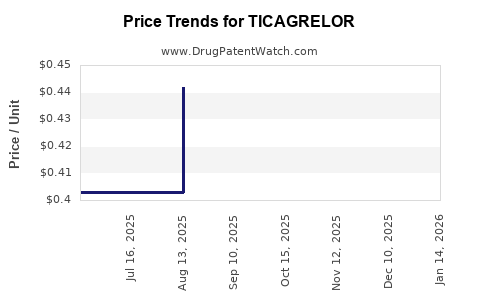
Drug Prices for TICAGRELOR

See drug prices for TICAGRELOR

Recent Clinical Trials for TICAGRELOR

Identify potential brand extensions & 505(b)(2) entrants

SponsorPhase
Montreal Heart InstitutePHASE3
Collegium Medicum w BydgoszczyPHASE4
Ministry of Science and Higher Education, PolandPHASE4

See all TICAGRELOR clinical trials

Generic filers with tentative approvals for TICAGRELOR
Applicant Application No. Strength Dosage Form
⤷  Start Trial⤷  Start Trial90MGTABLET;ORAL

The 'tentative' approval signifies that the product meets all FDA standards for marketing, and, but for the patents / regulatory protections, it would approved.

Paragraph IV (Patent) Challenges for TICAGRELOR
Tradename Dosage Ingredient Strength NDA ANDAs Submitted Submissiondate
BRILINTA Tablets ticagrelor 60 mg 022433 3 2015-09-30
BRILINTA Tablets ticagrelor 90 mg 022433 16 2015-07-20

US Patents and Regulatory Information for TICAGRELOR

Applicant Tradename Generic Name Dosage NDA Approval Date TE Type RLD RS Patent No. Patent Expiration Product Substance Delist Req. Exclusivity Expiration
Alkem Labs Ltd TICAGRELOR ticagrelor TABLET;ORAL 210219-001 Oct 28, 2025 AB RX No No ⤷  Start Trial ⤷  Start Trial ⤷  Start Trial
Apotex TICAGRELOR ticagrelor TABLET;ORAL 208584-002 Oct 28, 2025 AB RX No No ⤷  Start Trial ⤷  Start Trial ⤷  Start Trial
Mylan TICAGRELOR ticagrelor TABLET;ORAL 208597-001 Jul 9, 2021 AB RX No No ⤷  Start Trial ⤷  Start Trial ⤷  Start Trial
Invagen Pharms TICAGRELOR ticagrelor TABLET;ORAL 208537-001 May 5, 2025 AB RX No No ⤷  Start Trial ⤷  Start Trial ⤷  Start Trial
Dr Reddys TICAGRELOR ticagrelor TABLET;ORAL 208541-001 Oct 29, 2024 AB RX No No ⤷  Start Trial ⤷  Start Trial ⤷  Start Trial
Changzhou Pharm TICAGRELOR ticagrelor TABLET;ORAL 216187-001 Oct 28, 2025 AB RX No No ⤷  Start Trial ⤷  Start Trial ⤷  Start Trial
>Applicant >Tradename >Generic Name >Dosage >NDA >Approval Date >TE >Type >RLD >RS >Patent No. >Patent Expiration >Product >Substance >Delist Req. >Exclusivity Expiration

Expired US Patents for TICAGRELOR

Applicant Tradename Generic Name Dosage NDA Approval Date Patent No. Patent Expiration
Astrazeneca BRILINTA ticagrelor TABLET;ORAL 022433-002 Sep 3, 2015 ⤷  Start Trial ⤷  Start Trial
Astrazeneca BRILINTA ticagrelor TABLET;ORAL 022433-001 Jul 20, 2011 ⤷  Start Trial ⤷  Start Trial
Astrazeneca BRILINTA ticagrelor TABLET;ORAL 022433-002 Sep 3, 2015 ⤷  Start Trial ⤷  Start Trial
Astrazeneca BRILINTA ticagrelor TABLET;ORAL 022433-001 Jul 20, 2011 ⤷  Start Trial ⤷  Start Trial
Astrazeneca BRILINTA ticagrelor TABLET;ORAL 022433-002 Sep 3, 2015 ⤷  Start Trial ⤷  Start Trial
>Applicant >Tradename >Generic Name >Dosage >NDA >Approval Date >Patent No. >Patent Expiration

EU/EMA Drug Approvals for TICAGRELOR

Company Drugname Inn Product Number / Indication Status Generic Biosimilar Orphan Marketing Authorisation Marketing Refusal
AstraZeneca AB Brilique ticagrelor EMEA/H/C/001241Brilique, co administered with acetylsalicylic acid (ASA), is indicated for the prevention of atherothrombotic events in adult patients withacute coronary syndromes (ACS) ora history of myocardial infarction (MI) and a high risk of developing an atherothrombotic eventBrilique, co-administered with acetyl salicylic acid (ASA), is indicated for the prevention of atherothrombotic events in adult patients with a history of myocardial infarction (MI occurred at least one year ago) and a high risk of developing an atherothrombotic event. Authorised no no no 2010-12-03
AstraZeneca AB Possia ticagrelor EMEA/H/C/002303Possia, co-administered with acetylsalicylic acid (ASA), is indicated for the prevention of atherothrombotic events in adult patients with acute coronary syndromes (unstable angina, non-ST-elevation myocardial infarction [NSTEMI] or ST-elevation myocardial infarction [STEMI]); including patients managed medically, and those who are managed with percutaneous coronary intervention (PCI) or coronary artery by-pass grafting (CABG). Withdrawn no no no 2010-12-03
>Company >Drugname >Inn >Product Number / Indication >Status >Generic >Biosimilar >Orphan >Marketing Authorisation >Marketing Refusal

Supplementary Protection Certificates for TICAGRELOR

Patent Number Supplementary Protection Certificate SPC Country SPC Expiration SPC Description
1135391 SPC/GB11/016 United Kingdom ⤷  Start Trial PRODUCT NAME: TICAGRELOR OR A PHARMACEUTICALLY ACCEPTABLE SALT THEREOF.; REGISTERED: UK EU/1/10/655/001 20101203; UK EU/1/10/655/002 20101203; UK EU/1/10/655/003 20101203; UK EU/1/10/655/004 20101203; UK EU/1/10/655/005 20101203; UK EU/1/10/655/006 20101203
1135391 PA2011004,C1135391 Lithuania ⤷  Start Trial PRODUCT NAME: TICAGRELORUM; REGISTRATION NO/DATE: EU/1/10/655/001 2010 12 03 EU/1/10/655/002 2010 12 03 EU/1/10/655/003 2010 12 03 EU/1/10/655/004 2010 12 03 EU/1/10/655/005 2010 12 03 EU/1/10/655/00 20101203
1135391 PA2011004 Lithuania ⤷  Start Trial PRODUCT NAME: TICAGRELORUM; REGISTRATION NO/DATE: EU/1/10/655/001 2010 12 03 EU/1/10/655/002 2010 12 03 EU/1/10/655/003 2010 12 03 EU/1/10/655/004 2010 12 03 EU/1/10/655/005 2010 12 03 EU/1/10/655/00 20101203
1135391 1190009-9 Sweden ⤷  Start Trial PRODUCT NAME: TICAGRELOR ELLER ETT FARMACEUTISKT ACCEPTABELT SALT DAERAV; REG. NO/DATE: EU/1/10/655/001-006 20101203
1135391 CA 2011 00013 Denmark ⤷  Start Trial PRODUCT NAME: TICAGRELOR ELLER ET FARMACEUTISK ACCEPTABELT SALT DERAF
1135391 C300485 Netherlands ⤷  Start Trial PRODUCT NAME: TICAGRELOR OF EEN FARMACEUTISCH AANVAARDBAAR ZOUT DAARVAN; REGISTRATION NO/DATE: EU/1/10/655/001-006 20101203
>Patent Number >Supplementary Protection Certificate >SPC Country >SPC Expiration >SPC Description
Last updated: June 21, 2026

Ticagrelor Market Dynamics and Financial Trajectory: Sales Trends, Patent/Generic Risk, and Competitive Shifts

Ticagrelor (Brilinta; AstraZeneca) remains a volume-driven branded antiplatelet with material regional sales dispersion, high payer scrutiny in cost-effectiveness markets, and ongoing patent-driven generic entry risk. Financial trajectory is shaped by (1) guideline penetration in acute coronary syndromes and secondary prevention, (2) swap risk from clopidogrel/prasugrel based on bleeding profile and formulary access, (3) regional pricing and reimbursement tightening, and (4) patent and exclusivity milestones that determine when sustained generic price compression begins.

The economic playbook for ticagrelor over the next cycle is mostly deterministic: where tablet-only pricing holds and substitution is delayed by patent/IP and local reference-product frameworks, revenues stabilize longer; where payers broaden DTC and hospital formularies around clopidogrel or switch to generics, ticagrelor’s net sales decline accelerates.


How has ticagrelor’s global sales trended over time?

Short answer: Ticagrelor sales have grown through label expansion and ACS penetration, then typically plateaued and softened in markets where payer restriction and generic alternatives reduced addressable share. Recent performance is defined by (a) continued adoption in PCI/ACS pathways and (b) erosion from formulary preferences and cost controls.

Key demand drivers

  • ACS and secondary prevention adherence: Ticagrelor’s role in dual antiplatelet therapy (DAPT) after myocardial infarction and in PCI pathways keeps demand sticky where guidelines and hospital protocols are stable.
  • Clinical switching inertia: Hospitals that have standardized protocols for ACS manage DAPT procurement centrally, delaying switching to cheaper comparators until procurement contracts expire.
  • Regional payer design: Co-pay structures and formulary tiering often decide whether ticagrelor keeps incremental users versus displacing to clopidogrel.

Key headwinds

  • Bleeding and dyspnea tolerability management: Real-world discontinuation risk influences persistence, especially in elderly/high-bleed-risk cohorts.
  • Payer cost-effectiveness pressure: Health technology assessments and budget impact analysis increasingly push to lower acquisition cost antiplatelet strategies where clinical benefit is treated as incremental.

What to watch in sales filings

  • Geographic split: Net sales often show uneven decline once generics gain reference status or formulary access shifts.
  • Contract timing: Hospital tender cycles create quarter-to-quarter volatility even without major label changes.

What market dynamics move ticagrelor demand: payers, guidelines, and formulary access?

Short answer: Payer behavior and formulary access are the dominant market levers for ticagrelor, with clinical differentiation influencing who gets approved for coverage rather than whether ticagrelor is clinically recommended.

Payer and reimbursement mechanics

  • Formulary tier placement: When ticagrelor is moved from preferred to restricted tiers, utilization often falls faster than would be expected from pure clinical competition.
  • Prior authorization and step therapy: Coverage constraints reduce initiation in lower-risk or borderline-eligible patients.
  • Indexing to reference pricing: Countries using external reference or internal reference pricing can compress net price without immediate generic entry.

Guideline penetration and protocol locking

  • PCI and ACS pathway inclusion: Where cardiology societies and national guidelines emphasize ticagrelor over alternatives, procurement volumes remain resilient.
  • Institutional pathway consistency: A hospital standardized DAPT protocol can keep ticagrelor share high even after payer restrictions unless explicit substitution is required.

Which competitors most affect ticagrelor share: clopidogrel and prasugrel?

Short answer: Clopidogrel is the main budget-driven comparator; prasugrel competes on clinical differentiation and bleeding-risk management in some ACS subpopulations.

Competitive trade-offs

  • Clopidogrel (generic-dominant): Drives the economic substitution curve. If ticagrelor’s net price premium cannot justify the modeled incremental clinical benefit, payers narrow access.
  • Prasugrel (often branded-to-generic depending on market): Competes in ACS/PCI where formulary committees treat bleeding risk and efficacy as balancing factors.

Market outcome patterns

  • Switching accelerates under cost containment: The slope of decline typically steepens when payer procurement bundles shift to lower acquisition cost.
  • Persistence differs by subgroup: Patients with earlier tolerability success on ticagrelor tend to remain on therapy longer than naïve initiations when access expands.

When does ticagrelor lose exclusivity and how does that affect generic entry risk?

Short answer: Generic and biosimilar timelines depend on the specific US and jurisdictional patent landscape for each dosage form and use, plus regulatory exclusivity (where applicable). The near-term financial issue is not just “first generic entry,” but whether multiple Paragraph IV challenges and settlements enable multi-source supply quickly and broadly.

How exclusivity drives the economic curve

  • Early generic entry: Creates immediate net price compression and margin pressure for the brand.
  • Multi-player entry: If multiple ANDA filers launch around the same time, price erosion stabilizes at a lower floor.
  • Delayed entry via secondary patents: Even after primary patent expiry, formulation, method-of-use, and polymorph or manufacturing patents can postpone full substitution.

What matters for licensing and litigation strategy

  • Settlement structures: Settlements that limit “at-risk” launch dates shape the timing of sales erosion.
  • 180-day exclusivity dynamics: The first filer’s incentive affects competitive launch pacing, especially once generic quality and supply scale.

What is the Paragraph IV and patent litigation landscape for ticagrelor?

Short answer: The generic entry path in ticagrelor is typically controlled by the interaction between ANDA filings, Orange Book-listed patents, and settlement outcomes that establish launch calendars. For financial modeling, the key is whether settlements result in narrow carve-outs that delay multiple launches.

Common litigation impact pathways

  • Brand settlement calendar: Settlement can set a date before which most ANDAs will not launch.
  • Court outcomes: Adjudication of claim validity and infringement affects the remaining patent portfolio.
  • Patent-by-patent thinning: Even if one patent is cleared, others may delay entry.

Business relevance

  • Revenue exposure is driven by broad substitution. Markets where multiple generic sources launch quickly see larger demand deflection even if clinical behavior is stable.

What is the Orange Book status of ticagrelor patents and how many are listed?

Short answer: Orange Book status is decisive for ANDA “carve-in/carve-out” launch eligibility; the number and type of listed patents (composition, formulation, method of use) determine whether generic entry is delayed beyond primary expiry.

How to model Orange Book risk

  • Count of active patents by category: More active formulation/method-of-use patents increases probability of staggered litigation.
  • Last-expiring claims drive “effective” exclusivity. Market substitution usually accelerates only after the last enforceable listed patent expires or is successfully designed around.

How do formulation and manufacturing patents influence ticagrelor market access?

Short answer: For oral antiplatelets, manufacturing method and formulation patents often determine whether generics can launch promptly or must use process changes that trigger new litigation.

Key technical IP categories that affect launch

  • Solid-state/formulation patents: Tablet composition or release-profile claims can be easier to detect and litigate than purely theoretical designs.
  • Process patents: Manufacturing steps can create infringement exposure even if composition is designed around.
  • Bioequivalence design constraints: Even if ANDA approval is available, the patent estate can still block launch until litigation resolves.

What generic launch scenarios are most plausible for ticagrelor?

Short answer: The most common scenarios are (1) delayed, settlement-driven entry by one first-filer plus limited early launch, or (2) broader multi-source entry once the last enforceable patent expires or is cleared.

Scenario mechanics for financial modeling

  • Single first-filer entry: Price erosion begins, but brand decline is moderated by limited supply and ongoing access restrictions.
  • Multi-filer synchronized entry: Typically produces steeper brand net sales declines and higher margin compression across the class.
  • Launch cutoffs by dosage form/strength: Ticagrelor is a multi-strength product; partial entry can slow near-term revenue erosion but not eliminate medium-term share loss.

How does ticagrelor’s financial trajectory compare with other antiplatelet brands?

Short answer: Compared with newer or more patent-secured cardiovascular agents, ticagrelor’s trajectory is more exposed to generic and payer dynamics because clopidogrel’s baseline affordability is persistent and market substitution is economically rational.

Relative dynamics vs typical peers

  • Versus branded-only competitors: Ticagrelor has more established guideline presence, but that advantage is offset when payer formularies move toward cheaper generics.
  • Versus newer CV drugs with stronger differentiation: Ticagrelor’s differentiation matters clinically but is harder for payers to justify at premium acquisition cost if modeled benefits are incremental.

What does revenue exposure look like by geography for ticagrelor?

Short answer: Geography determines both pricing and the speed of generic substitution. Financial outcomes hinge on (1) local reimbursement rules, (2) tender procurement structure, and (3) whether generics are permitted and launched at scale.

Geographic exposure factors

  • Net pricing and discounts: Higher statutory list prices do not reflect revenue if discounts are steep.
  • Formulary penetration: Some systems adopt new antiplatelet pathways rapidly, raising early uptake.
  • Generic density: Markets with multiple ANDA approvals and manufacturing capacity tend to compress price faster.

How strong is ticagrelor’s patent estate for protecting revenues?

Short answer: Strength is determined less by the presence of patents and more by whether the estate is enforceable against practical generic designs for the full commercial product set (strengths, dosage forms, and relevant use indications). An estate with multiple secondary patents typically extends the brand’s revenue protection window via litigation and settlement.

What “strong estate” means in practice

  • Multiple expiration dates: Staggering reduces probability of a single cliff drop.
  • Favorable settlement posture: If AstraZeneca can resolve most challenges into delayed launches, the effective revenue protection becomes calendar-stable.
  • Design-around difficulty: If generic designs still trigger infringement risk, launch schedules stay conservative.

What are the biggest financial risks from biosimilar or biologics pathways?

Short answer: Ticagrelor is a small-molecule antiplatelet. Biosimilar risk is not applicable; the relevant risk is generic competition under ANDA pathways and associated patent litigation.


Key takeaways

  • Ticagrelor’s financial trajectory is driven primarily by payer access and procurement dynamics as much as by clinical guideline penetration.
  • Generic and Paragraph IV risk dictates the timing of sustained net sales erosion; the slope depends on whether entry is limited (single first-filer) or multi-source.
  • Patent estate strength matters because last-expiring listed patents, not just primary expiry, control the effective launch calendar.
  • Geographic dispersion is central: markets with strict reimbursement and faster generic uptake see faster revenue pressure.
  • Biosimilar risk is not relevant; competition is classic small-molecule generic substitution plus IP enforcement.

FAQs

1) Does ticagrelor face clopidogrel substitution risk even without generic entry?

Yes. Even with limited generic supply, payers can restrict coverage and steer utilization to clopidogrel based on acquisition cost and budget impact.

2) Which factors most influence ticagrelor persistence in real-world use?

Bleeding risk, dyspnea tolerability, and adherence driven by prior tolerability history and payer coverage rules.

3) Are method-of-use patents a bigger threat to ticagrelor than composition patents?

For commercial oral cardiovascular products, both can matter; method-of-use patents can delay launch if generic labeling or carve-outs cannot avoid infringement risk.

4) How do settlement agreements typically affect ticagrelor brand revenues after patent expiry?

Settlements often establish a controlled launch date or limit early multi-source supply, which slows the rate of net price compression versus unscheduled “at-risk” entry.

5) What is the main lever payers use to manage ticagrelor spend?

Formulary tier restrictions and prior authorization that control initiation rates, which can reduce demand faster than it reduces persistence among already-treated patients.


References

  1. AstraZeneca. Brilinta (ticagrelor) prescribing information and product labeling. (Accessed via FDA labeling database).
  2. U.S. Food and Drug Administration. Orange Book: Approved Drug Products with Therapeutic Equivalence Evaluations (ticagrelor listings).
  3. U.S. Food and Drug Administration. Drug Competition and Patent Term Restoration Act (Drug and biologics competition framework and ANDA/Orange Book mechanics).

More… ↓

⤷  Start Trial

Make Better Decisions: Try a trial or see plans & pricing

Drugs may be covered by multiple patents or regulatory protections. All trademarks and applicant names are the property of their respective owners or licensors. Although great care is taken in the proper and correct provision of this service, thinkBiotech LLC does not accept any responsibility for possible consequences of errors or omissions in the provided data. The data presented herein is for information purposes only. There is no warranty that the data contained herein is error free. We do not provide individual investment advice. This service is not registered with any financial regulatory agency. The information we publish is educational only and based on our opinions plus our models. By using DrugPatentWatch you acknowledge that we do not provide personalized recommendations or advice. thinkBiotech performs no independent verification of facts as provided by public sources nor are attempts made to provide legal or investing advice. Any reliance on data provided herein is done solely at the discretion of the user. Users of this service are advised to seek professional advice and independent confirmation before considering acting on any of the provided information. thinkBiotech LLC reserves the right to amend, extend or withdraw any part or all of the offered service without notice.