Last updated: October 16, 2026
Brilinta, AstraZeneca’s ticagrelor antiplatelet drug, generated approximately $1.55 billion in product sales in 2023, down from about $1.60 billion in 2022 as the U.S. market moved toward generic entry and mature-market pricing pressure increased (AstraZeneca, 2024). The drug remains commercially relevant because of its use in acute coronary syndrome, myocardial-infarction secondary prevention, and selected coronary artery disease populations. Its principal risk is small-molecule generic erosion rather than biosimilar competition.
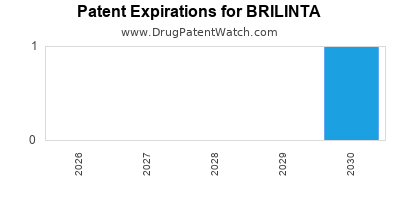
U.S. exclusivity has largely expired or is expiring around the mid-2020s, depending on the strength, indication, and applicable patent or regulatory protection. Brilinta’s revenue trajectory therefore depends on international sales, continued use in higher-risk patients, label breadth, physician preference versus generic clopidogrel, and the speed of generic launches.
What is Brilinta and how does it generate revenue?
Brilinta is the brand name for ticagrelor, an oral, reversible P2Y12 platelet inhibitor marketed by AstraZeneca. It is used with aspirin in several cardiovascular settings, including acute coronary syndrome and selected patients with prior myocardial infarction or coronary artery disease.
Ticagrelor differs from clopidogrel because it does not require metabolic activation through the same pathway and produces more rapid, consistent platelet inhibition. The clinical trade-off is a higher bleeding burden and adverse effects such as dyspnea. These distinctions support branded use in higher-risk patients but do not eliminate generic substitution after loss of exclusivity.
Key FDA milestones
| Milestone |
Date |
Commercial significance |
| Initial U.S. FDA approval for acute coronary syndrome |
July 2011 |
Established Brilinta in the U.S. P2Y12 market |
| Approval for reduced-dose extended treatment after myocardial infarction |
2015 |
Expanded use beyond the acute treatment window |
| Approval involving acute ischemic stroke or high-risk transient ischemic attack |
2020 |
Expanded the addressable cerebrovascular market |
| Global guideline adoption in acute coronary syndrome |
2011 onward |
Supported premium positioning versus generic clopidogrel |
| U.S. generic litigation and abbreviated new drug application activity |
Late 2010s onward |
Created a mid-2020s erosion risk |
The FDA label requires ticagrelor to be used with low-dose aspirin in approved cardiovascular indications. The drug is not a biologic, so it is not exposed to biosimilar substitution rules. Generic manufacturers must use the abbreviated new drug application pathway and demonstrate bioequivalence.
What is Brilinta’s financial trajectory?
Brilinta is a mature AstraZeneca product with substantial cash generation but declining growth. Public annual-report disclosures show a revenue pattern consistent with late-life-cycle erosion.
| Fiscal year |
Approximate AstraZeneca product sales |
Direction |
| 2021 |
About $1.5 billion |
Mature, broadly stable |
| 2022 |
About $1.6 billion |
High point in the recent period |
| 2023 |
About $1.55 billion |
Decline from market maturity and generic pressure |
Sources: AstraZeneca annual reports and financial disclosures (AstraZeneca, 2023, 2024).
Brilinta’s financial profile differs from AstraZeneca’s major growth products, including Tagrisso, Farxiga, Calquence, Fasenra and Enhertu. Those products carry more of the company’s forward growth burden. Brilinta contributes cash flow, but its strategic value is declining as cardiovascular sales become less dependent on the brand.
What is driving the revenue decline?
The main factors are:
- Generic clopidogrel remains widely available at a substantially lower cost.
- Ticagrelor has higher bleeding and dyspnea concerns than clopidogrel.
- Hospital formularies increasingly use protocol-driven P2Y12 selection.
- U.S. patent and settlement activity has reduced the duration of protected branded sales.
- The acute coronary syndrome market is competitive and increasingly cost-sensitive.
- Brilinta’s major indications are mature, limiting volume growth.
The product retains pricing power in patients for whom rapid platelet inhibition, prior treatment failure, or higher ischemic risk supports ticagrelor. That segment is smaller than the total population treated with antiplatelet therapy.
When does Brilinta lose exclusivity?
Brilinta’s effective loss-of-exclusivity period is tied to the expiry of listed patents, pediatric extensions, regulatory exclusivity and generic settlement terms. The principal U.S. commercial risk is concentrated in the mid-2020s rather than in a single global date.
The core composition-of-matter and formulation protection has been supplemented by patents covering pharmaceutical compositions, dosing regimens and methods of treatment. Patent term adjustments, patent-term extensions and settlement agreements can create different launch dates for different generic applicants.
U.S. exclusivity profile
| Protection category |
Status and commercial impact |
| New chemical entity exclusivity |
Expired after the initial FDA protection period |
| Method-of-use protection |
Important for extended treatment, stroke/TIA and coronary artery disease uses |
| Formulation and composition patents |
Used to delay or narrow generic competition |
| Pediatric exclusivity |
May have extended selected listed protections by six months |
| Paragraph IV litigation |
Created launch uncertainty for ANDA applicants |
| Generic entry |
Mid-2020s risk, subject to patent settlements and court outcomes |
A generic applicant may launch after patent expiry, after a successful Paragraph IV challenge, after an invalidity or non-infringement judgment, or under a confidential or publicly disclosed settlement. A first-filer may also receive 180 days of generic exclusivity if the statutory conditions are met.
Because ticagrelor is a small molecule, a generic entrant can usually substitute at the pharmacy level subject to state law, payer policy and product-specific FDA requirements. That substitution dynamic is more severe than the physician-mediated uptake pattern often seen with biologics.
What patents protect Brilinta?
Brilinta has been protected by a layered patent estate rather than a single patent. The estate has included:
- Ticagrelor chemical compound claims.
- Pharmaceutical composition claims.
- Tablet and dosage-form claims.
- Treatment methods for acute coronary syndrome.
- Extended-duration treatment after myocardial infarction.
- Stroke and transient ischemic attack treatment methods.
- Coronary artery disease risk-reduction methods.
- Manufacturing and process-related intellectual property.
The most commercially important protection has been the core ticagrelor patent family and later method-of-use and formulation patents. Method patents can be valuable where the generic label omits a protected indication, but they are less effective when physicians prescribe the generic for unprotected uses or when induced-infringement claims are difficult to prove.
How strong is the Brilinta patent estate?
The estate is commercially meaningful but weaker than a broad composition patent with a long remaining term. Its strength has declined because:
- The active ingredient is well characterized.
- Multiple generic companies have pursued market entry.
- Method-of-use claims can face divided-infringement and label-scraping issues.
- Generic applicants can challenge validity, enforceability or infringement.
- Product-specific settlements can permit launches before the latest listed expiry date.
The most important business question is not whether AstraZeneca owns patents, but whether those patents can prevent an ANDA product from entering the principal U.S. market. The answer becomes less favorable as core patents expire and litigation settlements accumulate.
What is the Orange Book status of Brilinta?
Brilinta’s U.S. FDA Orange Book listing has included patents associated with ticagrelor tablets and approved methods of use. Orange Book-listed patents can trigger a 30-month stay when an applicant submits a Paragraph IV certification and the patent holder files an infringement action within the statutory period.
The Orange Book does not guarantee that every listed patent will block generic launch until its nominal expiration date. A generic applicant can:
- Certify that a patent has expired.
- State that the product will launch after the patent expires.
- Challenge validity or infringement under Paragraph IV.
- Carve out a patented indication from the proposed label.
- Reach a settlement with AstraZeneca.
- Launch at risk after litigation developments.
The practical exclusivity date is therefore the earliest legally available launch date for a competitively substitutable product, not simply the latest Orange Book patent date.
Which companies are challenging Brilinta exclusivity?
Brilinta has attracted ANDA activity from multiple generic manufacturers and patent litigants. Publicly reported litigation and settlement activity has involved major generic companies, including Teva, Mylan, Apotex, Dr. Reddy’s Laboratories and Amneal, among other applicants reported in patent records and industry filings.
The litigation pattern has generally involved challenges to ticagrelor patents covering the compound, formulations or methods of use. Settlement agreements may permit an authorized generic, a licensee generic or an independent generic launch on a negotiated date.
What does a Paragraph IV challenge mean for Brilinta?
A Paragraph IV certification alleges that an Orange Book-listed patent is invalid, unenforceable or not infringed. If AstraZeneca sues within the statutory period, FDA approval may be stayed for up to 30 months, subject to litigation events and statutory exceptions.
For investors, a Paragraph IV filing is an indicator of potential acceleration in revenue decline. It is not equivalent to immediate generic availability. The commercial outcome depends on the number of challengers, the strength of the challenged claims, settlement dates and whether the first applicant receives 180-day exclusivity.
What generic entry risks exist for Brilinta?
Generic entry can reduce branded revenue sharply because ticagrelor tablets have a straightforward oral dosage form and do not require complex delivery technology. The most likely erosion sequence is:
- One or more generic launches after settlement or patent expiry.
- Initial discounts below the branded price.
- Pharmacy and payer substitution.
- Loss of preferred formulary status.
- Increased generic price competition.
- Residual branded sales concentrated in patients with physician preference or reimbursement protection.
A first generic entrant can capture a disproportionate share of volume while maintaining a meaningful price premium over later entrants. Once several products are available, net pricing generally falls faster.
What could a generic launch do to Brilinta sales?
| Scenario |
Commercial effect |
| Delayed launch with one authorized generic |
Gradual erosion; AstraZeneca retains some channel control |
| Single independent generic |
Material U.S. volume loss with partial price protection |
| Multiple simultaneous generics |
Rapid pharmacy substitution and steep net-price decline |
| Label carve-out excluding protected indication |
Slower erosion in the carved-out use |
| Broad generic label covering major indications |
Highest revenue and market-share risk |
A mature cardiovascular drug can retain meaningful revenue after loss of exclusivity when it has guideline support and a clinically differentiated profile. Brilinta’s retention potential is limited by the low cost of clopidogrel and the availability of other antiplatelet strategies.
What formulation patents protect Brilinta?
Brilinta is marketed primarily as immediate-release tablets in 60 mg and 90 mg strengths. Formulation protection has focused on tablet composition, dosage form and pharmaceutical compositions rather than on a complex device or depot-release technology.
This limits manufacturing barriers. Generic manufacturers can produce conventional tablets using established oral-solid-dose infrastructure. The main obstacles are regulatory equivalence, patent clearance, quality control, supply scale and litigation cost.
Manufacturing patents can delay or complicate entry if they cover a commercially necessary process. They are less likely to preserve large branded revenue when alternative processes can produce the same active ingredient and dosage form.
Is Brilinta exposed to biosimilar competition?
No. Brilinta is a chemically synthesized small-molecule drug, not a biologic. It faces generic-drug competition through ANDAs, not biosimilars through the Public Health Service Act pathway.
The distinction matters commercially:
- Generic ticagrelor can receive substitutable approval after bioequivalence review.
- Biosimilar approval requires a biologic reference product and a different evidentiary framework.
- Brilinta does not benefit from the slower, physician-mediated uptake that can characterize some biosimilars.
- Pharmacy substitution can accelerate branded erosion.
How does Brilinta compare with clopidogrel and prasugrel?
| Factor |
Brilinta |
Clopidogrel |
Prasugrel |
| Active ingredient |
Ticagrelor |
Clopidogrel |
Prasugrel |
| Product type |
Small molecule |
Small molecule |
Small molecule |
| Current brand status |
Mature branded product |
Predominantly generic |
Brand and generic competition |
| Administration |
Twice daily |
Once daily |
Once daily |
| Platelet inhibition |
Rapid and reversible |
Slower, variable activation |
Potent and irreversible |
| Principal concern |
Bleeding, dyspnea, adherence |
Variable response, bleeding |
Bleeding, patient-selection limits |
| Generic substitution risk |
High in the mid-2020s |
Already extensive |
High |
| Commercial position |
Premium, differentiated P2Y12 inhibitor |
Low-cost standard |
Niche acute-care alternative |
Brilinta’s twice-daily dosing can weaken adherence relative to once-daily alternatives. Its pharmacologic advantages support use in selected acute and high-risk patients, but price-sensitive payers can favor generic clopidogrel when clinical circumstances permit.
What licensing deals affect Brilinta?
Brilinta’s commercialization has been led by AstraZeneca, with regional distribution and commercialization arrangements varying by market. The business has not depended on a major external licensing transaction comparable to AstraZeneca’s partnerships for certain oncology products.
The important commercial agreements are generic settlements and potential authorized-generic arrangements. Their value lies in controlling the timing, number and economics of post-exclusivity entrants. A settlement can preserve some branded revenue while reducing litigation expense, but it also establishes a known date for competitive erosion.
What is Brilinta’s litigation status?
The relevant litigation category is Hatch-Waxman patent litigation in U.S. federal courts. Disputes generally concern:
- Validity of compound, formulation or method patents.
- Infringement by proposed generic labels.
- Whether an indication can be carved out.
- The timing of FDA approval.
- Settlement terms governing generic launch.
The financial impact is asymmetric. AstraZeneca can preserve substantial revenue if it delays broad generic entry, while a generic challenger gains meaningful value from an early launch. Settlements are therefore common when both parties face material litigation risk.
A definitive litigation outcome should be evaluated against the actual proposed generic label, the challenged patent claims and the agreed launch date. Patent litigation alone does not establish that generic competition will be delayed through every indication or dosage strength.
What is the geographic coverage of Brilinta protection?
Patent protection and generic entry dates vary materially by jurisdiction.
- United States: Orange Book listings, Paragraph IV litigation and pharmacy substitution drive the largest commercial risk.
- European Union: National validation, unitary patent developments and local litigation determine enforcement; reimbursement pressure is often stronger than in the U.S.
- China and other emerging markets: Local patent expiry, regulatory approval and tender pricing can produce rapid price compression.
- Japan: Regulatory and reimbursement rules influence uptake, with local patent and data-protection terms determining entry timing.
The international revenue base can cushion a U.S. decline, but many markets impose stronger price controls. AstraZeneca’s global sales are therefore likely to experience different erosion curves rather than one synchronized patent cliff.
What is the likely Brilinta generic launch scenario?
The base commercial scenario is a staged decline rather than an immediate disappearance of the brand. U.S. sales are likely to fall first, followed by lower prices and broader substitution as additional generic suppliers enter.
AstraZeneca can mitigate erosion through:
- Continued use in guideline-supported high-risk patients.
- Physician education around ticagrelor’s pharmacology.
- Contracting with payers and hospitals.
- Authorized-generic economics.
- Geographic prioritization.
- Lifecycle management of approved indications.
These measures protect residual revenue but do not recreate exclusivity. The size of the remaining market depends on the share of patients for whom ticagrelor’s clinical advantages justify a premium over generic clopidogrel.
Key Takeaways
- Brilinta is a mature AstraZeneca cardiovascular product with approximately $1.55 billion in 2023 sales.
- Revenue has entered a declining phase after a recent peak near $1.6 billion.
- The product faces generic, not biosimilar, competition.
- U.S. exclusivity risk is concentrated in the mid-2020s and depends on Orange Book patents, litigation and settlement dates.
- Formulation and method-of-use patents add protection but do not create a durable barrier comparable to a long-lived composition patent.
- Generic ticagrelor can receive ANDA approval and may be substitutable at the pharmacy level.
- Generic clopidogrel remains the largest commercial constraint on Brilinta pricing.
- AstraZeneca’s most probable outcome is continued residual branded sales with material U.S. erosion and slower international decline.
- Brilinta is strategically important as a cash-generating mature product, but it is not a major long-term growth driver for AstraZeneca.
FAQs About Brilinta Patents, Generic Entry and Sales
When will generic Brilinta become available in the United States?
Generic availability depends on the earliest effective launch date permitted by patent expiry, litigation outcomes and settlement agreements. The principal risk period is the mid-2020s.
Does Brilinta have a biosimilar?
No. Ticagrelor is a small-molecule drug. Competitors seek approval as generic tablets through the ANDA pathway.
Why is Brilinta more expensive than generic clopidogrel?
Brilinta has differentiated pharmacology, branded manufacturing and historical patent protection. Generic clopidogrel has been available for years and is priced as a low-cost standard therapy.
Can a generic launch with fewer Brilinta indications?
Yes. An ANDA applicant can use a label carve-out for a patented method of use, subject to FDA requirements and the scope of the protected indication.
Will AstraZeneca lose all Brilinta revenue after generic entry?
No. Residual sales can remain where physicians prefer ticagrelor, where payer policies preserve coverage, or where patients have clinical characteristics supporting its use. Revenue and price typically decline sharply after broad generic substitution.
References
-
AstraZeneca. (2023). Annual report and Form 20-F 2022. AstraZeneca PLC.
-
AstraZeneca. (2024). Annual report and Form 20-F 2023. AstraZeneca PLC.
-
U.S. Food and Drug Administration. (2011). Brilinta prescribing information. U.S. Department of Health and Human Services.
-
U.S. Food and Drug Administration. (2020). Brilinta prescribing information: Acute ischemic stroke and high-risk transient ischemic attack indications. U.S. Department of Health and Human Services.
-
U.S. Food and Drug Administration. (2024). Approved drug products with therapeutic equivalence evaluations. U.S. Department of Health and Human Services.
-
European Society of Cardiology. (2023). 2023 ESC guidelines for the management of acute coronary syndromes. European Heart Journal.