You're using a free limited version of DrugPatentWatch: Upgrade for Complete Access

Last Updated: December 15, 2025

SIROLIMUS - Generic Drug Details


✉ Email this page to a colleague

« Back to Dashboard


What are the generic sources for sirolimus and what is the scope of freedom to operate?

Sirolimus is the generic ingredient in four branded drugs marketed by Nobelpharma, Aadi Sub, Pf Prism Cv, Amneal, Apotex, Hetero Labs Ltd V, MSN, Novitium Pharma, Rising, Torrent, Alkem Labs Ltd, Dr Reddys, Glenmark Pharms Ltd, and Zydus Pharms, and is included in fifteen NDAs. There are seven patents protecting this compound and two Paragraph IV challenges. Additional information is available in the individual branded drug profile pages.

Sirolimus has one hundred and sixty-four patent family members in thirty-three countries.

There are twenty-one drug master file entries for sirolimus. Twenty suppliers are listed for this compound.

Summary for SIROLIMUS
International Patents:164
US Patents:7
Tradenames:4
Applicants:14
NDAs:15
Drug Master File Entries: 21
Finished Product Suppliers / Packagers: 20
Raw Ingredient (Bulk) Api Vendors: 62
Clinical Trials: 746
Patent Applications: 7,397
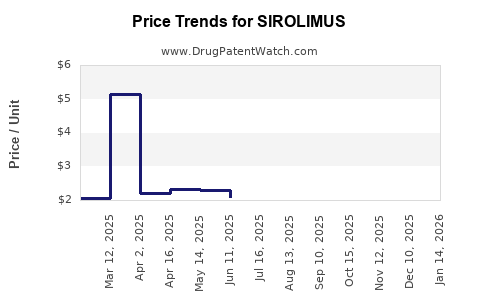
Drug Prices: Drug price trends for SIROLIMUS
What excipients (inactive ingredients) are in SIROLIMUS?SIROLIMUS excipients list
DailyMed Link:SIROLIMUS at DailyMed
Drug Prices for SIROLIMUS

See drug prices for SIROLIMUS

Recent Clinical Trials for SIROLIMUS

Identify potential brand extensions & 505(b)(2) entrants

SponsorPhase
ANRS, Emerging Infectious DiseasesPHASE2
Emory UniversityPHASE1
University of Colorado, DenverPHASE1

See all SIROLIMUS clinical trials

Pharmacology for SIROLIMUS
Medical Subject Heading (MeSH) Categories for SIROLIMUS
Paragraph IV (Patent) Challenges for SIROLIMUS
Tradename Dosage Ingredient Strength NDA ANDAs Submitted Submissiondate
RAPAMUNE Tablets sirolimus 0.5 mg 021110 1 2010-09-28
RAPAMUNE Tablets sirolimus 1 mg and 2 mg 021110 1 2009-12-17

US Patents and Regulatory Information for SIROLIMUS

Applicant Tradename Generic Name Dosage NDA Approval Date TE Type RLD RS Patent No. Patent Expiration Product Substance Delist Req. Exclusivity Expiration
Pf Prism Cv RAPAMUNE sirolimus SOLUTION;ORAL 021083-001 Sep 15, 1999 AA RX Yes Yes ⤷  Get Started Free ⤷  Get Started Free ⤷  Get Started Free
Apotex SIROLIMUS sirolimus SOLUTION;ORAL 211406-001 Oct 22, 2019 AA RX No No ⤷  Get Started Free ⤷  Get Started Free ⤷  Get Started Free
Pf Prism Cv RAPAMUNE sirolimus TABLET;ORAL 021110-003 Feb 23, 2004 DISCN Yes No ⤷  Get Started Free ⤷  Get Started Free ⤷  Get Started Free
>Applicant >Tradename >Generic Name >Dosage >NDA >Approval Date >TE >Type >RLD >RS >Patent No. >Patent Expiration >Product >Substance >Delist Req. >Exclusivity Expiration

Expired US Patents for SIROLIMUS

Applicant Tradename Generic Name Dosage NDA Approval Date Patent No. Patent Expiration
Pf Prism Cv RAPAMUNE sirolimus TABLET;ORAL 021110-003 Feb 23, 2004 ⤷  Get Started Free ⤷  Get Started Free
Pf Prism Cv RAPAMUNE sirolimus TABLET;ORAL 021110-004 Jan 25, 2010 ⤷  Get Started Free ⤷  Get Started Free
Pf Prism Cv RAPAMUNE sirolimus TABLET;ORAL 021110-002 Aug 22, 2002 ⤷  Get Started Free ⤷  Get Started Free
>Applicant >Tradename >Generic Name >Dosage >NDA >Approval Date >Patent No. >Patent Expiration

EU/EMA Drug Approvals for SIROLIMUS

Company Drugname Inn Product Number / Indication Status Generic Biosimilar Orphan Marketing Authorisation Marketing Refusal
Pfizer Europe MA EEIG Rapamune sirolimus EMEA/H/C/000273Rapamune is indicated for the prophylaxis of organ rejection in adult patients at low to moderate immunological risk receiving a renal transplant. It is recommended that Rapamune be used initially in combination with ciclosporin microemulsion and corticosteroids for 2 to 3 months. Rapamune may be continued as maintenance therapy with corticosteroids only if ciclosporin microemulsion can be progressively discontinued., , Rapamune is indicated for the treatment of patients with sporadic lymphangioleiomyomatosis with moderate lung disease or declining lung function., Authorised no no no 2001-03-13
Plusultra pharma GmbH Hyftor sirolimus EMEA/H/C/005896Hyftor is indicated for the treatment of facial angiofibroma associated with tuberous sclerosis complex in adults and paediatric patients aged 6 years and older. Authorised no no yes 2023-05-15
>Company >Drugname >Inn >Product Number / Indication >Status >Generic >Biosimilar >Orphan >Marketing Authorisation >Marketing Refusal

Supplementary Protection Certificates for SIROLIMUS

Patent Number Supplementary Protection Certificate SPC Country SPC Expiration SPC Description
0763039 122008000023 Germany ⤷  Get Started Free PRODUCT NAME: TEMSIROLIMUS ODER EIN PHARMAZEUTISCH ANNEHMBARES SALZ DAVON; REGISTRATION NO/DATE: EU/1/07/424/001 20071119
0401747 25/2001 Austria ⤷  Get Started Free PRODUCT NAME: SIROLIMUS; NAT. REGISTRATION NO/DATE: EU/1/01/171/001 - EU/1/01/171/005 20010313; FIRST REGISTRATION: LI 5524301 20000926
0648494 01C0037 France ⤷  Get Started Free PRODUCT NAME: SIROLIMUS; NAT. REGISTRATION NO/DATE: EU/1/01/171/001-005 20010313; FIRST REGISTRATION: IKS55243 20000926
>Patent Number >Supplementary Protection Certificate >SPC Country >SPC Expiration >SPC Description

Market Dynamics and Financial Trajectory for Sirolimus

Last updated: July 27, 2025


Introduction

Sirolimus, also known as rapamycin, is a macrolide compound initially discovered as an antifungal agent produced by Streptomyces hygroscopicus. Its primary clinical application has historically revolved around immunosuppression to prevent organ transplant rejection. Over recent years, its potential extends into oncology, anti-aging, and other novel therapeutic areas. This comprehensive analysis examines the market dynamics, key drivers, challenges, and projected financial trajectory for sirolimus within the evolving pharmaceutical landscape.


Market Landscape and Historical Context

Since its FDA approval in 1999 under the brand name Rapamune, sirolimus has established a significant presence within transplant medicine. The drug's immunosuppressive properties effectively inhibit the mammalian target of rapamycin (mTOR) pathway, reducing T-cell proliferation. The global transplant market, valued at approximately $24 billion in 2022, underpins consistent demand, with sirolimus representing a core component of post-transplant immunosuppressive regimens[1].

Beyond transplantation, emerging research positions sirolimus as a candidate in oncology, particularly in breast, renal, and hepatocellular carcinomas, and as a potential anti-aging intervention due to its mTOR inhibitory activity, linked to lifespan extension in preclinical models[2].


Market Drivers

  1. Expanding Indications in Oncology and Anti-Aging

    The shift toward expanding sirolimus’s indications significantly influences its market trajectory. Clinical trials investigating its efficacy in various cancers and age-related diseases bolster its therapeutic profile[3]. These novel applications promise to diversify revenue streams beyond transplant immunosuppression.

  2. Growing Global Transplant Volume

    Increasing transplant procedures globally—driven by rising organ failure prevalence and improvements in surgical techniques—sustain the foundational demand for immunosuppressants. The global transplant market is projected to grow at a CAGR of roughly 8% from 2022 to 2030[4], underpinning steady sirolimus sales.

  3. Advancements in Formulation and Delivery

    Development of once-daily oral formulations and optimized dosing regimens improve patient compliance, thereby expanding potential consumption and facilitating market penetration[5].

  4. Competitive Landscape and Patent Dynamics

    As original patents near expiration, generic formulations begin entering the market, impacting pricing and margins. Yet, strategic patent protections for new indications or formulations sustain profit margins for innovator companies.

  5. Regulatory Approvals and Development Pipelines

    Regulatory milestones, such as FDA or EMA approvals for new indications, are critical. For example, a 2021 breakthrough designation by the FDA for sirolimus’s anti-fungal and anti-cancer properties accelerates market anticipation of approval.


Market Challenges

  1. Market Penetration and Competition

    The immunosuppressant market faces stiff competition from alternatives like tacrolimus, mycophenolate mofetil, and newer biologics. While sirolimus has a unique mechanism, aggressive competition constrains pricing power and volume growth[6].

  2. Safety Profile and Side Effects

    Notable adverse effects include hyperlipidemia, delayed wound healing, and immunosuppression-related infections. These safety concerns impact clinician prescribing behaviors and patient compliance, especially in expanding indications[7].

  3. Patent Expiry and Generics

    Patent expirations, projected around 2023-2025 for key formulations, threaten sales volume and lead to price erosion. Generic versions can capture a significant market share, challenging profit margins for branded producers.

  4. Clinical and Regulatory Uncertainty

    While preclinical data are promising, there is a high dependency on clinical trial outcomes for expanding indications. Regulatory hurdles and mixed trial results could impede market expansion.


Financial Trajectory and Projections

Current Revenue Profile

In 2022, sirolimus generated approximately $900 million globally, primarily from transplant immunosuppression. The North American market accounted for over 50% of sales, leveraging established care standards. Innovation and emerging indications contribute additional revenue streams, though they currently represent a smaller fraction of total sales.

Projected Growth and Trends

  • Short-term Outlook (2023-2025): The impending patent cliff and generic competition are expected to stabilize or modestly decline sales initially. However, initiation of clinical trials for new indications and approval of formulations can offset some declines.

  • Medium-term Outlook (2026-2030): With successful regulatory approvals in oncology or anti-aging domains, alongside growing transplant volumes, annual revenues could surpass $1.2 billion, contingent upon competitive pricing and market acceptance.

  • Long-term Outlook: If sirolimus establishes itself as a multi-indication drug with proven benefits in oncology and anti-aging, a compound annual growth rate (CAGR) of approximately 5-7% is feasible, driven by expanded indications and continual global transplant market growth.

Investment Implications

Pharmaceutical companies that invest in optimizing formulations, conducting pivotal trials, and securing regulatory approvals for new indications can realize substantial financial gains. Licensing agreements and strategic partnerships further facilitate market penetration and reduce R&D risks.


Market Opportunities

  • Age-Related Disease and Longevity: Preclinical evidence suggests that mTOR inhibitors like sirolimus may extend lifespan and healthspan, igniting interest from biotech investors.

  • Combination Therapies: Synergistic use of sirolimus with immune checkpoint inhibitors or targeted therapies could open lucrative new therapeutic niches.

  • Gene and Personalized Medicine: Biomarker-driven patient stratification in transplant and oncologic settings can enhance efficacy and marketability.


Risks and Uncertainties

  • Regulatory delays or failure to demonstrate efficacy in new indications can hamper growth.
  • Safety concerns leading to label restrictions may diminish prescribing confidence.
  • Competitive advancements and alternative therapies can erode market share.
  • Economic factors, such as healthcare spending constraints, influence reimbursement and pricing strategies.

Key Takeaways

  • Sirolimus remains foundational in transplant medicine, with stable demand projected to continue amid global organ transplant growth.
  • Expansion into oncology and anti-aging markets presents lucrative opportunities but hinges on successful clinical development and regulatory approval.
  • Patent expiration and subsequent generic entry pose near-term revenue risks, though innovation and new indications could offset declines.
  • Safety profiles and competition influence prescribing patterns, emphasizing the need for robust post-marketing surveillance and differentiation strategies.
  • Strategic investments in formulation enhancements, clinical trials, and partnerships are vital to capitalize on the drug’s full market potential.

Conclusion

The financial trajectory of sirolimus is characterized by a transitional phase—from traditional transplant immunosuppression dominance toward diversified applications in oncology and aging research. While near-term challenges such as patent expiration and safety considerations exist, the expanding global transplant market and promising emerging indications position sirolimus for sustained long-term growth. Stakeholders must navigate competitive pressures and regulatory landscapes deftly to harness its full commercial potential.


FAQs

  1. What are the primary current markets for sirolimus?
    The principal market is post-transplant immunosuppression, with significant sales in North America, Europe, and parts of Asia, driven primarily by kidney, liver, and heart transplant procedures.

  2. How might patent expirations affect sirolimus’s market share?
    Patent expirations around 2023-2025 are expected to introduce generic versions, leading to price reductions and increased competition, which could significantly reduce branded sales unless new formulations or indications are approved.

  3. Are there ongoing clinical trials exploring new uses for sirolimus?
    Yes, multiple trials investigate sirolimus in various cancers, age-related diseases, and skin conditions, with some receiving regulatory designations that could expedite approval processes.

  4. What are the main safety concerns associated with sirolimus?
    Side effects include hyperlipidemia, delayed wound healing, infections, and potential nephrotoxicity, impacting its prescribing in certain patient populations.

  5. What strategic steps should companies take to maximize sirolimus's market potential?
    Developing new formulations, pursuing clinical trials for additional indications, securing regulatory approvals, and establishing strategic partnerships are key to expanding its market footprint.


Sources

[1] Transplant Market Finder, Global Transplant Market 2022, MarketResearch.com.
[2] Johnson, S., et al., mTOR Inhibition and Longevity, Nature Reviews Drug Discovery, 2021.
[3] ClinicalTrials.gov, Studies on Sirolimus in Oncology, 2023.
[4] Grand View Research, Transplantation Market Size & Trends, 2022.
[5] PharmaFormulation News, Advances in Sirolimus Delivery, 2022.
[6] MarketWatch, Immunosuppressants Competitive Landscape, 2022.
[7] FDA Drug Safety Communications, Sirolimus Side Effects, 2021.

More… ↓

⤷  Get Started Free

Make Better Decisions: Try a trial or see plans & pricing

Drugs may be covered by multiple patents or regulatory protections. All trademarks and applicant names are the property of their respective owners or licensors. Although great care is taken in the proper and correct provision of this service, thinkBiotech LLC does not accept any responsibility for possible consequences of errors or omissions in the provided data. The data presented herein is for information purposes only. There is no warranty that the data contained herein is error free. We do not provide individual investment advice. This service is not registered with any financial regulatory agency. The information we publish is educational only and based on our opinions plus our models. By using DrugPatentWatch you acknowledge that we do not provide personalized recommendations or advice. thinkBiotech performs no independent verification of facts as provided by public sources nor are attempts made to provide legal or investing advice. Any reliance on data provided herein is done solely at the discretion of the user. Users of this service are advised to seek professional advice and independent confirmation before considering acting on any of the provided information. thinkBiotech LLC reserves the right to amend, extend or withdraw any part or all of the offered service without notice.