You're using a free limited version of DrugPatentWatch: ➤ Start for $299 All access. No Commitment.

Last Updated: December 15, 2025

PRAVASTATIN SODIUM - Generic Drug Details


✉ Email this page to a colleague

« Back to Dashboard


What are the generic drug sources for pravastatin sodium and what is the scope of patent protection?

Pravastatin sodium is the generic ingredient in two branded drugs marketed by Bristol Myers Squibb, Accord Hlthcare, Apnar Pharma Lp, Apotex, Aurobindo Pharma, Aurobindo Pharma Usa, Biocon Pharma, Chartwell Rx, Cipla, Dr Reddys Labs Inc, Glenmark Pharms Ltd, Hisun Pharm Hangzhou, Pharmobedient, Pliva Hrvatska Doo, Ranbaxy Labs Ltd, Watson Labs, and Zydus Pharms Usa, and is included in nineteen NDAs. Additional information is available in the individual branded drug profile pages.

There are fifteen drug master file entries for pravastatin sodium. Thirty-seven suppliers are listed for this compound. There are two tentative approvals for this compound.

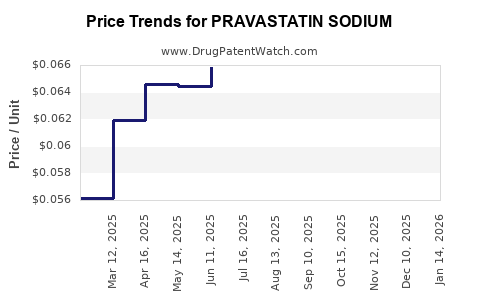
Drug Prices for PRAVASTATIN SODIUM

See drug prices for PRAVASTATIN SODIUM

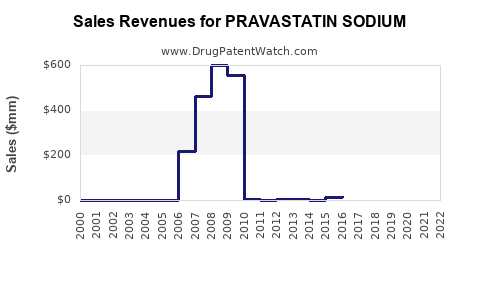
Drug Sales Revenue Trends for PRAVASTATIN SODIUM

See drug sales revenues for PRAVASTATIN SODIUM

Recent Clinical Trials for PRAVASTATIN SODIUM

Identify potential brand extensions & 505(b)(2) entrants

SponsorPhase
First Affiliated Hospital of Chongqing Medical UniversityPHASE4
Pachankis, Yang I., M.D.PHASE4
University of Maryland, BaltimorePhase 4

See all PRAVASTATIN SODIUM clinical trials

Generic filers with tentative approvals for PRAVASTATIN SODIUM
Applicant Application No. Strength Dosage Form
⤷  Get Started Free⤷  Get Started Free80MGTABLET;ORAL
⤷  Get Started Free⤷  Get Started Free40MGTABLET;ORAL
⤷  Get Started Free⤷  Get Started Free20MGTABLET;ORAL

The 'tentative' approval signifies that the product meets all FDA standards for marketing, and, but for the patents / regulatory protections, it would approved.

Pharmacology for PRAVASTATIN SODIUM
Medical Subject Heading (MeSH) Categories for PRAVASTATIN SODIUM
Anatomical Therapeutic Chemical (ATC) Classes for PRAVASTATIN SODIUM
Paragraph IV (Patent) Challenges for PRAVASTATIN SODIUM
Tradename Dosage Ingredient Strength NDA ANDAs Submitted Submissiondate
PRAVACHOL Tablets pravastatin sodium 30 mg 019898 1 2005-06-01

US Patents and Regulatory Information for PRAVASTATIN SODIUM

Applicant Tradename Generic Name Dosage NDA Approval Date TE Type RLD RS Patent No. Patent Expiration Product Substance Delist Req. Exclusivity Expiration
Ranbaxy Labs Ltd PRAVASTATIN SODIUM pravastatin sodium TABLET;ORAL 076445-003 Apr 23, 2007 DISCN No No ⤷  Get Started Free ⤷  Get Started Free ⤷  Get Started Free
Pliva Hrvatska Doo PRAVASTATIN SODIUM pravastatin sodium TABLET;ORAL 077730-005 Nov 21, 2006 DISCN No No ⤷  Get Started Free ⤷  Get Started Free ⤷  Get Started Free
Apotex PRAVASTATIN SODIUM pravastatin sodium TABLET;ORAL 076341-001 Oct 23, 2006 AB RX No No ⤷  Get Started Free ⤷  Get Started Free ⤷  Get Started Free
Pliva Hrvatska Doo PRAVASTATIN SODIUM pravastatin sodium TABLET;ORAL 077730-001 Nov 21, 2006 DISCN No No ⤷  Get Started Free ⤷  Get Started Free ⤷  Get Started Free
>Applicant >Tradename >Generic Name >Dosage >NDA >Approval Date >TE >Type >RLD >RS >Patent No. >Patent Expiration >Product >Substance >Delist Req. >Exclusivity Expiration

Expired US Patents for PRAVASTATIN SODIUM

Applicant Tradename Generic Name Dosage NDA Approval Date Patent No. Patent Expiration
Bristol Myers Squibb PRAVACHOL pravastatin sodium TABLET;ORAL 019898-004 Mar 22, 1993 ⤷  Get Started Free ⤷  Get Started Free
Bristol Myers Squibb PRAVACHOL pravastatin sodium TABLET;ORAL 019898-008 Dec 18, 2001 ⤷  Get Started Free ⤷  Get Started Free
Bristol Myers Squibb PRAVACHOL pravastatin sodium TABLET;ORAL 019898-003 Oct 31, 1991 ⤷  Get Started Free ⤷  Get Started Free
Bristol Myers Squibb PRAVACHOL pravastatin sodium TABLET;ORAL 019898-004 Mar 22, 1993 ⤷  Get Started Free ⤷  Get Started Free
>Applicant >Tradename >Generic Name >Dosage >NDA >Approval Date >Patent No. >Patent Expiration

Market Dynamics and Financial Trajectory for Pravastatin Sodium

Last updated: July 27, 2025

Introduction

Pravastatin sodium, a widely prescribed statin, belongs to the class of HMG-CoA reductase inhibitors used primarily for hypercholesterolemia and cardiovascular disease prevention. Since its introduction in the 1990s, pravastatin has experienced significant market shifts driven by evolving healthcare landscapes, regulatory pathways, and competitive pressures. This analysis explores the current market dynamics and forecasts the financial trajectory of pravastatin sodium, providing valuable insights for stakeholders ranging from pharmaceutical companies and investors to healthcare providers.

Market Overview

Historical Context and Market Position

Pravastatin sodium debuted as one of the first-generation statins, offering an effective cholesterol-lowering mechanism with a favorable safety profile. Originally marketed by Bristol-Myers Squibb and later by other key players, it captured substantial market share owing to its proven clinical efficacy and tolerability.

Over time, the market has seen an influx of newer statins—atorvastatin, rosuvastatin, and pitavastatin—offering enhanced potency or reduced dosing frequency. Despite this, pravastatin retained a significant niche, especially in populations with contraindications or sensitivities to more potent statins.

Current Market Dynamics

Patent Expiry and Generic Competition

The expiration of patents in the early 2000s precipitated a surge in generic pravastatin availability, dramatically reducing prices and expanding accessibility. This commoditization intensified competition but also widened market reach, particularly in emerging economies, thereby stabilizing its sales volumes.

Regulatory Environment

Regulatory agencies worldwide, including the FDA and EMA, continue to approve formulations of pravastatin for various indications. However, stringent cardiovascular guidelines, like those from the American College of Cardiology/American Heart Association, have curated stricter prescribing practices, favoring high-potency statins in high-risk patients but maintaining pravastatin's relevance for specific subsets.

Clinical Guidelines and Prescribing Trends

Clinical guidelines favor high-intensity statins for secondary prevention. Nonetheless, pravastatin remains endorsed for primary prevention in patients at low to moderate risk due to its safety profile, especially in elderly populations and those with comorbidities such as liver disease.

Competitive Landscape

The pharmaceutical landscape features several generic suppliers, diluting the market price. Big Pharma continues to develop combination therapies incorporating pravastatin, such as fixed-dose combinations with ezetimibe, to maintain market share. Additionally, emerging therapies like PCSK9 inhibitors present competition in high-risk patients but remain cost-prohibitive for widespread use.

Market Drivers and Restraints

Drivers:

  • Growing global burden of cardiovascular disease (CVD) fuels demand for lipid-lowering therapies.
  • Increasing awareness and screening initiatives promote earlier intervention.
  • Expanding healthcare access in emerging markets enhances market penetration.
  • Cost-effective generics sustain continued use in economically constrained settings.

Restraints:

  • Introduction of novel lipid-lowering agents with superior efficacy.
  • Evolving guidelines favoring high-potency statins over moderate-acting drugs like pravastatin.
  • Potential safety concerns or adverse effects, albeit minimal, may limit prescribing.

Financial Trajectory Forecast

Revenue Projections

Analysts project a steady decline in pravastatin sodium's global revenues over the next five years, primarily attributable to generic price erosion and market share redistribution. Nonetheless, in specific segments such as primary prevention among elderly and certain geographic regions, sales are anticipated to stabilize owing to established clinical use and affordability.

Regional Market Trends

North America: The mature market will see diminishing revenues owing to high penetration of high-potency statins and emerging competition from PCSK9 therapies. However, sustained demand persists in primary prevention, especially among Medicare beneficiaries.

Europe: Similar trends prevail, but increased adoption of clinical guidelines favoring optimized lipid management may preserve modest sales levels.

Asia-Pacific: Rapid healthcare infrastructure development and growing CVD prevalence code for expansion, with pravastatin serving as an affordable treatment option. Growth here will likely counterbalance declines elsewhere.

Emerging Economies: Price sensitivity, increased generic manufacturing, and government procurement policies favor continued use, fostering a resilient revenue stream.

Investment and R&D Outlook

Current R&D efforts focus on combination formulations and novel delivery systems to extend pravastatin's lifecycle. However, investment in new chemical entities remains limited, with most innovation directed toward pipeline drugs offering superior efficacy or safety. Pharmaceutical companies are increasingly leveraging strategic collaborations to develop such generics and biosimilars.

Strategic Opportunities

  • Formulation Enhancements: Developing fixed-dose combinations can improve adherence and differentiate products.
  • Patent Strategies: Exploiting secondary patents or new formulations may delay generic entry.
  • Regional Expansion: Tailoring marketing strategies for emerging markets promises incremental revenue growth.
  • Digital Health Integration: Incorporating digital compliance tools can enhance patient outcomes and loyalty.

Industry and Market Challenges

  • Pricing Pressure: Continued generic competition exerts downward pricing force.
  • Regulatory Hurdles: Variability in approval standards complicates market entry strategies.
  • Therapeutic Substitutes: Emerging therapies, including PCSK9 inhibitors and gene-based interventions, threaten market share in high-risk cohorts.
  • Patient Adherence: Polypharmacy and side-effects influence long-term adherence, impacting sales.

Conclusion

Pravastatin sodium remains a cornerstone in cardiovascular risk management, particularly in primary prevention and specific patient groups. While its revenues are expected to decline in developed markets due to generic competition and evolving prescribing patterns, significant growth opportunities persist in emerging economies and through strategic formulation innovations. Long-term viability hinges on adaptive marketing, regulatory navigation, and exploring combination therapies.

Key Takeaways

  • The patent expiry precipitated price reductions, leading to a competitive, price-sensitive market dominated by generics.
  • Regulatory guidelines favor higher-potency statins, slightly constraining pravastatin's growth but maintaining its market in targeted populations.
  • Emerging markets offer substantial growth opportunities for pravastatin due to affordability and increasing cardiovascular disease burden.
  • Strategic development of fixed-dose combinations and regional expansion are crucial for sustaining revenues.
  • Competition from novel lipid-lowering therapies necessitates ongoing innovation and market adaptation.

FAQs

1. Will pravastatin sodium rebound in the future?
While potential exists through formulation innovations and regional market expansion, its overall global market share will likely continue to decline relative to newer statins and emerging therapies.

2. How does pravastatin compare to newer statins regarding efficacy?
Pravastatin offers moderate LDL cholesterol reduction, less potent than atorvastatin or rosuvastatin. Its safety profile is favorable, making it suitable for specific populations but less preferred for high-risk patients who require intensive lipid lowering.

3. What are the primary factors influencing pravastatin's declining revenues?
Patent expiration leading to generics, evolving clinical guidelines favoring high-potency statins, and the emergence of newer therapeutic classes primarily drive revenue decline.

4. Are there ongoing innovations in pravastatin formulations?
Yes, developing fixed-dose combinations and other delivery modifications aims to improve adherence and differentiation in a competitive market.

5. Which regions will drive pravastatin's growth in the coming years?
The Asia-Pacific region and other emerging economies will be pivotal, as increasing healthcare access and cardiovascular disease prevalence boost demand.


Sources:

  1. [1] Market research reports on statins and cardiovascular therapeutics
  2. [2] Clinical guidelines from the American College of Cardiology/American Heart Association
  3. [3] Regulatory agency publications and approval histories
  4. [4] Financial filings and pharmaceutical industry analyses
  5. [5] Market intelligence on generic drug manufacturing and regional healthcare expansion

More… ↓

⤷  Get Started Free

Make Better Decisions: Try a trial or see plans & pricing

Drugs may be covered by multiple patents or regulatory protections. All trademarks and applicant names are the property of their respective owners or licensors. Although great care is taken in the proper and correct provision of this service, thinkBiotech LLC does not accept any responsibility for possible consequences of errors or omissions in the provided data. The data presented herein is for information purposes only. There is no warranty that the data contained herein is error free. We do not provide individual investment advice. This service is not registered with any financial regulatory agency. The information we publish is educational only and based on our opinions plus our models. By using DrugPatentWatch you acknowledge that we do not provide personalized recommendations or advice. thinkBiotech performs no independent verification of facts as provided by public sources nor are attempts made to provide legal or investing advice. Any reliance on data provided herein is done solely at the discretion of the user. Users of this service are advised to seek professional advice and independent confirmation before considering acting on any of the provided information. thinkBiotech LLC reserves the right to amend, extend or withdraw any part or all of the offered service without notice.