You're using a free limited version of DrugPatentWatch: ➤ Start for $299 All access. No Commitment.

Last Updated: March 26, 2026

PRAVASTATIN SODIUM - Generic Drug Details


✉ Email this page to a colleague

« Back to Dashboard


What are the generic drug sources for pravastatin sodium and what is the scope of freedom to operate?

Pravastatin sodium is the generic ingredient in two branded drugs marketed by Bristol Myers Squibb, Accord Hlthcare, Apnar Pharma Lp, Apotex, Aurobindo Pharma, Aurobindo Pharma Usa, Biocon Pharma, Chartwell Rx, Cipla, Dr Reddys Labs Inc, Glenmark Pharms Ltd, Hisun Pharm Hangzhou, Pharmobedient, Pliva Hrvatska Doo, Ranbaxy Labs Ltd, Watson Labs, and Zydus Pharms Usa, and is included in nineteen NDAs. Additional information is available in the individual branded drug profile pages.

There are fifteen drug master file entries for pravastatin sodium. Thirty-six suppliers are listed for this compound. There are two tentative approvals for this compound.

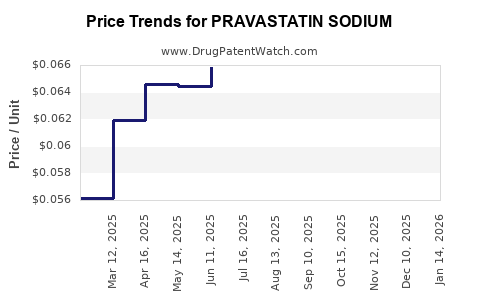
Drug Prices for PRAVASTATIN SODIUM

See drug prices for PRAVASTATIN SODIUM

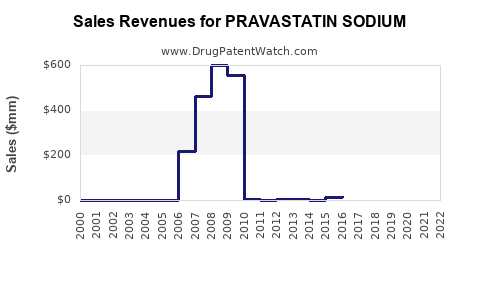
Drug Sales Revenue Trends for PRAVASTATIN SODIUM

See drug sales revenues for PRAVASTATIN SODIUM

Recent Clinical Trials for PRAVASTATIN SODIUM

Identify potential brand extensions & 505(b)(2) entrants

SponsorPhase
Pachankis, Yang I., M.D.PHASE4
First Affiliated Hospital of Chongqing Medical UniversityPHASE4
University of Maryland, BaltimorePhase 4

See all PRAVASTATIN SODIUM clinical trials

Generic filers with tentative approvals for PRAVASTATIN SODIUM
Applicant Application No. Strength Dosage Form
⤷  Start Trial⤷  Start Trial80MGTABLET;ORAL
⤷  Start Trial⤷  Start Trial40MGTABLET;ORAL
⤷  Start Trial⤷  Start Trial20MGTABLET;ORAL

The 'tentative' approval signifies that the product meets all FDA standards for marketing, and, but for the patents / regulatory protections, it would approved.

Pharmacology for PRAVASTATIN SODIUM
Medical Subject Heading (MeSH) Categories for PRAVASTATIN SODIUM
Anatomical Therapeutic Chemical (ATC) Classes for PRAVASTATIN SODIUM
Paragraph IV (Patent) Challenges for PRAVASTATIN SODIUM
Tradename Dosage Ingredient Strength NDA ANDAs Submitted Submissiondate
PRAVACHOL Tablets pravastatin sodium 30 mg 019898 1 2005-06-01

US Patents and Regulatory Information for PRAVASTATIN SODIUM

Applicant Tradename Generic Name Dosage NDA Approval Date TE Type RLD RS Patent No. Patent Expiration Product Substance Delist Req. Exclusivity Expiration
Hisun Pharm Hangzhou PRAVASTATIN SODIUM pravastatin sodium TABLET;ORAL 206061-001 Nov 23, 2018 DISCN No No ⤷  Start Trial ⤷  Start Trial ⤷  Start Trial
Aurobindo Pharma Usa PRAVASTATIN SODIUM pravastatin sodium TABLET;ORAL 076056-001 Apr 24, 2006 AB RX No No ⤷  Start Trial ⤷  Start Trial ⤷  Start Trial
Pliva Hrvatska Doo PRAVASTATIN SODIUM pravastatin sodium TABLET;ORAL 077730-003 Nov 21, 2006 DISCN No No ⤷  Start Trial ⤷  Start Trial ⤷  Start Trial
>Applicant >Tradename >Generic Name >Dosage >NDA >Approval Date >TE >Type >RLD >RS >Patent No. >Patent Expiration >Product >Substance >Delist Req. >Exclusivity Expiration

Expired US Patents for PRAVASTATIN SODIUM

Applicant Tradename Generic Name Dosage NDA Approval Date Patent No. Patent Expiration
Bristol Myers Squibb PRAVACHOL pravastatin sodium TABLET;ORAL 019898-008 Dec 18, 2001 5,622,985*PED ⤷  Start Trial
Bristol Myers Squibb PRAVACHOL pravastatin sodium TABLET;ORAL 019898-004 Mar 22, 1993 5,622,985*PED ⤷  Start Trial
Bristol Myers Squibb PRAVACHOL pravastatin sodium TABLET;ORAL 019898-002 Oct 31, 1991 4,346,227*PED ⤷  Start Trial
>Applicant >Tradename >Generic Name >Dosage >NDA >Approval Date >Patent No. >Patent Expiration

PRAVASTATIN SODIUM: PATENT LANDSCAPE AND MARKET PROJECTIONS

Last updated: February 19, 2026

Pravastatin sodium, a member of the statin class of cholesterol-lowering drugs, faces a mature market characterized by generic competition and evolving treatment guidelines. The compound's intellectual property landscape is largely depleted, with primary patents having expired. Current market dynamics are driven by pricing, manufacturing efficiency, and clinical positioning within broader cardiovascular disease management.

WHAT IS THE CORE PATENT EXIPRY STATUS OF PRAVASTATIN SODIUM?

The foundational patents for pravastatin sodium have long expired. The initial U.S. patent for pravastatin was U.S. Patent No. 4,446,140, granted on May 1, 1984, to Sankyo Company, Ltd. (now Daiichi Sankyo). This patent covered the composition of matter for pravastatin. Subsequent patents addressed synthesis, formulations, and specific uses. For example, U.S. Patent No. 5,028,612, also assigned to Sankyo, granted in 1991, covered a specific crystalline form and manufacturing process. These core patents are no longer active, allowing for widespread generic manufacturing and marketing. The expiration of these primary patents in the early to mid-2000s paved the way for significant generic market entry.

WHAT ARE THE KEY ACTIVE INGREDIENTS AND THERAPEUTIC USES OF PRAVASTATIN SODIUM?

Pravastatin sodium's active pharmaceutical ingredient (API) is pravastatin, a hydroxymethylglutaryl-coenzyme A (HMG-CoA) reductase inhibitor. It functions by competitively inhibiting HMG-CoA reductase, a rate-limiting enzyme in the cholesterol biosynthesis pathway [1].

The primary therapeutic uses for pravastatin sodium include:

  • Reduction of Elevated Total-C, LDL-C, and Triglycerides: It is prescribed to lower high levels of cholesterol and triglycerides in the blood.
  • Increase in HDL-C: Pravastatin sodium also increases high-density lipoprotein cholesterol (HDL-C) levels.
  • Prevention of Cardiovascular Disease: It is indicated to reduce the risk of myocardial infarction (heart attack), stroke, and cardiovascular death in individuals with or without symptoms of coronary heart disease, particularly those with hypercholesterolemia.
  • Treatment of Homozygous Familial Hypercholesterolemia: In conjunction with diet, it is used to manage this rare genetic disorder.

WHAT IS THE CURRENT GLOBAL MARKET SIZE AND PROJECTED GROWTH FOR PRAVASTATIN SODIUM?

The global market for pravastatin sodium is characterized by maturity and extensive generic penetration. Specific market size figures are challenging to isolate due to its classification as a generic drug within the broader statin and lipid-lowering agent categories. However, the overall statin market, of which pravastatin is a component, is substantial. Reports estimate the global statins market to be valued in the tens of billions of U.S. dollars annually.

For pravastatin sodium specifically, the market size is difficult to quantify precisely without proprietary market intelligence. However, its position is that of a well-established, lower-cost option within the statin class. Growth is projected to be modest, driven by:

  • Continued Use in Established Patient Populations: Patients already on pravastatin therapy are likely to remain on it due to its efficacy and cost-effectiveness.
  • Emerging Markets: Penetration in developing economies may offer some growth opportunities as healthcare access expands and the burden of cardiovascular disease rises.
  • Competition within the Generic Statin Space: Growth is constrained by intense price competition from other generic statins (e.g., simvastatin, atorvastatin, rosuvastatin) and the emergence of newer lipid-lowering therapies.

The CAGR for pravastatin sodium is generally considered low, likely in the low single digits (1-3%), reflecting its established, generic status rather than significant new market expansion. The market is primarily volume-driven, with manufacturers competing on production cost and supply chain efficiency.

WHAT ARE THE KEY COMPETITIVE LANDSCAPE DYNAMICS FOR PRAVASTATIN SODIUM?

The competitive landscape for pravastatin sodium is dominated by generic manufacturers. The absence of patent protection means that numerous companies can produce and market the drug globally. Key dynamics include:

  • Price Competition: This is the most significant driver. Manufacturers strive to offer the lowest possible prices to secure market share, particularly in tenders and government formularies.
  • Manufacturing Efficiency: Companies with optimized synthesis routes and economies of scale have a distinct advantage. Access to cost-effective raw materials is also critical.
  • Supply Chain Reliability: Consistent and dependable supply is paramount for securing long-term contracts with wholesalers and pharmacies.
  • Regulatory Compliance: Adherence to Good Manufacturing Practices (GMP) and other regulatory standards is non-negotiable for market access.
  • Therapeutic Equivalence: All generic pravastatin sodium products must demonstrate bioequivalence to the reference listed drug.
  • Market Segmentation: While the primary market is well-defined, some manufacturers may focus on specific geographic regions or distribution channels.

Leading generic players in the statin market, including those that would likely produce pravastatin sodium, often include companies like Teva Pharmaceutical Industries, Mylan (now Viatris), Sandoz (Novartis), and numerous smaller regional manufacturers.

WHAT ARE THE MAJOR REGULATORY CONSIDERATIONS AND PATENT EXTENSIONS FOR PRAVASTATIN SODIUM?

As a drug whose primary patents have expired, formal patent extensions under schemes like the U.S. Patent Term Extension (PTE) are not currently applicable for the composition of matter. However, regulatory considerations remain crucial:

  • ANDA Filings (Abbreviated New Drug Application): Generic manufacturers must file ANDAs with regulatory bodies like the U.S. Food and Drug Administration (FDA) to demonstrate that their product is bioequivalent to the reference listed drug and manufactured under GMP.
  • Post-Approval Surveillance: Manufacturers are subject to ongoing regulatory oversight, including facility inspections and pharmacovigilance requirements to monitor drug safety.
  • Labeling Requirements: Generic labels must be consistent with the reference product's approved labeling, including indications, contraindications, warnings, and precautions.
  • Intellectual Property for New Formulations or Uses: While the core drug is off-patent, companies might pursue patents on novel formulations (e.g., extended-release, combination products) or new therapeutic uses of pravastatin sodium. These would be subject to standard patent application and examination processes. For example, a patent might cover a specific combination of pravastatin with another cardiovascular agent.
  • Data Exclusivity: For any new indications or significant formulations approved, data exclusivity periods may apply, preventing other generics from relying on the innovator's data for a certain period. However, for standard pravastatin sodium generics, this is not a relevant factor.

WHAT ARE THE KEY MANUFACTURING AND SUPPLY CHAIN CONSIDERATIONS FOR PRAVASTATIN SODIUM?

Manufacturing pravastatin sodium involves a multi-step chemical synthesis. Key considerations include:

  • API Sourcing: Manufacturers can either produce the API in-house or source it from third-party suppliers. The cost, quality, and reliability of API suppliers are critical. Major API manufacturing hubs are located in India and China, which often offer cost advantages.
  • Synthesis Route Optimization: Efficiency in the synthetic pathway directly impacts production costs. Companies invest in R&D to refine existing routes or develop novel, more cost-effective synthesis methods.
  • Formulation Development: Pravastatin sodium is typically formulated into oral tablets. Considerations include selecting appropriate excipients (binders, fillers, disintegrants, lubricants) to ensure tablet integrity, dissolution profiles, and bioavailability.
  • Quality Control: Rigorous quality control measures are essential at every stage, from raw material testing to in-process checks and final product release. This includes analytical testing for purity, potency, and dissolution.
  • Scale of Production: To achieve competitive pricing, manufacturers must operate at significant scales of production. This requires substantial capital investment in manufacturing facilities and equipment.
  • Global Supply Chain Management: Ensuring a robust and uninterrupted supply chain is vital. This involves managing logistics for raw materials, intermediates, and finished products, as well as mitigating risks associated with geopolitical instability, natural disasters, or transportation disruptions.
  • Environmental Regulations: Pharmaceutical manufacturing is subject to stringent environmental regulations regarding waste disposal and emissions. Compliance adds to the operational cost.

WHAT ARE THE EMERGING CLINICAL GUIDELINES AND THEIR IMPACT ON PRAVASTATIN SODIUM PRESCRIPTIONS?

Clinical guidelines for dyslipidemia management have evolved, influencing the prescribing patterns of statins, including pravastatin sodium. While guidelines still recommend statins as first-line therapy for many patients, the emphasis has shifted towards risk-based stratification and the consideration of newer agents.

  • Risk-Based Approach: Guidelines from organizations like the American Heart Association/American College of Cardiology (AHA/ACC) emphasize calculating an individual's 10-year atherosclerotic cardiovascular disease (ASCVD) risk. This approach guides the intensity of lipid-lowering therapy.
  • Primary Prevention: For primary prevention in individuals without established ASCVD, statins are recommended for those with higher ASCVD risk scores (e.g., >= 7.5% or 10%). Pravastatin sodium is a viable option for this group, particularly for patients who are statin-intolerant to other statins or where cost is a primary concern.
  • Secondary Prevention: For patients with established ASCVD (e.g., history of heart attack, stroke, peripheral artery disease), high-intensity statin therapy is generally recommended. While pravastatin sodium can be used, it is a moderate-intensity statin and may not be sufficient as monotherapy for achieving aggressive LDL-C reduction goals in all such patients.
  • Newer Therapies: The advent of PCSK9 inhibitors (e.g., evolocumab, alirocumab) and bempedoic acid has provided alternative or add-on options for patients who cannot achieve LDL-C goals with maximally tolerated statins, or who are statin-intolerant. These newer, often more expensive, therapies can indirectly impact the use of older, generic statins by altering the treatment pathway for specific patient segments.
  • Statin Intolerance: For patients experiencing statin-related side effects, pravastatin sodium's generally favorable side-effect profile (compared to some other statins) can make it a preferred choice when a statin is still indicated.

Overall, while pravastatin sodium remains a valuable and cost-effective option, particularly for primary prevention and in price-sensitive markets, the trend towards more aggressive LDL-C reduction targets and the availability of newer therapies mean it is often used in specific patient populations or as a foundational therapy rather than the sole or most potent agent for all indications.

WHAT ARE THE FUTURE MARKET PROJECTIONS AND POTENTIAL GROWTH AREAS FOR PRAVASTATIN SODIUM?

The future market for pravastatin sodium is likely to remain stable with low single-digit growth. Key projections and potential growth areas include:

  • Continued Dominance in Generic Markets: In regions with high generic drug utilization and price sensitivity, pravastatin sodium will continue to be a significant prescription.
  • Emerging Markets: As healthcare infrastructure develops in lower and middle-income countries, the demand for affordable, established medications like pravastatin sodium is expected to rise. Cardiovascular disease prevalence is increasing in these regions, creating a need for cost-effective lipid-lowering therapies.
  • Combination Therapies: While not currently a major market segment for pravastatin, there is potential for new combination products that pair pravastatin with other cardiovascular agents (e.g., antihypertensives, antiplatelets) if clinical utility and patentability can be demonstrated.
  • Niche Therapeutic Uses: Exploration of pravastatin sodium in specific sub-populations or for less common indications could potentially create niche growth opportunities, though this is speculative without significant clinical research.
  • Competition and Commoditization: The market will continue to be highly competitive, with pricing pressure and commoditization being the dominant themes. Manufacturers will need to focus on operational excellence to maintain profitability.

The overall outlook is one of sustained but modest demand, with growth opportunities limited by the drug's generic status and the availability of newer therapeutic alternatives. Innovation will likely be in manufacturing efficiency and supply chain logistics rather than novel clinical applications.

Key Takeaways

  • Pravastatin sodium's primary patents have expired, leading to a highly competitive generic market.
  • The drug remains a cost-effective option for cholesterol management, particularly in primary prevention and price-sensitive markets.
  • Market growth is projected to be low single-digit, driven by emerging markets and continued use in established patient populations.
  • Key competitive factors are price, manufacturing efficiency, and supply chain reliability.
  • Evolving clinical guidelines and the introduction of newer lipid-lowering therapies influence prescribing patterns, often positioning pravastatin sodium as a moderate-intensity option.

FAQs

  1. Are there any active patents on pravastatin sodium formulations that could impact generic entry? While the composition of matter patents are expired, it is possible for companies to hold patents on specific, novel formulations (e.g., extended-release, specific salt forms, or combination products) that could offer some degree of protection for those particular versions. However, these would not prevent the marketing of standard, immediate-release generic pravastatin sodium tablets.

  2. What is the typical pricing strategy for generic pravastatin sodium manufacturers? Manufacturers primarily employ a cost-plus pricing strategy, aiming to produce the drug at the lowest possible cost to achieve profitability at competitive market prices. This often involves optimizing manufacturing processes and securing raw materials at the lowest available rates.

  3. How does pravastatin sodium compare in efficacy and safety to other common statins like atorvastatin and simvastatin? Pravastatin sodium is generally considered a moderate-intensity statin, while atorvastatin and simvastatin are often classified as high-intensity statins, capable of achieving greater LDL-C reductions. In terms of safety, pravastatin sodium is often reported to have a lower incidence of muscle-related side effects (myopathy) compared to some other statins, although this can vary individually.

  4. What is the projected impact of biosimilar competition on the market for pravastatin sodium? Biosimilars are relevant for biologic drugs, not small molecule generics like pravastatin sodium. The competition pravastatin sodium faces is from other generic manufacturers producing identical chemical entities.

  5. Are there any significant off-label uses of pravastatin sodium that contribute to its market demand? While pravastatin sodium has established on-label indications for lipid management and cardiovascular risk reduction, significant or widely recognized off-label uses that substantially impact its market demand are not prominently documented. Its primary use remains within its approved therapeutic scope.

Citations

[1] The Pharmaceutical Society of Australia. (2011). Australian Medicines Handbook. Retrieved from https://www.australianmedicineshandbook.com.au/ (Note: Specific page or entry not provided, general knowledge base for drug mechanisms)

More… ↓

⤷  Start Trial

Make Better Decisions: Try a trial or see plans & pricing

Drugs may be covered by multiple patents or regulatory protections. All trademarks and applicant names are the property of their respective owners or licensors. Although great care is taken in the proper and correct provision of this service, thinkBiotech LLC does not accept any responsibility for possible consequences of errors or omissions in the provided data. The data presented herein is for information purposes only. There is no warranty that the data contained herein is error free. We do not provide individual investment advice. This service is not registered with any financial regulatory agency. The information we publish is educational only and based on our opinions plus our models. By using DrugPatentWatch you acknowledge that we do not provide personalized recommendations or advice. thinkBiotech performs no independent verification of facts as provided by public sources nor are attempts made to provide legal or investing advice. Any reliance on data provided herein is done solely at the discretion of the user. Users of this service are advised to seek professional advice and independent confirmation before considering acting on any of the provided information. thinkBiotech LLC reserves the right to amend, extend or withdraw any part or all of the offered service without notice.