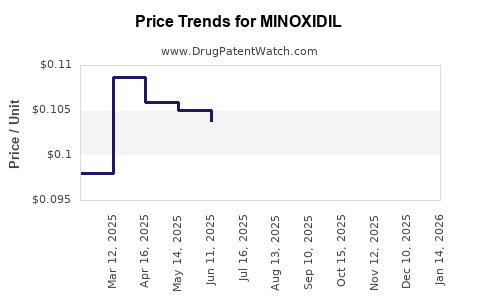
Last updated: February 19, 2026
What is Minoxidil?
Minoxidil is an antihypertensive vasodilator medication initially developed by Upjohn (now Pfizer) in the 1950s for treating ulcers. Its hair-growth-stimulating properties were discovered during clinical trials for hypertension. The U.S. Food and Drug Administration (FDA) approved minoxidil as a topical treatment for androgenetic alopecia (hair loss) in men in 1988 and for women in 1992. It is available in over-the-counter (OTC) formulations, primarily as a 2% and 5% topical solution or foam. The mechanism of action involves vasodilation, which is believed to increase blood flow to hair follicles, prolong the anagen (growth) phase of the hair cycle, and potentially enlarge miniaturized hair follicles.
Market Size and Growth Projections
The global minoxidil market is substantial, driven by the increasing prevalence of hair loss conditions and growing consumer awareness of treatment options. The market size was estimated at approximately $2.3 billion in 2022 and is projected to grow at a compound annual growth rate (CAGR) of 5.6% from 2023 to 2030, reaching an estimated $3.5 billion by 2030 [1].
Key factors contributing to this growth include:
- Rising Incidence of Hair Loss: Androgenetic alopecia affects a significant portion of the global population. Estimates suggest that up to 50% of men over 50 and a considerable percentage of women experience some form of hair loss [2]. This demographic trend fuels demand for effective treatments.
- Aging Global Population: The increasing lifespan of the global population correlates with a higher incidence of age-related hair thinning and loss, further expanding the consumer base for minoxidil products.
- Growing Market for Cosmetics and Personal Care: The expanding personal care industry, particularly in emerging economies, contributes to market growth as consumers invest more in appearance-enhancing products.
- Availability of OTC Formulations: Minoxidil's OTC status simplifies access for consumers, allowing for self-treatment without a prescription, which significantly broadens its market reach compared to prescription-only medications.
- Technological Advancements and Product Innovation: Manufacturers are developing new formulations, such as foams and higher-concentration products, to improve efficacy and patient compliance. The introduction of combination therapies with other hair growth stimulants is also a growing trend.
Key Market Segments
The minoxidil market can be segmented by:
- Formulation: Topical solutions, topical foams, and shampoos. Topical solutions and foams are the dominant segments due to their direct application to the scalp and established efficacy.
- Concentration: 2% and 5% concentrations. The 5% concentration is generally considered more effective for men and is a leading product category.
- Gender: Men and women. Men constitute the larger segment due to the higher prevalence of male pattern baldness.
- Distribution Channel: Pharmacies and drug stores, online retail, and dermatology clinics. Online retail is a rapidly growing channel due to convenience and competitive pricing.
Competitive Landscape
The minoxidil market is moderately fragmented with several established players and numerous generic manufacturers. Competition primarily revolves around product efficacy, brand reputation, pricing, and distribution reach.
Key companies in the minoxidil market include:
- Pfizer Inc. (Rogaine): The original brand-name manufacturer, Rogaine, holds significant brand recognition and market share, particularly in North America and Europe.
- Perrigo Company plc: A leading provider of generic OTC pharmaceuticals, Perrigo offers a wide range of minoxidil products under various store brands and its own labels.
- Sun Pharmaceutical Industries Ltd.: A major global pharmaceutical company with a strong presence in generics and branded generics, offering minoxidil formulations in multiple markets.
- Bayer AG (Propecia - finasteride, but often discussed in conjunction with minoxidil for hair loss): While Finasteride (Propecia) is a different mechanism, it is a major competitor in the hair loss treatment space.
- Generic Manufacturers: Numerous smaller companies produce generic minoxidil formulations, contributing to price competition and market accessibility globally.
Innovation in this space often focuses on:
- Improved delivery systems: Enhancing scalp absorption and reducing potential side effects.
- Combination products: Formulating minoxidil with other active ingredients like finasteride or ketoconazole for synergistic effects.
- Dermatologically tested formulations: Targeting consumers seeking scientifically backed and gentle products.
Patent Landscape and Exclusivity
The original patents for minoxidil as a hair growth stimulant have long expired. The earliest U.S. patent for minoxidil hair loss treatment was issued in the late 1980s. This has led to a highly genericized market, characterized by intense price competition.
However, innovation continues in the form of:
- Formulation patents: New patents are issued for novel formulations, such as specific combinations of minoxidil with other ingredients, proprietary delivery systems, or unique dosage forms (e.g., specific foam compositions, micro-emulsions) [3].
- Method of use patents: Patents may cover new methods of treating specific types of hair loss or using minoxidil in conjunction with other therapies.
- Manufacturing process patents: Improvements in the synthesis or purification of minoxidil can be patented, although these are less impactful on the end-user market compared to formulation or use patents.
The lack of strong, broad patent protection for the core compound means that the competitive advantage for many companies relies on:
- Brand strength and consumer trust: Companies like Pfizer leverage the established reputation of Rogaine.
- Cost-effective manufacturing: Generic manufacturers focus on optimizing production to offer lower prices.
- Distribution networks: Broad access to pharmacies and online platforms is critical.
- Marketing and consumer education: Raising awareness about the efficacy and availability of minoxidil.
The expiry of primary patents has facilitated the entry of numerous generic products, driving down prices and increasing accessibility. For instance, generic versions of Rogaine became widely available after the expiration of key patents, leading to significant price erosion for the branded product [4].
Financial Trajectory and Market Drivers
The financial trajectory of minoxidil is closely tied to the growth of the hair loss treatment market. While the price per unit has decreased due to generic competition, the sheer volume of sales and the expanding consumer base have maintained a positive revenue growth trend.
Revenue Drivers:
- Increasing prevalence of hair loss: The primary driver remains the high and growing incidence of androgenetic alopecia globally.
- Consumer demand for visible results: Minoxidil is one of the few OTC treatments that has demonstrated efficacy in clinical trials, making it a preferred choice for many consumers seeking to manage hair thinning.
- Expansion into emerging markets: As disposable incomes rise in developing countries, more individuals can afford cosmetic treatments like minoxidil.
- E-commerce growth: The increasing popularity of online shopping platforms provides a convenient and often more affordable channel for consumers to purchase minoxidil. This channel also allows manufacturers to reach a wider geographic audience directly.
- Cosmeceutical trend: The blurring lines between cosmetics and pharmaceuticals, where consumers seek scientifically proven solutions for personal care concerns, benefits minoxidil.
Challenges and Constraints:
- Generic competition and price pressure: The mature nature of the market, with widespread generic availability, limits significant price increases and necessitates high sales volumes for sustained revenue growth.
- Limited efficacy for some individuals: Minoxidil does not work for everyone, and its efficacy can vary. This can lead to consumer dissatisfaction and a search for alternative or supplemental treatments.
- Side effects and compliance issues: While generally well-tolerated, some users experience scalp irritation, dryness, or unwanted hair growth in other areas. Patient compliance can also be a challenge due to the need for consistent, long-term application.
- Emergence of novel therapies: While minoxidil remains a gold standard, ongoing research into alternative treatments, including advanced pharmacological agents, regenerative medicine, and hair transplantation techniques, could potentially shift market share in the long term.
Regulatory Environment
Minoxidil's status as an Over-The-Counter (OTC) drug in many major markets, including the United States, is a significant factor in its market accessibility.
- FDA Approval: The FDA approved topical minoxidil for OTC sale for hair loss, classifying it as a Nonprescription Drug. This classification allows it to be sold in pharmacies, drug stores, and mass retailers without a doctor's prescription.
- Labeling Requirements: OTC products are subject to strict labeling requirements that detail ingredients, directions for use, warnings, and potential side effects, ensuring consumer safety and informed usage.
- Global Variations: While widely available OTC in North America and Europe, regulatory status can vary by country. Some regions may still require a prescription or have different approval processes for topical minoxidil.
- Good Manufacturing Practices (GMP): All pharmaceutical products, including minoxidil, must be manufactured in compliance with GMP standards to ensure quality, purity, and consistency.
The OTC status has been instrumental in the widespread adoption and commercial success of minoxidil, enabling direct-to-consumer access and reducing healthcare system burdens.
Future Outlook
The market for minoxidil is expected to remain robust due to the persistent demand for hair loss solutions. While the core product faces intense generic competition, companies that can innovate through formulation, delivery systems, or strategic marketing may capture increased market share.
- Focus on Combination Therapies: The development and marketing of minoxidil in combination with other hair growth agents or through advanced delivery mechanisms will likely be a key area of growth and differentiation.
- Personalized Medicine Approaches: As the understanding of hair loss mechanisms deepens, minoxidil may be integrated into more personalized treatment regimens, potentially leading to niche market opportunities.
- Emerging Market Penetration: Continued economic development in Asia, Latin America, and Africa will unlock new consumer bases for affordable and effective hair loss treatments.
- Direct-to-Consumer (DTC) Models: The growth of online sales and direct-to-consumer marketing will continue to shape how minoxidil products are distributed and marketed.
The financial trajectory will likely be characterized by steady, volume-driven growth, with incremental revenue gains stemming from product differentiation and market expansion rather than significant price appreciation.
Key Takeaways
- The global minoxidil market is projected to reach $3.5 billion by 2030, growing at a CAGR of 5.6%, driven by the rising prevalence of hair loss and OTC accessibility.
- Key market segments include topical solutions and foams, 5% concentrations, and the male demographic.
- The competitive landscape is characterized by a strong presence of generic manufacturers due to the expiry of core patents, leading to price competition.
- Innovation is focused on new formulations, delivery systems, and combination therapies to differentiate products.
- The financial trajectory is stable, with growth driven by sales volume and market expansion, rather than price increases.
- Minoxidil's OTC status in major markets is a critical factor for its broad accessibility and continued market relevance.
Frequently Asked Questions
-
What is the primary mechanism by which minoxidil promotes hair growth?
Minoxidil acts as a vasodilator, increasing blood flow to hair follicles. This improved circulation is believed to stimulate hair growth by prolonging the anagen (growth) phase of the hair cycle and potentially enlarging miniaturized hair follicles.
-
Which are the leading market segments for minoxidil products globally?
The leading segments are topical solutions and foams, the 5% concentration, and products targeted at men, reflecting the higher prevalence of male pattern baldness and the perceived efficacy of higher concentrations for this demographic.
-
How has the patent expiry affected the minoxidil market?
The expiry of core patents for minoxidil has led to a highly genericized market. This has resulted in increased price competition, broader product availability, and a focus on brand strength and cost-effective manufacturing for market advantage.
-
What are the main challenges facing the minoxidil market in the coming years?
Key challenges include intense price pressure from generic competitors, varying efficacy among individuals, potential side effects leading to compliance issues, and the emergence of novel hair loss treatments that could offer alternative solutions.
-
Can minoxidil be considered a long-term solution for hair loss?
Minoxidil requires consistent, long-term application to maintain results. If treatment is stopped, hair loss typically resumes, and any regrowth achieved may be lost within several months. It is generally viewed as a management therapy rather than a permanent cure.
Citations
[1] Grand View Research. (2023). Minoxidil Market Size, Share & Trends Analysis Report By Formulation (Topical Solution, Topical Foam), By Concentration (2%, 5%), By Gender (Men, Women), By Distribution Channel (Pharmacies & Drug Stores, Online Retail), By Region, And Segment Forecasts, 2023 - 2030. Retrieved from https://www.grandviewresearch.com/industry-analysis/minoxidil-market
[2] National Institutes of Health. (n.d.). Hair Loss. MedlinePlus. Retrieved from https://medlineplus.gov/hairloss.html
[3] U.S. Patent and Trademark Office. (n.d.). Patent Search. Retrieved from https://www.uspto.gov/patents/search (Note: Specific patent numbers for formulations would require targeted database searches.)
[4] Datamonitor Healthcare. (2015). Minoxidil Topical Market Report: Market Analysis, Forecast, Key Players, And Trends. (Note: Specific report details and access may vary.)