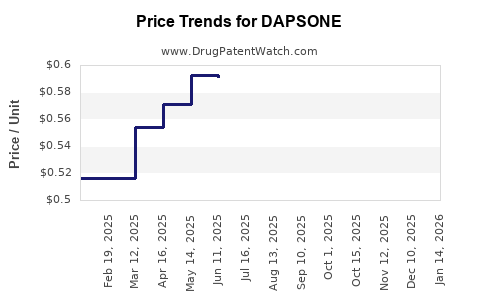
Last updated: October 31, 2026
Dapsone is a mature anti-infective and dermatology drug with two distinct commercial markets. Oral dapsone is an established generic used mainly for leprosy, dermatitis herpetiformis, Pneumocystis jirovecii prophylaxis, and selected inflammatory disorders. Topical dapsone gel, marketed primarily as Aczone in the United States, has historically generated the higher commercial value because it addresses acne and retains branded dermatology positioning.
The long-term outlook is mixed. Oral dapsone has minimal pricing power and limited revenue growth. Topical dapsone retains prescription demand, but generic competition, payer controls, therapeutic substitution, and the availability of alternative acne treatments constrain financial expansion. Dapsone has no biosimilar exposure, and its core active-ingredient patents expired long ago.
What is the current commercial market for dapsone?
Dapsone is sold through three principal channels:
| Segment |
Main products |
Commercial status |
Key demand driver |
| Oral generic |
Dapsone tablets, commonly 25 mg and 100 mg |
Mature generic market |
Rare diseases, leprosy, prophylaxis, specialist use |
| Topical branded |
Aczone dapsone gel 5% and 7.5% |
Branded dermatology product |
Acne prescriptions and physician familiarity |
| Topical generic or alternative products |
Dapsone gel equivalents and pharmacy-dispensed versions |
Increasing price competition |
Formulary substitution and lower out-of-pocket cost |
Oral dapsone is inexpensive and has limited volume growth. It remains clinically important because few drugs provide the same combination of antimicrobial and anti-inflammatory activity, particularly for dermatitis herpetiformis and leprosy.
Topical dapsone has a larger commercial opportunity per prescription. Its market competes with benzoyl peroxide, topical retinoids, clindamycin combinations, azelaic acid, minocycline foam, sarecycline, and oral acne therapies.
The market is therefore stable in clinical demand but structurally weak in pricing power.
How large is the dapsone market?
Public companies generally do not report dapsone revenue as a separate line item. Aczone sales, where disclosed, are typically included in a broader U.S. dermatology portfolio. Oral generic dapsone revenue is also not reported at the molecule level by major generic manufacturers.
The market can be characterized as follows:
- Oral dapsone is a low-value, low-growth generic market.
- Topical dapsone is a small branded dermatology market with higher revenue per prescription.
- Total dapsone sales are materially smaller than those of leading acne drugs such as isotretinoin, clindamycin combinations, tretinoin, or oral tetracyclines.
- Commercial value is concentrated in the branded topical segment rather than the oral tablet segment.
- Revenue visibility is limited because manufacturers do not separately disclose product sales.
Demand is supported by chronic acne treatment, but dapsone is not a first-line treatment for all acne patients. It is most commercially relevant for inflammatory acne and for patients who need a topical option with a different tolerability or mechanism profile.
Who markets dapsone and Aczone?
The commercial structure differs by formulation.
Oral dapsone manufacturers
Oral dapsone is supplied by multiple generic manufacturers and wholesalers. The product is commonly available through hospital, specialty-pharmacy, and retail channels. Supply may be more vulnerable than demand because the market is relatively small and manufacturers may have limited incentives to maintain extensive inventory.
Topical dapsone manufacturers
Aczone has been associated with Allergan and later with Almirall’s dermatology portfolio. Almirall acquired several U.S. dermatology products from Allergan in 2019, including products associated with the Aczone franchise.[1]
The branded product competes with:
- Generic dapsone gel products.
- Topical retinoids.
- Benzoyl peroxide products.
- Clindamycin-containing formulations.
- Azelaic acid.
- Oral and topical tetracyclines.
- Newer branded acne products with stronger promotional budgets.
The commercial strength of Aczone depends less on molecule novelty than on brand recognition, physician prescribing habits, reimbursement, and the availability of generic equivalents.
When does dapsone lose exclusivity?
The active pharmaceutical ingredient has no meaningful remaining composition-of-matter exclusivity. Dapsone was discovered and commercialized decades ago, and oral dapsone is fully generic.
The commercially relevant exclusivity question concerns topical formulations and product-specific claims.
| Protection category |
Current commercial relevance |
| Dapsone composition patent |
Expired |
| Oral tablet patents |
Expired or commercially immaterial |
| Topical gel formulation patents |
Potentially relevant, depending on claim scope and expiration |
| Method-of-use patents |
May cover acne treatment or specified patient populations |
| Regulatory exclusivity |
No meaningful new-drug exclusivity for the mature oral product |
| Brand protection |
Trademark and market recognition remain relevant |
Topical exclusivity is weaker than composition-of-matter exclusivity. Formulation patents can delay direct generic substitution, but they do not prevent physicians from switching patients to other acne therapies.
The exact Orange Book position depends on the specific Aczone strength, listing date, patent status, and current FDA records. Product-specific patents should be evaluated against the current FDA Orange Book and applicable USPTO records rather than against the broader dapsone patent history.[2]
What patents protect topical dapsone?
The main patent value lies in the delivery system and formulation, not in dapsone itself.
Topical dapsone intellectual property can cover:
- Gel vehicles.
- Solubilization or suspension systems.
- Particle-size characteristics.
- Concentration ranges.
- Stabilization methods.
- Application to acne or other dermatologic conditions.
- Reduced irritation or improved skin penetration.
- Manufacturing processes.
Formulation protection is commercially narrower than an active-ingredient patent. A generic manufacturer can avoid infringement by using a different vehicle, particle profile, manufacturing process, or product concentration if the alternative satisfies FDA requirements.
For investors and licensing teams, the most important distinction is between:
- Patents listed in the Orange Book and potentially relevant to an ANDA Paragraph IV filing.
- Non-listed formulation or process patents that may still support litigation.
- Expired patents that retain historical relevance but no longer block launch.
- Trademark rights that affect product presentation but do not create pharmaceutical exclusivity.
What is the Orange Book status of Aczone?
Aczone is an FDA-approved topical dapsone product. Its Orange Book significance depends on the strength and specific reference-listed drug entry.
The relevant regulatory pathway for a generic topical dapsone product is generally an abbreviated new drug application. A generic applicant must establish pharmaceutical equivalence and bioequivalence or the applicable product-specific equivalence standard. For topical dermatology products, demonstrating equivalent performance can be more complex than for conventional oral tablets because formulation differences can affect skin delivery, rheology, particle distribution, and local tolerability.
The principal regulatory risks are:
- Failure to establish therapeutic equivalence.
- Differences in inactive ingredients.
- Difficulty matching the reference product’s physical characteristics.
- Product-specific patent litigation.
- FDA questions concerning local delivery or comparative clinical performance.
A Paragraph IV certification would be the principal route for challenging listed patents before expiration. Publicly visible commercial outcomes depend on the applicant, patent claims, litigation filings, and any settlement agreement. No molecule-wide patent barrier prevents generic dapsone entry.
Which companies are challenging dapsone exclusivity?
Dapsone has a fragmented generic market rather than a single high-profile challenger structure. Multiple generic manufacturers can pursue oral dapsone because the active ingredient is long genericized. The more meaningful competitive question concerns topical dapsone gel.
Generic manufacturers may challenge topical exclusivity through:
- Paragraph IV certifications.
- Paragraph III certifications tied to patent expiry.
- ANDA approval after listed patents expire.
- Formulation designs that attempt to avoid listed claims.
- Authorized-generic or licensed supply arrangements.
The commercial impact of a topical generic depends on whether the product receives an AB rating or otherwise qualifies for substitution under state pharmacy law and payer policy.
What generic entry risks exist for Aczone?
Aczone faces conventional mature-product erosion rather than a sudden loss of all demand.
Base-case scenario
A generic topical product gains market access and gradually captures price-sensitive prescriptions. Aczone retains a portion of volume through brand loyalty, physician preference, prior authorization positioning, and patients who respond well to the branded formulation.
Downside scenario
Multiple generic entrants reach the market. Pharmacy substitution accelerates, payers move the branded product to non-preferred tiers, and net price declines sharply. The branded product becomes a specialty or exception product.
Resilient-brand scenario
Aczone maintains meaningful value because of prescriber familiarity, favorable tolerability, patient response, and limited generic penetration. Revenue declines in price but remains supported by prescription volume.
The most likely pattern is a gradual decline in net sales rather than a complete collapse. Topical dermatology products often retain residual branded demand after generic entry, especially when patients and prescribers perceive formulation differences.
How strong is the dapsone patent estate?
The overall patent estate is weak for oral dapsone and moderate at most for selected topical products.
| Factor |
Assessment |
| Active-ingredient protection |
None of commercial significance |
| Oral product protection |
Weak |
| Topical formulation protection |
Potentially meaningful but claim-specific |
| Method-of-use protection |
Narrow and vulnerable to design-around |
| Manufacturing protection |
May create barriers but rarely blocks all competitors |
| Regulatory exclusivity |
Limited |
| Litigation leverage |
Concentrated in listed topical patents |
| Long-term durability |
Low to moderate |
The estate does not support premium valuation based on durable exclusivity. Any remaining value depends on the enforceability and remaining term of specific topical patents, generic approval timing, and the strength of the brand.
Is there biosimilar risk for dapsone?
No. Dapsone is a small-molecule drug, not a biologic. Biosimilar regulation does not apply.
The relevant competitive threats are:
- ANDA-approved oral generics.
- Generic topical gels.
- Therapeutic substitution by other acne medicines.
- Compounded products in limited circumstances.
- New branded dermatology products with superior reimbursement or promotional support.
This distinction matters because there is no biologic-style interchangeability framework or reference-product exclusivity period supporting dapsone pricing.
What litigation and settlement issues affect dapsone?
Dapsone litigation is more likely to involve product-specific topical patents than the oral molecule. Potential disputes include:
- ANDA Paragraph IV patent challenges.
- Infringement claims concerning gel vehicles.
- Process-patent disputes.
- Hatch-Waxman litigation over Orange Book-listed patents.
- Patent settlements that delay generic launch.
- Trademark disputes involving Aczone branding.
No broad, molecule-wide litigation barrier protects dapsone. A settlement involving one topical product would not prevent other manufacturers from entering the oral market or developing alternative topical formulations.
Any settlement economics would depend on the first filer’s exclusivity position, the remaining patent term, the number of potential entrants, and the ability of the brand owner to preserve reimbursement.
What licensing deals affect dapsone?
The most commercially relevant transaction has been the transfer of dermatology assets from Allergan to Almirall. The transaction placed Aczone within Almirall’s U.S. dermatology portfolio.[1]
The transaction supports three conclusions:
- Dapsone’s commercial value is tied to portfolio economics rather than standalone molecule growth.
- A dermatology company can monetize Aczone through sales-force leverage and payer relationships.
- The asset is more valuable as part of a broader acne and medical-dermatology portfolio than as an independent platform.
No major licensing structure changes the generic economics of oral dapsone.
What is the FDA regulatory status of dapsone?
The FDA has approved oral dapsone products and topical dapsone gel products. The regulatory profile is mature, and the main FDA issues are product quality, labeling, manufacturing, and generic equivalence rather than new clinical development.
Safety considerations affect prescribing and market access. Oral dapsone carries clinically important risks, including hemolysis, methemoglobinemia, agranulocytosis, and hypersensitivity. G6PD deficiency is particularly relevant to treatment decisions. These risks limit broad use but support specialist demand in conditions where dapsone has established utility.[3]
Topical dapsone generally has lower systemic exposure than oral therapy, but labeling still addresses hematologic and dermatologic risks. The safety difference supports topical use in acne but does not eliminate monitoring or contraindication concerns.
How does dapsone compare with competing acne drugs?
| Product category |
Relative market position |
Pricing power |
Main competitive advantage |
| Generic dapsone gel |
Low to moderate |
Low |
Lower cost |
| Aczone |
Moderate in selected patients |
Moderate before generic erosion |
Brand familiarity and topical dapsone positioning |
| Tretinoin |
High |
Low to moderate |
Strong guideline and generic adoption |
| Benzoyl peroxide |
High |
Low |
Broad use and low cost |
| Clindamycin combinations |
High |
Low to moderate |
Established acne treatment |
| Azelaic acid |
Moderate |
Moderate |
Acne and pigmentary benefits |
| Sarecycline and branded antibiotics |
Smaller |
Higher |
Branded positioning and physician promotion |
| Isotretinoin |
High clinical importance |
Managed through specialty channels |
Strong efficacy for severe acne |
Dapsone’s competitive position is strongest when physicians want an anti-inflammatory topical option and weakest when payers prioritize low-cost generic retinoids or benzoyl peroxide.
What is the financial trajectory for dapsone?
The expected trajectory is:
- Oral dapsone revenue: stable to declining, with low unit prices.
- Aczone revenue before broad generic competition: supported by brand prescription volume and dermatology promotion.
- Aczone revenue after generic entry: lower net price, declining branded share, and increased payer pressure.
- Total dapsone market value: flat to declining in nominal terms unless a new indication or differentiated formulation expands demand.
The financial profile is defensive rather than growth-oriented. Manufacturing economics can still be attractive for efficient generic suppliers because the molecule is established, the clinical demand is persistent, and development costs are lower than for novel drugs. The principal risk is limited market size and periodic supply concentration.
For a brand owner, the highest-value strategies are:
- Retaining formulary access.
- Expanding physician use in appropriate acne subgroups.
- Protecting differentiated formulation claims.
- Managing authorized-generic exposure.
- Using the product to support a broader dermatology sales platform.
For a generic manufacturer, the value proposition is volume efficiency, reliable supply, and low-cost production rather than high unit margins.
What manufacturing and IP barriers affect dapsone?
Oral dapsone manufacturing is technically established, but commercial barriers can arise from:
- API sourcing.
- Impurity controls.
- Batch consistency.
- Tablet content uniformity.
- Stability and packaging.
- Limited supplier economics.
- Regulatory compliance at API and finished-dose facilities.
Topical manufacturing is more demanding because the product must maintain consistent rheology, uniform dapsone distribution, preservative performance, and acceptable skin feel. These requirements can slow generic development and increase the risk of formulation failure.
The manufacturing barrier is meaningful but not prohibitive. It supports some temporary differentiation without creating durable protection comparable to a new chemical entity patent.
Key Takeaways
- Dapsone is a mature small-molecule drug with no meaningful active-ingredient exclusivity.
- Oral dapsone is a low-price generic market with persistent specialist demand.
- Aczone and other topical dapsone products contain most of the commercial value.
- Topical formulation and method-of-use patents may delay or complicate generic entry, but they do not create durable molecule-wide protection.
- No biosimilar risk exists.
- Generic entry is the primary threat to branded dapsone revenue.
- Product-specific Orange Book patents, Paragraph IV filings, and settlement terms determine the timing of topical competition.
- Dapsone revenue is generally not disclosed separately by manufacturers.
- The long-term financial trajectory is stable to declining, with limited upside absent a new formulation, indication, or stronger dermatology positioning.
- Dapsone is more valuable as part of a dermatology portfolio than as a standalone growth asset.
FAQs
Is dapsone still profitable for pharmaceutical companies?
Dapsone can remain profitable for efficient generic manufacturers and for branded dermatology companies with strong reimbursement, but it is unlikely to generate high growth. Profitability is concentrated in topical branded products rather than oral tablets.
Can a generic manufacturer launch dapsone without challenging patents?
Yes. Oral dapsone has no meaningful remaining active-ingredient barrier. For topical dapsone, a manufacturer can wait for patent expiry, certify under Paragraph III, or pursue a non-infringing formulation.
Does dapsone have orphan-drug market potential?
Dapsone treats rare conditions such as dermatitis herpetiformis and leprosy, but historical use of the drug does not automatically create orphan exclusivity. A new orphan indication would require a separate FDA designation and approval strategy.
Is Aczone stronger than generic dapsone gel?
Clinical performance depends on the specific formulation, patient response, tolerability, and adherence. Brand status alone does not establish superior efficacy. Generic substitution risk is highest when the generic receives an equivalent therapeutic rating and payer coverage is favorable.
What would increase the value of the dapsone market?
Value could increase through a differentiated topical delivery system, a validated new dermatologic indication, improved tolerability, better adherence, or a formulation that gains favorable reimbursement before generic competition intensifies.
References
-
Almirall. (2019). Almirall acquires five established dermatology products from Allergan in the United States. Almirall corporate announcement.
-
U.S. Food and Drug Administration. (2024). Approved drug products with therapeutic equivalence evaluations. FDA Orange Book.
-
U.S. Food and Drug Administration. (2023). Dapsone and dapsone gel prescribing information. FDA and DailyMed labeling database.
-
National Library of Medicine. (2024). Dapsone: Drug information and product labeling. DailyMed.
-
U.S. Food and Drug Administration. (2024). Electronic Orange Book and abbreviated new drug application resources. FDA.