Last updated: September 5, 2026
Acetazolamide is a mature, low-cost generic carbonic anhydrase inhibitor with limited patent protection and low commercial concentration. Its principal markets are glaucoma, edema, epilepsy, metabolic alkalosis, and acute mountain sickness. Revenue growth is driven by prescription volume, hospital use, supply availability, and price changes rather than new intellectual property. The product has no meaningful biosimilar exposure, no material branded exclusivity remaining, and limited ability to support premium pricing.
What is the current market position of acetazolamide?
Acetazolamide is marketed primarily as a generic drug in tablets, extended-release capsules, and injectable form. The original branded product, Diamox, established the drug’s clinical market, but most current sales are generated by generic manufacturers.
| Market characteristic |
Acetazolamide position |
| Active ingredient |
Acetazolamide |
| Drug class |
Carbonic anhydrase inhibitor |
| Main dosage forms |
125 mg and 250 mg tablets; 500 mg extended-release capsules; injection |
| Key indications |
Glaucoma, altitude sickness, edema, epilepsy, metabolic alkalosis |
| FDA pathway |
Abbreviated New Drug Application, or ANDA, for most current products |
| Commercial status |
Mature generic market |
| Biosimilar risk |
None |
| Patent-based pricing power |
Minimal |
| Primary commercial risks |
Supply interruptions, reimbursement pressure, manufacturing concentration |
| Primary growth drivers |
Prescription volume, expanded altitude-sickness use, hospital demand, geographic expansion |
Acetazolamide remains clinically relevant because it is inexpensive, orally available, and included in standard treatment approaches for several conditions. Its use in acute mountain sickness is especially visible in travel and wilderness medicine, while ophthalmology and hospital medicine create recurring demand.
The drug is also used in specialized settings, including idiopathic intracranial hypertension and selected cases of central sleep apnea. These uses can support prescription volume but generally do not create durable commercial exclusivity because many uses are established in medical practice rather than protected by enforceable patents.
How large is the acetazolamide market?
There is no single audited global revenue figure for acetazolamide because sales are split across generic manufacturers, wholesalers, hospitals, retail pharmacies, government tenders, and international distributors. Commercial databases also vary in whether they include injectable products, hospital purchases, branded legacy products, and non-U.S. markets.
The financial profile is best characterized as a high-volume, low-price market:
- Unit demand is relatively stable because the underlying indications are chronic or recurrent.
- Average selling prices are constrained by generic substitution.
- Revenue can rise temporarily during shortages or supplier withdrawals.
- Margin performance depends heavily on manufacturing cost, channel mix, and contract supply.
- No single company controls the global market in the way an originator controls a patented specialty drug.
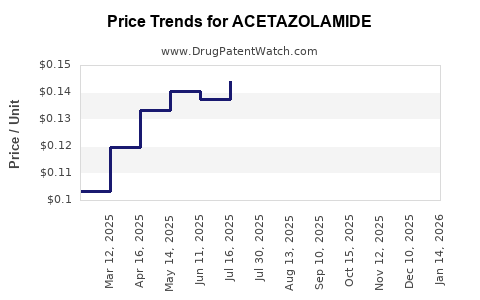
U.S. retail pricing varies by strength, manufacturer, pharmacy benefit design, and supply conditions. Generic tablets typically sell at low absolute prices, while injectable products may carry higher prices because hospital procurement, sterile manufacturing, and shortage risk affect the market differently.
A manufacturer with a small market share can still generate attractive returns if it has reliable active pharmaceutical ingredient supply, efficient tableting capacity, and limited competition in a specific channel. The commercial opportunity is therefore operational rather than patent-driven.
When does acetazolamide lose exclusivity?
Acetazolamide lost meaningful exclusivity decades ago. The original product was introduced in the 1950s, and generic competition has existed for many years. No current U.S. market exclusivity period protects the active ingredient.
| Exclusivity category |
Current position |
| New chemical entity exclusivity |
Expired |
| Original compound patent |
Expired |
| Orphan-drug exclusivity |
Not applicable to the core product |
| Pediatric exclusivity |
No current material protection |
| New-product exclusivity |
Not material for established acetazolamide products |
| Generic exclusivity |
Any ANDA-specific period would be limited and product-specific |
| Patent-term extension |
No commercially relevant extension identified for the mature product |
Acetazolamide does not have the lifecycle profile of a recently approved small molecule. The commercial question is not when exclusivity ends, but whether a manufacturer can maintain supply and earn acceptable margins after decades of generic competition.
What patents protect acetazolamide products?
The core acetazolamide molecule is no longer protected by an enforceable U.S. composition-of-matter patent. Current patent value, where it exists, would be limited to particular formulations, delivery systems, manufacturing processes, or methods of use.
Potential protection categories include:
- Extended-release dosage forms.
- Tablet composition and excipient systems.
- Injectable formulations.
- Manufacturing or purification processes.
- Combination products.
- Narrow method-of-use claims.
These categories have limited commercial effect unless they cover a product with substantial substitution barriers. A formulation patent does not automatically protect the active ingredient or prevent generic immediate-release tablets from entering the market.
What formulations are protected by acetazolamide patents?
The principal differentiated formulation is the extended-release capsule historically marketed as Diamox Sequels. Extended-release products can face additional formulation and bioequivalence requirements, but the commercial protection associated with the original product has largely expired.
Generic manufacturers may launch immediate-release tablets without infringing claims directed only to a controlled-release formulation. Conversely, a manufacturer seeking to market an extended-release product may need to address formulation patents, if any remain listed or enforceable, through a Paragraph IV certification or a non-infringement and invalidity position.
The practical barrier is usually product development and bioequivalence rather than active-ingredient patent protection.
What is the Orange Book status of acetazolamide?
The FDA Orange Book identifies reference-listed products and approved therapeutic equivalents. Acetazolamide products have historically included tablets, extended-release capsules, and injectable presentations. The Orange Book status is relevant to dosage-form substitution and ANDA approvals, but it does not create new exclusivity for the active ingredient.
For commercial diligence, the key distinctions are:
- Whether the product is the reference-listed drug or an ANDA product.
- Whether patents are listed for the specific dosage form.
- Whether a generic has an AB therapeutic-equivalence rating.
- Whether the marketed product has been discontinued or remains available.
- Whether the dosage form has a distinct reference product.
FDA Orange Book listings should be reviewed at the product and dosage-form level because tablet, extended-release, and injectable products can have different regulatory histories. FDA’s Orange Book and Drugs@FDA databases are the controlling sources for current listing, approval, and patent information. [1][2]
Are there Paragraph IV challenges involving acetazolamide?
Paragraph IV litigation risk is low for the conventional acetazolamide market because the core patents have expired and generic products are already widely available. A Paragraph IV filing could still arise for a newly developed extended-release formulation, combination product, or other protected dosage form.
The commercial impact of such a challenge would depend on:
- The scope and remaining term of the listed patent.
- The size of the protected formulation market.
- Whether the generic product is substitutable for the reference product.
- The timing of 180-day generic exclusivity.
- The likelihood of an injunction or settlement.
- The ability of other manufacturers to launch competing products.
There is no broad, current patent dispute comparable to the litigation surrounding major branded oncology, immunology, or diabetes products. Acetazolamide litigation risk is product-specific rather than molecule-wide.
What patent litigation affects acetazolamide?
Publicly available regulatory and commercial information does not indicate a material molecule-level patent litigation campaign affecting ordinary acetazolamide tablets or injection. The more relevant legal risks are routine generic-drug disputes:
- ANDA patent challenges involving an extended-release product.
- Manufacturing-process disputes.
- Trade-secret claims involving API or formulation know-how.
- Product-liability litigation unrelated to exclusivity.
- Antitrust or supply-contract claims arising during shortages.
A generic manufacturer should not treat the absence of composition patents as the absence of all legal risk. Manufacturing know-how, quality systems, supplier agreements, and regulatory compliance can still determine whether a company can launch and maintain product.
Which companies are challenging or competing in acetazolamide?
The market is supplied by multiple generic and specialty pharmaceutical companies, with manufacturer participation varying by country and dosage form. U.S. availability has included products from large generic suppliers and smaller contract manufacturers. The relevant competitive set changes as companies discontinue low-margin products or enter during supply shortages.
Competition should be assessed across four layers:
| Competitive layer |
Main determinant |
| Retail tablets |
Price, wholesaler access, therapeutic-equivalence rating |
| Extended-release capsules |
Bioequivalence capability and formulation economics |
| Injectable acetazolamide |
Sterile manufacturing, hospital contracts, shortage exposure |
| International markets |
Tender access, local registration, API sourcing |
Large generic companies can compete on purchasing scale and distribution. Smaller suppliers may compete by serving shortage markets, hospital accounts, or countries where fewer manufacturers are registered.
No manufacturer appears to possess durable control over the global acetazolamide market. Supplier turnover is more likely to result from economics, regulatory action, or manufacturing interruptions than from patent exclusion.
How strong is the acetazolamide patent estate?
The patent estate is weak for the active ingredient and conventional immediate-release products. It is potentially stronger, but still limited in duration and scope, for differentiated formulations or manufacturing technology.
| Patent dimension |
Assessment |
| Composition of matter |
Weak or expired |
| Immediate-release tablet |
Weak |
| Extended-release formulation |
Potentially stronger, product-specific |
| Injectable presentation |
Regulatory and manufacturing barriers exceed patent barriers |
| Method of use |
Usually narrow and difficult to enforce against established clinical practice |
| Manufacturing process |
Potentially valuable if difficult to design around |
| Overall estate |
Low strength for molecule-wide exclusion |
The most defensible competitive advantage is likely to come from quality, supply reliability, approved manufacturing capacity, and distribution rather than patents.
What is the financial trajectory for acetazolamide?
Acetazolamide’s financial trajectory is mature and relatively defensive. The drug is unlikely to produce rapid, innovation-led revenue growth. Its financial performance follows a volume-and-supply model.
Base-case trajectory
In a stable supply environment, revenue should remain broadly flat to modestly growing in nominal terms. Prescription volume can increase with population growth, expanded diagnosis of intracranial hypertension, continued glaucoma treatment, and sustained use in altitude medicine. Generic price erosion offsets much of that volume growth.
Upside scenario
Revenue and margin can improve when:
- A competitor exits the market.
- FDA-recognized shortages constrain supply.
- A manufacturer secures hospital or government contracts.
- A supplier adds an injectable or extended-release product.
- A company enters an under-supplied geographic market.
- Pricing remains elevated after a manufacturing disruption.
Downside scenario
Financial performance can weaken when:
- Several manufacturers launch simultaneously.
- Wholesalers increase rebate demands.
- API prices rise.
- A sterile facility receives regulatory action.
- Reimbursement agencies impose lower generic prices.
- Product discontinuation shifts demand to competitors.
For public companies, acetazolamide is unlikely to be a material standalone revenue driver unless the company has concentrated exposure to the product or benefits from a shortage. Its value is more likely to appear within a broader generic portfolio.
What generic entry risks exist for acetazolamide?
Generic entry risk is already realized for conventional acetazolamide products. The remaining commercial risk is intensified competition, not first generic entry.
A company evaluating entry should focus on:
- FDA approval status and therapeutic equivalence.
- API source qualification.
- Tablet and capsule manufacturing cost.
- Injectable sterility and fill-finish capacity.
- Expected wholesale acquisition price.
- Pharmacy benefit manager discounting.
- Retail and institutional channel access.
- Historical shortage frequency.
- Product discontinuation history.
- State and federal procurement requirements.
The market can support a new entrant when supply is constrained, but excess capacity can quickly compress prices. Entry into immediate-release tablets is easier than entry into sterile injection or complex extended-release products.
Does acetazolamide face biosimilar risk?
No. Acetazolamide is a synthetic small-molecule drug, not a biologic. It is regulated through small-molecule drug pathways, primarily the ANDA framework for generic products. Biosimilar approval, interchangeability, and biologic reference-product issues do not apply. [3]
What licensing deals affect acetazolamide?
Acetazolamide has no widely recognized, current licensing transaction that materially changes the global market structure. Historical brand rights, distribution arrangements, contract manufacturing agreements, and regional registrations may exist, but they generally do not create molecule-wide exclusivity.
The commercially relevant transactions are more likely to involve:
- Product acquisitions within generic portfolios.
- Contract manufacturing.
- API supply agreements.
- Regional commercialization rights.
- Hospital tenders.
- Transfers of abbreviated applications.
These arrangements can affect supply and margins without changing the underlying patent position.
What FDA regulatory issues affect acetazolamide?
FDA risk is concentrated in manufacturing quality, supply continuity, labeling, and facility compliance. The injectable product carries higher operational risk because sterile manufacturing failures can remove supply rapidly. Tablet products have lower technical barriers but remain exposed to quality-control findings and API disruptions.
FDA review should include:
- Current ANDA approvals.
- Therapeutic-equivalence ratings.
- Drug shortages.
- Product discontinuations.
- Recalls.
- Manufacturing-site compliance.
- Labeling differences across dosage forms.
FDA shortage data is particularly important for financial modeling because a low-priced generic can experience temporary pricing power when capacity falls below demand. [4]
Key Takeaways
- Acetazolamide is a mature generic drug with no meaningful remaining composition-of-matter exclusivity.
- The market is fragmented, price-sensitive, and driven by supply reliability rather than patent protection.
- Conventional tablets face high generic competition and limited pricing power.
- Extended-release and injectable products may have higher regulatory and manufacturing barriers.
- Paragraph IV and patent litigation risk is low for ordinary acetazolamide products.
- Biosimilar risk is not applicable.
- Financial upside comes mainly from shortages, supplier exits, hospital contracts, and operational efficiency.
- The most valuable competitive assets are approved capacity, API security, sterile manufacturing, and distribution access.
- Revenue growth is likely to be modest unless a market disruption creates temporary pricing leverage.
- Acetazolamide is a portfolio product rather than a standalone innovation franchise.
FAQs
Is acetazolamide a profitable generic drug?
It can be profitable when manufacturing costs are low and supply is constrained. In a fully competitive market, margins are usually limited by low generic pricing.
Can a new company still launch acetazolamide in the United States?
Yes, subject to FDA approval, product-specific regulatory requirements, manufacturing capacity, and commercial access. Immediate-release tablets generally present lower technical barriers than injectable or extended-release products.
Does Diamox still have patent protection?
The original acetazolamide product does not have meaningful active-ingredient patent protection. Any remaining rights would need to be assessed at the specific formulation or product level.
Is acetazolamide included in the FDA drug-shortage market?
Availability can vary by dosage form and manufacturer. Injectable acetazolamide is more exposed to sterile-manufacturing disruptions than standard tablets. FDA shortage and discontinuation records should be checked for current status. [4]
Which acetazolamide dosage form has the strongest commercial opportunity?
Injectable and extended-release products can offer better protection from direct commodity competition, but they require greater regulatory, manufacturing, and supply-chain investment. Immediate-release tablets offer easier entry but generally lower margins.
References
-
U.S. Food and Drug Administration. (2025). Approved drug products with therapeutic equivalence evaluations: The Orange Book. https://www.accessdata.fda.gov/scripts/cder/ob/
-
U.S. Food and Drug Administration. (2025). Drugs@FDA: FDA-approved drugs. https://www.accessdata.fda.gov/scripts/cder/daf/
-
U.S. Food and Drug Administration. (2024). Biosimilar and interchangeable products. https://www.fda.gov/drugs/therapeutic-biologics-applications-bla/biosimilar-biological-products
-
U.S. Food and Drug Administration. (2025). Drug shortages. https://www.fda.gov/drugs/drug-safety-and-availability/drug-shortages-index