Genzyme Company Profile
✉ Email this page to a colleague
What is the competitive landscape for GENZYME
GENZYME has eleven approved drugs.
There are sixteen US patents protecting GENZYME drugs.
Summary for Genzyme
| US Patents: | 16 |
| Tradenames: | 10 |
| Ingredients: | 10 |
| NDAs: | 11 |
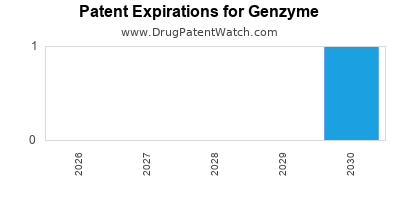
Drugs and US Patents for Genzyme
| Applicant | Tradename | Generic Name | Dosage | NDA | Approval Date | TE | Type | RLD | RS | Patent No. | Patent Expiration | Product | Substance | Delist Req. | Exclusivity Expiration |
|---|---|---|---|---|---|---|---|---|---|---|---|---|---|---|---|
| Genzyme Corp | WAYRILZ | rilzabrutinib | TABLET;ORAL | 219685-001 | Aug 29, 2025 | RX | Yes | Yes | 8,940,744 | ⤷ Start Trial | Y | Y | ⤷ Start Trial | ||
| Genzyme Corp | CAPRELSA | vandetanib | TABLET;ORAL | 022405-002 | Apr 6, 2011 | RX | Yes | Yes | 8,067,427 | ⤷ Start Trial | Y | ⤷ Start Trial | |||
| Genzyme Corp | WAYRILZ | rilzabrutinib | TABLET;ORAL | 219685-001 | Aug 29, 2025 | RX | Yes | Yes | 9,994,576 | ⤷ Start Trial | Y | Y | ⤷ Start Trial | ||
| Genzyme | RENAGEL | sevelamer hydrochloride | TABLET;ORAL | 021179-002 | Jul 12, 2000 | AB | RX | Yes | Yes | ⤷ Start Trial | ⤷ Start Trial | ||||
| Genzyme Corp | QFITLIA | fitusiran sodium | SOLUTION;SUBCUTANEOUS | 219019-001 | Mar 28, 2025 | RX | Yes | Yes | 11,091,759 | ⤷ Start Trial | ⤷ Start Trial | ||||
| Genzyme Corp | WAYRILZ | rilzabrutinib | TABLET;ORAL | 219685-001 | Aug 29, 2025 | RX | Yes | Yes | 9,266,895 | ⤷ Start Trial | Y | Y | ⤷ Start Trial | ||
| Genzyme | RENVELA | sevelamer carbonate | FOR SUSPENSION;ORAL | 022318-002 | Feb 18, 2009 | DISCN | Yes | No | 9,095,509 | ⤷ Start Trial | Y | ⤷ Start Trial | |||
| >Applicant | >Tradename | >Generic Name | >Dosage | >NDA | >Approval Date | >TE | >Type | >RLD | >RS | >Patent No. | >Patent Expiration | >Product | >Substance | >Delist Req. | >Exclusivity Expiration |
Expired US Patents for Genzyme
| Applicant | Tradename | Generic Name | Dosage | NDA | Approval Date | Patent No. | Patent Expiration |
|---|---|---|---|---|---|---|---|
| Genzyme | RENAGEL | sevelamer hydrochloride | TABLET;ORAL | 021179-002 | Jul 12, 2000 | 7,014,846 | ⤷ Start Trial |
| Genzyme Corp | CAPRELSA | vandetanib | TABLET;ORAL | 022405-001 | Apr 6, 2011 | 8,642,608 | ⤷ Start Trial |
| Genzyme Corp | CAPRELSA | vandetanib | TABLET;ORAL | 022405-002 | Apr 6, 2011 | 8,642,608 | ⤷ Start Trial |
| Genzyme | MOZOBIL | plerixafor | SOLUTION;SUBCUTANEOUS | 022311-001 | Dec 15, 2008 | RE42152 | ⤷ Start Trial |
| Genzyme | RENVELA | sevelamer carbonate | FOR SUSPENSION;ORAL | 022318-001 | Aug 12, 2009 | 7,014,846 | ⤷ Start Trial |
| Genzyme | RENAGEL | sevelamer hydrochloride | CAPSULE;ORAL | 020926-001 | Oct 30, 1998 | 5,496,545 | ⤷ Start Trial |
| Genzyme | RENAGEL | sevelamer hydrochloride | TABLET;ORAL | 021179-001 | Jul 12, 2000 | 7,459,151 | ⤷ Start Trial |
| >Applicant | >Tradename | >Generic Name | >Dosage | >NDA | >Approval Date | >Patent No. | >Patent Expiration |
Paragraph IV (Patent) Challenges for GENZYME drugs
| Drugname | Dosage | Strength | Tradename | Submissiondate |
|---|---|---|---|---|
| ➤ Subscribe | Tartrate Capsules | 84mg | ➤ Subscribe | 2018-08-20 |
| ➤ Subscribe | Tablets | 400 mg and 800 mg | ➤ Subscribe | 2008-05-22 |
| ➤ Subscribe | Powder for Oral Suspension | 0.8 g/packet and 2.4 g/packet | ➤ Subscribe | 2009-12-30 |
| ➤ Subscribe | Injection | 24 mg/1.2 mL vials (20 mg/mL) | ➤ Subscribe | 2012-12-17 |
| ➤ Subscribe | Tablets | 800 mg | ➤ Subscribe | 2008-12-04 |
| ➤ Subscribe | Injection | 1 mg/mL, 20 mL vial | ➤ Subscribe | 2012-02-23 |
International Patents for Genzyme Drugs
| Country | Patent Number | Estimated Expiration |
|---|---|---|
| European Patent Office | 3133070 | ⤷ Start Trial |
| Japan | 6985283 | ⤷ Start Trial |
| Japan | 2025163155 | ⤷ Start Trial |
| Taiwan | 201639562 | ⤷ Start Trial |
| Mexico | 2015002955 | ⤷ Start Trial |
| Chile | 2014002869 | ⤷ Start Trial |
| Portugal | 1924246 | ⤷ Start Trial |
| >Country | >Patent Number | >Estimated Expiration |
Supplementary Protection Certificates for Genzyme Drugs
| Patent Number | Supplementary Protection Certificate | SPC Country | SPC Expiration | SPC Description |
|---|---|---|---|---|
| 1411918 | 1290023-9 | Sweden | ⤷ Start Trial | PRODUCT NAME: PLERIXAFOR, VALFRITT I FORMEN AV ETT FARMACEUTISKT GODTAGBART SALT DAERAV; REG. NO/DATE: EU/1/09/534/001 20090804 |
| 0716606 | C300080 | Netherlands | ⤷ Start Trial | PRODUCT NAME: SEVELAMER, DESGEWENST IN DE VORM VAN EEN FARMACEUTISCH AAN- VAARDBAAR ZOUT, IN HET BIJZONDER SEVELAMER HYDROCHLORIDE; REGISTRATION NO/DATE: EU/1/99/123/001-00420000128 20000128 |
| 2371361 | C02371361/01 | Switzerland | ⤷ Start Trial | PRODUCT NAME: PLERIXAFOR; REGISTRATION NO/DATE: SWISSMEDIC-ZULASSUNG 63139 15.08.2014 |
| 2371361 | 2019C/544 | Belgium | ⤷ Start Trial | PRODUCT NAME: MOZOBIL - PLERIXAFOR; AUTHORISATION NUMBER AND DATE: EU/1/09/537/001 20090804 |
| 1409467 | C20150027 00161 | Estonia | ⤷ Start Trial | PRODUCT NAME: ELIGLUSTAAT;REG NO/DATE: EU/1/14/974 21.01.2015 |
| 1244647 | 300543 | Netherlands | ⤷ Start Trial | PRODUCT NAME: VANDETANIB, DESGEWENST IN DE VORM VAN EEN FARMACEUTISCH AANVAARDBAAR ZOUT; REGISTRATION NO/DATE: EU/1/11/749/001-002 20120217 |
| 2371361 | 5/2020 | Austria | ⤷ Start Trial | PRODUCT NAME: PLERIXAFOR, GEGEBENENFALLS IN FORM EINES PHARMAZEUTISCH ANNEHMBAREN SALZES ODER EINES PHARMAZEUTISCH ANNEHMBAREN METALLKOMPLEXES; REGISTRATION NO/DATE: EU/1/09/537/001 20090804 |
| >Patent Number | >Supplementary Protection Certificate | >SPC Country | >SPC Expiration | >SPC Description |
Similar Applicant Names
Applicants may be listed under multiple names.
Here is a list of applicants with similar names.
Here is a list of applicants with similar names.
