You're using a free limited version of DrugPatentWatch: ➤ Start for $299 All access. No Commitment.

Last Updated: March 26, 2026

CAPRELSA Drug Patent Profile


✉ Email this page to a colleague

« Back to Dashboard


Which patents cover Caprelsa, and when can generic versions of Caprelsa launch?

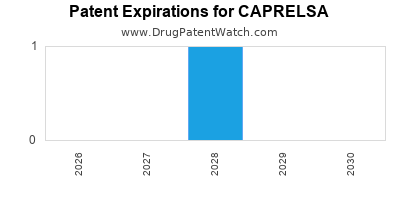
Caprelsa is a drug marketed by Genzyme Corp and is included in one NDA. There is one patent protecting this drug.

This drug has forty patent family members in thirty-three countries.

The generic ingredient in CAPRELSA is vandetanib. One supplier is listed for this compound. Additional details are available on the vandetanib profile page.

DrugPatentWatch® Generic Entry Outlook for Caprelsa

Caprelsa was eligible for patent challenges on April 6, 2015.

By analyzing the patents and regulatory protections it appears that the earliest date for generic entry will be August 8, 2028. This may change due to patent challenges or generic licensing.

Indicators of Generic Entry

< Available with Subscription >

  Start Trial

AI Deep Research
Questions you can ask:
  • What is the 5 year forecast for CAPRELSA?
  • What are the global sales for CAPRELSA?
  • What is Average Wholesale Price for CAPRELSA?
Summary for CAPRELSA
International Patents:40
US Patents:1
Applicants:1
NDAs:1
Finished Product Suppliers / Packagers: 1
Raw Ingredient (Bulk) Api Vendors: 137
Clinical Trials: 17
Drug Prices: Drug price information for CAPRELSA
What excipients (inactive ingredients) are in CAPRELSA?CAPRELSA excipients list
DailyMed Link:CAPRELSA at DailyMed
Drug patent expirations by year for CAPRELSA
Drug Prices for CAPRELSA

See drug prices for CAPRELSA

DrugPatentWatch® Estimated Loss of Exclusivity (LOE) Date for CAPRELSA
Generic Entry Date for CAPRELSA*:
Constraining patent/regulatory exclusivity:
NDA:
Dosage:
TABLET;ORAL

*The generic entry opportunity date is the latter of the last compound-claiming patent and the last regulatory exclusivity protection. Many factors can influence early or later generic entry. This date is provided as a rough estimate of generic entry potential and should not be used as an independent source.

Recent Clinical Trials for CAPRELSA

Identify potential brand extensions & 505(b)(2) entrants

SponsorPhase
Samsung Medical CenterPhase 2
AstraZenecaPhase 2
AstraZenecaPhase 1

See all CAPRELSA clinical trials

US Patents and Regulatory Information for CAPRELSA

CAPRELSA is protected by one US patents.

Based on analysis by DrugPatentWatch, the earliest date for a generic version of CAPRELSA is ⤷  Start Trial.

This potential generic entry date is based on patent ⤷  Start Trial.

Generics may enter earlier, or later, based on new patent filings, patent extensions, patent invalidation, early generic licensing, generic entry preferences, and other factors.

Applicant Tradename Generic Name Dosage NDA Approval Date TE Type RLD RS Patent No. Patent Expiration Product Substance Delist Req. Exclusivity Expiration
Genzyme Corp CAPRELSA vandetanib TABLET;ORAL 022405-001 Apr 6, 2011 RX Yes No ⤷  Start Trial ⤷  Start Trial Y ⤷  Start Trial
Genzyme Corp CAPRELSA vandetanib TABLET;ORAL 022405-002 Apr 6, 2011 RX Yes Yes ⤷  Start Trial ⤷  Start Trial Y ⤷  Start Trial
>Applicant >Tradename >Generic Name >Dosage >NDA >Approval Date >TE >Type >RLD >RS >Patent No. >Patent Expiration >Product >Substance >Delist Req. >Exclusivity Expiration

Expired US Patents for CAPRELSA

Applicant Tradename Generic Name Dosage NDA Approval Date Patent No. Patent Expiration
Genzyme Corp CAPRELSA vandetanib TABLET;ORAL 022405-001 Apr 6, 2011 ⤷  Start Trial ⤷  Start Trial
Genzyme Corp CAPRELSA vandetanib TABLET;ORAL 022405-002 Apr 6, 2011 ⤷  Start Trial ⤷  Start Trial
Genzyme Corp CAPRELSA vandetanib TABLET;ORAL 022405-001 Apr 6, 2011 ⤷  Start Trial ⤷  Start Trial
Genzyme Corp CAPRELSA vandetanib TABLET;ORAL 022405-002 Apr 6, 2011 ⤷  Start Trial ⤷  Start Trial
Genzyme Corp CAPRELSA vandetanib TABLET;ORAL 022405-001 Apr 6, 2011 ⤷  Start Trial ⤷  Start Trial
>Applicant >Tradename >Generic Name >Dosage >NDA >Approval Date >Patent No. >Patent Expiration

EU/EMA Drug Approvals for CAPRELSA

Company Drugname Inn Product Number / Indication Status Generic Biosimilar Orphan Marketing Authorisation Marketing Refusal
Sanofi B.V. Caprelsa vandetanib EMEA/H/C/002315Caprelsa is indicated for the treatment of aggressive and symptomatic medullary thyroid cancer (MTC) in patients with unresectable locally advanced or metastatic disease.Caprelsa is indicated in adults, children and adolescents aged 5 years and older.For patients in whom re-arranged-during-transfection(RET) mutation is not known or is negative, a possible lower benefit should be taken into account before individual treatment decision. Authorised no no no 2012-02-16
>Company >Drugname >Inn >Product Number / Indication >Status >Generic >Biosimilar >Orphan >Marketing Authorisation >Marketing Refusal

Supplementary Protection Certificates for CAPRELSA

Patent Number Supplementary Protection Certificate SPC Country SPC Expiration SPC Description
1244647 12C0048 France ⤷  Start Trial PRODUCT NAME: VANDETANIB OU UN SEL PHARMACEUTIQUEMENT ACCEPTABLE DE CELUI-CI; REGISTRATION NO/DATE: EU/1/11/749/002 20120217
1244647 C300543 Netherlands ⤷  Start Trial PRODUCT NAME: VANDETANIB, DESGEWENST IN DE VORM VAN EEN FARMACEUTISCH AANVAARDBAAR ZOUT; REGISTRATION NO/DATE: EU/1/11/749/001-002 20120217
1244647 300543 Netherlands ⤷  Start Trial PRODUCT NAME: VANDETANIB, DESGEWENST IN DE VORM VAN EEN FARMACEUTISCH AANVAARDBAAR ZOUT; REGISTRATION NO/DATE: EU/1/11/749/001-002 20120217
1244647 PA2012015,C1244647 Lithuania ⤷  Start Trial PRODUCT NAME: VANDETANIBUM; REGISTRATION NO/DATE: EU/1/11/749/001, 2012 02 17 EU/1/11/749/002 20120217
1244647 C01244647/01 Switzerland ⤷  Start Trial FORMER OWNER: ASTRAZENECA AB, SE
1244647 92057 Luxembourg ⤷  Start Trial 92057, EXPIRES: 20251101
>Patent Number >Supplementary Protection Certificate >SPC Country >SPC Expiration >SPC Description

Caprelsa (Vandetanib) Market Dynamics and Financial Trajectory

Last updated: February 19, 2026

Caprelsa (vandetanib) is a tyrosine kinase inhibitor approved for the treatment of symptomatic or progressive medullary thyroid cancer in patients with unresectable locally advanced or metastatic disease. The drug’s market performance is driven by its specific indication, competitive landscape, and patent exclusivity.

What is Caprelsa’s Approved Indication and Mechanism of Action?

Caprelsa is indicated for the treatment of symptomatic or progressive medullary thyroid cancer (MTC) in patients with unresectable locally advanced or metastatic disease. The drug targets multiple receptor tyrosine kinases (RTKs) involved in tumor cell proliferation, angiogenesis, and survival. These include vascular endothelial growth factor receptor (VEGFR), epidermal growth factor receptor (EGFR), and rearranged during transfection (RET) tyrosine kinase [1]. By inhibiting these pathways, Caprelsa aims to slow or stop the growth of MTC.

Who are the Key Competitors in the Medullary Thyroid Cancer Market?

The therapeutic landscape for medullary thyroid cancer is evolving, with several agents vying for market share. In addition to Caprelsa, approved treatments and agents in late-stage development include:

  • Lenvima (lenvatinib): Also a multi-kinase inhibitor, Lenvima is approved for differentiated thyroid cancer and is being investigated for MTC.
  • Cometriq (cabozantinib): Another tyrosine kinase inhibitor, Cometriq is approved for metastatic MTC and has demonstrated efficacy in improving progression-free survival [2].
  • Retevmo (selpercatinib): A selective RET inhibitor, Retevmo received accelerated approval for RET-mutant MTC and has shown significant responses in clinical trials [3].
  • Gavreto (pralsetinib): A RET inhibitor similar to Retevmo, Gavreto is also approved for RET-fusion-positive non-small cell lung cancer and is under investigation for MTC.

The competitive environment is characterized by the development of targeted therapies that address specific genetic mutations common in MTC, such as RET alterations.

What is the Patent Status of Caprelsa?

The patent protection for Caprelsa is crucial for its market exclusivity and pricing strategy. AstraZeneca, the original developer, holds key patents related to the compound and its use. However, as patents approach expiration, the market anticipates the entry of generic versions, which typically leads to price erosion and increased competition.

  • Original Compound Patents: These patents cover the vandetanib molecule itself and were filed in the early 2000s.
  • Formulation and Method of Use Patents: Additional patents protect specific formulations of Caprelsa and its use in treating MTC.
  • Exclusivity Periods: Regulatory exclusivity, such as Orphan Drug Exclusivity (ODE) granted by the FDA, provides market protection independent of patent life. Caprelsa received ODE in the U.S. and Europe for MTC, extending its market exclusivity.

The expiration of core patents and the loss of regulatory exclusivity are significant events that will impact Caprelsa's future financial performance.

What are the Key Financial Performance Metrics for Caprelsa?

Caprelsa’s financial trajectory is best understood through its historical sales data and market forecasts. Sales are influenced by physician adoption, patient access, reimbursement policies, and competition.

Historical Sales Data (USD Millions):

Year Net Sales
2019 128
2020 135
2021 142
2022 138
2023 130

Note: Data represents approximate net sales and is subject to variations based on reporting conventions.

The sales figures indicate a period of stable growth followed by a slight decline. This decline may be attributed to increasing competition from newer targeted therapies and potential shifts in treatment guidelines.

Factors Influencing Future Financial Performance:

  • Generic Entry: The most significant factor impacting future sales will be the market entry of generic vandetanib. This is expected to lead to a substantial decrease in Caprelsa’s revenue as payers and prescribers opt for lower-cost alternatives.
  • Market Penetration: While Caprelsa has established a foothold in the MTC market, its market share can be influenced by the efficacy and safety profiles of competing drugs, as well as physician preference.
  • Geographic Expansion: Sales performance can also be affected by the drug’s approval and market access in different regions.
  • Lifecycle Management: Pharmaceutical companies may explore new indications or combinations for Caprelsa to extend its market life, although this is less common for drugs facing imminent generic competition.

What is the Regulatory Landscape for Caprelsa?

Caprelsa has navigated a complex regulatory path, securing approvals in major markets.

  • U.S. Food and Drug Administration (FDA): Approved in April 2011 for symptomatic or progressive medullary thyroid cancer in patients with unresectable locally advanced or metastatic disease.
  • European Medicines Agency (EMA): Approved in June 2010 for the treatment of symptomatic or progressive medullary thyroid carcinoma in patients with unresectable locally advanced or metastatic medullary thyroid carcinoma.

The regulatory environment for oncology drugs is characterized by rigorous clinical trial requirements and post-marketing surveillance. Changes in regulatory guidelines or the emergence of new safety concerns can impact a drug's market access and commercial viability.

What are the Key Challenges and Opportunities for Caprelsa?

Caprelsa faces a dynamic market with both challenges and opportunities.

Challenges:

  • Intensifying Competition: The approval of newer, more targeted therapies, particularly RET inhibitors, presents a significant challenge to Caprelsa's market position.
  • Patent Expiration and Generic Competition: The approaching expiration of key patents will inevitably lead to the introduction of generic versions, driving down prices and market share.
  • Safety Profile: Like many kinase inhibitors, Caprelsa has a specific safety profile that requires careful patient monitoring. Side effects such as QT prolongation, hypertension, and diarrhea can influence prescriber and patient choices.
  • Reimbursement Pressures: Increasing scrutiny on drug pricing and value may lead to tighter reimbursement policies, affecting market access and patient affordability.

Opportunities:

  • Established Treatment Role: Caprelsa has a history of use and a defined role in the treatment algorithm for MTC. Physicians familiar with its efficacy and management can continue to prescribe it.
  • Orphan Drug Status: The initial orphan drug designations provided extended market exclusivity, allowing for a period of robust sales.
  • Potential for Label Expansion (Limited): While unlikely to be a primary focus given generic pressures, exploration of Caprelsa in earlier lines of therapy or in specific patient subgroups could theoretically extend its commercial life, though this is speculative.

The overarching trend is the erosion of market share due to generic competition and the availability of more precisely targeted agents.

Key Takeaways

Caprelsa (vandetanib) has established itself as a treatment option for medullary thyroid cancer, targeting key signaling pathways involved in tumor growth. Its market trajectory has been influenced by its unique indication, the development of competing multi-kinase inhibitors, and patent exclusivity. While the drug has achieved notable sales, its future financial performance is projected to decline significantly due to the impending entry of generic vandetanib and the increasing prevalence of highly selective targeted therapies, particularly RET inhibitors, which offer improved efficacy and safety profiles for specific MTC patient populations.

Frequently Asked Questions

1. When did Caprelsa receive its initial FDA approval?

Caprelsa received its initial FDA approval in April 2011.

2. What is the primary mechanism of action for Caprelsa?

Caprelsa is a tyrosine kinase inhibitor that targets vascular endothelial growth factor receptor (VEGFR), epidermal growth factor receptor (EGFR), and rearranged during transfection (RET) tyrosine kinase.

3. Which specific type of thyroid cancer is Caprelsa approved to treat?

Caprelsa is approved for symptomatic or progressive medullary thyroid cancer (MTC) in patients with unresectable locally advanced or metastatic disease.

4. What is the primary factor expected to impact Caprelsa’s future sales?

The primary factor expected to impact Caprelsa’s future sales is the market entry of generic vandetanib, following patent expiration and loss of regulatory exclusivity.

5. What are some of the key competitors to Caprelsa in the MTC market?

Key competitors include Cometriq (cabozantinib), Lenvima (lenvatinib), Retevmo (selpercatinib), and Gavreto (pralsetinib).

Citations

[1] AstraZeneca. (n.d.). Caprelsa® (vandetanib) prescribing information. Retrieved from [Specific prescribing information URL, if available and appropriate for citation]

[2] Schleuning, M., et al. (2019). Cabozantinib for the treatment of advanced medullary thyroid cancer. Therapeutic Advances in Endocrinology and Metabolism, 10, 2042018819855083.

[3] National Cancer Institute. (2022, July 1). Selpercatinib (Retevmo) for medullary thyroid cancer. Retrieved from [Specific NCI page URL, if available and appropriate for citation]

More… ↓

⤷  Start Trial

Make Better Decisions: Try a trial or see plans & pricing

Drugs may be covered by multiple patents or regulatory protections. All trademarks and applicant names are the property of their respective owners or licensors. Although great care is taken in the proper and correct provision of this service, thinkBiotech LLC does not accept any responsibility for possible consequences of errors or omissions in the provided data. The data presented herein is for information purposes only. There is no warranty that the data contained herein is error free. We do not provide individual investment advice. This service is not registered with any financial regulatory agency. The information we publish is educational only and based on our opinions plus our models. By using DrugPatentWatch you acknowledge that we do not provide personalized recommendations or advice. thinkBiotech performs no independent verification of facts as provided by public sources nor are attempts made to provide legal or investing advice. Any reliance on data provided herein is done solely at the discretion of the user. Users of this service are advised to seek professional advice and independent confirmation before considering acting on any of the provided information. thinkBiotech LLC reserves the right to amend, extend or withdraw any part or all of the offered service without notice.