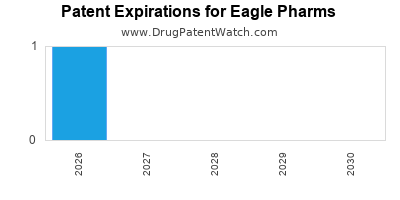
Last updated: July 31, 2026
Eagle Pharmaceuticals is a U.S.-focused specialty pharmaceutical company built around injectable hospital products, oncology supportive care, anesthesia, critical-care medicines and differentiated formulations. Its commercial position is strongest in products with limited competition, complex manufacturing requirements or clinically meaningful administration advantages. The portfolio includes Ryanodex, Belrapzo, Pemfexy, Tepylute and Byfavo.
Eagle’s key risks are concentrated product exposure, generic and authorized-generic competition, reliance on U.S. hospital purchasing channels, patent litigation involving Pemfexy, and the need to replace revenue from mature products. Unlike a biologics company, Eagle does not face conventional biosimilar substitution risk. Its principal competitive threat comes from abbreviated new drug applications, 505(b)(2) products, authorized generics and branded competitors.
What is Eagle Pharmaceuticals’ market position?
Eagle Pharmaceuticals is a specialty pharmaceutical company focused primarily on injectable and hospital-administered medicines. The company competes in markets where formulation, dosing speed, storage, administration logistics and manufacturing complexity can influence purchasing decisions.
Its competitive model has four components:
- Developing differentiated formulations of established active ingredients.
- Obtaining FDA approval through the 505(b)(2) pathway where appropriate.
- Using patents and regulatory exclusivity to delay direct competition.
- Acquiring or licensing commercial products with established hospital demand.
Eagle’s most recognizable product is Ryanodex, a rapid-reconstitution formulation of dantrolene sodium used to treat malignant hyperthermia. The product has a small but strategically valuable market because treatment is time-sensitive and hospitals must maintain emergency readiness.
Eagle also markets oncology products, including bendamustine, pemetrexed and thiotepa formulations. Its anesthesia portfolio expanded through the acquisition of Acacia Pharma, which brought Byfavo, an intravenous formulation of remimazolam, into the company’s commercial portfolio.[1]
Eagle Pharmaceuticals’ principal products
| Product |
Active ingredient |
Primary use |
Dosage form |
Competitive category |
| Ryanodex |
Dantrolene sodium |
Malignant hyperthermia |
Injectable powder |
Differentiated emergency formulation |
| Belrapzo |
Bendamustine hydrochloride |
Hematologic cancers |
Intravenous injection |
Branded oncology product |
| Pemfexy |
Pemetrexed injection |
Non-small-cell lung cancer and mesothelioma |
Intravenous injection |
505(b)(2) formulation |
| Tepylute |
Thiotepa |
Conditioning before hematopoietic progenitor-cell transplantation |
Intravenous injection |
Specialty oncology |
| Byfavo |
Remimazolam |
Procedural sedation |
Intravenous injection |
Hospital anesthesia product |
Which products drive Eagle Pharmaceuticals’ revenue?
Ryanodex, Belrapzo and Pemfexy historically formed the core of Eagle’s commercial base. Tepylute and Byfavo expanded the portfolio but also increased the company’s exposure to products with different prescriber, reimbursement and hospital formulary dynamics.
Ryanodex
Ryanodex contains dantrolene sodium and is supplied in a 250-mg vial designed for rapid preparation. Traditional dantrolene products require multiple vials and more diluent during an emergency. Ryanodex’s value proposition is operational: faster preparation, lower storage burden and simplified emergency response.
The product is used mainly by hospitals, ambulatory surgical centers and other facilities required to maintain malignant hyperthermia treatment capability. Its market is relatively narrow, but switching can be constrained by emergency protocols, institutional training and stocking requirements.
Ryanodex remains exposed to generic dantrolene products. Its commercial defensibility depends more on formulation, administration convenience, institutional adoption and patent protection than on broad patient volume.
Belrapzo
Belrapzo is an intravenous formulation of bendamustine hydrochloride used in certain hematologic malignancies. Bendamustine is also marketed in other formulations and by competing manufacturers, including generic suppliers.
The product competes in a mature oncology market. Its commercial prospects depend on contracting, supply reliability, oncology practice preference and the ability to differentiate against generic bendamustine products. The product has less structural protection than a novel molecular entity because the active ingredient is established and multiple bendamustine products exist.
Pemfexy
Pemfexy is a pemetrexed injection approved for indications that include nonsquamous non-small-cell lung cancer and malignant pleural mesothelioma. It was developed as a ready-to-use formulation intended to simplify preparation compared with lyophilized pemetrexed products.
Pemetrexed is a high-value oncology molecule with significant generic competition. Eagle’s commercial strategy relies on formulation and administration advantages, including reduced preparation steps and a ready-to-use presentation. The product is therefore more exposed to formulation-specific competition than to competition based solely on the active ingredient.
Tepylute
Tepylute is a thiotepa injection used as part of conditioning treatment before hematopoietic progenitor-cell transplantation. Thiotepa is a specialty oncology product with a narrower market than pemetrexed or bendamustine.
The product’s commercial value comes from the specialized treatment setting, limited supplier base and hospital need for reliable supply. Its market size is smaller, but competition may be less crowded than in mature high-volume oncology products.
Byfavo
Byfavo contains remimazolam and is used for induction and maintenance of procedural sedation in adults. It competes with established sedatives, including midazolam and propofol, as well as other anesthesia products.
The principal commercial question is adoption. Byfavo must demonstrate practical advantages in onset, offset, recovery profile, titration or workflow. Because anesthesia products are administered in controlled hospital and procedure-center settings, formulary placement and clinician familiarity are important barriers to rapid uptake.
How strong is Eagle Pharmaceuticals’ patent estate?
Eagle’s patent estate is strongest where the company has protected a differentiated formulation, dosing regimen, administration method or product presentation. The estate is weaker when the product competes directly with multiple generic versions of the same active ingredient.
Patent strategy by product
| Product |
Main protection type |
Patent strength assessment |
| Ryanodex |
Formulation, concentration, preparation and administration claims |
Relatively strong product differentiation, subject to generic and formulation challenges |
| Pemfexy |
Ready-to-use injectable formulation and related use claims |
Material protection, but exposed to Paragraph IV litigation |
| Belrapzo |
Product formulation and commercial exclusivity |
Moderate, with substantial active-ingredient competition |
| Tepylute |
Product-specific formulation and regulatory protection |
Potentially meaningful in a narrow market |
| Byfavo |
New active ingredient, formulation and method-of-use protection |
Stronger innovation profile, but adoption and competing sedatives remain risks |
Eagle’s assets are generally more defensible than ordinary commodity generics because the company has emphasized formulation and delivery improvements. That protection does not eliminate competition. Generic applicants can challenge formulation patents, seek non-infringement positions or develop alternative formulations that avoid asserted claims.
What patents protect Pemfexy?
Pemfexy protection is centered on the product’s injectable formulation and ready-to-use presentation rather than ownership of pemetrexed itself. The relevant patent strategy is designed to prevent a competing product from relying on the same formulation architecture or a materially equivalent approach.
The FDA Orange Book should be used to identify the patents listed for Pemfexy, including patent numbers, expiration dates and any pediatric exclusivity adjustments. Orange Book listings can change as patents are added, delisted or updated.[2] Eagle’s SEC filings and federal court complaints provide the litigation-specific record for asserted claims.[3]
What is the FDA and Orange Book status of Eagle Pharmaceuticals’ products?
Eagle’s major products are FDA-approved prescription medicines. The company has used both conventional new drug applications and the 505(b)(2) pathway.
| Product |
FDA pathway and status |
Orange Book relevance |
| Ryanodex |
Approved NDA product |
Listed patents may cover formulation and administration |
| Belrapzo |
Approved NDA product |
Patent and exclusivity status should be assessed against bendamustine generics |
| Pemfexy |
505(b)(2)-based injectable product |
Orange Book patents have been central to generic-entry analysis |
| Tepylute |
Approved specialty oncology product |
Product-specific patent and regulatory protections may apply |
| Byfavo |
Approved NDA product originating with Acacia Pharma |
Listed patents and regulatory exclusivity must be reviewed separately |
A 505(b)(2) approval can reduce development requirements by allowing reliance on existing safety and efficacy information for a reference drug. It does not prevent ANDA applicants from challenging listed patents. A generic applicant can file a Paragraph IV certification alleging that a listed patent is invalid, unenforceable or not infringed.
Which companies are challenging Eagle’s products through Paragraph IV filings?
The most material Paragraph IV risk has involved Pemfexy. Generic pemetrexed applicants have had an economic incentive to challenge formulation and product patents because pemetrexed is a large and established oncology market.
The precise challenger list, litigation posture and launch rights depend on the relevant FDA filing dates, court docket, settlement terms and Orange Book entries. Eagle’s annual reports identify product-specific litigation and patent disputes, while federal district court records establish the procedural history.[3]
A Paragraph IV filing does not itself authorize immediate market entry. The filing can trigger a 30-month stay under the Hatch-Waxman Act if the NDA holder brings a timely patent infringement action. The stay may end earlier through court action, settlement or other statutory events.[4]
What generic launch scenarios exist for Pemfexy?
| Scenario |
Commercial effect |
| Patent claims upheld and no settlement |
Generic launch may be delayed until patent expiry |
| Patent claims invalidated or found not infringed |
Earlier generic entry is possible |
| Settlement with licensed entry |
Entry occurs on a negotiated date, potentially with supply or royalty terms |
| At-risk launch |
Generic enters before final patent resolution, creating damages and injunction risk |
| Alternative formulation approval |
Competitor avoids some asserted claims and enters through a separate product design |
The largest financial risk is not always full generic substitution. A licensed generic or competing ready-to-use product can reduce pricing while preserving some market volume. Hospital contracts can accelerate share loss once a lower-cost substitute achieves formulary approval.
When do Eagle Pharmaceuticals’ products lose exclusivity?
Eagle’s exclusivity timeline is product-specific and depends on patents, pediatric extensions, regulatory exclusivity, settlements and the launch rights of approved generic competitors.
Exclusivity framework
| Protection |
Typical legal function |
| Patent protection |
Can block or delay competing products if claims survive litigation |
| Five-year NCE exclusivity |
Applies to qualifying new chemical entities, not ordinary reformulations |
| Three-year clinical-investigation exclusivity |
May apply to certain new formulations or indications supported by new clinical studies |
| Orphan-drug exclusivity |
Can block approval of the same drug for the same indication for seven years |
| Pediatric exclusivity |
Adds six months to certain listed exclusivity periods |
| 30-month stay |
Temporarily delays ANDA approval after timely patent litigation |
Eagle’s reformulated products generally should not be treated as enjoying the same exclusivity profile as a novel chemical entity. Their commercial protection is more dependent on patent claims, formulation differentiation and market access.
For exact expiration dates, investors and competitors should reconcile the FDA Orange Book, FDA approval letters, patent records, Eagle’s annual reports and any settlement agreements. Patent expiration can also be affected by patent-term adjustment, terminal disclaimers and pediatric extensions.[2][3]
Does Eagle Pharmaceuticals face biosimilar risk?
Eagle does not face conventional biosimilar risk for its principal commercial products because its portfolio consists primarily of small-molecule drugs and non-biologic injectable products.
The relevant competitive pathways are:
- ANDA-approved generics.
- 505(b)(2) products.
- Authorized generics.
- Competing branded formulations.
- Hospital-administered alternatives with different active ingredients.
Byfavo, Ryanodex, Pemfexy, Belrapzo and Tepylute are therefore evaluated under small-molecule or conventional drug competition frameworks rather than the Biologics Price Competition and Innovation Act pathway.
What formulation patents are strategically important to Eagle?
Formulation patents matter because Eagle’s products frequently improve preparation, concentration, storage, dosing or administration rather than introduce a new active ingredient.
Ryanodex formulation protection
Ryanodex’s differentiation is based on a high-concentration dantrolene presentation and rapid preparation. Patent claims may address composition, concentration, reconstitution and use in malignant hyperthermia treatment. Competitors can challenge the estate by using different excipients, concentrations, vial configurations or reconstitution methods.
Pemfexy formulation protection
Pemfexy’s commercial distinction is the ready-to-use injectable format. A competitor may attempt to design around claims by changing the concentration, excipient system, container, manufacturing process or administration instructions.
Tepylute manufacturing and formulation protection
Thiotepa is a highly specialized injectable product. Patent value can arise from stability, storage, container closure, manufacturing controls and preparation requirements. These features can create practical barriers even when the active ingredient is old.
What manufacturing and intellectual-property barriers affect Eagle?
Eagle’s products are injectable medicines, which creates more manufacturing complexity than standard oral tablets. Barriers include:
- Sterile manufacturing capacity.
- Aseptic filling and container-closure validation.
- Stability and impurity control.
- Supply of specialized active pharmaceutical ingredients.
- Validation of ready-to-use formulations.
- Hospital procurement qualification.
- Product-specific preparation instructions.
- Regulatory approval of manufacturing-site changes.
These barriers can slow generic entry, but they are not equivalent to patent exclusivity. Contract manufacturing constraints, shortages and quality events can affect both Eagle and competitors.
Eagle’s ability to maintain supply is commercially important because hospitals prefer products that are consistently available. A competitor with lower pricing but unreliable supply may not immediately displace an established product.
What patent litigation affects Eagle Pharmaceuticals?
Eagle’s most important litigation exposure is associated with patent enforcement and challenges involving Pemfexy and other injectable products. Hatch-Waxman litigation typically determines whether an ANDA product can launch before listed patent expiry.
The relevant legal questions include:
- Whether the asserted patent claims are valid.
- Whether the generic product infringes those claims.
- Whether the patent is enforceable.
- Whether the litigation triggers or extends the 30-month stay.
- Whether the parties settle and establish a licensed entry date.
Eagle’s litigation risk is asymmetric. A successful defense can preserve pricing and delay generic entry. An adverse decision can compress the protected revenue period and reduce the value of the formulation patent estate.
Has Eagle Pharmaceuticals entered licensing deals or acquisitions?
Eagle expanded beyond internally developed products through transactions and licensing arrangements.
The acquisition of Acacia Pharma added Byfavo and related hospital products to Eagle’s portfolio. The transaction broadened Eagle’s exposure to anesthesia and procedural sedation while increasing its dependence on commercial execution in a new therapeutic area.[1]
Eagle has also used licensing and strategic partnerships to obtain rights to specialty products. These arrangements can accelerate product access but may reduce gross margin through royalties, milestone payments or profit-sharing obligations. They also create dependence on counterparties for supply, regulatory support or territory rights.
How does Eagle compare with competing pharmaceutical companies?
Eagle versus generic manufacturers
Generic manufacturers generally compete on price, scale and supply. Eagle competes through branded formulation differentiation, hospital relationships and patent protection.
| Factor |
Eagle Pharmaceuticals |
Generic manufacturers |
| Pricing |
Branded or specialty pricing |
Lower-cost pricing |
| Product strategy |
Differentiated formulations and specialty products |
Bioequivalent or alternative formulations |
| Patent exposure |
Enforces and defends product patents |
Challenges patents through Paragraph IV filings |
| Customer base |
Hospitals, oncology practices and procedure centers |
Wholesalers, group purchasing organizations and pharmacies |
| Main risk |
Patent expiry and portfolio concentration |
Litigation, approval timing and price erosion |
Eagle versus larger specialty pharmaceutical companies
Larger specialty companies have broader sales forces, more products and greater contracting leverage. Eagle can compete where a focused commercial team is sufficient and where a product has a specific hospital-use advantage.
Eagle is more exposed to the failure of individual products. A large pharmaceutical company can absorb a product decline more easily because revenue is distributed across a larger portfolio.
Eagle versus branded oncology competitors
In oncology, Eagle competes with originator companies, generic suppliers and other branded injectable manufacturers. Clinical guidelines and physician preference matter, but procurement economics are often decisive for mature injectable products.
What revenue exposure and commercial risks does Eagle face?
Eagle’s revenue exposure is concentrated in a limited number of products. This creates operating leverage when a product performs well but increases risk when a major product loses exclusivity or faces price competition.
The primary commercial risks are:
- Generic entry for Pemfexy or other mature products.
- Lower reimbursement or hospital contracting pressure.
- Product shortages or manufacturing interruptions.
- Slow adoption of Byfavo.
- Declining demand for older oncology formulations.
- Dependence on U.S. sales.
- Litigation costs and settlement payments.
- Acquisition integration risk.
The strongest revenue defense is a portfolio of products with different competitive timelines. Tepylute and Byfavo can reduce reliance on mature oncology products if they achieve sustained hospital adoption.
How strong is Eagle Pharmaceuticals’ overall competitive position?
Eagle has a credible niche strategy but not the risk profile of a diversified global pharmaceutical company. Its strengths are concentrated in product selection and formulation expertise.
Strengths
- Focus on complex injectable and hospital products.
- Experience with 505(b)(2) development.
- Established relationships in oncology and acute-care markets.
- Product differentiation through preparation and administration.
- Exposure to specialized markets with fewer suppliers.
- Ability to acquire or license commercial-stage assets.
Weaknesses
- Limited portfolio breadth.
- High exposure to patent expiry and generic substitution.
- Dependence on hospital purchasing and formulary access.
- Small-market products can require disproportionate commercial effort.
- Formulation patents can be easier to design around than composition-of-matter patents.
- Acquired products may require new commercial capabilities.
What is the likely generic-entry risk for Eagle?
Eagle’s generic-entry risk is highest for Pemfexy and Belrapzo because both compete in established markets with active generic interest. Ryanodex has a narrower market and a more differentiated presentation, but generic or alternative dantrolene products remain a risk.
Tepylute may have lower near-term competitive intensity because of its specialized use and manufacturing requirements. Byfavo’s principal threat is substitution by existing sedatives and competing anesthesia products rather than a near-term biosimilar-style competitor.
The most important diligence indicators are:
- New Orange Book patent listings.
- Paragraph IV certifications.
- ANDA approvals.
- District court decisions.
- Settlement announcements.
- Product-level price and volume trends.
- Hospital formulary wins and losses.
- FDA manufacturing or shortage notices.
Key Takeaways
- Eagle Pharmaceuticals is a specialty injectable company with a concentrated portfolio in oncology, anesthesia and emergency medicine.
- Ryanodex has the clearest administration-based differentiation.
- Pemfexy is strategically important but carries material Paragraph IV and formulation-patent risk.
- Belrapzo operates in a more competitive bendamustine market.
- Tepylute provides access to a specialized transplant-conditioning segment.
- Byfavo broadens Eagle into procedural sedation but requires significant market adoption.
- Eagle faces generic risk, not conventional biosimilar risk.
- Its patent estate is strongest for differentiated formulations and weakest where multiple generic products already compete.
- Manufacturing complexity supports market defensibility but does not replace patent protection.
- Portfolio concentration remains the principal commercial and investment risk.
Frequently Asked Questions
Is Eagle Pharmaceuticals a generic drug company?
No. Eagle is a specialty pharmaceutical company. It develops, acquires and commercializes differentiated formulations and specialty medicines, although several products compete directly with generic drugs.
Is Ryanodex protected by patents?
Ryanodex has relied on product-specific formulation and administration protection. The current patent scope and expiration dates should be verified through the FDA Orange Book and Eagle’s SEC filings.
Does Eagle Pharmaceuticals make biosimilars?
No. Eagle’s principal products are small-molecule or conventional injectable medicines. Its competitors generally use ANDA or 505(b)(2) pathways rather than biosimilar applications.
What is Eagle’s most important patent risk?
Pemfexy presents one of the company’s most important patent risks because pemetrexed is an established oncology market with generic demand and potential Paragraph IV challenges.
Can a generic version of Ryanodex launch before patent expiry?
A generic applicant may seek approval through an ANDA and challenge listed patents. Launch timing depends on the certification, litigation, court rulings, settlements and any applicable regulatory stay.
References
-
Eagle Pharmaceuticals, Inc. (2022). Annual report pursuant to Section 13 or 15(d) of the Securities Exchange Act of 1934. U.S. Securities and Exchange Commission.
-
U.S. Food and Drug Administration. (2024). Approved drug products with therapeutic equivalence evaluations: Orange Book. https://www.fda.gov/drugs/drug-approvals-and-databases/orange-book-data-files
-
Eagle Pharmaceuticals, Inc. (2023). Annual report pursuant to Section 13 or 15(d) of the Securities Exchange Act of 1934. U.S. Securities and Exchange Commission.
-
U.S. Food and Drug Administration. (2023). Hatch-Waxman amendments and abbreviated new drug applications. https://www.fda.gov/drugs/abbreviated-new-drug-application-anda/hatch-waxman-amendments-and-abbreviated-new-drug-applications