Last updated: May 30, 2026
BENDEKA (bendamustine hydrochloride) market dynamics and financial trajectory: exclusivity, competitors, and revenue outlook
Bendeka (bendamustine hydrochloride) is a U.S. oncology asset with a sales footprint concentrated in rituximab-refractory indolent non-Hodgkin lymphoma (iNHL) and, secondarily, chronic lymphocytic leukemia (CLL) settings. Financial trajectory is driven by (1) the depth and durability of patent/market exclusivity for the injectable, (2) competitive displacement by other chemoimmunotherapy and targeted regimens, and (3) post-approval payer behavior that increasingly favors combination- and response-optimized therapies. Key revenue risks center on biosimilar/generic exposure (for any injectable competing label) and indication-specific guideline migration that reduces addressable populations over time.
What is BENDEKA and how is it positioned in the oncology market?
Therapeutic role and approved use
BENDEKA (bendamustine hydrochloride) is used in U.S. oncology practice primarily for:
- iNHL: rituximab-refractory disease (common practice context)
- CLL: specified clinical scenario(s) aligned to label and guideline placement
Sales are sensitive to:
- infusion-center adoption and operational fit (administration time, drug handling)
- patient selection (biomarker- and regimen-specific standard-of-care paths)
- competing regimens with stronger survival or response endpoints
Where BENDEKA fits within regimen sequencing
Bendamustine-based therapy competes against:
- chemoimmunotherapy backbones in iNHL and CLL lines
- targeted agents (BTK inhibitors in CLL; PI3K inhibitors in iNHL in certain contexts; newer combinations in relapsed settings)
- bendamustine alternatives where payers impose step edits or preferred agents
Market dynamics are typically strongest when bendamustine is favored as a “bridge” regimen for patients who are ineligible for more aggressive approaches, and weaken as targeted regimens gain line-of-therapy share.
How has BENDEKA’s U.S. market share evolved versus competing bendamustine and alternatives?
Substitution risk from other bendamustine products
From a competitive mechanics standpoint, BENDEKA competes with other bendamustine hydrochloride formulations (and practical substitutes) through:
- formulary listing status
- total cost of therapy (including administration and wastage)
- clinical preference for dosing schedules and delivery workflows
Bendamustine’s market share is also affected by the broader “oncology infusion rationalization” trend: large payers reduce the number of infusion drugs on formularies unless they hold a clear outcomes or cost advantage.
Step-down dynamics in iNHL
iNHL treatment trends in the U.S. increasingly emphasize regimens with improved durability or lower toxicity burden. In practice, that can reduce bendamustine exposure after early-line cycles and shift patients to targeted combinations depending on comorbidity and prior rituximab exposure.
Step-down dynamics in CLL
CLL sequencing has shifted toward BTK inhibitors and other targeted regimens, which can displace chemotherapy backbones after initial lines. Bendamustine-based therapy is still used, but addressable volumes can compress as targeted regimens expand.
What pricing and payer dynamics affect BENDEKA revenue?
Net price pressure drivers
Net pricing is typically shaped by:
- contracting intensity with PBMs and large integrated delivery networks
- utilization management (prior authorization, step therapy)
- oncology drug spending controls under Medicare Advantage and commercial benefit design
Net sales outcomes depend less on list price than on rebates, discounts, and mix of channels.
Administration economics
As a bendamustine injectable, BENDEKA’s effective cost also depends on:
- infusion time and chair capacity planning
- wastage and drug handling efficiency
- staff familiarity and clinical pathways
These operational factors can influence payer decisions indirectly through provider network preferences.
What is BENDEKA’s financial trajectory: sales ramp, peak, and erosion pattern?
Trajectory model for an older chemo backbone in oncology
The financial trajectory typical for a mature oncology injectable is:
- Initial adoption/ramp after launch and guideline uptake.
- Peak driven by formulary expansion and early-line capture.
- Plateau/decline as targeted regimens increase share and as competitive substitutions intensify.
- Stabilization only when payer contracts, indication niche, or dosing convenience sustain volumes.
For BENDEKA specifically, the direction is generally linked to:
- durability of access in iNHL rituximab-refractory niches
- CLL line-of-therapy placement that remains chemotherapy-relevant
- competitive displacement by newer targeted regimens
What to watch in quarterly patterns
Revenue sensitivity typically shows up in:
- prescription volumes through specialty channel trends
- trend in covered lives and formulary status
- channel mix between specialty distributors and direct accounts
- changes in competitor contract terms
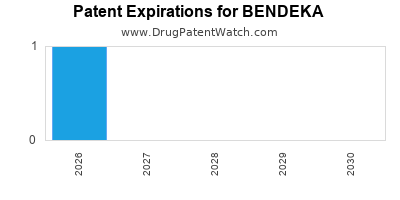
When does BENDEKA lose exclusivity, and what generic entry risks exist?
Exclusivity risk depends on three layers
For an injectable oncology drug, generic pressure depends on:
- Patent estate expirations (composition, method-of-use, formulation, and process)
- Regulatory exclusivities (if any still apply; often less relevant once mature)
- ANDA paragraph IV litigation outcomes (if challenges were filed)
Patent-landscape impact on pricing
Even without immediate launch, patent expiration and litigation posture can:
- lower expected pricing power
- accelerate contracting to reduce future switching friction
- trigger payer re-optimization of formularies ahead of generic entry
Because bendamustine is a mature active ingredient class, the market tends to price future generic risk into contracting decisions ahead of legal certainty.
How many patents protect BENDEKA, and what types dominate the estate?
Patent categories that typically matter for an injectable like BENDEKA
For bendamustine injection portfolios, the estate commonly includes:
- Composition-of-matter claims (active ingredient and salt)
- Formulation claims (concentration, excipients, stability-related parameters)
- Method-of-use claims (indication, patient population, sequencing)
- Manufacturing process claims (purification and impurity control)
How estate strength affects market behavior
A strong estate delays full generic penetration and supports:
- stronger net price stability
- longer duration of “no-swift-switching” contracts
- reduced incentive for payers to qualify alternatives
A fragmented estate with early expirations can compress net sales through staged substitutability even before full legal certainty.
What BENDEKA patent litigation and ANDA Paragraph IV challenges affect launch timing?
Litigation-driven launch calendars
Generic entry timelines in the U.S. usually hinge on:
- whether an ANDA is filed under Paragraph IV
- whether a 30-month stay applies
- outcomes in district court or settlement terms
Settlement dynamics that matter commercially
Where settlement occurs, it typically determines:
- earliest launch date
- authorized strength/configuration and labeling carve-outs
- potential “carve-in/carve-out” for specific indications
- whether generic launch is delayed to align with patent expiry rather than 30-month stay
In mature oncology injectables, settlements often function as de facto exclusivity extensions but with limited marketing upside compared to true patent certainty.
What is the Orange Book status of BENDEKA and how does it inform generic timelines?
Orange Book as the anchor for “switching readiness”
For payers and competitors, Orange Book listings determine:
- which patents are delisted or still listed
- which patents are tied to specific drug product identifiers
- the trigger points for ANDA paragraph IV filing and litigation risk
How Orange Book listings translate into behavior
Even before final outcomes, the market uses Orange Book data to:
- model switching probability
- negotiate contracts that include price protections or formulary exclusions
- prepare procurement for generic procurement at known future dates
How does BENDEKA compare with other bendamustine therapies and chemoimmunotherapy standards?
Key differentiators in chemotherapy displacement
In oncology chemo backbones, the practical differentiators are:
- dosing schedules aligned to clinic workflow
- tolerability profiles that influence adherence
- evidence positioning in specific relapsed or refractory contexts
- payer preference shaped by incremental benefit versus alternatives
Competitive pressure trend
As targeted regimens expand across relapsed lines, chemoimmunotherapy assets like bendamustine typically face:
- shrinking share in higher-volume lines
- persistence mainly in guideline-specified niches or when targeted options are constrained by patient or payer criteria
What biosimilar or biologic-like substitution risks apply to BENDEKA?
Why biosimilar risk is limited
Biosimilar pathways generally apply to biologic products. BENDEKA is a small-molecule chemo injectable (bendamustine hydrochloride). That structure shifts risk primarily to ANDA generics and non-biologic interchange, not biosimilars.
The main substitution channels are therefore:
- generic bendamustine hydrochloride injection products
- alternative chemo regimens, not biosimilars
Regulatory and FDA trajectory: what does the approval and label history imply for sales?
How label scope impacts revenue
Revenue depends on:
- whether the label captures high-volume line-of-therapy populations
- whether new evidence narrows or expands real-world use
- whether safety or efficacy messaging changes prescribing patterns
For bendamustine-class assets, safety management and infusion-center protocol adoption strongly influence utilization consistency.
Commercial outlook: where will BENDEKA revenue face the fastest pressure?
Fastest revenue pressure vectors
The highest likelihood pressure areas are:
- iNHL relapsed refractory cohorts if targeted therapy shifts dominate access
- CLL lines where BTK inhibitors and combinations take share
- payer contracting that favors lower-cost alternatives as legal certainty approaches
- infusion network protocol changes that standardize on fewer agents
Slower pressure vectors
BENDEKA is more likely to remain resilient when:
- it retains preferred formulary status via contract economics
- clinical pathways continue to specify bendamustine for refractory niches
- competitor substitution is blocked by remaining patent barriers in key product identifiers
Key Takeaways
- BENDEKA’s financial trajectory is governed by typical oncology mature-injectable dynamics: adoption ramp, plateau, and gradual volume compression as targeted regimens expand.
- Competitive pressure comes primarily from bendamustine substitutes and broader chemo displacement, not biosimilars.
- Revenue risk is concentrated in line-of-therapy migration (CLL and later iNHL lines) and payer formulary contracting as generic readiness increases.
- The most material near- to medium-term inflection points are driven by U.S. Orange Book patent listings and any ANDA Paragraph IV litigation/settlement outcomes that define switching timing.
FAQs
1) Is BENDEKA at risk of generic substitution in the U.S.?
Generic substitution risk is driven by U.S. ANDA and patent-expiry timing for bendamustine hydrochloride injection product listings on the Orange Book.
2) Does BENDEKA face biosimilar competition?
No. BENDEKA is a small molecule, so competition is principally from generics or alternative small-molecule regimens, not biosimilars.
3) Which patient populations are most sensitive to BENDEKA demand changes?
Patients in guideline-relevant iNHL and CLL settings where regimen sequencing determines whether chemotherapy backbones remain preferred.
4) How do infusion-center economics affect BENDEKA’s commercial performance?
Infusion logistics, administration workflow fit, and drug handling efficiency influence provider preference and indirectly shape payer contracting outcomes.
5) What is the biggest revenue swing factor for BENDEKA?
Net sales volatility tied to payer formulary status and utilization management as competitors and lower-cost alternatives gain access.
References (APA)
- U.S. Food and Drug Administration. Orange Book: Approved Drug Products with Therapeutic Equivalence Evaluations. https://www.accessdata.fda.gov/scripts/cder/daf/index.cfm
- FDA. Drug Approval Package for BENDEKA (bendamustine hydrochloride) (access via Drugs@FDA). https://www.accessdata.fda.gov/scripts/cder/daf/index.cfm
- FDA. ANDA Submissions, 505(j) Applications, and Paragraph IV Certifications overview (FDA guidance and resources). https://www.fda.gov/drugs/abbreviated-new-drug-application-anda