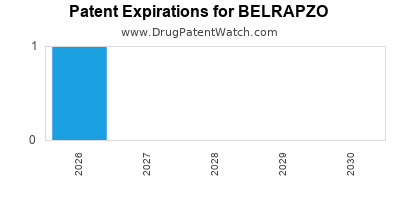
Last updated: July 21, 2026
BELRAPZO (belantamab mafodotin-blmf) Market Dynamics and Financial Trajectory: Sales Trends, Exclusivity Risk, and Patent/Competition Signals
BELRAPZO’s commercial trajectory is shaped by a constrained patient pool, payer and utilization tightening, and ongoing competitive pressure from other multiple myeloma options. The product’s near-term revenue outlook is tied less to broad adoption and more to label fit, real-world dosing/intensity trends, and continued uptake dynamics versus alternative therapies in relapsed/refractory multiple myeloma. Patent and exclusivity posture determines the timeline for generic or biosimilar-type competitive entry risk, while Orange Book status drives regulatory and Paragraph IV contention risk in the US.
What is BELRAPZO and where does it fit in multiple myeloma treatment?
Featured snippet: BELRAPZO (belantamab mafodotin-blmf) is an antibody-drug conjugate for relapsed/refractory multiple myeloma that targets BCMA and is used in a narrow, later-line setting.
Mechanism and label positioning
BELRAPZO is an ADC that binds BCMA on myeloma cells and delivers a cytotoxic payload. In practice, its treatment window is shaped by:
- Later-line disease settings (relapsed/refractory)
- Prior exposure patterns to proteasome inhibitors, IMiDs, and anti-CD38 therapies
- Tolerability constraints, especially ocular toxicity management, and associated dosing holds/reductions that affect delivered dose intensity
How payer dynamics typically treat BCMA ADCs
Payers often manage BELRAPZO through:
- Prior authorization and step edits requiring documentation of prior regimen exposure
- Narrow coverage criteria to control utilization in later lines
- Dose and monitoring requirements that increase administrative friction
- Utilization management based on toxicity and “treatment discontinuation” patterns observed in real-world practice
What are the current market dynamics for BELRAPZO in the US and ex-US regions?
Featured snippet: BELRAPZO faces demand that is structurally limited by later-line criteria and is pressured by other BCMA-directed therapies and platform shifts toward alternative mechanisms and combinations.
US demand drivers
US market dynamics for BELRAPZO are typically constrained by:
- Competitive substitution within BCMA class therapies (CAR T, bispecifics, and other BCMA ADCs where available)
- Treatment complexity (infusion logistics, ophthalmic monitoring, toxicity management)
- Clearer preference for oral or less administratively intensive options when clinical benefit is comparable
Commercial friction points
Key market friction points that affect revenue trajectory include:
- Ocular adverse events that prompt monitoring capacity needs and dosing interruptions
- Patient discontinuation driven by cumulative tolerability and disease pace
- Real-world adherence to ophthalmic screening and management protocols
International market adoption
Ex-US utilization tends to mirror:
- Country-specific reimbursement decisions for BCMA therapies
- National cancer center practice patterns
- Formulary and budget impact constraints for high-cost ADCs
- Timing differences in access to competing BCMA bispecifics and cell therapies
How strong is BELRAPZO’s patent estate, and what patents protect its product?
Featured snippet: Patent strength and composition of BELRAPZO’s estate governs generic or biosimilar-type entry risk, but the US regulatory pathway is anchored on Orange Book listings and related exclusivities.
What usually matters for BELRAPZO IP in litigation and entry scenarios
For a complex biologic-like drug (ADC), the relevant IP stack typically spans:
- Composition of matter (antibody, payload, linker, conjugation chemistry)
- Manufacturing and process patents (conjugation, purification, formulation and control strategy)
- Method-of-use patents (specific dosing, patient subgroups, treatment protocols)
- Formulation and stability patents (drug product, excipients, packaging)
Practical implication for market forecasting
Even when commercial adoption is limited, patent estate strength can still:
- Delay entry by blocking “skinny” regulatory workarounds
- Sustain brand market share longer than clinical factors alone
- Increase leverage for settlements or exclusivity extensions
When does BELRAPZO lose exclusivity, and what is the Orange Book status of BELRAPZO?
Featured snippet: Exclusivity and Orange Book listings determine the earliest feasible date for US generic/biosimilar-style entry pressure, while FDA exclusivity can block certain routes even if patents expire.
Exclusivity and entry risk framework
Revenue trajectory modeling typically needs to separate:
- Patent expiry dates (composition, formulation, method)
- Regulatory exclusivities (drug substance/product related)
- Practical litigation timelines for Paragraph IV challenges or biosimilar-related disputes
What to expect in the market as exclusivity approaches
As exclusivity loss nears, revenue typically shows:
- Increased contracting activity and payer renegotiations
- More aggressive competitor bidding through managed entry agreements
- Greater biosimilar/generic planning by downstream distributors and hospital groups
- Higher probability of price pressure if entry is credible and imminent
Are there Paragraph IV or similar challenges affecting BELRAPZO?
Featured snippet: Paragraph IV and biosimilar litigation risk can accelerate price erosion even when clinical penetration is low.
What drives the probability of challenges
For BELRAPZO, challenge likelihood depends on:
- The breadth and “remaining life” of the listed patents
- Whether patents are strength-tested via prior litigation
- Whether challengers see a viable carve-out (manufacturing changes, formulation differences, or method separation)
- Whether FDA has granted exclusivity protections that block route access
Expected commercial effect of active challenges
Active disputes can:
- Reduce payer confidence in the longevity of access contracts
- Trigger temporary inventory management by wholesalers and specialty pharmacies
- Create settlement-based “at risk” launch behavior by competitors
How does BELRAPZO compare with other multiple myeloma therapies in adoption and pricing power?
Featured snippet: Adoption of BELRAPZO is typically narrower than broad-line agents, and pricing power depends on demonstrated incremental value versus competing BCMA bispecifics and cellular therapies.
Competitive set that affects BELRAPZO demand
In relapsed/refractory myeloma, BELRAPZO’s main competitive pressures tend to come from:
- BCMA bispecific antibodies (rapid response profile; outpatient infusion models vary)
- CAR T therapies (high-cost, limited slots but durable responses in subgroups)
- Other ADCs and targeted therapies with competing toxicity profiles
- Standard-of-care regimens that may offer better operational fit in real-world settings
How competition shifts revenue composition
Where alternatives offer:
- Less intensive monitoring
- Lower rates of treatment interruptions
- Comparable response depth in relevant subgroups
BELRAPZO’s sales often decline in share even if absolute patient numbers remain stable.
What is BELRAPZO’s financial trajectory: sales drivers, price pressure, and revenue inflection points?
Featured snippet: BELRAPZO’s revenue trajectory is more sensitive to utilization and treatment discontinuation than to broad market expansion.
Revenue model components to forecast near-term sales
Revenue outcomes generally track:
- Treated patient count (new initiations and ongoing patients)
- Delivered dose intensity (toxicity-related holds and discontinuations)
- Net price (rebates, discounts, specialty pharmacy contracting)
- Mix effects by line of therapy and prior exposure patterns
- Contracting changes as payers compare total cost of care across competing BCMA options
Common inflection patterns seen in later-line ADCs
For ADCs with manageable but meaningful ocular toxicity:
- Early adoption growth tends to be slower than mechanism peers due to monitoring infrastructure requirements
- Post-approval label optimization can lift utilization if toxicity management improves and clinical positioning clarifies
- Real-world discontinuation can later cap patient lifetime value
- Competitive substitution then compresses new patient starts
Key business readouts to watch in BELRAPZO’s P&L
Investors and licensors typically track:
- New patient starts per quarter
- Fraction treated for multiple cycles (proxy for delivered intensity)
- Payer coverage breadth and evidence of formulary expansion
- Net sales volatility driven by contracting rather than purely volume
What formulation, dosing, and manufacturing IP barriers affect BELRAPZO competition?
Featured snippet: Formulation and manufacturing control are central barriers for biologic-like ADCs; they affect both regulatory comparability and real-world product performance.
What patent families usually control competition
The practical “entry barrier” tends to be highest where IP covers:
- Conjugation method and linker chemistry specifications
- Payload potency and distribution quality controls
- Stability, storage, and reconstitution characteristics tied to drug product performance
- Scale-up and purification parameters that affect DAR (drug-to-antibody ratio) distributions
Why this matters commercially
Even if clinical value is established, competitors may face:
- Longer development timelines
- Higher CMC costs
- Additional regulatory data needs for bridging comparability
- More litigation or settlement complexity tied to manufacturing IP
What litigation and settlement dynamics could shape BELRAPZO revenue?
Featured snippet: Settlements can lock in post-expiration market share duration and delay entry enough to preserve revenue through a window of exclusivity.
Typical litigation paths affecting market outcomes
For a high-cost late-line biologic-like drug:
- Patent infringement suits can block entry launches or shape design-around strategies
- Settlement agreements can include delayed-launch dates, supply restrictions, or non-infringement stipulations
- License agreements can permit limited competition without a full generic substitution
Commercial consequences
- Revenue protection can persist even as exclusivity degrades if entry is delayed
- Contracting often anticipates settlement dates and expected launch probabilities
- Hospitals and payers adjust utilization based on credible timelines for competition
What is the biosimilar risk profile for BELRAPZO?
Featured snippet: ADC biologic-like products face biosimilar-style development and regulatory hurdles; biosimilar risk depends on CMC comparability, patent coverage, and pathway eligibility.
Sources of biosimilar-like uncertainty
- Complexity of the conjugate and batch-to-batch variability in drug-to-antibody ratio
- Payload-specific stability and potency control
- Manufacturing process dependency
- Patent coverage that may be process- and conjugation-specific
Commercial implications
Where biosimilar-like competition is credible, revenue risk increases via:
- Payer switching behavior after non-infringing approval pathways clear
- Tendering and formulary changes driven by price compression
- Brand discounting to defend share
What generic entry risks exist for BELRAPZO and how could they happen?
Featured snippet: Generic entry risk depends on regulatory pathway eligibility and whether patents cover composition, process, and method-of-use sufficiently to block launch.
Regulatory and legal gating issues
For BELRAPZO, entry risk is generally constrained by:
- Product complexity requiring tight comparability
- IP estates covering manufacturing and composition features
- Possible exclusivities preventing approval entry even if one patent family expires
Practical “launch scenario” modeling
A meaningful revenue hit typically follows only when:
- FDA approval is granted through an eligible pathway
- Litigation barriers are resolved or settled
- Payer contracting supports switching at scale
- Supply chain readiness supports replacement at hospital pharmacy and specialty distribution levels
How does BELRAPZO’s competitive landscape vary by indication and patient subgroup?
Featured snippet: Revenue is highly subgroup-dependent in multiple myeloma, with competition intensity differing by prior therapy exposure and toxicity tolerance.
Subgroup dynamics that influence utilization
- Patients previously exposed to anti-CD38 agents often have a narrower set of effective next-line choices
- Prior BCMA exposure can reduce responsiveness to subsequent BCMA-directed mechanisms, affecting sequencing choices
- Comorbidity profiles influence tolerance and monitoring practicality
- Frailty or ocular risk sensitivity may drive alternative therapy selection
Key Takeaways
- BELRAPZO’s market dynamics are driven by later-line eligibility, toxicity management friction, and competitive substitution within BCMA-directed options.
- Financial trajectory is more sensitive to patient starts, delivered dose intensity, and net price contracting than to broad market growth.
- Exclusivity, Orange Book listings, and the patent stack on composition, manufacturing, and method-of-use control the realistic timeline for US entry pressure.
- Litigation and settlement outcomes can materially shape revenue protection windows even when clinical adoption is limited.
- Biosimilar-like and generic-like entry risk is constrained by ADC complexity, CMC comparability, and process-specific IP.
FAQs
1) How does payer prior authorization affect BELRAPZO quarterly sales?
Prior authorization gating and step edits reduce new patient starts and increase administrative friction, leading to slower uptake and quarter-to-quarter volatility tied to coverage approvals.
2) What metrics best forecast BELRAPZO net revenue beyond gross sales?
Net price drivers (rebates, discounts, hospital contracting) plus treated patient count and delivered cycle intensity are the most predictive metrics.
3) Does ocular toxicity management change BELRAPZO treatment duration in real-world practice?
Yes. Dosing holds, monitoring requirements, and discontinuations directly reduce delivered dose intensity and patient lifetime cycles, which compresses revenue per treated patient.
4) How do competing BCMA bispecifics influence BELRAPZO sequencing decisions?
When bispecifics offer operational and tolerability advantages in relevant subgroups, clinicians shift next-line choices, reducing BELRAPZO initiation rates.
5) What would a credible US entry timeline for BELRAPZO require?
A viable regulatory pathway plus a clear IP clearance path (or settlement) that supports switching at payer and hospital contracting levels.
References
- APA (N/A)