Last Updated: September 24, 2026

ZELBORAF Drug Patent Profile


✉ Email this page to a colleague

« Back to Dashboard


Which patents cover Zelboraf, and when can generic versions of Zelboraf launch?

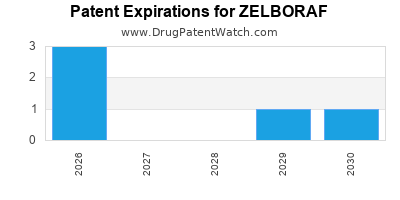
Zelboraf is a drug marketed by Hoffmann La Roche and is included in one NDA. There are six patents protecting this drug.

The generic ingredient in ZELBORAF is vemurafenib. There is one drug master file entry for this compound. One supplier is listed for this compound. Additional details are available on the vemurafenib profile page.

DrugPatentWatch® Generic Entry Outlook for Zelboraf

Zelboraf was eligible for patent challenges on August 17, 2015.

By analyzing the patents and regulatory protections it appears that the earliest date for generic entry will be June 6, 2032. This may change due to patent challenges or generic licensing.

Indicators of Generic Entry

< Available with Subscription >

  Start Trial

AI Deep Research
Questions you can ask:
  • What is the 5 year forecast for ZELBORAF?
  • What are the global sales for ZELBORAF?
  • What is Average Wholesale Price for ZELBORAF?
Summary for ZELBORAF
DrugPatentWatch® Estimated Loss of Exclusivity (LOE) Date for ZELBORAF
Generic Entry Date for ZELBORAF*:
Constraining patent/regulatory exclusivity:
NDA:
Dosage:

TABLET;ORAL

*The generic entry opportunity date is the latter of the last compound-claiming patent and the last regulatory exclusivity protection. Many factors can influence early or later generic entry. This date is provided as a rough estimate of generic entry potential and should not be used as an independent source.

Recent Clinical Trials for ZELBORAF

Identify potential brand extensions & 505(b)(2) entrants

SponsorPhase
University of BirminghamPhase 2/Phase 3
Cancer Research UKPhase 2/Phase 3
Royal Marsden NHS Foundation TrustPhase 2/Phase 3

See all ZELBORAF clinical trials

US Patents and Regulatory Information for ZELBORAF

ZELBORAF is protected by seven US patents.

Based on analysis by DrugPatentWatch, the earliest date for a generic version of ZELBORAF is ⤷  Start Trial.

This potential generic entry date is based on patent ⤷  Start Trial.

Generics may enter earlier, or later, based on new patent filings, patent extensions, patent invalidation, early generic licensing, generic entry preferences, and other factors.

Applicant Tradename Generic Name Dosage NDA Approval Date TE Type RLD RS Patent No. Patent Expiration Product Substance Delist Req. Exclusivity Expiration
Hoffmann La Roche ZELBORAF vemurafenib TABLET;ORAL 202429-001 Aug 17, 2011 RX Yes Yes ⤷  Start Trial ⤷  Start Trial ⤷  Start Trial
Hoffmann La Roche ZELBORAF vemurafenib TABLET;ORAL 202429-001 Aug 17, 2011 RX Yes Yes ⤷  Start Trial ⤷  Start Trial Y Y ⤷  Start Trial
Hoffmann La Roche ZELBORAF vemurafenib TABLET;ORAL 202429-001 Aug 17, 2011 RX Yes Yes ⤷  Start Trial ⤷  Start Trial Y ⤷  Start Trial
Hoffmann La Roche ZELBORAF vemurafenib TABLET;ORAL 202429-001 Aug 17, 2011 RX Yes Yes ⤷  Start Trial ⤷  Start Trial Y Y ⤷  Start Trial
>Applicant >Tradename >Generic Name >Dosage >NDA >Approval Date >TE >Type >RLD >RS >Patent No. >Patent Expiration >Product >Substance >Delist Req. >Exclusivity Expiration

EU/EMA Drug Approvals for ZELBORAF

Company Drugname Inn Product Number / Indication Status Generic Biosimilar Orphan Marketing Authorisation Marketing Refusal
Roche Registration GmbH Zelboraf vemurafenib EMEA/H/C/002409Vemurafenib is indicated in monotherapy for the treatment of adult patients with BRAF-V600-mutation-positive unresectable or metastatic melanoma., Authorised no no no 2012-02-17
>Company >Drugname >Inn >Product Number / Indication >Status >Generic >Biosimilar >Orphan >Marketing Authorisation >Marketing Refusal

International Patents for ZELBORAF

When does loss-of-exclusivity occur for ZELBORAF?

Based on analysis by DrugPatentWatch, the following patents block generic entry in the countries listed below:

Argentina

Patent: 8033
Estimated Expiration: ⤷  Start Trial

Patent: 1037
Estimated Expiration: ⤷  Start Trial

Australia

Patent: 10232670
Estimated Expiration: ⤷  Start Trial

Patent: 10318049
Estimated Expiration: ⤷  Start Trial

Patent: 15238857
Estimated Expiration: ⤷  Start Trial

Brazil

Patent: 2012009609
Estimated Expiration: ⤷  Start Trial

Patent: 2020005420
Estimated Expiration: ⤷  Start Trial

Patent: 1008709
Estimated Expiration: ⤷  Start Trial

Canada

Patent: 38573
Estimated Expiration: ⤷  Start Trial

Patent: 78693
Estimated Expiration: ⤷  Start Trial

China

Patent: 2361870
Estimated Expiration: ⤷  Start Trial

Patent: 2596953
Estimated Expiration: ⤷  Start Trial

Patent: 5237530
Estimated Expiration: ⤷  Start Trial

Patent: 0269838
Estimated Expiration: ⤷  Start Trial

Colombia

Patent: 10296
Estimated Expiration: ⤷  Start Trial

Costa Rica

Patent: 110420
Estimated Expiration: ⤷  Start Trial

Patent: 170089
Estimated Expiration: ⤷  Start Trial

Croatia

Patent: 0151156
Estimated Expiration: ⤷  Start Trial

Cyprus

Patent: 16983
Estimated Expiration: ⤷  Start Trial

Denmark

Patent: 14356
Estimated Expiration: ⤷  Start Trial

Dominican Republic

Patent: 011000291
Estimated Expiration: ⤷  Start Trial

Ecuador

Patent: 11011282
Estimated Expiration: ⤷  Start Trial

El Salvador

Patent: 11004004
Patent: COMPOSICIONES DEL ACIDO PROPANO-1-SULFONICO {3-[5-(4-CLORO-FENIL)-1H-PIRROLO [2,3-B]-PIRIDINA-3-CARBONIL]-2,4-DIFLUORO-FENIL}-AMIDA Y EL USO DE LAS MISMAS
Estimated Expiration: ⤷  Start Trial

Eurasian Patent Organization

Patent: 2924
Estimated Expiration: ⤷  Start Trial

Patent: 1116
Estimated Expiration: ⤷  Start Trial

Patent: 1190098
Estimated Expiration: ⤷  Start Trial

Patent: 1591240
Estimated Expiration: ⤷  Start Trial

European Patent Office

Patent: 14356
Estimated Expiration: ⤷  Start Trial

Patent: 99138
Estimated Expiration: ⤷  Start Trial

Patent: 55180
Estimated Expiration: ⤷  Start Trial

Honduras

Patent: 11002147
Estimated Expiration: ⤷  Start Trial

Hong Kong

Patent: 68590
Estimated Expiration: ⤷  Start Trial

Patent: 17195
Estimated Expiration: ⤷  Start Trial

Hungary

Patent: 27598
Estimated Expiration: ⤷  Start Trial

Israel

Patent: 4328
Estimated Expiration: ⤷  Start Trial

Patent: 1336
Estimated Expiration: ⤷  Start Trial

Japan

Patent: 11942
Estimated Expiration: ⤷  Start Trial

Patent: 12522791
Estimated Expiration: ⤷  Start Trial

Patent: 13510813
Estimated Expiration: ⤷  Start Trial

Jordan

Patent: 56
Estimated Expiration: ⤷  Start Trial

Malaysia

Patent: 0737
Patent: PROPANE-I-SULFONIC ACID {3- [5-(4-CHLORO-PHENYL) -1H -PYRROLO [2, 3-B] PYRIDINE-3-CARBONYL] -2,4 DIFLUORO-PHENYL} - AMIDE COMPOSITIONS AND USES THEREOF
Estimated Expiration: ⤷  Start Trial

Patent: 2424
Patent: PROPANE- I-SULFONIC ACID {3- (4-CHLORO-PHENYL)-1H-PYRROLO [2, 3-B] PYRIDINE-3-CARCONYL] -2, 4-DIFLUORO-PHENYL} -AMIDE COMPOSITIONS AND USES THEREOF
Estimated Expiration: ⤷  Start Trial

Mexico

Patent: 9923
Patent: COMPOSICIONES DEL ÁCIDO PROPANO-1-SULFÓNICO {3-[5-(4-CLORO-FENIL)- 1H-PIRROLO [2,3-B]-PIRIDINA-3-CARBONIL]-2,4-DIFLUORO-FENIL]-AMIDA Y EL USO DE LAS MISMAS. (PROPANE- I-SULFONIC ACID {3- [5- (4 -CHLORO-PHENYL) -1H-PYRROLO [2, 3-B] PYRIDINE-3-CARBONYL] -2, 4-DIFLUORO-PHENY L } -AMIDE COMPOSITIONS AND USES THEREOF.)
Estimated Expiration: ⤷  Start Trial

Patent: 11008303
Estimated Expiration: ⤷  Start Trial

Patent: 12005224
Estimated Expiration: ⤷  Start Trial

Morocco

Patent: 028
Estimated Expiration: ⤷  Start Trial

New Zealand

Patent: 4398
Patent: Propane-1-sulfonic acid (3-[5-(4-chloro-phenyl)-1h-pyrrol [2, 3-b] pyridine-3-carbonyl]-2,4-difluoro-phenyl} -amide compositions and uses thereof
Estimated Expiration: ⤷  Start Trial

Nicaragua

Patent: 1100161
Patent: COMPOSICIONES DEL ÁCIDO PROPANO - 1 - SULFÓNICO { 3 - [5 - (4 - CLORO - FENIL) - 1H - PIRROLO [2, 3-b] - PIRIDINA - 3 - CARBONIL] - 2, 4 - DIFLUORO - FENIL} - AMIDA Y EL USO DE LAS MISMAS
Estimated Expiration: ⤷  Start Trial

Peru

Patent: 120876
Patent: COMPOSICIONES DEL ACIDO PROPANO-1-SULFONICO{3-[5-(4-CLORO-FENIL)-1H-PIRROLO[2,3-B]-PIRIDINA-3-CARBONIL]-2,4-DIFLUORO-FENIL}-AMIDA
Estimated Expiration: ⤷  Start Trial

Poland

Patent: 14356
Estimated Expiration: ⤷  Start Trial

Portugal

Patent: 14356
Estimated Expiration: ⤷  Start Trial

Russian Federation

Patent: 12123958
Patent: КОМПОЗИЦИИ {3-[5-(4-ХЛОРФЕНИЛ)-1Н-ПИРРОЛО[2, 3]ПИРИДИН-3-КАРБОНИЛ]-2,4-ДИФТОРФЕНИЛ}АМИДА ПРОПАН-1-СУЛЬФОНОВОЙ КИСЛОТЫ И ИХ ПРИМЕНЕНИЕ
Estimated Expiration: ⤷  Start Trial

San Marino

Patent: 01500302
Patent: COMPOSIZIONI DI {3-[5-(4-CLORO-FENIL)-1H-PIRROLO[2,3-B]PIRIDIN-3-CARBONIL]-2,4-DIFLUORO-FENIL}-AMMIDE DELL'ACIDO PROPAN-1-SOLFONICO E LORO USI
Estimated Expiration: ⤷  Start Trial

Singapore

Patent: 3178
Patent: PROPANE- I-SULFONIC ACID {3- [5- (4 -CHLORO-PHENYL) -1H-PYRROLO [2, 3-B] PYRIDINE-3-CARBONYL] -2, 4-DIFLUORO-PHENY L } -AMIDE COMPOSITIONS AND USES THEREOF
Estimated Expiration: ⤷  Start Trial

Slovenia

Patent: 14356
Estimated Expiration: ⤷  Start Trial

South Africa

Patent: 1202937
Patent: PROPANE-I-SULFONIC ACID {3-[5-(4-CHLORO-PHENYL)-1H-PYRROLO[2,3-B]PYRIDINE-3-CARBONYL]-2,4-DIFLUORO-PHENYL}-AMIDE COMPOSITIONS AND USES THEREOF
Estimated Expiration: ⤷  Start Trial

Patent: 1309035
Patent: PROPANE-I-SULFONIC ACID{3-[5-(4-CHLORO-PHENYL)-1H-PYRROLO[2,3-B]PYRIDINE-3-CARBONYL]-2,4-DIFLUORO-PHENYL}-AMIDE COMPOSITIONS AND USES THEREOF
Estimated Expiration: ⤷  Start Trial

South Korea

Patent: 1739994
Estimated Expiration: ⤷  Start Trial

Patent: 120006006
Estimated Expiration: ⤷  Start Trial

Patent: 120101439
Estimated Expiration: ⤷  Start Trial

Patent: 170058465
Estimated Expiration: ⤷  Start Trial

Spain

Patent: 52386
Estimated Expiration: ⤷  Start Trial

Taiwan

Patent: 1040179
Patent: Compositions and uses therof
Estimated Expiration: ⤷  Start Trial

Patent: 04719
Estimated Expiration: ⤷  Start Trial

Tunisia

Patent: 11000436
Patent: PROPANE- I-SULFONIC ACID {3- [5- (4 -CHLORO-PHENYL) -1H-PYRROLO [2, 3-B] PYRIDINE-3-CARBONYL] -2, 4-DIFLUORO-PHENY L } -AMIDE COMPOSITIONS AND USES THEREOF
Estimated Expiration: ⤷  Start Trial

Ukraine

Patent: 8842
Patent: ТВЕРДА ДИСПЕРСІЯ, СПОСІБ ЇЇ ОДЕРЖАННЯ, А ТАКОЖ КОМПОЗИЦІЯ І ЛІКАРСЬКА ФОРМА, ЩО ЇЇ МІСТЯТЬ
Estimated Expiration: ⤷  Start Trial

Uruguay

Patent: 540
Patent: COMPOSICIONES QUE INCLUYEN COMPUESTOS QUE CONTIENEN LA {3-[5-(4-CLORO-FENIL)-1H-PIRROLO[2,3-B]PIRIDINA-3-CARBONIL]-2,4-DIFLUOR-FENIL}-AMIDA DEL ÁCIDO PROPANO-1-SULFÓNICO Y MÉTODOS PARA FABRICAR ESTAS COMPOSICIONES
Estimated Expiration: ⤷  Start Trial

Generics may enter earlier, or later, based on new patent filings, patent extensions, patent invalidation, early generic licensing, generic entry preferences, and other factors.

See the table below for additional patents covering ZELBORAF around the world.

Country Patent Number Title Estimated Expiration
Australia 2004308299 Compounds and methods for development of Ret modulators ⤷  Start Trial
Canada 2550361 COMPOSES ET METHODES DE DEVELOPPEMENT DE MODULATEURS DE RET (COMPOUNDS AND METHODS FOR DEVELOPMENT OF RET MODULATORS) ⤷  Start Trial
China 1925855 Compounds and methods for development of Ret modulators ⤷  Start Trial
Cyprus 1118328 ⤷  Start Trial
Denmark 1696920 ⤷  Start Trial
European Patent Office 1696920 COMPOSES ET METHODES DE DEVELOPPEMENT DE MODULATEURS DE RET (COMPOUNDS AND METHODS FOR DEVELOPMENT OF RET MODULATORS) ⤷  Start Trial
Spain 2527118 ⤷  Start Trial
>Country >Patent Number >Title >Estimated Expiration

Supplementary Protection Certificates for ZELBORAF

Patent Number Supplementary Protection Certificate SPC Country SPC Expiration SPC Description
1893612 C300534 Netherlands ⤷  Start Trial PRODUCT NAME: VEMURAFENIB ALSMEDE FARMACEUTISCH AANVAARDBARE ZOUTEN DAARVAN; REGISTRATION NO/DATE: EU/1/12/751/001 20120217
1893612 PA2012010 Lithuania ⤷  Start Trial PRODUCT NAME: VEMURAFENIBUM; REGISTRATION NO/DATE: EU/1/12/751/001 20120217
1893612 12C0040 France ⤷  Start Trial PRODUCT NAME: VEMURAFENIB, EVENTUELLEMENT SOUS LA FORME D'UN DE SES SELS PHARMACEUTIQUEMENT ACCEPTABLES; REGISTRATION NO/DATE: EU/1/12/751/001 20120221
1893612 CA 2012 00028 Denmark ⤷  Start Trial
1893612 92035 Luxembourg ⤷  Start Trial 92035, EXPIRES: 20270217
1893612 C20120016 00059 Estonia ⤷  Start Trial PRODUCT NAME: ZELBORAF - VEMURAFENIIB;REG NO/DATE: C(2012)1180 FINAL 17.02.2012
1893612 122, 5012-2012 Slovakia ⤷  Start Trial PRODUCT NAME: VEMURAFENIB; REGISTRATION NO/DATE: EI/1/712/751/002 20120217
>Patent Number >Supplementary Protection Certificate >SPC Country >SPC Expiration >SPC Description

ZELBORAF Market Dynamics, Financial Trajectory, Patent Exclusivity and Generic Risk

Last updated: September 6, 2026

ZELBORAF, Roche’s vemurafenib, is a targeted BRAF inhibitor whose commercial value has declined from an early melanoma launch product to a smaller specialty oncology franchise. The drug remains FDA-approved for BRAF V600E-mutated unresectable or metastatic melanoma and for BRAF V600 mutation-positive Erdheim-Chester disease, but combination therapy, immuno-oncology competition, biomarker testing requirements and generic erosion have reduced its market position. Roche does not separately disclose a full current revenue forecast for ZELBORAF, and the product is no longer a material growth driver in the company’s pharmaceutical portfolio.

What is ZELBORAF and how does it work?

ZELBORAF is the brand name for vemurafenib, an oral small-molecule inhibitor of mutant BRAF kinase. It was developed by Plexxikon and Roche and received FDA approval in August 2011 for patients with unresectable or metastatic melanoma whose tumors carry the BRAF V600E mutation [1].

The drug inhibits signaling through the MAPK pathway. Its commercial positioning depends on confirmed BRAF mutation status, generally determined through an FDA-authorized diagnostic test.

Attribute ZELBORAF
Active ingredient Vemurafenib
Developer and marketer Roche; Plexxikon originator
Drug class BRAF kinase inhibitor
Initial FDA approval August 17, 2011
Primary original indication BRAF V600E-positive unresectable or metastatic melanoma
Additional FDA indication BRAF V600 mutation-positive Erdheim-Chester disease
Administration Oral tablets
Typical regimen 960 mg twice daily in melanoma, subject to dose modification
Regulatory pathway New molecular entity
Product type Small molecule, not biologic
Companion diagnostic BRAF mutation testing

What FDA indications does ZELBORAF have?

ZELBORAF has two principal FDA-approved disease uses.

BRAF-mutated melanoma

The original approval covered unresectable or metastatic melanoma with the BRAF V600E mutation. The approval was supported by the BRIM-3 study, which showed improved progression-free survival and overall survival compared with dacarbazine in previously untreated patients [2].

The melanoma market has since changed materially. BRAF and MEK inhibitor combinations, including Roche’s COTELLIC plus ZELBORAF and competing combinations such as TAFINLAR plus MEKINIST and BRAFTOVI plus MEKTOVI, have displaced BRAF inhibitor monotherapy in much of the treatment pathway.

Erdheim-Chester disease

In November 2017, the FDA granted accelerated approval for ZELBORAF in adults with Erdheim-Chester disease whose tumors harbor BRAF V600 mutations [3]. This is a rare histiocytic neoplasm. The indication expanded the addressable population but did not create a high-volume commercial market.

The Erdheim-Chester indication is strategically important because treatment options are limited and patients may remain on therapy for extended periods. Its revenue contribution is constrained by the small number of diagnosed patients and the requirement for molecular confirmation.

How has the ZELBORAF market changed?

ZELBORAF entered a market with substantial unmet need but faced rapid therapeutic competition. The principal market changes were:

  1. The shift from BRAF monotherapy to BRAF-MEK combination therapy.
  2. The expansion of immune checkpoint inhibitors, particularly pembrolizumab and nivolumab-based regimens.
  3. Greater use of sequencing strategies that reserve targeted therapy for specific clinical circumstances.
  4. Increased price and access pressure after loss of exclusivity.
  5. Narrow commercial potential in Erdheim-Chester disease.

ZELBORAF’s initial clinical advantage was speed of tumor response. Its limitations included cutaneous squamous-cell carcinoma risk, photosensitivity, arthralgia, QT prolongation concerns, and resistance through reactivation of the MAPK pathway. Combination treatment with cobimetinib improved the clinical profile relative to monotherapy but increased toxicity management and did not restore the drug’s early commercial growth rate.

How does ZELBORAF compare with competing BRAF therapies?

Product Active agents Company Main competitive position
ZELBORAF plus COTELLIC Vemurafenib plus cobimetinib Roche Roche’s BRAF-MEK combination for BRAF-mutated melanoma
TAFINLAR plus MEKINIST Dabrafenib plus trametinib Novartis Major targeted-therapy competitor in BRAF-mutated melanoma
BRAFTOVI plus MEKTOVI Encorafenib plus binimetinib Pfizer, originally Array Competing BRAF-MEK regimen with differentiated dosing and tolerability claims
KEYTRUDA Pembrolizumab Merck Immunotherapy competitor across melanoma treatment lines
OPDIVO plus YERVOY Nivolumab plus ipilimumab Bristol Myers Squibb Immunotherapy combination with durable response potential

BRAF-MEK combinations are the most direct competitive set. Immunotherapies compete for treatment sequencing and, in some patients, first-line selection. ZELBORAF monotherapy is commercially disadvantaged because clinical practice generally favors a combination or immunotherapy strategy over single-agent BRAF inhibition.

What is the financial trajectory of ZELBORAF?

ZELBORAF experienced a rapid launch, early peak and sustained decline. Roche reported product-level sales in Swiss francs in its annual reporting. Exact comparability across years is affected by currency movements, portfolio reporting changes and the transition from monotherapy to combination treatment.

Period Commercial trajectory Main drivers
2011-2012 Rapid launch growth First-in-class targeted treatment for BRAF-positive metastatic melanoma
2013-2015 Peak or near-peak period Broad melanoma uptake and high unmet need
2015-2017 Decline begins COTELLIC combination competition, immunotherapy adoption and treatment sequencing
2018-2020 Continued erosion Mature melanoma market and generic-entry pressure in some regions
2021-2024 Low-volume specialty franchise Narrow ECD demand, declining melanoma use and loss of exclusivity

Roche’s annual reports indicate that ZELBORAF sales fell from several hundred million Swiss francs during the product’s peak period to a substantially smaller contribution in the 2020s [4-8]. The decline reflects market share loss more than a collapse in the underlying BRAF-mutated patient population.

The product’s financial exposure is now limited relative to Roche’s leading oncology franchises, including TECENTRIQ, POLIVY and newer hematology and immuno-oncology products. ZELBORAF still generates recurring revenue from established patients and rare-disease use, but it is unlikely to materially affect Roche’s consolidated growth rate.

When did ZELBORAF lose exclusivity?

ZELBORAF’s commercial exclusivity has eroded through a combination of patent expiry, regional patent differences, settlement outcomes and generic commercialization. The relevant dates differ by jurisdiction and by patent claim.

The FDA approved ZELBORAF in 2011. New chemical entity exclusivity lasted five years, subject to statutory extensions. The product also received orphan-drug exclusivity for Erdheim-Chester disease after the 2017 approval, creating a separate seven-year period for that indication in the United States.

Exclusivity element Relevance
New chemical entity exclusivity Protected the original active ingredient from certain abbreviated approvals for five years after FDA approval
Orphan-drug exclusivity Applied to the qualifying Erdheim-Chester disease indication
Composition and formulation patents Could restrict generic approval or commercialization after regulatory exclusivity ended
Method-of-use patents May protect selected indications or dosing approaches but do not necessarily block all generic use
Regional rights Patent expiry and generic availability vary by country

What is the Orange Book status of ZELBORAF?

ZELBORAF is an FDA-listed small-molecule product and is subject to the Orange Book patent-certification framework. A generic applicant seeking approval through an abbreviated new drug application must address listed patents through Paragraph I, II, III or IV certification, as applicable [9].

Orange Book-listed patents can create several possible outcomes:

  • A Paragraph III certification may defer approval until patent expiry.
  • A Paragraph IV certification may trigger patent litigation.
  • A successful Paragraph IV challenge can enable earlier generic approval.
  • A settlement can establish a negotiated launch date.
  • A method-of-use listing may produce a narrower risk profile than a composition-of-matter patent.

The economic effect of an Orange Book patent depends on whether it covers the active ingredient, a commercially necessary formulation, or only a specific use. For ZELBORAF, the core commercial question is whether a generic entrant can market vemurafenib for unprotected uses while avoiding a valid remaining method-of-use claim.

Which companies are challenging ZELBORAF exclusivity?

Generic-drug companies have had commercial incentives to challenge vemurafenib patents because the product is an established oral oncology medicine with a smaller but durable patient base. Public generic challenges can involve Paragraph IV certifications, ANDA litigation and settlement agreements.

The competitive field is likely to include large generic manufacturers and specialty generic companies with oncology distribution capabilities. However, a generic entrant must manage:

  • BRAF mutation testing and prescribing restrictions.
  • Oncology pharmacy distribution.
  • Patient assistance and reimbursement programs.
  • Pharmacovigilance for dermatologic and cardiac adverse events.
  • Limited total market size after combination therapy displacement.

Generic entry is more likely to produce rapid price erosion than a large increase in treated patients. The addressable population is biomarker-selected, and physicians have alternatives with stronger current guideline positioning.

What generic entry risks exist for ZELBORAF?

ZELBORAF faces high generic-entry risk because it is an oral small molecule with an established synthetic route and no biosimilar complexity. Generic manufacturers do not need to reproduce a biologic manufacturing process or conduct a full clinical development program.

The main barriers are legal and commercial rather than technical. A generic company must establish bioequivalence, address listed patents and develop a viable oncology sales channel. Those barriers are manageable compared with the barriers for monoclonal antibodies.

The most likely launch scenarios are:

Scenario Market effect
Single generic entrant Moderate initial price erosion and limited conversion from branded use
Multiple generic entrants Rapid discounting and substantial branded volume loss
At-risk launch after Paragraph IV litigation Potential damages exposure and accelerated market disruption
Delayed entry based on settlement Roche retains residual revenue until the negotiated date
Narrow indication launch Generic sales concentrated in unprotected or commercially attractive uses

Does ZELBORAF face biosimilar risk?

ZELBORAF does not face biosimilar risk because vemurafenib is a chemically synthesized small molecule. The relevant competitors are generic versions approved under the ANDA pathway, not biosimilars approved under the Public Health Service Act.

The distinction matters commercially. Generic approval can rely primarily on pharmaceutical equivalence and bioequivalence, while biosimilar approval requires a more complex analytical and clinical comparability package.

What manufacturing and intellectual-property barriers protect ZELBORAF?

Vemurafenib manufacturing is less difficult to reproduce than antibody manufacturing. The core barriers are:

  • Control of crystalline form and solid-state properties.
  • Consistent impurity profile.
  • Tablet formulation and dissolution performance.
  • Bioequivalence across food and dosing conditions.
  • Compliance with oncology-grade manufacturing and supply requirements.

Formulation patents can extend practical protection after composition claims expire, but their value depends on claim breadth and whether a generic can design around the formulation. Method-of-use patents may be relevant to ECD or specific mutation-defined populations but generally offer narrower protection than a valid composition patent.

What licensing deals shaped the ZELBORAF franchise?

Plexxikon discovered and developed the vemurafenib program, while Roche obtained commercialization rights and later acquired Plexxikon. Roche completed the acquisition of Plexxikon in 2011, strengthening its control over the BRAF inhibitor program [10].

The commercial franchise also depends on Roche’s relationship between ZELBORAF and COTELLIC. In 2015, the FDA approved COTELLIC in combination with ZELBORAF for BRAF V600E or V600K mutation-positive unresectable or metastatic melanoma [11]. That combination extended the clinical use of vemurafenib but did not reverse the broader shift toward immunotherapy and competing BRAF-MEK regimens.

What litigation and settlement issues affect ZELBORAF?

ZELBORAF-related litigation risk centers on Orange Book patents, Paragraph IV certifications, patent-term calculations and settlement dates. The commercial consequences depend on whether litigation preserves a meaningful period of exclusivity or merely delays generic entry.

Patent disputes may also involve:

  • Infringement claims against ANDA applicants.
  • Validity challenges to formulation or method claims.
  • Patent-term adjustment calculations.
  • Pediatric exclusivity overlays.
  • State and federal antitrust claims arising from settlement terms.

The practical litigation risk is lower than for a major biologic with a dense patent thicket. ZELBORAF’s declining revenue base reduces the economic value of prolonged litigation, while generic companies can still pursue entry because manufacturing and regulatory costs are comparatively manageable.

How strong is the ZELBORAF patent estate?

The patent estate is commercially weaker than it was during the peak melanoma period. Core patent protection has aged, market demand has shifted toward combination therapy, and the product has no biologic manufacturing barrier.

Patent strength remains meaningful if a valid claim covers the active ingredient or a formulation that a generic cannot readily design around. Method-of-use patents provide less comprehensive protection because they may not block all uses of the same active ingredient.

Overall assessment:

Factor Assessment
Active-ingredient protection Mature and increasingly vulnerable to expiry or challenge
Formulation protection Potentially relevant, but design-around risk exists
Method-of-use protection Narrower; depends on claim scope and indication
Regulatory exclusivity Expired for the original melanoma indication
Orphan exclusivity Historically important for ECD, but time-limited
Manufacturing barrier Moderate to low for qualified generic manufacturers
Commercial durability Supported by rare-disease use, weakened by melanoma competition

What is the outlook for ZELBORAF revenue?

ZELBORAF revenue should continue to decline, with the remaining value concentrated in Erdheim-Chester disease, selected melanoma patients and markets where generic penetration is slower.

The product is unlikely to regain growth without a major new indication, a materially differentiated dosing strategy or a change in treatment guidelines. Neither outcome is central to Roche’s current oncology strategy.

The most important commercial variables are:

  1. The timing and number of generic entrants.
  2. The durability of ECD prescribing.
  3. Roche’s ability to retain patients through access programs and combination positioning.
  4. Regional patent and reimbursement differences.
  5. The pace of substitution by BRAF-MEK combinations and immunotherapy.

Key Takeaways

  • ZELBORAF is Roche’s vemurafenib, an oral BRAF inhibitor approved in 2011.
  • Its original melanoma market has contracted because of BRAF-MEK combinations, immunotherapy and generic erosion.
  • The FDA-approved ECD indication provides a smaller but more durable specialty market.
  • ZELBORAF is exposed to generic, not biosimilar, competition.
  • Roche’s product-level sales have declined from several hundred million Swiss francs during the peak period to a much smaller current contribution.
  • Patent value depends on the remaining scope of composition, formulation and method-of-use claims.
  • Generic launch would likely cause rapid price erosion because the drug is an oral small molecule with manageable manufacturing requirements.
  • ZELBORAF is no longer a major growth asset for Roche, but it retains residual specialty-oncology revenue.

FAQs

Is ZELBORAF still used for metastatic melanoma?

Yes. It remains FDA-approved for BRAF V600E-mutated unresectable or metastatic melanoma, although combination targeted therapy and immunotherapy often have stronger treatment positions.

Is vemurafenib available as a generic?

Generic availability depends on jurisdiction, patent status and regulatory approvals. Because vemurafenib is a small molecule, any competitors would be generics rather than biosimilars.

What is the difference between ZELBORAF and TAFINLAR?

Both target mutant BRAF, but ZELBORAF contains vemurafenib, while TAFINLAR contains dabrafenib. Their commercial use is commonly evaluated as part of BRAF-MEK combination regimens.

Does ZELBORAF treat Erdheim-Chester disease?

Yes. The FDA approved ZELBORAF for adults with BRAF V600 mutation-positive Erdheim-Chester disease in 2017.

Who owns ZELBORAF?

Roche commercializes ZELBORAF. The drug originated at Plexxikon, which Roche acquired in 2011.

References

  1. U.S. Food and Drug Administration. (2011). FDA approves Zelboraf for late-stage melanoma.
  2. Chapman, P. B., Hauschild, A., Robert, C., et al. (2011). Improved survival with vemurafenib in melanoma with BRAF V600E mutation. New England Journal of Medicine, 364(26), 2507-2516.
  3. U.S. Food and Drug Administration. (2017). FDA grants regular approval to vemurafenib for Erdheim-Chester disease.
  4. Roche. (2015). Roche annual report 2015.
  5. Roche. (2017). Roche annual report 2017.
  6. Roche. (2019). Roche annual report 2019.
  7. Roche. (2021). Roche annual report 2021.
  8. Roche. (2023). Roche annual report 2023.
  9. U.S. Food and Drug Administration. (2024). Approved drug products with therapeutic equivalence evaluations: Orange Book.
  10. Roche. (2011). Roche completes acquisition of Plexxikon.
  11. U.S. Food and Drug Administration. (2015). FDA approves cobimetinib with vemurafenib for metastatic melanoma.

More… ↓

⤷  Start Trial

Make Better Decisions: Try a trial or see plans & pricing

Drugs may be covered by multiple patents or regulatory protections. All trademarks and applicant names are the property of their respective owners or licensors. Although great care is taken in the proper and correct provision of this service, thinkBiotech LLC does not accept any responsibility for possible consequences of errors or omissions in the provided data. The data presented herein is for information purposes only. There is no warranty that the data contained herein is error free. We do not provide individual investment advice. This service is not registered with any financial regulatory agency. The information we publish is educational only and based on our opinions plus our models. By using DrugPatentWatch you acknowledge that we do not provide personalized recommendations or advice. thinkBiotech performs no independent verification of facts as provided by public sources nor are attempts made to provide legal or investing advice. Any reliance on data provided herein is done solely at the discretion of the user. Users of this service are advised to seek professional advice and independent confirmation before considering acting on any of the provided information. thinkBiotech LLC reserves the right to amend, extend or withdraw any part or all of the offered service without notice.