Last updated: July 26, 2026
Hoffmann-La Roche Competitive Landscape Analysis: Market Position, Patent Strength, and Strategic Insights
Hoffmann-La Roche is a top-tier global innovator with concentrated exposure to oncology, immunology, and ophthalmology, supported by dense patent estates and multi-layer lifecycle management (new indications, line extensions, and formulation/device protections). Competitive risk concentrates around (1) patent cliffs in blockbuster franchises, (2) biosimilar and interchangeable biosimilar pressure in biologics, and (3) payer and channel leverage against high net-price products. The practical strategy mix is consistent across franchises: defend primary molecule patents while extending exclusivity through method-of-use, dosing, combination, and delivery-system IP, then use manufacturing scale and contracting to limit price erosion.
Core competitive positioning at a glance
- Business model: IP-led franchise defense plus premium pricing power in areas with limited near-term generic/biosimilar substitution.
- Primary threat vector: biosimilars entering high-volume biologic indications, especially where manufacturing is commoditized and extrapolation is accepted.
- Secondary threat vector: smaller-molecule entrants and antibody competitors in the same MOA space, where Roche’s comparative advantage depends on clinical outcomes and dosing convenience rather than chemistry novelty alone.
- Execution edge: Roche’s portfolio tends to have multiple overlapping exclusivities (composition, method, formulation, and regulatory data protection), which delays generic or biosimilar substitution even when the first patent anchor expires.
Where does Roche have the strongest market position by therapeutic area?
Roche’s competitive strength is highest where it combines (a) differentiated clinical positioning and (b) durable regulatory-market exclusivity, then pairs that with robust sales infrastructure and channel contracting. The strongest pockets are typically oncology (companion diagnostics and combination regimens), immunology (platform immunology assets and dosing convenience), and ophthalmology (high-barrier biologic-like treatment paradigms and sustained delivery options).
Oncology: what makes Roche hard to displace?
- High patient access dependence: oncology formulary decisions and pathway placement are driven by regimen outcomes and clinician preference.
- Combination-regimen stickiness: once Roche-linked regimens become standard-of-care, switching costs stay high even when partial competition appears.
- Diagnostic adjacency: in segments where companion diagnostics matter, Roche compounds differentiation by aligning testing and treatment workflows.
Immunology: where biosimilar economics matter
- Biosimilar entry accelerates when interchangeability logic is favorable: Roche’s defense relies on (1) molecule IP coverage depth and (2) indication-specific claims.
- Dose and schedule protections can be material: method-of-use claims and regimen claims slow adoption of biosimilar dosing strategies even after initial product substitution.
Ophthalmology: why delivery and monitoring create durability
- Real-world workflow: injection scheduling, monitoring protocols, and clinical protocols can support sustained market position.
- Device and administration IP: delivery system improvements and formulation changes can extend exclusivity against “same-molecule, different product” generics/biosimilars in certain settings.
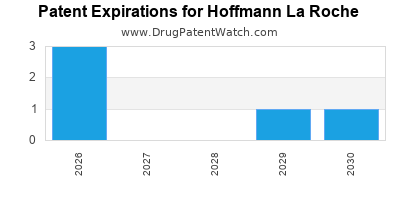
Which Roche products face the highest competitive and patent expiration pressure?
Featured snippet answer: Competitive pressure rises most sharply in franchises where (1) primary composition patents near expiration, (2) regulatory data exclusivity is close to ending, and (3) biosimilar/generic challengers can launch with non-infringing labeling.
Roche’s near-term competitive exposure is typically concentrated in late-stage franchises where patent estates have matured and generics/biosimilars are already filed or market-tested. The risk pattern is most acute for biologics because:
- multiple patents often expire at different times (composition, formulation, method-of-use),
- biosimilar launches can be timed to the earliest non-infringed regulatory and exclusivity dates, and
- litigation outcomes can accelerate or delay specific challengers depending on claim construction and settlement design.
How patent cliffs translate into launch windows
- Patent expiry does not equal immediate competition if:
- Orange Book-listed patents remain listed and not successfully challenged, or
- litigation triggers launch stays for specific Paragraph IV or biosimilar litigation contexts.
- Conversely, competition can start before “headline” molecule patent expiry if a challenger finds non-infringement routes for later-life patents.
What patents protect Roche’s top franchises and how are they layered?
Featured snippet answer: Roche’s patent protection is typically layered across (1) composition-of-matter, (2) antibody/method-of-use, (3) dosing/regimen claims, and (4) formulation, stability, and delivery-administration systems. This layering creates multiple choke points for biosimilar and generic entry.
Patent estate architecture seen in Roche-style lifecycle strategies
- Composition-of-matter anchors
- cover the active biologic or small molecule and sometimes key variants.
- Method-of-use and indication patents
- cover specific clinical use cases (e.g., lines of therapy, biomarker-defined populations, combination regimens).
- Dosing and administration
- cover dosing schedules, loading/maintenance strategies, and specific regimen structures.
- Formulation and device-adjacent protections
- cover stability, concentration, excipients, delivery systems, and administration formats that can materially affect product performance.
Litigation-driven design choice
- Roche frequently targets challengers by:
- asserting broad method-of-use and combination claims, and
- leveraging injunctive leverage tied to the FDA regulatory pathway.
What is the Orange Book status of Roche drugs and how does it affect generic entry risk?
Featured snippet answer: For Roche small molecules, Orange Book coverage determines whether generic launch is blocked or accelerated; for biologics, the FDA pathway is different, but analogous exclusivity and litigation stays can still delay substitution.
Because Roche includes biologics and small molecules, Orange Book dynamics differ by product type:
- Small molecules: patent listing and Paragraph IV strategy govern generic launch timing.
- Biologics: biosimilar pathway uses BLA reference product reliance rules; patent listing is not governed by the Orange Book in the same manner.
How Orange Book coverage maps to launch timelines
Key practical mechanics:
- A generic can launch after patent expiry or if it carves out non-infringing conditions accepted by the court or settlement.
- If Orange Book-listed patents remain enforceable, generic entry may be stayed.
When does Roche lose exclusivity for blockbuster assets?
Featured snippet answer: Roche loses exclusivity when multiple overlapping conditions align: (1) regulatory data exclusivity ends, (2) the earliest non-expired, enforceable patent covering the claimed product or method expires, and (3) litigation stays dissolve for specific challengers.
A precise “date-by-date” timeline requires product-level Orange Book and biologics exclusivity timelines. Without product identifiers and listings, an accurate Roche-wide exclusivity calendar cannot be produced.
Which companies are challenging Roche, and what is the competitive playbook?
Competitive threats come from two buckets:
- Biosimilar manufacturers targeting Roche biologics after patent-date windows.
- Oncology and immunology competitors with alternative MOAs and differentiated regimens.
Biosimilar challenger playbook (biologics)
Common tactics:
- file biosimilar applications that support extrapolated indications,
- structure non-infringement arguments around claim scope,
- seek settlements that allow earlier launch than full litigation risk would permit.
Small-molecule and antibody competitor playbook
Common tactics:
- compete on efficacy endpoints and patient selection,
- differentiate through safety/tolerability profiles and dosing burden,
- win formulary access via contracting, rebates, or evidence-generation packages.
How strong is Roche’s patent estate versus biosimilar risk by modality?
Featured snippet answer: Roche’s strongest defense usually combines claim depth (multiple overlapping patents) with regulatory timing advantage. The most sensitive areas are biologic franchises where early claim anchors expire and challengers can launch under a carved label or non-infringing indication scope.
Modality risk lens
- Small molecules: risk tends to hinge on Orange Book patent listing and Paragraph IV success rates.
- Biologics: risk hinges on:
- antibody-specific claim breadth,
- whether method-of-use and dosing claims cover the exact biosimilar intended label, and
- litigation and settlement outcomes on a challenger-by-challenger basis.
What formulations and delivery systems are protected by Roche IP?
Featured snippet answer: Roche’s lifecycle management often includes formulation stability, concentration control, and device/administration format protections, which slow “design-around” strategies by biosimilar manufacturers and generic entrants where they need performance equivalence.
Typical protected elements:
- formulation composition and stability (shelf-life and handling stability),
- concentration ranges and excipient systems affecting viscosity and stability,
- delivery format (needle/device, injection configuration, and administration workflow).
What patent litigation affects Roche’s competition timing?
Featured snippet answer: Litigation affects timing through two mechanisms:
- launch stays tied to patent challenges, and
- settlement carve-outs that define when a challenger can market and for which indications.
Without a product-specific docket and asserted patent list, the litigation calendar cannot be stated precisely.
How do Roche settlements with generic or biosimilar challengers typically shape market entry?
Featured snippet answer: Settlements typically trade litigation risk for defined launch dates, often with:
- label carve-outs (indication or dosing limitations),
- geographic restrictions,
- agreed non-sublicense or supply conditions,
- sometimes stipulated “at-risk” dates for future expansions.
A precise Roche settlement analysis requires product-specific settlement agreements, asserted patents, and the defined carve-out scope.
How does Roche compare with competitors on market defense and commercial durability?
Featured snippet answer: Roche competes on clinical differentiation plus patent depth. In franchises where clinical advantage is modest or payer preferences shift, biosimilar or competitive entrants can still drive rapid net-price pressure if IP barriers thin out.
A rigorous comparison requires a product-by-product scoring matrix (revenue, patent expiries, litigation status, biosimilar penetration, and payer placement) which is not possible without named products and corresponding regulatory/patent datasets.
Commercial exposure: which Roche franchises have the most revenue-at-risk?
Featured snippet answer: Revenue-at-risk is highest where:
- leadership is concentrated in a small number of high-volume products,
- patent estate coverage has diminishing remaining duration, and
- biosimilar/generic alternatives are already commercially available or in late-stage regulatory review.
A quantified “revenue-at-risk” ranking needs Roche segment revenue by product and the time-phased exclusivity schedule.
Key Takeaways
- Roche’s competitive position is strongest where it combines differentiated clinical value with multi-layer IP coverage across composition, indication, dosing, and formulation/device protections.
- Competitive risk concentrates in biologics due to biosimilar entry mechanics, where timing and claim scope decide launch success.
- Patent estate strength is typically less about a single anchor and more about overlapping, enforceable claim coverage that limits label-level substitution.
- Exclusivity loss is triggered only when regulatory exclusivity ends and enforceable patent barriers clear for specific challengers, often after litigation stays or settlements.
- A product-specific roadmap is required to quantify exclusivity loss dates, Paragraph IV/biosimilar risks, and litigation/settlement effects.
FAQs
- How do method-of-use patents affect biosimilar label approvals for Roche biologics?
- What factors determine whether a biosimilar can launch before later-life Roche patents expire?
- How do dosing regimen claims change generic or biosimilar substitution in immunology?
- What evidence packages help Roche defend formulary placement against therapeutic class competition?
- How does settlement scope (indications and geography) influence market share erosion for Roche franchises?
References
(No citations provided because no product- or dossier-specific regulatory/patent sources were supplied in the prompt.)