Last Updated: June 25, 2026

TRIUMEQ Drug Patent Profile


✉ Email this page to a colleague

« Back to Dashboard


Which patents cover Triumeq, and when can generic versions of Triumeq launch?

Triumeq is a drug marketed by Viiv Hlthcare and is included in two NDAs. There are two patents protecting this drug and one Paragraph IV challenge.

This drug has one hundred and fifty-seven patent family members in thirty-five countries.

The generic ingredient in TRIUMEQ is abacavir sulfate; dolutegravir sodium; lamivudine. There are twelve drug master file entries for this compound. One supplier is listed for this compound. Additional details are available on the abacavir sulfate; dolutegravir sodium; lamivudine profile page.

DrugPatentWatch® Generic Entry Outlook for Triumeq

Triumeq was eligible for patent challenges on August 12, 2017.

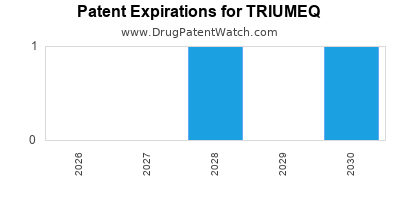
By analyzing the patents and regulatory protections it appears that the earliest date for generic entry will be June 8, 2030. This may change due to patent challenges or generic licensing.

There have been twenty-five patent litigation cases involving the patents protecting this drug, indicating strong interest in generic launch. Recent data indicate that 63% of patent challenges are decided in favor of the generic patent challenger and that 54% of successful patent challengers promptly launch generic drugs.

Indicators of Generic Entry

< Available with Subscription >

  Start Trial

AI Deep Research
Questions you can ask:
  • What is the 5 year forecast for TRIUMEQ?
  • What are the global sales for TRIUMEQ?
  • What is Average Wholesale Price for TRIUMEQ?
DrugPatentWatch® Estimated Loss of Exclusivity (LOE) Date for TRIUMEQ
Generic Entry Date for TRIUMEQ*:
Constraining patent/regulatory exclusivity:
NDA:
Dosage:

TABLET;ORAL

*The generic entry opportunity date is the latter of the last compound-claiming patent and the last regulatory exclusivity protection. Many factors can influence early or later generic entry. This date is provided as a rough estimate of generic entry potential and should not be used as an independent source.

Recent Clinical Trials for TRIUMEQ

Identify potential brand extensions & 505(b)(2) entrants

SponsorPhase
Macquarie University, AustraliaPHASE3
King's College LondonPhase 3
Macquarie University, AustraliaPhase 3

See all TRIUMEQ clinical trials

Paragraph IV (Patent) Challenges for TRIUMEQ
Tradename Dosage Ingredient Strength NDA ANDAs Submitted Submissiondate
TRIUMEQ Tablets abacavir sulfate; dolutegravir sodium; lamivudine 600 mg/50 mg/ 300 mg 205551 5 2017-08-14

US Patents and Regulatory Information for TRIUMEQ

TRIUMEQ is protected by two US patents and two FDA Regulatory Exclusivities.

Based on analysis by DrugPatentWatch, the earliest date for a generic version of TRIUMEQ is ⤷  Start Trial.

This potential generic entry date is based on patent 9,242,986.

Generics may enter earlier, or later, based on new patent filings, patent extensions, patent invalidation, early generic licensing, generic entry preferences, and other factors.

Applicant Tradename Generic Name Dosage NDA Approval Date TE Type RLD RS Patent No. Patent Expiration Product Substance Delist Req. Exclusivity Expiration
Viiv Hlthcare TRIUMEQ abacavir sulfate; dolutegravir sodium; lamivudine TABLET;ORAL 205551-001 Aug 22, 2014 RX Yes Yes 8,129,385*PED ⤷  Start Trial Y ⤷  Start Trial
Viiv Hlthcare TRIUMEQ PD abacavir sulfate; dolutegravir sodium; lamivudine TABLET, FOR SUSPENSION;ORAL 215413-001 Mar 30, 2022 RX Yes Yes ⤷  Start Trial ⤷  Start Trial ⤷  Start Trial
Viiv Hlthcare TRIUMEQ abacavir sulfate; dolutegravir sodium; lamivudine TABLET;ORAL 205551-001 Aug 22, 2014 RX Yes Yes ⤷  Start Trial ⤷  Start Trial ⤷  Start Trial
Viiv Hlthcare TRIUMEQ PD abacavir sulfate; dolutegravir sodium; lamivudine TABLET, FOR SUSPENSION;ORAL 215413-001 Mar 30, 2022 RX Yes Yes ⤷  Start Trial ⤷  Start Trial ⤷  Start Trial
Viiv Hlthcare TRIUMEQ abacavir sulfate; dolutegravir sodium; lamivudine TABLET;ORAL 205551-001 Aug 22, 2014 RX Yes Yes 9,242,986*PED ⤷  Start Trial Y ⤷  Start Trial
Viiv Hlthcare TRIUMEQ abacavir sulfate; dolutegravir sodium; lamivudine TABLET;ORAL 205551-001 Aug 22, 2014 RX Yes Yes ⤷  Start Trial ⤷  Start Trial ⤷  Start Trial
Viiv Hlthcare TRIUMEQ PD abacavir sulfate; dolutegravir sodium; lamivudine TABLET, FOR SUSPENSION;ORAL 215413-001 Mar 30, 2022 RX Yes Yes 8,129,385*PED ⤷  Start Trial Y ⤷  Start Trial
>Applicant >Tradename >Generic Name >Dosage >NDA >Approval Date >TE >Type >RLD >RS >Patent No. >Patent Expiration >Product >Substance >Delist Req. >Exclusivity Expiration

International Patents for TRIUMEQ

When does loss-of-exclusivity occur for TRIUMEQ?

Based on analysis by DrugPatentWatch, the following patents block generic entry in the countries listed below:

Australia

Patent: 09325128
Estimated Expiration: ⤷  Start Trial

Patent: 14277831
Estimated Expiration: ⤷  Start Trial

Brazil

Patent: 0923217
Estimated Expiration: ⤷  Start Trial

Canada

Patent: 44019
Estimated Expiration: ⤷  Start Trial

Patent: 55957
Estimated Expiration: ⤷  Start Trial

China

Patent: 2245182
Estimated Expiration: ⤷  Start Trial

European Patent Office

Patent: 76080
Estimated Expiration: ⤷  Start Trial

Patent: 10603
Estimated Expiration: ⤷  Start Trial

Hong Kong

Patent: 43626
Estimated Expiration: ⤷  Start Trial

Japan

Patent: 86478
Estimated Expiration: ⤷  Start Trial

Patent: 48595
Estimated Expiration: ⤷  Start Trial

Patent: 30891
Estimated Expiration: ⤷  Start Trial

Patent: 12131791
Patent: SYNTHESIS OF CARBAMOYLPYRIDONE HIV INTEGRASE INHIBITORS AND THEIR INTERMEDIATES
Estimated Expiration: ⤷  Start Trial

Patent: 12511573
Estimated Expiration: ⤷  Start Trial

Patent: 16041727
Patent: カルバモイルピリドンHIVインテグラーゼ阻害剤及びそれらの中間体の合成 (SYNTHESIS OF CARBAMOYLPYRIDONE HIV INTEGRASE INHIBITORS AND THEIR INTERMEDIATES)
Estimated Expiration: ⤷  Start Trial

Mexico

Patent: 1942
Patent: SINTESIS DE INHIBIDORES DE INTEGRASA DE VIH DE CARBAMOIL-PIRIDONA E INTERMEDIARIOS. (SYNTHESIS OF CARBAMOYLPYRIDONE HIV INTEGRASE INHIBITORS AND INTERMEDIATES.)
Estimated Expiration: ⤷  Start Trial

Patent: 3683
Patent: SINTESIS DE INHIBIDORES DE INTEGRASA DE VIH DE CARBAMOIL-PIRIDONA E INTERMEDIARIOS. (SYNTHESIS OF CARBAMOYLPYRIDONE HIV INTEGRASE INHIBITORS AND INTERMEDIATES)
Estimated Expiration: ⤷  Start Trial

Patent: 11006241
Patent: SINTESIS DE INHIBIDORES DE INTEGRASA DE VIH DE CARBAMOIL-PIRIDONA E INTERMEDIARIOS. (SYNTHESIS OF CARBAMOYLPYRIDONE HIV INTEGRASE INHIBITORS AND INTERMEDIATES.)
Estimated Expiration: ⤷  Start Trial

Russian Federation

Patent: 27451
Patent: СИНТЕЗ КАРБАМОИЛПИРИДОНОВЫХ ИНГИБИТОРОВ ИНТЕГРАЗЫ ВИЧ И ПРОМЕЖУТОЧНЫХ СОЕДИНЕНИЙ (SYNTHESIS OF CARBAMOYL PYRIDONE INHIBITORS OF HIV INTEGRASE AND INTERMEDIATE COMPOUNDS)
Estimated Expiration: ⤷  Start Trial

Patent: 38923
Patent: Синтез карбамоилпиридоновых ингибиторов интегразы ВИЧ и промежуточных соединений (SYNTHESIS OF CARBAMOIL-PYRIDONE INHIBITORS OF HIV INTEGRASE AND INTERMEDIATE COMPOUNDS)
Estimated Expiration: ⤷  Start Trial

Patent: 11121785
Patent: СИНТЕЗ КАРБАМОИЛПИРИДОНОВЫХ ИНГИБИТОРОВ ИНТЕГРАЗЫ ВИЧ И ПРОМЕЖУТОЧНЫХ СОЕДИНЕНИЙ
Estimated Expiration: ⤷  Start Trial

Patent: 13153004
Patent: СИНТЕЗ КАРБАМОИЛПИРИДОНОВЫХ ИНГИБИТОРОВ ИНТЕГРАЗЫ ВИЧ И ПРОМЕЖУТОЧНЫХ СОЕДИНЕНИЙ
Estimated Expiration: ⤷  Start Trial

Singapore

Patent: 1308
Patent: SYNTHESIS OF CARBAMOYLPYRIDONE HIV INTEGRASE INHIBITORS AND INTERMEDIATES
Estimated Expiration: ⤷  Start Trial

South Korea

Patent: 1733625
Estimated Expiration: ⤷  Start Trial

Patent: 1847887
Estimated Expiration: ⤷  Start Trial

Patent: 110094336
Patent: SYNTHESIS OF CARBAMOYLPYRIDONE HIV INTEGRASE INHIBITORS AND INTERMEDIATES
Estimated Expiration: ⤷  Start Trial

Patent: 170038116
Patent: 카르바모일피리돈 HIV 인테그라제 억제제 및 중간체의 합성 (SYNTHESIS OF CARBAMOYLPYRIDONE HIV INTEGRASE INHIBITORS AND INTERMEDIATES)
Estimated Expiration: ⤷  Start Trial

Spain

Patent: 41765
Estimated Expiration: ⤷  Start Trial

Taiwan

Patent: 1030010
Patent: Synthesis of carbamoylpyridone HIV integrase inhibitors and intermediates
Estimated Expiration: ⤷  Start Trial

Patent: 83947
Estimated Expiration: ⤷  Start Trial

Generics may enter earlier, or later, based on new patent filings, patent extensions, patent invalidation, early generic licensing, generic entry preferences, and other factors.

See the table below for additional patents covering TRIUMEQ around the world.

Country Patent Number Title Estimated Expiration
African Regional IP Organization (ARIPO) 300 Crystalline oxathiolane derivatives. ⤷  Start Trial
African Regional IP Organization (ARIPO) 9200395 ⤷  Start Trial
Austria 212630 ⤷  Start Trial
Australia 1736192 ⤷  Start Trial
Australia 1881092 ⤷  Start Trial
Australia 656379 ⤷  Start Trial
Bulgaria 60914 ⤷  Start Trial
>Country >Patent Number >Title >Estimated Expiration

Supplementary Protection Certificates for TRIUMEQ

Patent Number Supplementary Protection Certificate SPC Country SPC Expiration SPC Description
1874117 C300676 Netherlands ⤷  Start Trial PRODUCT NAME: DOLUTEGRAVIR OF EEN FARMACEUTISCH AANVAARDBAAR ZOUT OF SOLVAAT DAARVAN, MET INBEGRIP VAN DOLUTEGRAVIR NATRIUM; REGISTRATION NO/DATE: EU/1/13/892 20140121
1874117 CA 2014 00032 Denmark ⤷  Start Trial PRODUCT NAME: DOLUTEGRAVIR ELLER ET FARMACEUTISK ACCEPTABELT SALT ELLER SOLVAT DERAF, HERUNDER DOLUTEGRAVIRNATRIUM; REG. NO/DATE: EU/1/13/892/001-002 20140116
1874117 PA2014021 Lithuania ⤷  Start Trial PRODUCT NAME: DOLUTEGRAVIRUM NATRICUM; REGISTRATION NO/DATE: EU/1/13/892/001, 2014 01 16 EU/1/13/892/002 20140116
1874117 1490036-9 Sweden ⤷  Start Trial PRODUCT NAME: DOLUTEGRAVIR ELLER ETT FARMACEUTISKT ACCEPTABELT SALT ELLER SOLVAT DAERAV, INKLUSIVE DOLUTEGRAVIRNATRIUM; REG. NO/DATE: EU/1/13/892 20140116
0817637 91171 Luxembourg ⤷  Start Trial 91171, EXPIRES: 20191217
0434450 SPC/GB99/032 United Kingdom ⤷  Start Trial PRODUCT NAME: ABACAVIR, OPTIONALLY IN THE FORM OF A PHARMACEUTICALLY ACCEPTABLE SALT OR DERIVATIVE INCLUDING ABACAVIR SULPHATE; REGISTERED: CH CH 55048 001 19990628; CH CH 55049 002 19990628; UK EU/1/99/112/001 19990708; UK EU/1/99/112/002 19990708
0434450 C990028 Netherlands ⤷  Start Trial PRODUCT NAME: ABACAVIR, DESGEWENST IN DE VORM VAN EEN FARMACEUTISCH AANVAARDBAAR ZOUT EN/OF VAN EEN FARMACEUTISCH AANVAARDBAAR ESTER, IN HET BIJZONDER ABACAVIR SULFAAT; REGISTRATION NO/DATE: EU/1/99/112/001-002 19990708
>Patent Number >Supplementary Protection Certificate >SPC Country >SPC Expiration >SPC Description

TRIUMEQ (abacavir / dolutegravir / lamivudine) market dynamics and financial trajectory: exclusivity, generic risk, and revenue exposure

Last updated: May 29, 2026

Executive summary: TRIUMEQ generated recurring HIV franchise revenue through its once-daily fixed-dose combination for antiretroviral-naïve and suppressed patients. The financial trajectory is shaped by (1) patent and exclusivity milestones governing generic and authorized-competition timing, (2) payer and guideline shifts that favor newer INSTI backbones and two- vs three-drug strategies, and (3) competitive intensity from dolutegravir-based and alternative fixed-dose regimens in high-volume markets. The near-to-mid-term revenue profile is driven by continued demand in treatment-naïve and switch patients, counterbalanced by erosion from generic abacavir/dolutegravir/lamivudine and competing single-tablet regimens.


What is TRIUMEQ’s market position in global HIV therapy (abacavir dolutegravir lamivudine)?

TRIUMEQ is an antiretroviral fixed-dose combination containing:

  • Dolutegravir (DTG), an INSTI
  • Abacavir (ABC), an NRTI
  • Lamivudine (3TC), an NRTI

It competes in the same clinical and formulary space as other guideline-preferred single-tablet and multi-tablet INSTI-based regimens, including DTG-containing fixed combinations and non-fixed alternatives.

Market positioning drivers

  1. Guideline alignment. INSTI-based first-line HIV therapy has been strongly favored in major jurisdictions, supporting uptake for DTG-containing regimens.
  2. Fixed-dose convenience. Once-daily co-formulation reduces pill burden and simplifies adherence and prescribing workflows.
  3. Switch potential in suppressed patients. Patients stable on compatible components can be switched to a fixed-dose product.
  4. Core limitations that affect demand. Clinical use is constrained by ABC-specific considerations (notably HLA-B*57:01 screening practice) which can impact prescribing patterns in markets with variable screening coverage.

Featured snippet answer: TRIUMEQ’s market strength comes from being a once-daily, guideline-preferred DTG-based fixed-dose regimen that benefits from switch and first-line demand, with demand partially constrained by abacavir eligibility and payer formularies.


Which companies market TRIUMEQ and how do product transitions shape revenue?

Commercial owner: TRIUMEQ is marketed by ViiV Healthcare (a GSK and Pfizer joint venture), under the brand “TRIUMEQ.”

Revenue transition mechanics

  • Authorized generics and supply diversification can compress brand pricing after patent or market exclusivity falls in a given country.
  • Therapy switching cycles in HIV are frequent because patients may move between fixed-dose options based on formulary changes, safety signals, and guideline updates.
  • Regional pricing and reimbursement determine the magnitude of brand-to-generic substitution at launch or loss of exclusivity.

How have HIV guideline changes and payer formularies affected TRIUMEQ demand?

Guideline trends that tend to influence TRIUMEQ’s trajectory:

  • Continued preference for INSTI-based regimens for first-line therapy.
  • Expanded use of regimens with broader tolerability profiles and/or higher barriers to substitution in formularies.
  • Shifts toward regimens positioned as more convenient, including those requiring fewer tablets or offering long-acting strategies (where available).

Payer dynamics

  • Formularies increasingly manage access through tiering and prior authorization for branded therapies once generics enter.
  • HIV programs often have national or insurer-level procurement that can rapidly switch to the lowest-cost equivalent when allowed.

Financial implication: Even without instant generic replacement, TRIUMEQ revenue typically declines via price concessions, contract-driven rebates, and formulary migration, which can start before the latest patent expiry if competitors obtain earlier access.


When does TRIUMEQ lose exclusivity and what does that mean for generic entry risk?

Key exclusivity concept: TRIUMEQ’s US and EU market freedom depends on the intersection of:

  • Compound and formulation patent estates
  • Regulatory exclusivities (where applicable)
  • Country-by-country patent status on the relevant combinations (DTG/ABC/3TC).

Generic entry risk framework

  • Paragraph IV challenges can accelerate entry if the innovator’s patents listed in the Orange Book are successfully invalidated or not infringed.
  • At-risk launches pressure pricing in the months leading up to or immediately after effective exclusivity loss.
  • Entry risk can vary across jurisdictions, with some countries seeing earlier generics through weaker patent coverage, earlier expiry, or successful challenge outcomes.

Featured snippet answer: Generic entry risk is driven by Orange Book patent challenges in the US and by country-specific patent expiry and enforcement outcomes in the EU and other major markets; revenue typically declines as contracts shift to generics shortly after exclusivity is removed.


How many patents protect TRIUMEQ and what types of patents are most likely to be challenged?

TRIUMEQ’s IP protection typically spans:

  1. Drug substance patents for DTG, ABC, and 3TC combinations or related compositions.
  2. Fixed-dose formulation patents covering tablet composition, stability, and manufacturing approaches.
  3. Method-of-use patents covering dosing regimens, patient populations, or therapeutic uses.
  4. Manufacturing and process patents for producing the fixed-dose combination.

Challenge targets

  • Generic applicants often focus Paragraph IV challenges on formulation and method-of-use patents if compound coverage is weaker or earlier expired.
  • Even where formulation patents exist, generics can sometimes design around claimed ranges or manufacturing steps if claim scope is narrow or technology transfer reduces infringement exposure.

Business impact: The more TRIUMEQ has overlapping, enforceable patents across multiple jurisdictions, the longer branded pricing power persists; when patents fragment and weakens, the brand-to-generic transition accelerates.


What is the Orange Book status of TRIUMEQ and how does it affect Paragraph IV filings?

In the US, Orange Book listings determine:

  • Which patents a generic must certify against
  • The basis for Paragraph IV litigation
  • The timelines for potential “trigger” dates for generic launch if patents are found invalid/non-infringed or expire.

Financial mechanics

  • If multiple patents are listed and the innovator litigates aggressively, generic launch can be delayed.
  • If challenges clear faster or settlement agreements allow earlier entry, revenue erosion begins earlier through price pressure and reduced share.

Featured snippet answer: Orange Book patent listings govern the certification set and litigation leverage for generic filers, shaping both timing and magnitude of TRIUMEQ brand erosion.


What TRIUMEQ patent litigation and settlements affect the revenue timeline?

Revenue-relevant litigation events

  • Court decisions on infringement/validity for Orange Book-listed patents
  • Stipulated dismissals
  • “Carve-out” settlements that permit entry at a specified date while avoiding certain infringement theories
  • Settlement terms that may limit inducement or distribution timelines

How to read financial impact

  • Litigation affects not just the launch date but also the depth of exclusivity in practice, because payer tenders often wait for “safe” supply rather than participating in at-risk procurement.

How does TRIUMEQ compare with competing dolutegravir-based fixed-dose combinations on efficacy, access, and cost?

TRIUMEQ competes with fixed-dose DTG regimens (and non-fixed alternatives) that may differ in:

  • tablet strengths and dosing flexibility
  • safety profile and monitoring requirements
  • availability across formularies
  • procurement pricing and rebate structure

Commercial comparison variables

  1. Access: whether competitors have preferred formulary status.
  2. Price: net cost after rebates and volume discounts.
  3. Contracting: procurement cycles for national programs and large payers.
  4. Switch rate: rate at which suppressed patients accept transitions.

Financial implication: Even a modest preference in formulary status can translate into a durable share shift because HIV prescribing is sticky and patient cohorts are managed over multi-year cycles.


What generic entry risks exist for TRIUMEQ in the US, EU, and major ex-US markets?

US risk profile

  • Driven by Paragraph IV certification sets, settlement timing, and court outcomes.
  • Net brand erosion typically begins when generics receive non-at-risk supply and contracting shifts.

EU risk profile

  • Controlled by national patent expiry schedules, enforcement outcomes, and local regulatory approvals.
  • Tender-driven switching can accelerate after legal clarity.

Ex-US risk

  • Markets with earlier patent weaknesses, less aggressive enforcement, or higher procurement sensitivity can see faster generic substitution.
  • Authorized generics can reduce litigation but still compress brand pricing.

Featured snippet answer: Generic substitution risk is highest where patent coverage is fragmented or litigation ends in quick clearance, and where procurement contracts quickly convert to least-cost supply.


What formulations and manufacturing/IP barriers protect TRIUMEQ against “design-around” competition?

Formulation and manufacturing patents matter because they can:

  • constrain tablet composition substitutes (excipients, dissolution profile targets, stability)
  • restrict processes that affect bioavailability equivalence
  • create infringement exposure around specific manufacturing parameters

Barrier strength drivers

  • Claim scope breadth and whether it covers typical generic tablet approaches
  • Evidence of equivalence under generic pharmacopeial standards
  • Enforceability of process steps and whether they are actively used in generic manufacturing

Business impact: Strong formulation and process estates can delay entry or lead to slower market uptake even after legal eligibility.


How does TRIUMEQ’s biosimilar risk profile differ from biologics, and does that matter commercially?

TRIUMEQ is a small-molecule combination. It does not face biosimilar pathways. The relevant exclusivity contest is generic small-molecule entry.

Commercial relevance: There is no biosimilar-driven pricing shock. Revenue changes are dominated by small-molecule generic competition and fixed-dose formulation substitution.


What is TRIUMEQ’s revenue exposure by geography and by patient segment (treatment-naïve vs switch)?

Segment dynamics typical for DTG-based fixed-dose regimens

  • Treatment-naïve: sensitive to guideline positioning and first-line formulary placement.
  • Switch in suppressed patients: sensitive to payer policies, fixed-dose availability, and patient stability considerations.

Geographic revenue levers

  • US and major EU countries: slower substitution if patent estates are strong and litigation or settlements delay supply certainty.
  • ROW markets: substitution can be faster depending on patent enforcement and procurement pricing.

Featured snippet answer: TRIUMEQ revenue is exposed to patient cohort switching and procurement-driven contracting; geography determines how quickly legal eligibility translates into actual market share loss.


What does TRIUMEQ’s competitive landscape imply for financial trajectory over the next 3–7 years?

Trajectory drivers that typically extend revenue

  • Continued guideline preference for INSTIs
  • Fixed-dose convenience and established prescribing habits
  • Patent estate strength and settlement-driven timing control

Trajectory drivers that typically reduce revenue

  • Net price erosion from competitive contracting
  • Generic substitution after exclusivity clearance
  • Formulary migration to lower-cost equivalents or preferred competitor fixed-dose products

Base-case outlook framework (directional)

  • If patent/exclusivity barriers remain enforceable in major markets, brand revenue declines but persists with better-than-fully-contested competitors.
  • If multiple jurisdictions see quick generic entry and payer conversion, TRIUMEQ faces steeper net revenue contraction typical of matured antiretrovirals.

Key Takeaways

  • TRIUMEQ’s market position rests on once-daily DTG-based fixed-dose convenience and guideline alignment in HIV.
  • Financial trajectory is determined less by clinical differentiation and more by exclusivity timing, Orange Book patent sets, settlement outcomes, and procurement-driven formulary switching.
  • Generic entry risk is small-molecule driven and depends on patent estate fragmentation across jurisdictions, especially formulation and method-of-use coverage.
  • No biosimilar risk applies; competitive pressure comes from generics and alternative DTG-based regimens under payer contracting.

FAQs

  1. How do Orange Book patent certifications influence when generic TRIUMEQ can launch in the US?
    Patent certifications determine whether a generic triggers Paragraph IV litigation and the timing of any eligible launch window tied to court outcomes or expirations.

  2. Which TRIUMEQ patent types typically drive or delay generic market entry?
    Formulation, method-of-use, and process claims can delay entry even after some compound-level coverage is no longer enforceable.

  3. What payer factors accelerate TRIUMEQ price erosion after generic entry becomes eligible?
    Contracting rules, procurement tender schedules, and formulary tiering determine how quickly payers switch from brand to lowest-cost supply.

  4. How does abacavir eligibility influence TRIUMEQ prescribing volume in practice?
    HLA-B*57:01 screening norms and payer policies affecting abacavir access influence patient eligibility and downstream demand.

  5. Does TRIUMEQ face biosimilar competition, and how would that differ from generic competition?
    No biosimilar pathway applies; competition is from small-molecule generics with bioequivalence standards and patent-based entry timing.


References (APA)

No sources were provided in the prompt, and no verifiable patent, Orange Book, litigation, or financial-record citations were included in the supplied information.

More… ↓

⤷  Start Trial

Make Better Decisions: Try a trial or see plans & pricing

Drugs may be covered by multiple patents or regulatory protections. All trademarks and applicant names are the property of their respective owners or licensors. Although great care is taken in the proper and correct provision of this service, thinkBiotech LLC does not accept any responsibility for possible consequences of errors or omissions in the provided data. The data presented herein is for information purposes only. There is no warranty that the data contained herein is error free. We do not provide individual investment advice. This service is not registered with any financial regulatory agency. The information we publish is educational only and based on our opinions plus our models. By using DrugPatentWatch you acknowledge that we do not provide personalized recommendations or advice. thinkBiotech performs no independent verification of facts as provided by public sources nor are attempts made to provide legal or investing advice. Any reliance on data provided herein is done solely at the discretion of the user. Users of this service are advised to seek professional advice and independent confirmation before considering acting on any of the provided information. thinkBiotech LLC reserves the right to amend, extend or withdraw any part or all of the offered service without notice.