TRIUMEQ PD Drug Patent Profile
✉ Email this page to a colleague
When do Triumeq Pd patents expire, and when can generic versions of Triumeq Pd launch?
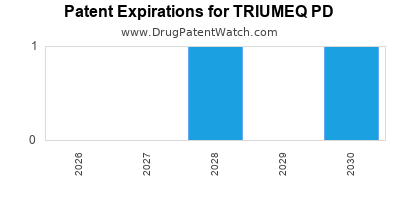
Triumeq Pd is a drug marketed by Viiv Hlthcare and is included in one NDA. There are two patents protecting this drug and one Paragraph IV challenge.
The generic ingredient in TRIUMEQ PD is abacavir sulfate; dolutegravir sodium; lamivudine. There is one drug master file entry for this compound. One supplier is listed for this compound. Additional details are available on the abacavir sulfate; dolutegravir sodium; lamivudine profile page.
DrugPatentWatch® Generic Entry Outlook for Triumeq Pd
By analyzing the patents and regulatory protections it appears that the earliest date
for generic entry will be June 8, 2030. This may change due to patent challenges or generic licensing.
There have been twenty-six patent litigation cases involving the patents protecting this drug, indicating strong interest in generic launch. Recent data indicate that 63% of patent challenges are decided in favor of the generic patent challenger and that 54% of successful patent challengers promptly launch generic drugs.
Indicators of Generic Entry
AI Deep Research
Questions you can ask:
- What is the 5 year forecast for TRIUMEQ PD?
- What are the global sales for TRIUMEQ PD?
- What is Average Wholesale Price for TRIUMEQ PD?
Summary for TRIUMEQ PD
| US Patents: | 2 |
| Applicants: | 1 |
| NDAs: | 1 |
| Finished Product Suppliers / Packagers: | 1 |
| Clinical Trials: | 20 |
| Drug Prices: | Drug price information for TRIUMEQ PD |
| Patent Litigation and PTAB cases: | See patent lawsuits and PTAB cases for TRIUMEQ PD |
| DailyMed Link: | TRIUMEQ PD at DailyMed |

DrugPatentWatch® Estimated Loss of Exclusivity (LOE) Date for TRIUMEQ PD
Generic Entry Date for TRIUMEQ PD*:
Constraining patent/regulatory exclusivity:
NDA:
Dosage:
TABLET, FOR SUSPENSION;ORAL |
*The generic entry opportunity date is the latter of the last compound-claiming patent and the last regulatory exclusivity protection. Many factors can influence early or later generic entry. This date is provided as a rough estimate of generic entry potential and should not be used as an independent source.
Recent Clinical Trials for TRIUMEQ PD
Identify potential brand extensions & 505(b)(2) entrants
| Sponsor | Phase |
|---|---|
| Macquarie University, Australia | PHASE3 |
| Stichting TRICALS Foundation | Phase 3 |
| King's College London | Phase 3 |
Paragraph IV (Patent) Challenges for TRIUMEQ PD
| Tradename | Dosage | Ingredient | Strength | NDA | ANDAs Submitted | Submissiondate |
|---|---|---|---|---|---|---|
| TRIUMEQ PD | Tablets for Oral Suspension | abacavir sulfate; dolutegravir sodium; lamivudine | 60 mg/5 mg/30 mg | 215413 | 1 | 2023-03-31 |
US Patents and Regulatory Information for TRIUMEQ PD
TRIUMEQ PD is protected by two US patents and two FDA Regulatory Exclusivities.
Based on analysis by DrugPatentWatch, the earliest date for a generic version of TRIUMEQ PD is ⤷ Start Trial.
This potential generic entry date is based on patent 9,242,986.
Generics may enter earlier, or later, based on new patent filings, patent extensions, patent invalidation, early generic licensing, generic entry preferences, and other factors.
| Applicant | Tradename | Generic Name | Dosage | NDA | Approval Date | TE | Type | RLD | RS | Patent No. | Patent Expiration | Product | Substance | Delist Req. | Exclusivity Expiration |
|---|---|---|---|---|---|---|---|---|---|---|---|---|---|---|---|
| Viiv Hlthcare | TRIUMEQ PD | abacavir sulfate; dolutegravir sodium; lamivudine | TABLET, FOR SUSPENSION;ORAL | 215413-001 | Mar 30, 2022 | RX | Yes | Yes | 9,242,986*PED | ⤷ Start Trial | Y | ⤷ Start Trial | |||
| Viiv Hlthcare | TRIUMEQ PD | abacavir sulfate; dolutegravir sodium; lamivudine | TABLET, FOR SUSPENSION;ORAL | 215413-001 | Mar 30, 2022 | RX | Yes | Yes | ⤷ Start Trial | ⤷ Start Trial | ⤷ Start Trial | ||||
| Viiv Hlthcare | TRIUMEQ PD | abacavir sulfate; dolutegravir sodium; lamivudine | TABLET, FOR SUSPENSION;ORAL | 215413-001 | Mar 30, 2022 | RX | Yes | Yes | 8,129,385*PED | ⤷ Start Trial | Y | ⤷ Start Trial | |||
| Viiv Hlthcare | TRIUMEQ PD | abacavir sulfate; dolutegravir sodium; lamivudine | TABLET, FOR SUSPENSION;ORAL | 215413-001 | Mar 30, 2022 | RX | Yes | Yes | ⤷ Start Trial | ⤷ Start Trial | ⤷ Start Trial | ||||
| >Applicant | >Tradename | >Generic Name | >Dosage | >NDA | >Approval Date | >TE | >Type | >RLD | >RS | >Patent No. | >Patent Expiration | >Product | >Substance | >Delist Req. | >Exclusivity Expiration |
International Patents for TRIUMEQ PD
When does loss-of-exclusivity occur for TRIUMEQ PD?
Based on analysis by DrugPatentWatch, the following patents block generic entry in the countries listed below:
Australia
Patent: 09325128
Estimated Expiration: ⤷ Start Trial
Patent: 14277831
Estimated Expiration: ⤷ Start Trial
Brazil
Patent: 0923217
Estimated Expiration: ⤷ Start Trial
Canada
Patent: 44019
Estimated Expiration: ⤷ Start Trial
Patent: 55957
Estimated Expiration: ⤷ Start Trial
China
Patent: 2245182
Estimated Expiration: ⤷ Start Trial
European Patent Office
Patent: 76080
Estimated Expiration: ⤷ Start Trial
Patent: 10603
Estimated Expiration: ⤷ Start Trial
Hong Kong
Patent: 43626
Estimated Expiration: ⤷ Start Trial
Japan
Patent: 86478
Estimated Expiration: ⤷ Start Trial
Patent: 48595
Estimated Expiration: ⤷ Start Trial
Patent: 30891
Estimated Expiration: ⤷ Start Trial
Patent: 12131791
Patent: カルバモイルピリドンHIVインテグラーゼ阻害剤及びそれらの中間体の合成 (SYNTHESIS OF CARBAMOYLPYRIDONE HIV INTEGRASE INHIBITORS AND THEIR INTERMEDIATES)
Estimated Expiration: ⤷ Start Trial
Patent: 12511573
Estimated Expiration: ⤷ Start Trial
Patent: 16041727
Patent: カルバモイルピリドンHIVインテグラーゼ阻害剤及びそれらの中間体の合成 (SYNTHESIS OF CARBAMOYLPYRIDONE HIV INTEGRASE INHIBITORS AND THEIR INTERMEDIATES)
Estimated Expiration: ⤷ Start Trial
Mexico
Patent: 1942
Patent: SINTESIS DE INHIBIDORES DE INTEGRASA DE VIH DE CARBAMOIL-PIRIDONA E INTERMEDIARIOS. (SYNTHESIS OF CARBAMOYLPYRIDONE HIV INTEGRASE INHIBITORS AND INTERMEDIATES.)
Estimated Expiration: ⤷ Start Trial
Patent: 3683
Patent: SINTESIS DE INHIBIDORES DE INTEGRASA DE VIH DE CARBAMOIL-PIRIDONA E INTERMEDIARIOS. (SYNTHESIS OF CARBAMOYLPYRIDONE HIV INTEGRASE INHIBITORS AND INTERMEDIATES)
Estimated Expiration: ⤷ Start Trial
Patent: 11006241
Patent: SINTESIS DE INHIBIDORES DE INTEGRASA DE VIH DE CARBAMOIL-PIRIDONA E INTERMEDIARIOS. (SYNTHESIS OF CARBAMOYLPYRIDONE HIV INTEGRASE INHIBITORS AND INTERMEDIATES.)
Estimated Expiration: ⤷ Start Trial
Russian Federation
Patent: 27451
Patent: СИНТЕЗ КАРБАМОИЛПИРИДОНОВЫХ ИНГИБИТОРОВ ИНТЕГРАЗЫ ВИЧ И ПРОМЕЖУТОЧНЫХ СОЕДИНЕНИЙ (SYNTHESIS OF CARBAMOYL PYRIDONE INHIBITORS OF HIV INTEGRASE AND INTERMEDIATE COMPOUNDS)
Estimated Expiration: ⤷ Start Trial
Patent: 38923
Patent: Синтез карбамоилпиридоновых ингибиторов интегразы ВИЧ и промежуточных соединений (SYNTHESIS OF CARBAMOIL-PYRIDONE INHIBITORS OF HIV INTEGRASE AND INTERMEDIATE COMPOUNDS)
Estimated Expiration: ⤷ Start Trial
Patent: 11121785
Patent: СИНТЕЗ КАРБАМОИЛПИРИДОНОВЫХ ИНГИБИТОРОВ ИНТЕГРАЗЫ ВИЧ И ПРОМЕЖУТОЧНЫХ СОЕДИНЕНИЙ (SYNTHESIS OF CARBAMOYL PYRIDONE INHIBITORS OF HIV INTEGRASE AND INTERMEDIATE COMPOUNDS)
Estimated Expiration: ⤷ Start Trial
Patent: 13153004
Patent: СИНТЕЗ КАРБАМОИЛПИРИДОНОВЫХ ИНГИБИТОРОВ ИНТЕГРАЗЫ ВИЧ И ПРОМЕЖУТОЧНЫХ СОЕДИНЕНИЙ (SYNTHESIS OF CARBAMOIL-PYRIDONE INHIBITORS OF HIV INTEGRASE AND INTERMEDIATE COMPOUNDS)
Estimated Expiration: ⤷ Start Trial
Singapore
Patent: 1308
Patent: SYNTHESIS OF CARBAMOYLPYRIDONE HIV INTEGRASE INHIBITORS AND INTERMEDIATES
Estimated Expiration: ⤷ Start Trial
South Korea
Patent: 1733625
Estimated Expiration: ⤷ Start Trial
Patent: 1847887
Estimated Expiration: ⤷ Start Trial
Patent: 110094336
Patent: 카르바모일피리돈 HIV 인테그라제 억제제 및 중간체의 합성 (SYNTHESIS OF CARBAMOYLPYRIDONE HIV INTEGRASE INHIBITORS AND INTERMEDIATES)
Estimated Expiration: ⤷ Start Trial
Patent: 170038116
Patent: 카르바모일피리돈 HIV 인테그라제 억제제 및 중간체의 합성 (SYNTHESIS OF CARBAMOYLPYRIDONE HIV INTEGRASE INHIBITORS AND INTERMEDIATES)
Estimated Expiration: ⤷ Start Trial
Spain
Patent: 41765
Estimated Expiration: ⤷ Start Trial
Taiwan
Patent: 1030010
Patent: Synthesis of carbamoylpyridone HIV integrase inhibitors and intermediates
Estimated Expiration: ⤷ Start Trial
Patent: 83947
Estimated Expiration: ⤷ Start Trial
Generics may enter earlier, or later, based on new patent filings, patent extensions, patent invalidation, early generic licensing, generic entry preferences, and other factors.
See the table below for additional patents covering TRIUMEQ PD around the world.
| Country | Patent Number | Title | Estimated Expiration |
|---|---|---|---|
| Austria | E516026 | ⤷ Start Trial | |
| Australia | 2006239177 | Polycyclic carbamoylpyridone derivative having HIV integrase inhibitory activity | ⤷ Start Trial |
| Australia | 2006307101 | Polycyclic carbamoylpyridone derivative having inhibitory activity on HIV integrase | ⤷ Start Trial |
| Brazil | PI0610030 | composto, processo para a preparação de um composto, método de tratamento de uma infecção por hiv em um humano, uso de um composto, e, composição farmacêutica | ⤷ Start Trial |
| Brazil | PI0617842 | composto ou um sal farmaceuticamente aceitável ou um solvato do mesmo, e, composição farmacêutica | ⤷ Start Trial |
| Canada | 2606282 | DERIVE POLYCYCLIQUE DE LA CARBAMOYLPYRIDONE A ACTIVITE INHIBITRICE SUR L'INTEGRASE DU VIH (POLYCYCLIC CARBAMOYLPYRIDONE DERIVATIVE HAVING HIV INTEGRASEINHIBITORY ACTIVITY) | ⤷ Start Trial |
| Canada | 2626956 | DERIVE DE CARBAMOYLPYRIDONE POLYCYCLIQUE AYANT UNE ACTIVITE D'INHIBITION SUR L'INTEGRASE DU VIH (POLYCYCLIC CARBAMOYLPYRIDONE DERIVATIVE HAVING INHIBITORY ACTIVITY ON HIV INTEGRASE) | ⤷ Start Trial |
| >Country | >Patent Number | >Title | >Estimated Expiration |
Supplementary Protection Certificates for TRIUMEQ PD
| Patent Number | Supplementary Protection Certificate | SPC Country | SPC Expiration | SPC Description |
|---|---|---|---|---|
| 1874117 | C300676 | Netherlands | ⤷ Start Trial | PRODUCT NAME: DOLUTEGRAVIR OF EEN FARMACEUTISCH AANVAARDBAAR ZOUT OF SOLVAAT DAARVAN, MET INBEGRIP VAN DOLUTEGRAVIR NATRIUM; REGISTRATION NO/DATE: EU/1/13/892 20140121 |
| 1874117 | CA 2014 00032 | Denmark | ⤷ Start Trial | PRODUCT NAME: DOLUTEGRAVIR ELLER ET FARMACEUTISK ACCEPTABELT SALT ELLER SOLVAT DERAF, HERUNDER DOLUTEGRAVIRNATRIUM; REG. NO/DATE: EU/1/13/892/001-002 20140116 |
| 1874117 | PA2014021 | Lithuania | ⤷ Start Trial | PRODUCT NAME: DOLUTEGRAVIRUM NATRICUM; REGISTRATION NO/DATE: EU/1/13/892/001, 2014 01 16 EU/1/13/892/002 20140116 |
| 1874117 | 1490036-9 | Sweden | ⤷ Start Trial | PRODUCT NAME: DOLUTEGRAVIR ELLER ETT FARMACEUTISKT ACCEPTABELT SALT ELLER SOLVAT DAERAV, INKLUSIVE DOLUTEGRAVIRNATRIUM; REG. NO/DATE: EU/1/13/892 20140116 |
| 0434450 | SPC/GB99/032 | United Kingdom | ⤷ Start Trial | PRODUCT NAME: ABACAVIR, OPTIONALLY IN THE FORM OF A PHARMACEUTICALLY ACCEPTABLE SALT OR DERIVATIVE INCLUDING ABACAVIR SULPHATE; REGISTERED: CH CH 55048 001 19990628; CH CH 55049 002 19990628; UK EU/1/99/112/001 19990708; UK EU/1/99/112/002 19990708 |
| 0434450 | C990028 | Netherlands | ⤷ Start Trial | PRODUCT NAME: ABACAVIR, DESGEWENST IN DE VORM VAN EEN FARMACEUTISCH AANVAARDBAAR ZOUT EN/OF VAN EEN FARMACEUTISCH AANVAARDBAAR ESTER, IN HET BIJZONDER ABACAVIR SULFAAT; REGISTRATION NO/DATE: EU/1/99/112/001-002 19990708 |
| 0434450 | 33/1999 | Austria | ⤷ Start Trial | PRODUCT NAME: ''ABACAVIR'', GEGEBENENFALLS IN FORM EINES PHARMAZEUTISCH ANNEHMBAREN SALZES ODER DERIVATS, EINSCHLIESSLICH ABACAVIR-SULFAT.; NAT. REGISTRATION NO/DATE: EU/1/99/112/001 EU/1/99/112/002 19990708; FIRST REGISTRATION: LI 55048 001, 55049 002 19990628 |
| >Patent Number | >Supplementary Protection Certificate | >SPC Country | >SPC Expiration | >SPC Description |
More… ↓
Make Better Decisions: Try a trial or see plans & pricing
Drugs may be covered by multiple patents or regulatory protections. All trademarks and applicant names are the property of their respective owners or licensors. Although great care is taken in the proper and correct provision of this service, thinkBiotech LLC does not accept any responsibility for possible consequences of errors or omissions in the provided data. The data presented herein is for information purposes only. There is no warranty that the data contained herein is error free. We do not provide individual investment advice. This service is not registered with any financial regulatory agency. The information we publish is educational only and based on our opinions plus our models. By using DrugPatentWatch you acknowledge that we do not provide personalized recommendations or advice. thinkBiotech performs no independent verification of facts as provided by public sources nor are attempts made to provide legal or investing advice. Any reliance on data provided herein is done solely at the discretion of the user. Users of this service are advised to seek professional advice and independent confirmation before considering acting on any of the provided information. thinkBiotech LLC reserves the right to amend, extend or withdraw any part or all of the offered service without notice.
ISSN: 2162-2639

Privacy and Cookies
Terms & Conditions
Site Map
DrugPatentWatch Alternatives
LOE / Major Patent Expirations 2026 - 2027
NCE-1 Patent Challenge Dates 2026 - 2027
Friedman, Yali. "DrugPatentWatch" DrugPatentWatch, thinkBiotech, 2026, www.DrugPatentWatch.com.
See Primary Research Papers Citing DrugPatentWatch