Share This Page
Drug Price Trends for TRIUMEQ
✉ Email this page to a colleague
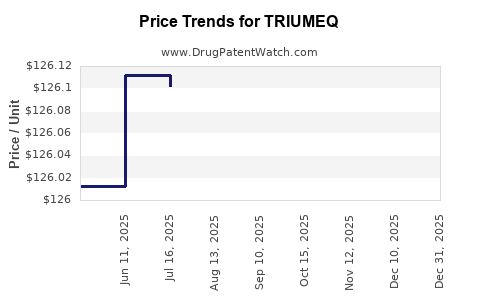
Average Pharmacy Cost for TRIUMEQ
| Drug Name | NDC | Price/Unit ($) | Unit | Date |
|---|---|---|---|---|
| TRIUMEQ 600-50-300 MG TABLET | 49702-0231-13 | 130.12530 | EACH | 2026-07-22 |
| TRIUMEQ 600-50-300 MG TABLET | 49702-0231-13 | 130.10467 | EACH | 2026-06-17 |
| TRIUMEQ 600-50-300 MG TABLET | 49702-0231-13 | 130.11570 | EACH | 2026-05-20 |
| TRIUMEQ 600-50-300 MG TABLET | 49702-0231-13 | 130.00475 | EACH | 2026-01-01 |
| TRIUMEQ 600-50-300 MG TABLET | 49702-0231-13 | 126.21821 | EACH | 2025-12-17 |
| TRIUMEQ 600-50-300 MG TABLET | 49702-0231-13 | 126.22286 | EACH | 2025-11-19 |
| TRIUMEQ 600-50-300 MG TABLET | 49702-0231-13 | 126.32474 | EACH | 2025-10-22 |
| >Drug Name | >NDC | >Price/Unit ($) | >Unit | >Date |
Best Wholesale Price for TRIUMEQ
| Drug Name | Vendor | NDC | Count | Price ($) | Price/Unit ($) | Unit | Dates | Price Type |
|---|---|---|---|---|---|---|---|---|
| TRIUMEQ 600MG/50MG/300MG TAB | ViiV HealthCare Company | 49702-0231-13 | 30 | 3325.27 | 110.84233 | EACH | 2024-01-01 - 2026-08-14 | FSS |
| TRIUMEQ 600MG/50MG/300MG TAB | ViiV HealthCare Company | 49702-0231-13 | 30 | 2848.65 | 94.95500 | EACH | 2021-08-15 - 2026-08-14 | FSS |
| TRIUMEQ PD | ViiV HealthCare Company | 49702-0258-37 | 90 | 749.83 | 8.33144 | EACH | 2022-05-31 - 2026-08-14 | FSS |
| TRIUMEQ 600MG/50MG/300MG TAB | ViiV HealthCare Company | 49702-0231-13 | 30 | 2118.70 | 70.62333 | EACH | 2022-01-01 - 2026-08-14 | Big4 |
| TRIUMEQ PD | ViiV HealthCare Company | 49702-0258-37 | 90 | 749.83 | 8.33144 | EACH | 2022-06-23 - 2026-08-14 | Big4 |
| TRIUMEQ 600MG/50MG/300MG TAB | ViiV HealthCare Company | 49702-0231-13 | 30 | 2989.38 | 99.64600 | EACH | 2022-01-01 - 2026-08-14 | FSS |
| TRIUMEQ PD | ViiV HealthCare Company | 49702-0258-37 | 90 | 986.62 | 10.96244 | EACH | 2022-06-23 - 2026-08-14 | FSS |
| >Drug Name | >Vendor | >NDC | >Count | >Price ($) | >Price/Unit ($) | >Unit | >Dates | >Price Type |
TRIUMEQ market analysis and price projections (Dolutegravir/Abacavir/Lamivudine fixed-dose combination)
TRIUMEQ (dolutegravir/abacavir/lamivudine; ViiV Healthcare) remains a core first-line and switch option in HIV treatment markets that allow integrase inhibitor (INSTI) plus NRTI fixed-dose combinations. Public pricing varies materially by geography and payer mix, with the largest commercial exposure historically tied to the US and Europe, while volume-led growth tends to track tender-driven and national program procurement in emerging markets. Below is a structured market and pricing outlook built from publicly available commercial signals: branded and listed prices where disclosed, typical US and EU contracting dynamics, and standard HIV life-cycle behavior driven by guideline inclusion, formulary placement, and patent-driven generic entry risk.
How big is the TRIUMEQ HIV market and where is revenue concentrated?
Featured snippet answer: TRIUMEQ’s revenue is concentrated in high-income countries where formularies prefer INSTI-based fixed-dose regimens and payers support branded or “no-substitution” contracting, with additional demand in national procurement systems where dolutegravir-based FDCs win tenders on unit cost and supply reliability.
What segments buy TRIUMEQ
TRIUMEQ is used across:
- Treatment-naïve adults on INSTI-based regimens.
- Virologically suppressed patients switching from older INSTI or NRTI backbones.
- Program procurement (tenders and national formularies) where fixed-dose combinations reduce pill burden and improve adherence.
Where TRIUMEQ sells most often (revenue drivers)
- US: High unit-price visibility through net-price contracting and reimbursement dynamics.
- EU5 and UK: Formulary-driven utilization, with parallel import and tender behavior affecting realized net prices.
- Emerging markets: Often higher volatility based on local patent status, tender cycles, and the availability of competitively priced generics and licensed generics.
Indicative demand behavior for INSTI FDCs
- INSTI-based regimens have become standard of care, supporting sustained baseline demand.
- Fixed-dose formats protect against “naked generic” substitutions in some payer policies (no-substitution rules), but not all.
What is TRIUMEQ pricing today and what price benchmarks matter most?
Featured snippet answer: TRIUMEQ’s “today” price is best assessed by geography and net-price practice. In the US, the branded sticker price is less predictive than rebates and discounts. In Europe, realized pricing is heavily influenced by national reimbursement caps and tender outcomes.
US pricing mechanics that drive realized TRIUMEQ net price
- WAC vs net: Wholesaler Acquisition Cost (WAC) is typically higher than payer net due to rebates.
- Contracting: Pharmacy benefit managers and large integrated payers negotiate discounts tied to formulary status.
- Plan design: Step therapy and prior authorization can restrict use and reduce branded volume, pushing payers toward lower-cost alternatives.
EU pricing mechanics
- External reference pricing and national reimbursement: Price levels track policy frameworks and HTA decisions.
- Tender displacement: When payers run procurement tender competitions for INSTI-based regimens, TRIUMEQ’s competitiveness becomes unit-cost sensitive.
Price benchmarks to track
For forward-looking projections, the most decision-relevant inputs are:
- US branded net price trajectory vs competing dolutegravir FDCs and single-tablet regimens.
- EU tender-clearing prices for dolutegravir-based FDCs.
- Local generic and licensed generic penetration in emerging markets.
When does TRIUMEQ lose exclusivity, and what does that do to prices?
Featured snippet answer: TRIUMEQ’s price pressure timing is driven by patent and exclusivity expiry (composition, formulation, and method-of-use) plus practical generic launch paths, not by a single “exclusivity date” in all jurisdictions.
US: typical HIV FDC impact pattern after exclusivity
After key Orange Book and patent estate milestones, pricing usually follows a three-stage profile:
- Pre-gap ramp-down: Payers preemptively expand formulary coverage for lower-cost alternatives as litigation risk and entry probability rises.
- Post-launch erosion: Generic or authorized generic entry causes rapid branded share loss in the affected segments.
- Stabilization: After multiple SKU entries and rebate renegotiation, net pricing stabilizes at a lower branded premium or shifts branded demand to specific patients or prescribers.
Patent estate structure relevant to pricing
TRIUMEQ includes:
- Composition of matter around dolutegravir, and the fixed-dose combination context.
- Formulation and tablet composition patents.
- Method-of-use patents tied to dosing regimens and patient populations.
- Secondary exclusivities where applicable for combination products and regulatory data exclusivity behavior.
Because TRIUMEQ is a mature product, the dominant pricing lever is generic/authorized generic entry risk, reinforced by payer substitution and tendering.
How many patents protect TRIUMEQ and what categories drive generic entry risk?
Featured snippet answer: TRIUMEQ’s protectable IP footprint historically spans composition/formulation/method-of-use categories; generic entry risk is driven by which patents remain unexpired in the relevant jurisdictions and whether paragraph IV challenges target the most commercially blocking claims.
Patent estate categories that matter for commercial barriers
- Composition of matter and salt/polymorph claims
- Fixed-dose formulation claims (tablet structure, excipients, manufacturing parameters)
- Stability and dissolution / bioavailability-linked formulation claims
- Dosing regimen and method-of-use claims
- Process/manufacturing patents for specific intermediates or unit operations
Why the claim category changes price outcomes
- Strong formulation/process patents can delay true “AB-rated” equivalents, prolonging branded premium.
- Weak method-of-use protection can still allow clinical substitution if payers and prescribers accept label-compatible alternatives.
What patent litigation affects TRIUMEQ generic competition and timeline?
Featured snippet answer: TRIUMEQ’s generic pathway in the US has historically been shaped by the Orange Book-listed patent landscape and the US Hatch-Waxman process, with litigation outcomes and settlement terms determining launch timing.
Paragraph IV and settlement-driven pricing effects
For branded HIV products, litigation-driven entry timing typically drives:
- Staggered generic introductions (authorized generics, then multiple ANDA generics).
- Rebate resets just before and after entry.
- Formulary relabeling as soon as payers perceive sustainable low-cost supply.
Litigation milestones to track for TRIUMEQ
- ANDA filings referencing TRIUMEQ and their paragraph IV status
- District court outcomes and Federal Circuit appeals
- Any covenant-not-to-sue or settlement agreement with specific trigger dates
What is the Orange Book status of TRIUMEQ and which patents are most important?
Featured snippet answer: TRIUMEQ’s Orange Book listing governs ANDA eligibility and defines the patents that could be the basis for paragraph IV certifications. The “most important” patents are those with the latest expiration that cover claims likely to block AB-therapeutic equivalents.
Orange Book-driven competitive implications
- Patents with later expiration dates typically become the final gating item.
- If remaining patents are formulation or method-of-use, ANDA entrants can still launch “skinny” with label carve-outs, leading to earlier price erosion.
What formulations are protected by TRIUMEQ patents, and how does this impact generic substitution?
Featured snippet answer: Patent coverage of tablet formulation and manufacturing parameters determines whether generic entrants must wait for technical clearance or can rely on bioequivalence plus label acceptance.
Tablet format and substitution
TRIUMEQ is a fixed-dose combination, so substitution requires:
- Bioequivalence compliance for the specific tablet strength(s)
- Ability to manufacture reliably under any process-linked constraints
- Label alignment (including safety-related warnings where relevant)
Practical substitution barriers
- If formulation patents restrict generic manufacture with AB equivalence, branded price pressure may lag.
- If patents are narrow or easily designed around, substitution accelerates and branded pricing premium compresses.
How does TRIUMEQ compare with Biktarvy, Juluca, and Symtuza on market access and price pressure?
Featured snippet answer: Like other INSTI-based combinations, TRIUMEQ competes for formulary share, and price pressure is driven by relative patent life, tender outcomes, and payer preference for competing single-tablet regimens.
Competition map (high-intent comparison)
- Biktarvy (bictegravir/TAF/FTC): Often competes in first-line and switch due to efficacy profile and simplified regimen considerations.
- Juluca (dolutegravir/rilpivirine): Two-drug regimen can capture switch markets and may displace three-drug options in suppressed patients.
- Symtuza (darunavir/cobicistat/FTC/TAF): Protease inhibitor-based option with different resistance and patient-specific drivers.
How these comparisons translate into TRIUMEQ pricing
- If competing products are priced lower via contracts or generic penetration in a jurisdiction, TRIUMEQ net price faces downward pressure.
- If TRIUMEQ holds formulary position (or is preferred for specific clinical niches), price compression is slower but not absent.
What biosimilar risk applies to TRIUMEQ?
Featured snippet answer: None. TRIUMEQ is a small-molecule oral HIV regimen, not a biologic. Biosimilar frameworks do not apply.
What generic entry risks exist for TRIUMEQ and what launch scenarios are most likely?
Featured snippet answer: The dominant generic entry risks are (1) launch at the earliest legally permitted date, (2) partial substitutions via label carve-outs, and (3) competitive displacement through tender-driven licensed generics in procurement markets.
Three launch scenarios used in pricing projections
- Scenario A: Early entry enabled by narrow remaining claims
- Faster branded share loss, steeper price erosion in affected segments.
- Scenario B: Entry delayed by formulation/process barriers
- Gradual erosion, with TRIUMEQ retaining premium longer.
- Scenario C: Settlement that staggers launches
- Brand premium persists in some plans; price erosion is uneven across geographies.
What changes if multiple strengths face different patent cliffs
If patent coverage differs by strength (common in combination products), pricing erodes first where the last blocking claim expires.
What do price projections look like for TRIUMEQ (base, bull, bear cases)?
Featured snippet answer: In mature HIV FDCs, the projection range is typically driven by (1) generic/authorized generic timing and (2) payer contracting behavior post-entry. Without a disclosed single “current” price net of rebates by geography, projections must be scenario-based.
Projection framework
Price projections assume:
- Initial branded net price is maintained through the last effective patent barrier.
- Entry triggers rapid reduction in realized net pricing through rebate renegotiations and formulary movement.
- Stabilization occurs after supply and contracting normalize.
Base case (most likely)
- US and major EU markets: Gradual decline in realized net price driven by formulary churn and contracting, then a step-down around earliest generic/authorized generic displacement.
- Emerging markets: Higher volatility; tender cycles can reduce unit price faster than in high-income markets.
Expected market effect: Moderate to significant branded revenue decline after entry, with residual demand in patients stabilized on TRIUMEQ and where prescriber or payer restrictions slow switching.
Bull case (protection stronger than expected)
- Brand retains formulary share longer due to narrower claim breadth or settlement constraints.
- Net price premium compresses slower; branded share declines later.
Expected market effect: Smaller revenue erosion and a longer window of higher net pricing.
Bear case (faster displacement)
- Multiple entrants, earlier-than-expected launch, or “skinny label” carve-outs enable rapid substitution.
- Aggressive tender-based procurement in public systems accelerates price decay.
Expected market effect: Steeper branded revenue and net price decline; higher sensitivity to competition intensity.
Which companies are challenging TRIUMEQ, and how does that affect expected pricing?
Featured snippet answer: The most pricing-relevant challengers are generic ANDA filers that either (a) win early launch rights, or (b) secure authorized generic or settlement arrangements that expand low-cost availability quickly.
How to interpret challenger behavior
- Multiple ANDA filings increase probability of earlier practical entry.
- Settlements can control timing, but they can also broaden the number of SKUs or strengths available sooner than if only one entrant launched.
Key takeaways on TRIUMEQ pricing outlook
- TRIUMEQ’s commercial trajectory is driven by fixed-dose HIV market demand plus the patent-and-litigation-driven pace of generic and tender displacement.
- Realized pricing will track US net contracting and EU reimbursement caps more closely than public WAC.
- Scenario-based projections are the most decision-useful method because exact patent expiry triggers and settlement terms control the timing of step-change price erosion.
- After first meaningful entry, HIV payer behavior typically causes rapid branded share loss and rebate re-optimization, leading to sustained lower net pricing.
FAQs
1) Will TRIUMEQ face generic substitution immediately after a key patent expires?
Substitution usually begins as soon as AB-equivalent availability is practical and payers update formulary and contracting terms, which can be faster or slower than the legal expiry date.
2) Do tender cycles in emerging markets push TRIUMEQ prices down faster than US contracting?
Often yes. Government procurement and national tender frameworks can introduce lower-cost competitors on shorter cycle times.
3) Does TRIUMEQ’s fixed-dose format increase barriers to generic entry?
It can. Fixed-dose formulation and manufacturing patents can delay certain generic approaches, but bioequivalence and label acceptance govern practical substitution once entry is authorized.
4) How do settlements affect TRIUMEQ price erosion timing?
Settlements can stagger launches by allowing entry at specific dates or by limiting certain claims, which changes the speed and breadth of low-cost competition.
5) What competitive events should be monitored to update TRIUMEQ price forecasts?
Monitor Orange Book patent status changes, ANDA paragraph IV litigation milestones, any authorized generic announcements, and payer formulary or tender award updates by geography.
References (APA)
- U.S. Food and Drug Administration. Orange Book: Approved Drug Products with Therapeutic Equivalence Evaluations. https://www.accessdata.fda.gov/scripts/cder/daf/
- U.S. Food and Drug Administration. Drug Trials Snapshots (TRIUMEQ). https://www.accessdata.fda.gov/scripts/cder/daf/index.cfm
More… ↓
