Last updated: July 19, 2026
TRICOR (fenofibrate): Market dynamics and financial trajectory for the pharmaceutical drug
Executive summary: TRICOR is a fenofibrate brand in the U.S. and other markets that has long faced generic erosion. Financial trajectory has been shaped by (1) rapid availability of multiple approved generic fenofibrate products, (2) periodic label and formulation substitutions, and (3) competitive pressure from alternative lipid-lowering strategies including statins, ezetimibe, and PCSK9 inhibitors. Current market dynamics are best described as mature, price-competitive, and volume-dependent, with profitability constrained by generics and payer-driven formulary placement.
What is TRICOR and how has the fenofibrate market evolved financially?
TRICOR is a lipid-regulating therapy containing fenofibrate, a fibric-acid derivative used for hypertriglyceridemia and mixed dyslipidemia (adjunct to diet and other therapies). In the broader cardiovascular risk management market, fenofibrate products sit in a crowded, guidelines-driven environment where the center of gravity is typically statins for LDL-C and newer agents for high-risk subsets.
How does fenofibrate fit into lipid therapy mix?
- Core use cases: elevated triglycerides and mixed dyslipidemia where triglyceride lowering matters.
- Guideline-driven friction: many patients are managed first with statins for ASCVD risk and LDL-C lowering; fibrates are used selectively, including high triglyceride subpopulations.
Market structure: brand under generic shadow
TRICOR’s financial trajectory has been constrained by the fact that fenofibrate is widely available as generic in the U.S. across multiple strengths and dosage forms. In practice, this converts TRICOR’s market behavior into:
- share competition vs low-cost generics,
- payer rebates and formulary management,
- substitution at pharmacy level (therapeutic interchange where allowed),
- periodic uptake of alternative lipid strategies.
Competitive set that pressures demand
- Statins (first-line in many regimens)
- Ezetimibe (adjunct)
- PCSK9 inhibitors (subset of very high-risk patients, often via specialty access)
- Fish oil / omega-3 formulations (for triglyceride lowering in some settings)
- Other fibrates where available as generics
What patent and exclusivity timeline dynamics explain TRICOR’s revenue curve?
Fenofibrate’s U.S. brand exclusivity is long past for the core molecule. TRICOR’s remaining commercial value historically relied less on composition-of-matter exclusivity and more on:
- specific label indications and prescriber familiarity,
- formulation-level barriers (where present),
- switching costs (limited in practice when generics are AB-rated).
What does generic entry do to TRICOR pricing and revenue?
Generic availability typically causes:
- rapid price compression after launch,
- accelerated share transfer away from brand,
- reduced net revenue as rebates increase and list price becomes irrelevant.
Typical revenue trajectory pattern for mature fibrate brands
- Pre-generic phase: higher net price, protected niche share.
- Post-first generic: steep share drop and margin pressure.
- Ongoing multi-generic competition: further price triangulation, volatility in pharmacy channel orders.
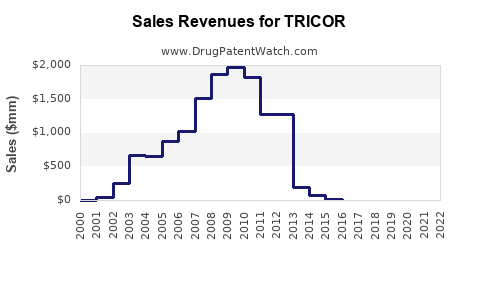
- Current phase: stable low-growth or declining sales depending on remaining differentiation and payer policy.
What Orange Book status applies to TRICOR and how does it shape generic entry risk?
TRICOR’s generic entry risk is structurally high because fenofibrate is a well-established active ingredient with many approved products. The controlling practical risk for any challenger is not “if” generic entry can occur, but whether any listed patents (if any still appear for specific TRICOR-listed products or dosage strengths) create a litigation or settlement barrier.
How Orange Book listings usually drive barriers for generics
- Listed patents can trigger Paragraph IV litigation if a generic applicant seeks approval despite patent claims.
- Method-of-use and formulation patents can be relevant, but in mature molecules the remaining patent landscape is often narrower than the market would imply.
Which TRICOR competitors matter most for market share and price?
For an investor or licensing analyst, the relevant comparison set is not “other brands” but generic fenofibrate producers and alternative lipid therapies with better payer outcomes.
Generic fenofibrate dynamics that compress brand economics
- Multiple manufacturers offer AB-rated fenofibrate at lower prices.
- Pharmacy benefit managers favor cost-minimizing options when clinical equivalence is accepted.
- Any remaining brand premium is reduced by:
- interchange,
- prior authorization,
- step therapy practices.
Alternative therapeutic pressures
- Patients eligible for potent lipid lowering increasingly migrate toward statin-based regimens and adjuncts when needed.
- For hypertriglyceridemia, omega-3-based products and other targeted therapies compete depending on payer coverage and prescribing patterns.
What product forms and dosing strengths influence TRICOR market performance?
TRICOR performance is sensitive to:
- dosing convenience (pill burden, frequency),
- tolerability and switching,
- prescriber comfort with specific fenofibrate formulations.
Why formulation matters even for an old molecule
Even when the active ingredient is the same, differences can shift:
- adherence,
- perception of tolerability,
- pharmacy substitution practices by strength and dosage form.
How do reimbursement and payer formularies drive TRICOR’s financial trajectory?
TRICOR’s net sales are shaped by a reimbursement system that typically treats fenofibrate as a cost-controllable therapy. In practical terms, payers:
- prefer generics unless a clinical exception applies,
- tighten formulary tiers for brand agents,
- negotiate rebates based on market share.
Financial effects of payer strategy
- Lower average selling price through rebate pressure.
- Volatile volume depending on formulary placement and seasonal hypertriglyceridemia prescribing patterns.
- Greater sensitivity to policy changes around interchange and prior authorization.
What Paragraph IV / patent litigation patterns typically affect mature fenofibrate brands?
For mature lipid molecules, litigation tends to be:
- limited in number once core exclusivity is exhausted,
- concentrated around specific listed patents for formulations, methods, or manufacturing processes if any remain.
Settlement outcomes that affect sales trajectories
- “Carve-out” settlements can delay certain generic strengths or formulations.
- License and settlement terms can preserve brand share briefly, but long-run outcomes are usually dominated by multi-generic price competition.
Does TRICOR face biosimilar-style substitution dynamics?
No. Biosimilar dynamics are not relevant because TRICOR is a small molecule (fenofibrate). The substitution and competitive pressure mechanisms are generic small-molecule entry, therapeutic interchange, and payer policies.
How does TRICOR compare with other lipid therapies on a market economics basis?
Brand economics vs alternatives
- Statins: massive generic penetration and entrenched guideline usage; margins depend on historical competition and rebate structures.
- PCSK9 inhibitors: higher unit prices, but narrower eligible populations and complex access. TRICOR competes indirectly by treating comorbid or alternative risk profiles.
- Omega-3 products: direct competition in triglyceride lowering for some payers and patient groups.
- Ezetimibe: adjunct in LDL-C lowering; not always a direct substitute for triglyceride-focused therapy.
Practical implication for financial trajectory
TRICOR’s growth ceiling is limited because the patient funnel often prefers statin-first approaches and newer triglyceride strategies where coverage supports them.
Which regulatory and FDA pathway milestones matter for TRICOR’s competitive landscape?
TRICOR’s FDA relevance is not about new regulatory exclusivity but about:
- maintenance of approved indications and label language,
- generic approvals for AB-rated equivalents,
- any postmarketing safety updates that change prescribing patterns.
How postmarketing label changes can move demand
For fenofibrate therapies, any label change affecting:
- muscle or liver safety monitoring,
- contraindications,
- patient selection guidance,
can affect utilization even when generics remain available.
What generic entry scenarios exist for TRICOR products, and how would they impact sales?
Scenario 1: additional generic strengths or dosage forms
- Expected outcome: further price compression, incremental share loss.
- Brand revenue impact: near-immediate due to AB interchange.
Scenario 2: delayed entry due to patent or settlement
- Expected outcome: a temporary stabilization or slower decline.
- Brand revenue impact: typically short-lived unless multiple sequential barriers exist.
Scenario 3: payer-driven restrictions increase brand differentiation value
- Expected outcome: reduced substitution and a temporary increase in brand share.
- Brand revenue impact: depends on the durability of payer rules and whether clinical exceptions are broad.
What does the competitive landscape imply for TRICOR profitability and cash flow?
Given mature generics, TRICOR’s profitability profile is usually characterized by:
- low unit gross margin vs historical brand levels,
- increased reliance on rebates and contracting structures,
- working capital variability from inventory management in a competitive channel.
For any current or prospective license model, the main valuation driver is the remaining “defensible” segment: patients and plans where brand use persists due to policy, prescriber preference, or product-specific dosing habits.
Key takeaways
- TRICOR (fenofibrate) operates in a mature, generic-dominant lipid segment where revenue is primarily governed by payer contracting and price competition rather than new exclusivity.
- Financial trajectory is typically declining or low-growth after generic penetration, with periodic stabilization only when payer rules or limited barriers slow substitution.
- Indirect competitive pressure comes from statins, ezetimibe, PCSK9 inhibitors, and triglyceride-focused therapies, narrowing the eligible funnel for fibrate-based regimens.
- The most material “market dynamics” lever is not innovation but channel economics: formulary placement, interchange rules, and rebate structures.
FAQs
- Why do fenofibrate brands like TRICOR lose share after generic approvals?
- How do formulary tiers and prior authorization policies affect fenofibrate brand sales versus generics?
- What patient subgroups drive ongoing demand for fenofibrate in mixed dyslipidemia?
- How do triglyceride-focused omega-3 therapies compete with fenofibrate on coverage and utilization?
- What label safety updates can shift prescriber behavior for fenofibrate products?
References
- FDA. Orange Book: Approved Drug Products with Therapeutic Equivalence Evaluations. U.S. Food and Drug Administration.
- FDA. Drugs@FDA: FDA-approved drugs. U.S. Food and Drug Administration.
- FDA. Guidance for Industry: Patent and Exclusivity Requirements. U.S. Food and Drug Administration.