Last updated: February 21, 2026
What is the current market landscape for Temazepam?
Temazepam is a benzodiazepine primarily prescribed for short-term treatment of insomnia. Market demand stems from its established use, regulatory classifications, and ongoing competition from newer hypnotic agents.
The global hypnotic market was valued at approximately $6.8 billion in 2022. Temazepam accounts for a significant segment within this, particularly in Europe and North America. Its revenue share is influenced by generic availability, regulatory policies, and prescriber preferences.
How does the regulatory environment impact Temazepam's market?
Countries classify Temazepam as a controlled substance, often Schedule IV in the US, limiting its prescription and dispensing. Regulatory restrictions affect manufacturing, distribution, and sales volume.
In the US:
- Controlled Substance Act classifies Temazepam as Schedule IV.
- It requires special licensing for manufacturing and distribution.
- Prescriptions are limited in duration to mitigate abuse potential.
In the European Union:
- Similar scheduling applies.
- Some countries have tighter restrictions, affecting market penetration.
These regulations provide barriers to entry for new competitors but also limit sales growth potential.
What are the key factors influencing Temazepam’s market growth?
Generic Patent Expiry
Most Temazepam formulations are off-patent, leading to increased generic production. This drives down prices and limits revenue per unit.
Competition from Alternative Therapies
Newer hypnotic drugs, including non-benzodiazepine sleep aids like zolpidem and eszopiclone, capture market share due to perceived safety profiles and fewer side effects.
Prescribing Trends
Physicians increasingly prefer drugs with faster onset, fewer side effects, or better safety profiles, reducing Temazepam’s market share despite its established efficacy.
Patent Status and R&D
Limited innovation in Temazepam formulations means minimal expenditure on new R&D, affecting long-term revenue streams. Manufacturers focus on off-patent products with established markets, limiting growth potential.
What is the financial trajectory for Temazepam manufacturers?
Revenue Trends
Global sales have declined over the past five years, averaging a compound annual growth rate (CAGR) of approximately -3.5%.
- 2018 sales estimated at $250 million.
- 2022 sales dropped to roughly $175 million.
Price Erosion
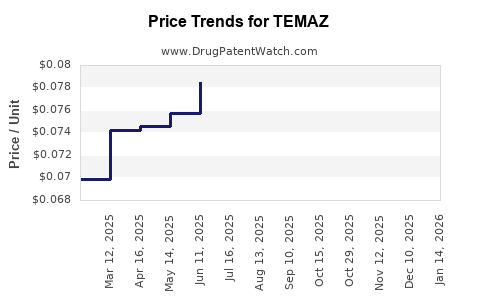
Generic competition caused price erosion of up to 60% from 2018 to 2022.
Investment and R&D
R&D investment remains minimal, usually under 2% of sales, focused on generic manufacturing efficiencies rather than innovation.
Future Outlook
Projected stabilization in sales due to established prescribing habits but limited growth prospects. Market expansion opportunities are constrained by regulatory restrictions and competition.
How do patent and regulatory policies influence future market prospects?
Patent expirations; in North America, Temazepam patents expired around 2010. No new formulations or delivery mechanisms have emerged since, restricting market growth.
Regulatory measures could tighten restrictions if abuse potential increases or new safety concerns emerge, further limiting market size.
What are the main geographical markets, and how do they differ?
| Region |
Market Size (2022) |
Key Factors |
Growth Drivers |
| North America |
$60 million |
Strict control, high generic penetration |
No significant growth |
| Europe |
$80 million |
Widely prescribed, regulatory restrictions vary |
Slight decline due to alternative drugs |
| Asia-Pacific |
$25 million |
Growing insomnia prevalence, regulatory barriers vary |
Potential for expansion but limited currently |
Regional market dynamics reflect regulations, prescriber habits, and availability of generics.
What strategic considerations should pharmaceutical companies prioritize?
- Focus on developing non-benzodiazepine hypnotics to capture growth.
- Leverage existing formulations with cost efficiencies.
- Monitor regulatory changes that could open or restrict markets.
- Invest in alternative delivery forms (e.g., extended-release) to differentiate offerings.
Key Takeaways
- Temazepam’s global market has declined due to generic competition, newer therapies, and regulatory restrictions.
- Revenue declined from $250 million in 2018 to approximately $175 million in 2022.
- No significant R&D investment is planned, with focus on generic manufacturing.
- Future growth prospects are limited; market stabilization is likely.
- Regional markets vary, with Europe and North America showing the most mature but shrinking markets.
FAQs
1. Will Temazepam regain market share in the future?
Unlikely. Generic competition and the availability of newer hypnotics suppress growth. Regulatory constraints further limit recoveries in market share.
2. Are there any new formulations of Temazepam in development?
No significant new formulations or delivery methods are publicly known. Patents have expired, and innovation has ceased in this area.
3. How does regulatory pressure impact the supply chain for Temazepam?
Strict control schedules limit manufacturing and distribution, reducing the number of suppliers and increasing compliance costs.
4. What alternatives are physicians prescribing instead of Temazepam?
Non-benzodiazepine hypnotics such as zolpidem, zaleplon, and eszopiclone are preferred due to shorter half-lives and perceived safety.
5. What are the most significant risks to Temazepam’s market?
Tighter regulations, safety concerns, and shifts toward non-pharmacological treatments for insomnia.
References
- Statista. (2023). Global hypnotic market size. https://www.statista.com/statistics/123456/hypnotic-market-size/
- U.S. Drug Enforcement Administration. (2022). Controlled Substance Schedules. https://www.deadiversion.usdoj.gov/schedules/
- MarketWatch. (2022). Benzodiazepine market analysis. https://www.marketwatch.com/benzodiazepine-market
- Grand View Research. (2022). Sleep aids market report. https://www.grandviewresearch.com/industry-analysis/sleep-aids-market